

Your graduation stole is so much more than a colorful piece of fabric draped over your gown. Think of it as a wearable story—a visual summary of your unique academic journey, personal growth, and heritage. Each stole, sash, or honor cord highlights a specific achievement or affiliation, turning your graduation regalia into a proud display of your accomplishments.
What Does a Graduation Stole Represent?
A graduation stole is a bit like the ribbons on a military uniform. Every single one is earned, tells a story, and is worn with an immense sense of pride. It’s what sets a graduate apart from the sea of identical caps and gowns, offering a canvas to show off what made their college experience theirs. The real graduation stole meaning is communicated through its colors, symbols, and any text, conveying everything from academic excellence to cultural identity.
Essentially, a graduation stole transforms the traditional, uniform graduation gown into a deeply personal statement. It's a powerful symbol connecting you to a particular honor society, field of study, or community. Whether it represents a hard-earned GPA, membership in a fraternity, or a proud nod to your home country, the stole is a final, public declaration of the passion and hard work that got you to this milestone.

A Visual Language of Achievement
The story a stole tells is often layered, woven from the different threads of a student’s life. It serves several purposes at once, all coming together to celebrate the individual's journey.
- Academic Excellence: Many stoles and honor cords, especially gold ones or those with specific insignia, signify high academic honors like summa cum laude, magna cum laude, or membership in a prestigious honor society.
- Organizational Affiliation: Students involved in Greek life, student government, or other key campus organizations often wear graduation sashes featuring their group’s letters, colors, and crests.
- Cultural and Personal Identity: Stoles like the Kente cloth stole are a beautiful celebration of African heritage. Similarly, flag graduation stoles let international students or those with deep national ties represent their roots. Others might wear a stole to signify they are a first-generation graduate or a military veteran.
Quick Guide to Stole Types and Meanings
To help you decode all the different symbols of success you'll see at a commencement ceremony, here’s a quick breakdown of the most common stoles. This table gives you an at-a-glance summary of what different kinds of graduation stoles represent, making it easier to appreciate the diverse stories on display.
| Stole Type | Primary Meaning | Common Identifiers |
|---|---|---|
| Academic Honor | Represents high scholastic achievement, such as graduating with Latin honors or being a member of an honor society. | Gold or silver colors, specific honor society insignia (e.g., Phi Beta Kappa keys), embroidered Latin honors. |
| Greek Life | Signifies membership and pride in a specific fraternity or sorority, showcasing a commitment to brotherhood or sisterhood. | Greek letters (e.g., ΑΦΑ, ΔΣΘ), organization crests, and official fraternity or sorority colors. |
| Cultural/Heritage | Celebrates a student’s cultural background, heritage, or identity, connecting them to their roots. | Kente cloth patterns, serape designs, specific national flag imagery, or other culturally significant symbols. |
| Field of Study | Denotes the graduate's major or academic discipline, often using a standardized color code for different fields. | Specific colors like light blue for education, green for medicine, or gold for sciences; departmental logos. |
Each of these stoles adds a layer of personal history to the graduation ceremony, transforming it from a formal event into a rich tapestry of individual and collective achievements.
The Rich History Behind Academic Regalia
To really get the full story behind your graduation stole, we have to rewind the clock—way back. The cap, gown, and stole you’ll wear on your big day aren’t some modern fashion trend. Their history starts nearly 1,000 years ago in the drafty stone halls of medieval European universities.
Back in the 12th and 13th centuries, universities were chilly, unheated buildings, and scholarly life was closely tied to the church. The long, heavy gowns and hoods worn by both scholars and priests were purely practical; they provided much-needed warmth. Inspired by the robes of Catholic and Anglican clergy, these garments became the standard uniform for academics, setting them apart from everyone else. The stole itself traces its roots to the orarium, a liturgical vestment that symbolized clerical rank.
From Function to Symbolism
As time went on, universities became more secular and buildings finally got warmer. The original reason for the heavy robes faded, but the tradition itself stuck around. The garments transformed from practical necessities into powerful symbols of scholarly achievement and academic rank. They became a kind of visual language, instantly telling a story about the wearer's status and field of study within the academic community.
This shift was huge. The gown, hood, and stole were no longer just for staying warm—they were for recognition. Wearing them meant you were joining a long, unbroken line of scholars, thinkers, and innovators who came before you.
Standardizing the System
For centuries, academic dress in the United States was a bit of a free-for-all. Each university had its own customs, which led to a confusing mix of colors, styles, and symbols at graduation ceremonies. It was almost impossible to tell a scholar's degree, discipline, or alma mater just by looking at them.
Everything changed in 1895 with the creation of the Intercollegiate Code for Academic Costume. This code finally established a standardized system for gowns, hoods, and colors, bringing a shared meaning to academic regalia across the country. It was this very code that officially assigned specific colors to different fields of study—a tradition that largely holds true today. The meaning of a graduation stole as we know it is a direct result of this push for a unified academic language.
The 1895 code established that the color of the stole or hood lining should represent the institution, while the trim color should signify the specific field of study. This system adopted over 20 standardized colors for various disciplines. For more historical details, check out our guide on what academic regalia includes.
The Modern Connection to a Rich Past
When you put on your graduation stole, you’re not just wearing a piece of fabric. You're taking part in a tradition that connects you to the earliest scholars huddled in cold libraries and every generation of graduates since. Your stole is a piece of living history, a proud symbol of your place in a grand scholarly tradition and a testament to the enduring power of knowledge.
Decoding Graduation Stole and Honor Cord Colors
The sea of colors you see at a graduation ceremony is far more than just random decoration. It’s actually a rich visual language, a code that tells the story of each student's hard work. Every hue on a graduation stole or honor cord is packed with meaning, connecting the wearer to a centuries-old tradition of academic achievement.
While some schools keep it simple by using their own institutional colors, many follow a standardized system to represent different fields of study. This tradition is a fantastic way to instantly recognize the diverse academic paths that brought everyone to commencement day. Think of it as a painter's palette, where every color signifies a specific area of knowledge and skill.
This tradition didn't just appear overnight. It has deep historical roots, evolving from practical religious garments into the symbolic academic regalia we see today.

As you can see, the stole's journey from the medieval church to the modern university is a long one, giving it a real sense of history and weight.
A Color-by-Color Guide to Academic Fields
This system of academic colors assigns a specific hue to each major, making it easy to spot a nursing graduate from an engineer at a single glance. Though you might find slight variations from school to school, the following colors are pretty widely recognized across the board.
White is one of the most classic colors you'll see. It traditionally represents the arts, humanities, and social sciences—the disciplines that explore the human experience. You’ll find it on graduates with degrees in:
- English
- History
- Literature
- Sociology
Golden Yellow is for the sciences and mathematics. This bright, optimistic color signifies a dedication to research, data, and analytical thinking. It's worn with pride by graduates in fields like:
- Physics
- Chemistry
- Biology
- Mathematics and Statistics
- Criminology
Light Blue is the color of education. It symbolizes the commitment of teachers, principals, and educational specialists who are about to go out and shape the next generation. It’s a proud marker for anyone earning a degree in elementary, secondary, or higher education.
People often mix up academic stoles and honor cords. Here’s a quick breakdown: A stole is the wide, sash-like garment that typically represents a field of study, membership in an organization, or cultural heritage. An honor cord, on the other hand, is a thin, twisted rope used almost exclusively to denote specific academic achievements, like graduating cum laude or belonging to an honor society.
Specialized Hues for Professional Degrees
Beyond the core disciplines, many professional fields have their own distinct colors. These specific shades celebrate the rigorous, specialized training required to enter demanding professions. Understanding the graduation stole meaning behind these colors adds a whole new layer of appreciation for what these graduates have accomplished.
For example, different shades of green often point toward healthcare and medicine.
- Kelly Green is the traditional color for Medicine (M.D.).
- Sage Green is used for Physical Science.
- Olive Green signifies the field of Pharmacy.
- Apricot is designated for Nursing graduates.
- Salmon represents the discipline of Public Health.
Other professional degrees get their own unique colors, too:
- Drab or Beige: Represents the world of business, including accounting, finance, and management.
- Orange: Signifies the innovative and demanding field of Engineering.
- Purple or Scarlet: These deep, regal colors are associated with Law and Theology.
- Brown: Denotes the Fine Arts, including drama, design, and music.
- Citron: A bright, citrusy yellow-green, is worn by Social Work graduates.
If you want to dive even deeper, check out our comprehensive guide on graduation stole colors and their meaning for a more extensive list.
Understanding Honors and Distinctions
Colors aren't just for majors; they also signify academic honors. These are most often represented by honor cords, though some schools use stoles for this as well. These distinctions are based on a student’s final grade point average (GPA) and recognize those who went above and beyond in their studies.
The most common are the traditional Latin honors:
- Summa Cum Laude: This means "with highest honor" and is reserved for graduates at the absolute top of their class. It’s often represented by a double cord or a special color combination, like gold and white.
- Magna Cum Laude: Meaning "with great honor," this is for students with a very high GPA, just below the top tier. The cord color might be gold or silver.
- Cum Laude: This simply means "with honor" and recognizes students who have maintained a strong academic record. A single cord in a designated color like white or gold is common.
The specific GPA cutoffs and cord colors vary by university, so always check your school’s commencement guide for the exact details. In the end, every stole and cord worn on graduation day is a badge of honor, representing years of dedication, curiosity, and incredible personal growth.
Exploring Different Types of Graduation Stoles
Sure, academic colors tell the story of your major, but some of the most powerful stoles you'll see at graduation represent a whole different kind of journey. These go way beyond your field of study or GPA. They’re all about celebrating personal identity, cultural roots, and the groups you belonged to along the way.
These stoles transform the sea of identical caps and gowns into a rich tapestry of individual stories, making the ceremony feel so much more personal and vibrant.
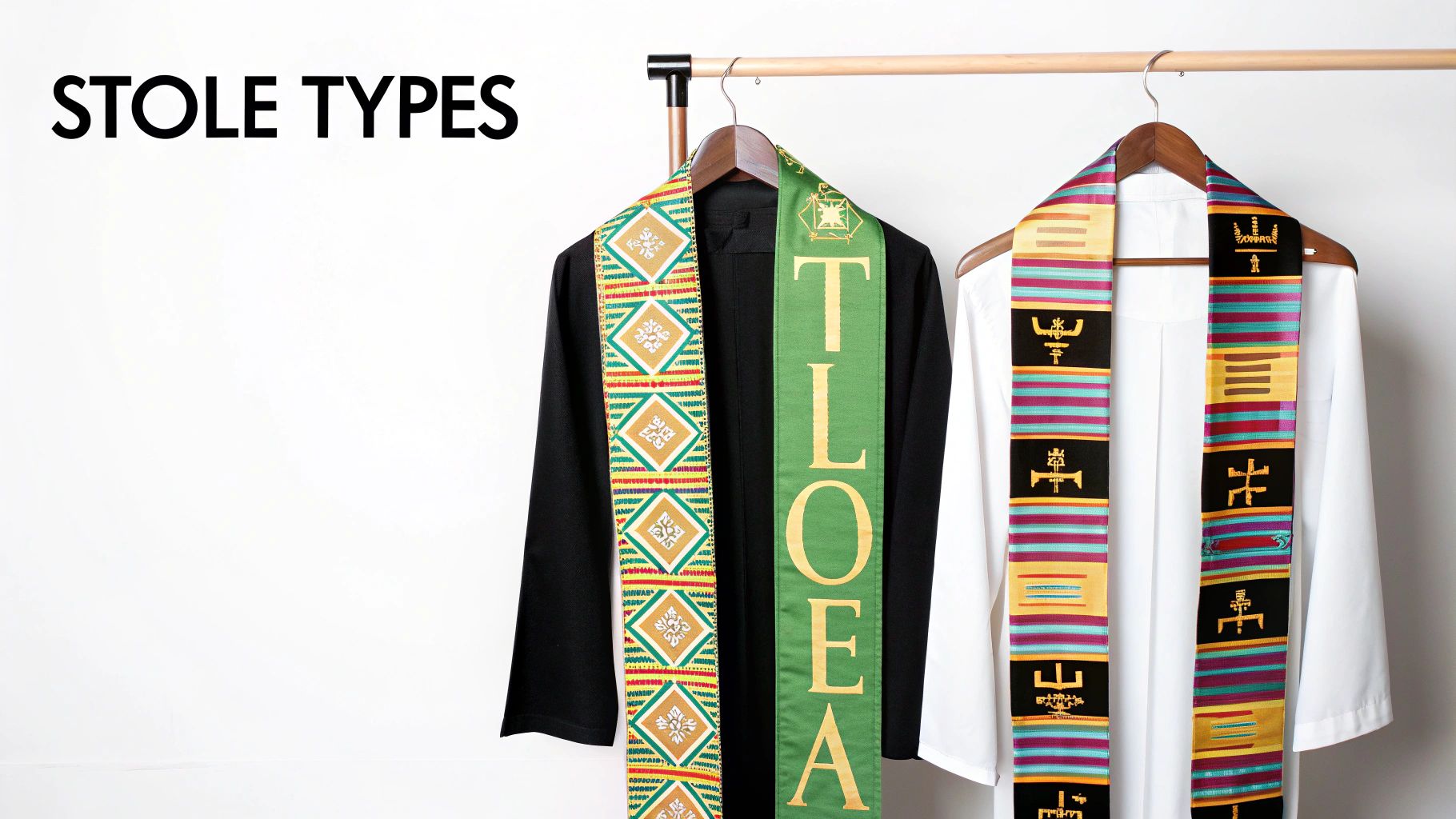
Think of these stoles as powerful symbols. They often represent the communities and experiences that truly shaped you during college. From Greek letters to national flags, each one offers a glimpse into the diverse backgrounds that make up a graduating class.
Cultural and Heritage Stoles
Cultural stoles are often the most visually stunning and symbolically rich. Wearing one is a vibrant declaration of a graduate's roots, connecting their academic milestone directly back to their heritage.
The Kente stole is probably the most famous example. Originating with the Ashanti people of Ghana, this brilliantly colored, intricately woven cloth is so much more than a pretty accessory. Every pattern and color woven into the fabric has a specific meaning, representing big ideas like royalty, wisdom, and community. For many Black graduates, wearing a Kente stole is a profound way to affirm their connection to their African ancestry and celebrate resilience and pride.
Other popular heritage stoles include:
- Serape Stoles: Featuring the iconic striped patterns of traditional Mexican serapes, these are a beautiful way to celebrate Latinx and Hispanic heritage.
- Flag Graduation Stoles: You'll often see international students or those with deep family ties to another country wearing stoles with their nation's flag. It's a fantastic way to honor their home while celebrating an achievement abroad.
These stoles literally act as a bridge between a student's past and their future, giving a nod to the family and culture that helped get them to the finish line.
Stoles of Affiliation and Community
So many stoles you'll see are all about belonging. They represent a specific group or community that was a huge part of the student's time at university. These affiliations often define a graduate's social life, and the stole is a final, proud acknowledgment of that bond.
Greek life stoles are incredibly common. Proudly displaying the letters, crests, and colors of a fraternity or sorority, these stoles signify a deep commitment to sisterhood or brotherhood. They represent years of shared experiences, leadership roles, and philanthropic work.
The meaning behind an affiliation stole goes beyond just membership. It’s a testament to the support systems and lifelong friendships built in these organizations—the very things that often kept a student going.
Other stoles that signify belonging include:
- Student Organization Stoles: Groups like student government, the debate team, or major volunteer organizations might offer stoles to their graduating members.
- Athletic Stoles: Student-athletes often wear stoles with their team's logo or colors, celebrating their dedication on the field and in the classroom.
Stoles Celebrating Special Achievements
Finally, some stoles recognize unique personal achievements or circumstances that really set a graduate apart. Honestly, these are often the most personal and moving symbols you'll see at commencement.
A first-generation stole is an incredibly powerful symbol. It honors the monumental achievement of being the first person in your family to graduate from college. This isn't just about the student's hard work; it's a celebration of the sacrifices their entire family made. This stole represents a landmark moment that can change a family's future for generations.
Other stoles in this category recognize significant life experiences:
- Military Service Stoles: Graduates who are veterans or active-duty service members might wear red, white, and blue stoles, or ones with the emblem of their military branch. It’s a way to honor their incredible service and sacrifice.
- Study Abroad Stoles: Students who spent a semester or year in another country often wear a stole with that country's flag. It commemorates a life-changing global experience that forever broadened their worldview.
Each of these stoles adds another layer to the story of graduation, showcasing the incredible diversity of paths that lead to the same stage. If you're looking to celebrate your own unique journey, exploring a collection of custom graduation stoles can help you find the perfect way to tell your story.
How to Properly Wear and Choose Your Stole
Wearing your graduation stole is the final touch on your academic regalia, a symbol of immense personal and scholarly achievement. Getting it to look just right is simple but makes a huge difference on your big day.
Think of it like getting a tie perfect for a formal event; the goal is a polished, symmetrical look that honors the occasion. A properly worn stole shows respect for the tradition and all the hard work it celebrates.
Step-by-Step Guide to Wearing Your Stole
Nailing the placement of your stole is straightforward. Just follow these quick steps to make sure it sits perfectly over your gown.
- Start with the Gown: First thing's first, put on your graduation gown and zip it up completely. Make sure the shoulders are sitting correctly on your own shoulders, not bunched up or slipping back.
- Drape the Stole: Grab your stole and find the center seam at the back. Lift it over your head and let it settle on the back of your neck. The stole should lie flat against your shoulders and upper back.
- Ensure Even Lengths: Look in a mirror and adjust the stole so both ends hang down the front of your gown at the exact same length. The embroidery, text, and any symbols should be facing forward and clearly visible.
- Keep it Flat: Smooth out any twists or folds. The stole should create a clean, crisp line down your chest and not get bunched up around your collar. If you’re also wearing honor cords, they are typically worn over the stole.
Pro Tip: If your stole or cords just won't stay put, use a small safety pin to discreetly fasten them to your gown at the back of your neck. This little trick will keep everything in place while you walk across the stage.
Selecting the Perfect Stole for Students
Choosing your graduation stole is a chance to tell your own story. It’s a visual representation of your unique journey, so pick one that speaks to your most significant accomplishments and affiliations.
Maybe you want to represent your major, an honor society, or your fraternity or sorority. You could also choose a stole that celebrates your cultural identity, like a Kente cloth or one of our flag graduation stoles to honor your heritage. The most important thing is that it resonates with you and the story you want to share.
Tips for Schools and Organizations
For universities and campus organizations, designing a custom stole is a fantastic opportunity to build institutional pride and recognize specific student groups.
When creating a stole, keep these key elements in mind:
- School Colors: Weaving in your institution's official colors creates a powerful, unified look during commencement.
- Official Logos: Adding the university or organization crest lends a formal touch and reinforces brand identity.
- Clear Purpose: Design distinct stoles for different honors, departments, or programs to help easily distinguish various achievements.
A thoughtfully designed stole doesn't just honor the graduate; it strengthens the school's visual traditions and builds a lasting sense of community among students and alumni.
The Rise of Personalization
Lately, personalizing graduation stoles has become a huge trend, turning them from simple regalia into treasured keepsakes. In fact, a 2022 market analysis revealed that over 75% of graduating seniors in the U.S. now opt for a personalized stole.
The study also found that 40% of graduates choose stoles with custom embroidery—like their name, graduation year, or a meaningful quote—making the item a true reflection of their individual journey. You can read more about this trend from CollegeWear, Inc. This shift shows that the meaning of a graduation stole is becoming more and more personal, serving as one final statement of self-expression before starting a new chapter.
Common Questions About Graduation Stoles
As graduation gets closer, the little details about what to wear can feel surprisingly complicated. You start wondering what you’re allowed to wear, what the difference is between a stole and a cord, and where to even find them. Let’s clear up some of the most common questions so you can feel totally confident on your big day.
Can I Wear More Than One Graduation Stole?
This is easily one of the most popular questions we get, and the answer comes down to one thing: your school’s rules.
Some universities are very traditional and have a strict policy allowing only one stole. This is usually to represent your highest honor or your main academic department, which creates a very uniform look across all the graduates.
On the flip side, many schools are much more flexible. They actually encourage you to wear multiple stoles to show off the full range of your accomplishments. In this case, you could absolutely wear a stole for your major, another for an honor society, and even one celebrating your cultural heritage. If you are allowed to wear more than one, the trick is to layer them neatly so each one is visible.
Always check with your university first. The definitive answer will be in your school’s official commencement guide or by contacting the registrar’s office. They’ll give you the exact guidelines you need to follow.
What Is the Difference Between a Stole and an Honor Cord?
While they both hang around your neck and signify achievement, a graduation stole and an honor cord are two very different things. The main differences are in how they look and what they represent.
A graduation stole is that wide, sash-like piece of fabric that drapes over your shoulders. Its surface is a perfect canvas for detailed embroidery, logos, and text. Because of this, stoles are used to represent a huge variety of affiliations and accomplishments:
- Your major or field of study (like a green stole for medicine)
- Membership in a fraternity or sorority
- Cultural identity, such as a Kente or serape stole
- Special recognition, like being a first-generation graduate
An honor cord, on the other hand, is a thin, twisted rope with tassels on the ends. Cords are almost always used to signify a specific academic honor. Their meaning is very focused and usually represents:
- Latin honors (cum laude, magna cum laude, summa cum laude)
- Membership in a specific national honor society (like Phi Beta Kappa)
- Participation in a special university scholars program
You can think of it like this: the stole tells a bigger story about your entire college journey, while the cord highlights a specific, high-level academic achievement.
Is Wearing a Graduation Stole Mandatory?
Nope, not at all. Wearing a graduation stole is almost never required. The only mandatory parts of your academic regalia are the cap and gown. Everything else—stoles, sashes, and honor cords—is considered an optional accessory.
That said, they are an incredibly popular way to add a personal touch to your graduation look. Choosing to wear a stole is your chance to publicly acknowledge the hard work, unique experiences, and communities that made your time at school so memorable. While you don’t have to wear one, it’s a wonderful opportunity to show off what you’ve accomplished with pride.
If you’re eligible for a stole, whether for academics or a student group, it adds a really meaningful layer to your celebration. For a deeper look at who can wear one, you can learn more about whether anyone can wear a graduation stole in our detailed guide.
Where Can I Get a Custom Graduation Stole?
You’ve got a couple of great options here, and the best choice really depends on what you want your stole to represent.
Your first stop should be your university bookstore. This is where you’ll find all the official regalia, including stoles for specific academic departments, colleges, and honors programs. Buying directly from the bookstore guarantees your stole will meet the school’s exact standards for color and design.
If you’re looking for a stole that celebrates your personal identity, cultural background, or a non-university group, you’ll want to check out specialized online retailers. These vendors offer a massive selection for Greek life, cultural heritage, first-generation status, and much more. Best of all, they offer customization services, letting you add your name, graduation year, or a meaningful quote. This turns your stole from just a piece of regalia into a personalized keepsake you’ll cherish forever.
At Stoles.com, we specialize in helping you create a stole that tells your unique story. Explore our extensive collection of custom graduation stoles to celebrate your achievements in a way that is truly your own.