

You're probably close to graduation day right now, looking at a cap, a gown, and one more decision that feels bigger than it first appears. A cultural graduation stole can look like a simple sash. In practice, it often carries family history, community pride, and the feeling of finally being seen in a ceremony that can otherwise blur everyone into the same robe.
That's why students and families get stuck. Is this the right design? Is it respectful? Will the school allow it? Should you choose a kente stole, a flag graduation stole, a serape-style graduation sash, or a custom graduation stole with your name and year? Those are good questions, and they deserve clear answers before you place an order.
What a Cultural Graduation Stole Really Represents
A family arrives early, finds its seats, and watches graduates file in wearing the same cap and gown. Then one student steps into view with a stole that reflects their culture, nationality, tribe, faith, or community. In that moment, relatives in the crowd often understand something immediately. The graduate is being recognized not only for finishing school, but for the story and people that helped them reach that stage.
A cultural graduation stole is a decorative sash worn over academic regalia to express identity and belonging. Its purpose is different from honors tied to grades, departments, or formal academic awards. That difference matters because many students wear several pieces of regalia at once, and each one communicates something distinct.
A simple way to read it is this. The gown marks the ceremony. The cultural stole marks the person within it.
Cultural stoles usually carry three kinds of meaning at the same time:
- Visible identity: They show heritage, nationality, diaspora, faith, or community affiliation during the ceremony.
- Family meaning: They can honor parents, grandparents, language, migration, military service, or a tradition kept across generations.
- Shared celebration: They connect one graduate to a larger group, especially in multicultural, affinity, or heritage-based commencement events.
That last point helps explain why these stoles matter so much in real ceremonies from 2024 through 2026. Across campuses, multicultural commencements have continued to make room for students whose identities are not fully captured by standard academic dress. Sometimes that looks like a kente stole. Sometimes it is a serape-style stole, a national flag design, or a custom sash with a tribal name, class year, or family message. The exact design changes. The function stays steady. It makes identity visible in a ceremony built around uniformity.
Families often feel this before students can explain it.
For many relatives, the gown says, "you graduated." The stole says, "this is the road your family traveled to get here." It works like a nameplate and a tribute at the same time. That is why a stole can feel much more personal than it first appears when viewed online.
Students also get confused because several regalia items can look similar from the audience. The meaning is not the same.
- Honor cords usually recognize academic achievement, leadership, service, or membership.
- Department stoles usually represent a school, major, program, or campus role.
- Cultural graduation stoles usually represent heritage, affinity, nationality, faith, tribe, or community identity.
That distinction helps with buying decisions, too. If you know what the stole is supposed to represent, you can choose more clearly between a broad identity marker and a very specific one. For example, some students want a design that signals a larger community, such as Black, Latino, Native, Pacific Islander, or international identity. Others want a stole that points to a particular nation, ethnic group, language tradition, or family history. Neither choice is more meaningful by default. The better choice is the one that fits the ceremony, the school policy, and the story the graduate wants to carry across the stage.
A cultural stole is not just decoration. It is ceremonial language in fabric. Understanding that makes the rest of the process easier, especially when students and families have to balance symbolism, budget, customization, and school rules before ordering.
Where Cultural Graduation Stoles Come From
A family often notices this question only after the order page is open. The gown looks familiar, but the stole carries a different kind of history.
The stole itself comes from the long tradition of academic dress. Historians trace college regalia back to medieval universities, and U.S. colleges later standardized much of what graduates wear today, as outlined in this history of graduation stoles and sashes. Cultural graduation stoles grew inside that older framework. They kept the same ceremonial shape, then took on newer community meanings as campuses created recognition events that reflected the students crossing the stage.
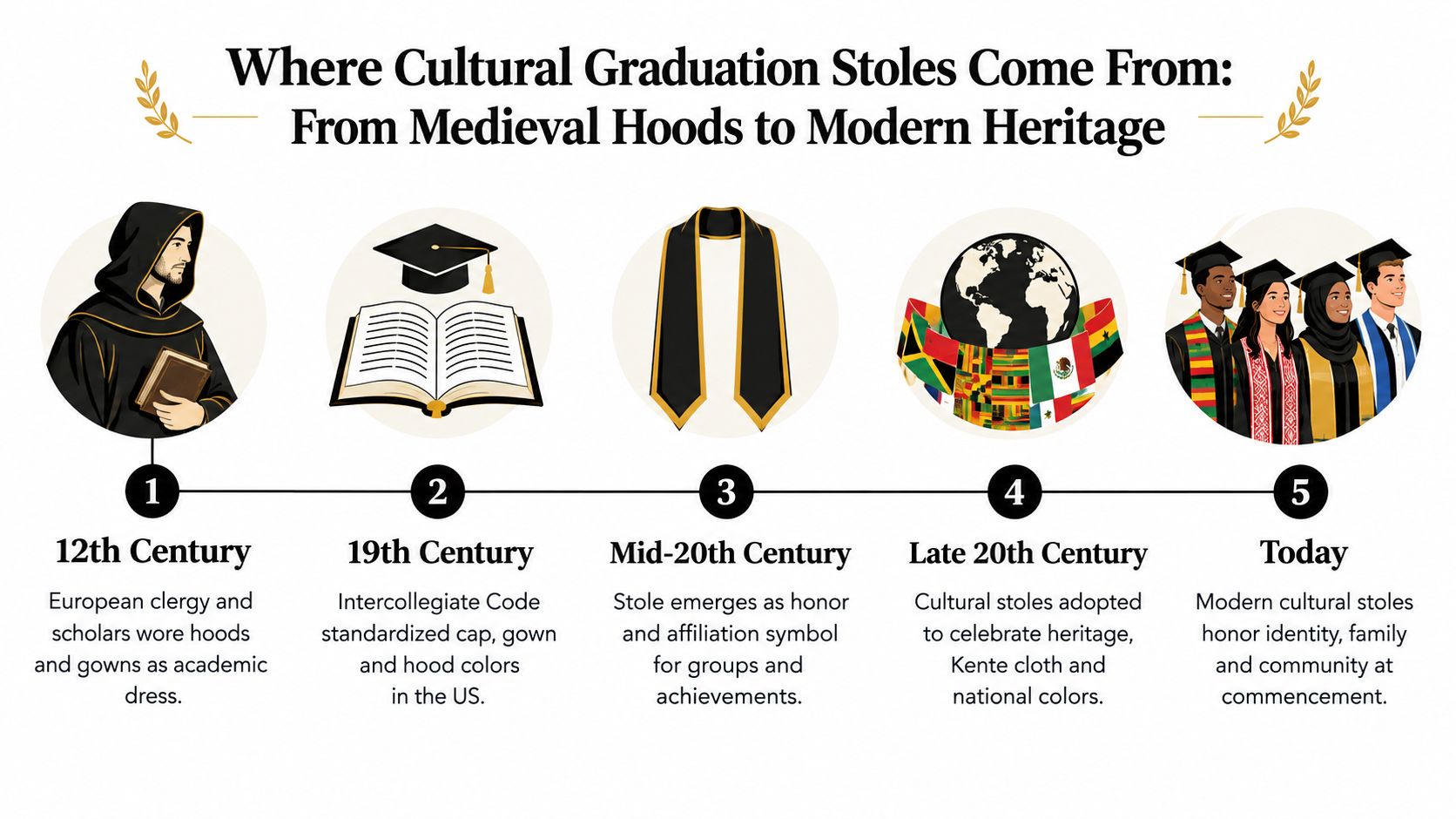
From academic dress to cultural recognition
A helpful way to read this history is to separate form from meaning. The form is old. The meaning is newer and more specific.
That is why a cultural stole can feel both established and personal in the same ceremony. The gown signals membership in the academic community. The stole adds community recognition within that shared ritual.
One of the clearest examples is the kente stole. Kente cloth comes from the Akan peoples of present-day Ghana, where it developed as a prestigious woven textile associated with status, ceremony, and leadership, as explained by the Metropolitan Museum of Art's background on kente cloth. In U.S. commencements, that textile tradition was adapted into stole form so Black graduates could be honored within the visual language of graduation rather than outside it.
If you want a concise explanation of that adaptation, this guide on what a kente stole is is a useful reference.
Why the campus ceremony model mattered
A turning point came when colleges began organizing identity-based graduation celebrations alongside the main commencement ceremony. That practice gave the stole a clear job. It was no longer just an accessory choice. It became a marker of recognition, belonging, and family pride in a formal academic setting.
That model spread because it solved a real ceremony problem. Schools wanted commencement to remain unified, but students also wanted their heritage and community ties to be visible. A stole handled both needs at once. It fit the existing regalia structure and carried specific cultural meaning without changing the cap-and-gown foundation.
You can see that pattern in many multicultural and affinity ceremonies held from 2024 through 2026. Campuses continue to use cultural stoles in Black graduation events, Latino and Hispanic celebrations, Native and Indigenous recognitions, APIDA ceremonies, international student programs, and broader multicultural convocations. For students and families making buying decisions, that recent practice matters as much as the older history. It tells you what the stole is doing in a real ceremony today.
Here's a short visual explainer before the story gets too abstract:
Inheritance and reinvention
Cultural graduation stoles make the most sense when you see them as inherited ceremony pieces that have been repurposed for modern identity recognition.
- The stole shape comes from academic regalia.
- The symbolism often comes from living cultural traditions, national identities, or affinity communities.
- The graduation use comes from campus ceremonies that wanted students to be recognized as scholars and as members of particular communities.
That history also helps with practical choices. A stole tied to a long-standing textile tradition calls for more care than a generic color block or novelty design. A school-sponsored multicultural ceremony may also favor one type of stole over another. Students who understand where a design comes from usually make better decisions about accuracy, customization, and whether a style fits both family expectations and campus policy.
Decoding Colors, Patterns, and Flags
A family in the stands usually has only a few seconds to read a stole as a graduate walks by. If the design is clear, they understand the message right away. If it mixes too many signals, the meaning gets lost.
That is why colors and patterns matter so much. A cultural stole works like a visual introduction. It can point to heritage, nationality, community membership, or a specific ceremony tradition, but each design language tends to do one of those jobs better than the others.
How schools already use visual coding
Seattle Colleges gives a useful real-world example of how campuses separate these meanings. Its regalia guide distinguishes multicolor designs for ethnic, cultural, or tribal affinity from flag-based designs tied to a specific country, and from pride-flag variations used for LGBTQ+ identification. The same guide also shows that white may be used for international students, which tells you something practical. A single ceremony can use more than one color system at the same time (color guide for graduation stoles).
That distinction helps everyone involved. Ceremony staff can sort regalia accurately. Photographers can identify groups quickly. Families can tell whether a stole is signaling culture, country, or community.
If your decision starts with nationality or family origin, these examples of graduation flag stoles make it easier to see how flag-based symbolism differs from broader cultural textile patterns.
Reading common color meanings
Color meaning depends on tradition. A gold stripe on one stole does not automatically mean the same thing on another.
In kente-associated symbolism, gold is often read as honor or royalty, green as growth or renewal, and black as spiritual maturity or ancestral connection. Those associations help explain why many Black graduation stoles are bold from a distance. The colors are doing symbolic work and visibility work at the same time.
Serape-style stoles usually communicate in a different way. Their striped palettes often read as festive, regional, and heritage-centered. Flag stoles are more literal. They usually identify a nation, homeland, or diaspora connection first, rather than a textile tradition.
| Color or Motif | Cultural Reference | Common Meaning |
|---|---|---|
| Gold | Kente-associated symbolism | Royalty, honor, achievement |
| Green | Kente-associated symbolism | Renewal, growth, future |
| Black | Kente-associated symbolism | Spiritual maturity, ancestral connection |
| Multicolor flag pattern | Country flag stole | National identity or family origin |
| Pride flag variation | LGBTQ+ affinity stole | Community identification |
| Striped serape palette | Hispanic/Latino ceremony use | Cultural celebration and heritage |
| Tribal or ethnic multicolor pattern | Affinity stole | Shared cultural or tribal belonging |
Avoiding mixed signals
Students often want one stole to carry every part of who they are. The instinct makes sense.
Ceremonies are easier to read when one message leads and the other details support it. Recent multicultural graduations in 2024 through 2026 often reinforce this point by using separate visual categories for separate purposes, so viewers can tell the difference between cultural affinity, national identity, and other forms of recognition without needing a program note.
A good rule is simple. Choose one primary identity marker, then add one secondary detail if your school allows customization. For example, a student might start with a country flag stole and add small text for a campus organization, or begin with a cultural pattern and add graduation year embroidery. Once a design includes a flag, multiple pattern systems, several symbols, and long wording, the stole starts to read like a collage instead of a clear ceremonial piece.
The clearest stole is usually the one your family can understand from the stands without extra explanation.
Before you order, ask one practical question first. What should this stole communicate first on ceremony day: heritage, national roots, faith, or community affiliation? Start there, then choose colors and symbols that support that single answer.
Popular Styles of Cultural Graduation Stoles
By the time most students start shopping, they've usually narrowed the decision to a few broad families. The problem is that many product pages show styles without explaining when each one makes the most sense. A side-by-side comparison fixes that.
The six families most students compare
Kente stoles are rooted in Ghanaian tradition and are commonly chosen for Black graduation celebrations and African diaspora recognition. They tend to use strong geometric patterning and high-contrast color combinations that stand out over black or dark gowns.
Serape stoles are often used in Hispanic or Latino recognition ceremonies. Their striped look reads immediately from a distance, which makes them effective in group photos and processional lines.
Heritage flag stoles work best when nationality or diaspora is the central message. These are often the clearest choice for international students or graduates whose family identity is strongly tied to a specific country.
Other styles with different goals
Pride stoles usually center LGBTQ+ identification through flag-based color systems rather than national or ethnic references.
Faith-based stoles often include symbols, script, or religious colors. These can overlap with seminary, ministry, or religious student group traditions, so it's worth checking whether your school treats them as cultural regalia or separate ceremonial wear.
Custom stoles give the most flexibility. They're often used by Greek organizations, first-generation graduates, multicultural centers, affinity groups, and families who want names, years, or tributes added to a graduation sash.
| Stole Style | Origin & Motifs | Color Palette | Best For |
|---|---|---|---|
| Kente | Ghanaian-rooted pattern tradition, geometric motifs | Bold multicolor combinations, often gold, green, black, red | Black graduation, African diaspora recognition |
| Serape | Mexican textile-inspired striped design | Bright linear stripes | Hispanic/Latino recognition ceremonies |
| Heritage Flag | National or regional flag imagery | Country-specific flag colors | International students, national pride |
| Pride | Pride flag variants | Community-specific pride colors | LGBTQ+ affinity recognition |
| Faith | Religious symbols or ceremonial colors | Depends on tradition | Faith-centered ceremonies or religious identity |
| Custom | Personalized text, logos, symbols, mixed motifs | Fully variable | Greek life, first-gen, clubs, family tribute |
How to match style to purpose
The best style usually depends on what you want the stole to do.
- Choose kente if the ceremony is explicitly tied to Black cultural recognition or African diaspora celebration.
- Choose serape if your school uses it in Latino or Hispanic commencement traditions.
- Choose a flag graduation stole if your main goal is to represent country of origin or family roots.
- Choose a custom graduation stole if no standard design fully reflects your identity.
A final point matters for students with layered identities. If two identities both matter greatly, many schools and student groups handle that by wearing one stole for a cultural celebration and another for the main commencement, or by wearing two stoles sequentially for photos and different ceremony moments. That tends to be cleaner than forcing several symbolic systems into one crowded design.
Design and Customization Options
Once you know what kind of stole you want, the next challenge is making sure the finished piece looks right on the gown. Many students make rushed decisions. The design seems good on a screen, but the fabric, text, or scale doesn't translate well in person.
Start with fabric and surface finish
Most graduation stoles and graduation sashes are made to drape smoothly over formal regalia. That means your first decision is usually about finish and structure.
Satin-style materials tend to give you shine, crisp color, and good photo presence. Matte or woven-looking options can feel more restrained and can suit designs meant to read as textile-inspired rather than glossy. Silk-blend and higher-texture options may appeal to buyers who want a more heirloom feel, but what matters most is whether the chosen material supports your design method well.
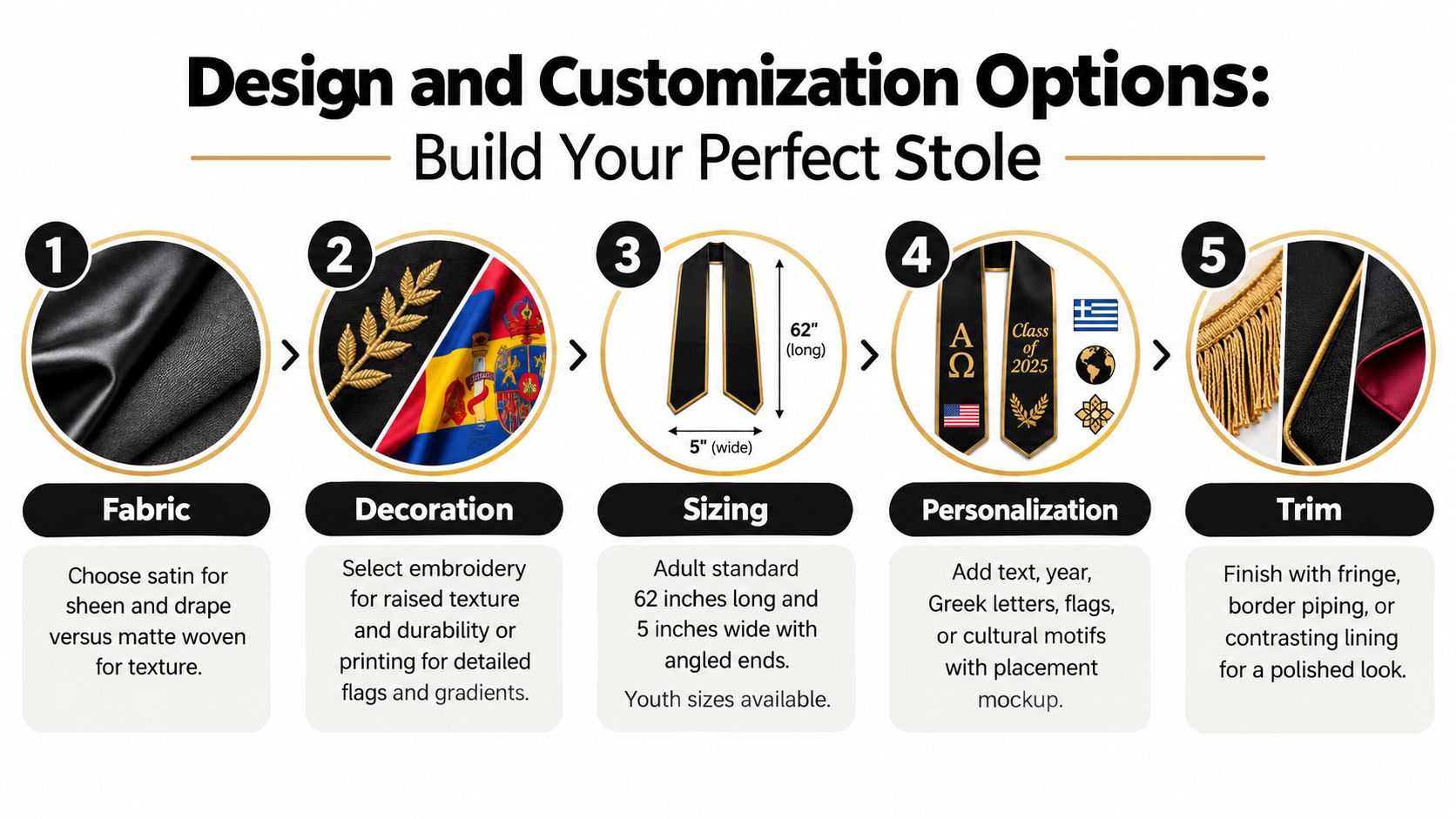
Then decide how the design will be applied
Embroidery and printing produce very different results.
- Embroidery gives raised texture and works well for names, years, Greek letters, and simpler symbols.
- Printing usually works better for flags, gradients, detailed motifs, or full-panel imagery.
- Mixed designs can use printed backgrounds with embroidered names or organization marks.
Placement matters just as much as method. A school name or family name can sit near the stole tip, while a crest, flag, or emblem may fit better at chest height where it remains visible in photos.
If you're exploring personalized options, this guide on customized cap and gown details gives a useful starting point for thinking through text, layout, and ceremony fit.
Size changes the visual effect
A narrower stole can look elegant but may hide more of the design once it sits over the gown. A wider stole gives artwork more room, but can feel visually heavy if too many symbols compete for attention.
The infographic above references a common adult format of 62 inches long and 5 inches wide. In practice, students should still check their school's regalia guidelines and compare the stole length against height, gown cut, and whether layered cords or medallions will sit on top of it.
When in doubt, prioritize readability over decoration. A name, year, and one strong symbol almost always wear better than a crowded layout.
Small additions that change the final look
Trim can push a stole toward formal, festive, or ceremonial.
Common finishing choices include:
- Fringe or tassel trim for a more ceremonial edge
- Border piping to sharpen contrast
- Pin-on medallions or charms for removable personalization
- Contrasting lining or backing when the stole may flip in motion
For group orders, ask to see a proof before production. That's especially important for cultural graduation stoles, where one misspelled name, incorrect flag orientation, or inaccurate color choice can turn a proud keepsake into a frustrating compromise.
School Policy, Etiquette, and Cultural Respect
A beautiful stole can still become a problem if it conflicts with school rules or misuses cultural symbols. The safest approach is to treat policy, etiquette, and cultural respect as one decision, not three separate ones.
Recent reporting points to a real guidance gap here. Existing content often explains what stoles mean, but rarely explains when they're appropriate, how schools should set review standards, or how to avoid tokenizing students in mixed-identity ceremonies. That gap matters because institutions are increasingly offering affinity graduations and inviting specific groups, including First Nations, Inuit, Métis, and African diaspora graduates, to request stoles (discussion of the policy gap in cultural stole use).
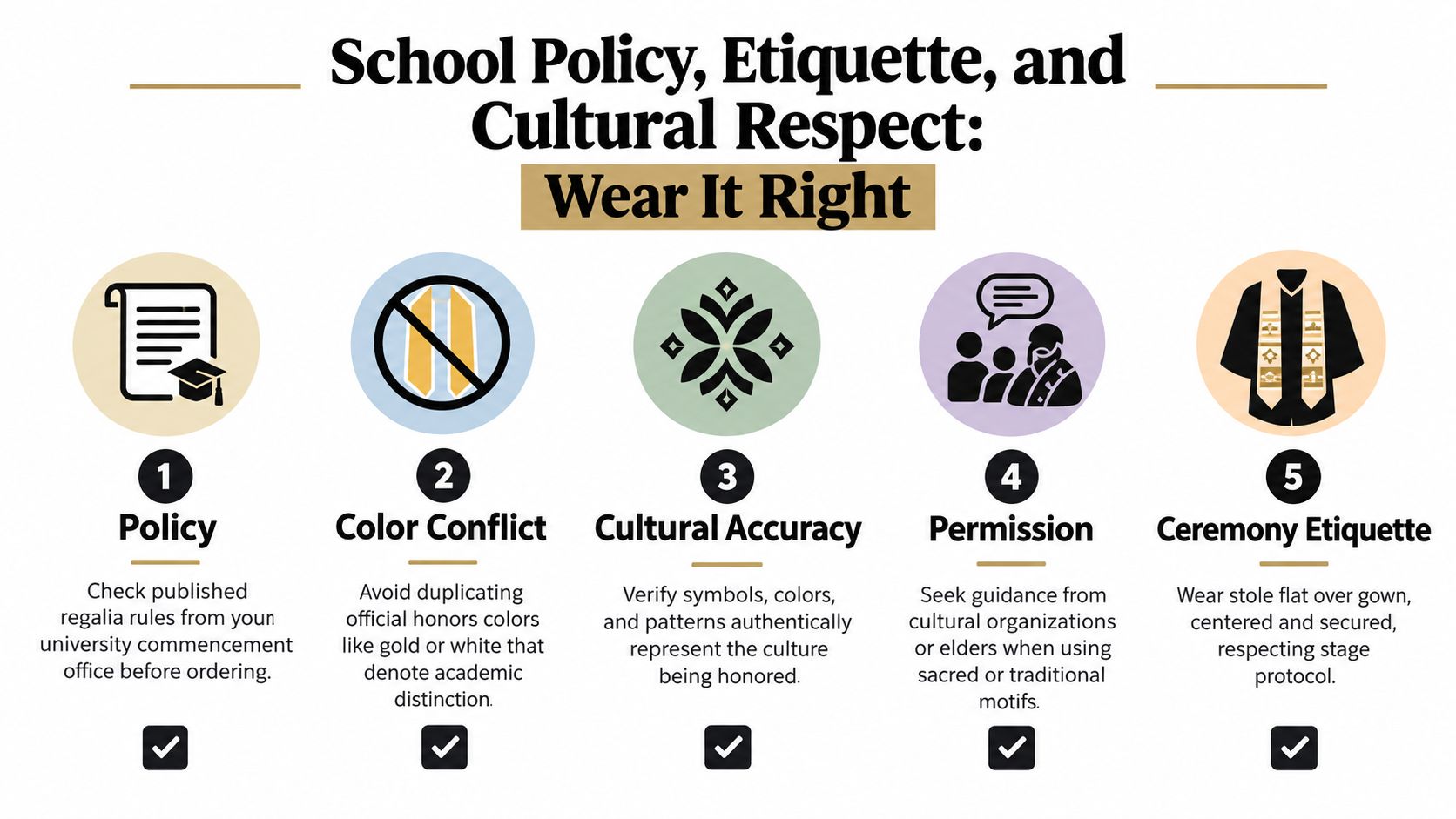
A simple approval framework
If your school offers multicultural graduation stoles directly, use that route first. If it doesn't, ask the commencement office, dean of students, multicultural center, or cultural organization what's allowed before ordering.
Three categories usually matter:
- University-approved stoles issued through official ceremonies or student affairs
- Department-issued stoles tied to academic programs or campus roles
- Student-chosen stoles purchased independently for cultural, faith, or family reasons
A short written approval can save a lot of stress. It also gives you something clear to show if check-in staff ask questions on ceremony day.
Watch for color conflicts
Schools often reserve certain colors for honors and organizations. That's not cosmetic. It helps guests and staff distinguish cultural symbols from academic distinctions.
Academic-regalia guidance from universities shows how strict that coding can be. LSU authorizes purple-and-gold cords for Latin honors and white cords for undergraduate upper-division honors, while restricting those combinations for other graduates. NDSU also assigns specific stole meanings, including a white stole for Pi Tau Sigma, a red stole for Sigma Tau Delta, and a yellow Stole of Gratitude (examples of color-controlled honor regalia). The practical lesson is simple. If your cultural stole uses colors already reserved on your campus, ask whether that creates confusion.
Respect comes before aesthetics
Not every pattern belongs on a graduation sash just because it looks meaningful. Some motifs may be sacred, ceremonial, or community-specific. If you're using a design outside your own direct tradition, seek guidance from the relevant student group, cultural office, artisan, or community elder where appropriate.
Wear the stole flat over the gown, centered at the neck, and adjusted so both ends hang evenly. If there's a formal affinity ceremony before commencement, follow the organizer's instructions about whether the stole is donned during the event or put on beforehand.
Cultural recognition works best when the wearer can explain the stole's meaning with accuracy and respect.
That standard won't answer every policy question, but it prevents many avoidable mistakes.
Ordering, Group Buys, and Care Tips
A familiar graduation problem starts like this. The group agrees they want matching cultural stoles, everyone is busy, and the order sits untouched until finals week. Then one student notices a misspelled name, another realizes the school deadline already passed, and the package arrives wrinkled two days before photos.
A stole order works much better when you treat it like event planning, not impulse shopping. The symbolic choice may be personal, but the buying process is practical. That is especially true for multicultural ceremonies in 2024 through 2026, where family photos, affinity celebrations, and main commencement often place the stole in full public view.
A clean ordering sequence
Start with the decision that shapes every other choice. What is this stole for?
A single graduate ordering for personal wear needs one kind of process. A Black Student Union, Latine affinity group, international student office, or Greek-letter organization planning a shared look needs another. The difference is similar to buying one formal outfit versus outfitting a wedding party. The meaning may be individual, but coordination changes everything.
Use this order:
- Define the purpose first: Personal identity piece, affinity ceremony stole, organization stole, flag stole, or custom stole with names and year.
- Approve the design before collecting money: Set the colors, symbols, wording, and layout first so students are paying for the same item.
- Check the campus timeline: Some schools set regalia deadlines weeks before commencement or before an affinity ceremony.
- Request and review a proof: Check spelling, flag orientation, symbol placement, and whether text is readable in photos.
- Name one point person: One student, advisor, or committee member should approve final details and keep the vendor communication in one place.
- Build in buffer time: Leave room for shipping delays, corrections, steaming, and distribution.
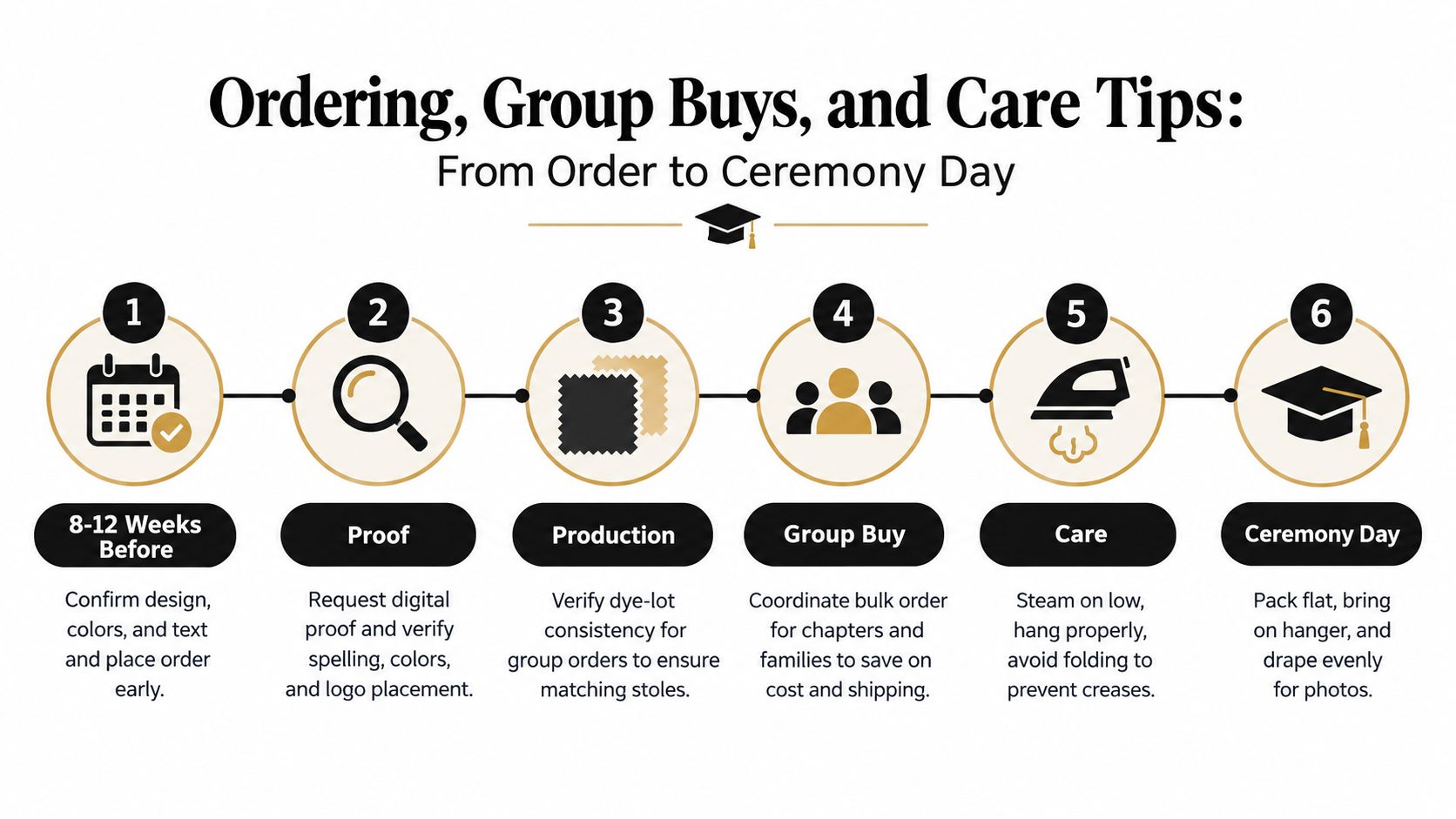
Group buys need stricter controls
Group orders fail in predictable ways. Screens show colors differently. One person approves an old draft. Individual names get added too late. A replacement arrives in a slightly different shade. None of those mistakes change the stole's meaning, but they do affect how unified the group looks in ceremony photos.
Recent multicultural ceremonies show why planning matters. As noted earlier, SUNY Cortland's 2025 Kente ceremony honored dozens of graduating seniors and drew a large crowd of family members and friends. At that size, small ordering errors become very visible.
Ask vendors these questions before you approve production:
| Order question | Why it matters |
|---|---|
| Will all stoles be produced in the same batch? | Helps keep color and fabric finish consistent across the group |
| Can we review a digital proof before production? | Catches misspellings, reversed flags, and layout errors early |
| Are custom names, class years, or titles included? | Shows whether each stole needs separate approval |
| What is the process for replacements or rush fixes? | Helps if one item is incorrect, missing, or late |
| How should the stoles be unpacked, steamed, and stored? | Prevents avoidable creasing before photos and ceremony day |
Students often ask whether a specialty vendor is worth comparing. The practical answer is yes. Stoles.com® offers cultural and personalized graduation stoles, including flag-based and custom options, so it can be useful as one comparison point when students or organizations are weighing format, layout, and customization choices.
Care matters if you want a keepsake
Many families keep the stole long after the cap and gown are boxed away. It may end up framed, packed with graduation photos, or worn again for portraits with parents and grandparents. A few minutes of care protects both the fabric and the memory attached to it.
Use simple habits that work:
- Steam lightly on low heat: Gentle steam usually removes packing wrinkles without flattening embroidery or damaging satin.
- Test first if the stole has printed color blocks or metallic details: A hidden corner can show whether heat or moisture will affect the finish.
- Store it flat or loosely rolled: This helps the stole keep its shape and reduces hard fold lines.
- Keep it away from direct sunlight during storage: Strong light can fade bright colors over time.
- Handle it with clean hands on ceremony day: Lotion, makeup, and food marks show quickly on smooth fabric.
If the order arrives wrong, act fast. Keep the packaging, take clear photos of the issue, and contact the seller before trying to trim threads, iron out a defect, or restitch anything yourself. That gives you the strongest chance of getting a correction in time for the ceremony.
Choosing a Stole You Will Be Proud to Wear
By the end of graduation season, many remember the walk, the applause, and the photos. Many graduates also remember one very specific feeling. They remember adjusting the stole on their shoulders and realizing that the ceremony finally looked like them.
That's what makes this choice worth slowing down for. The right cultural graduation stole doesn't just match your gown. It matches your story, your people, and the version of yourself that earned that degree.
A short checklist that works
Use this test before you order:
- Identity fit: Does this stole represent who you are, not just what looks familiar online?
- Cultural accuracy: Are the colors, flag elements, wording, and motifs correct?
- Policy fit: Have you confirmed that your school will allow it at commencement?
- Build quality: Will the stitching, print, and drape still look good in close photos?
- Timing: Are you ordering early enough to inspect and prepare it before ceremony day?
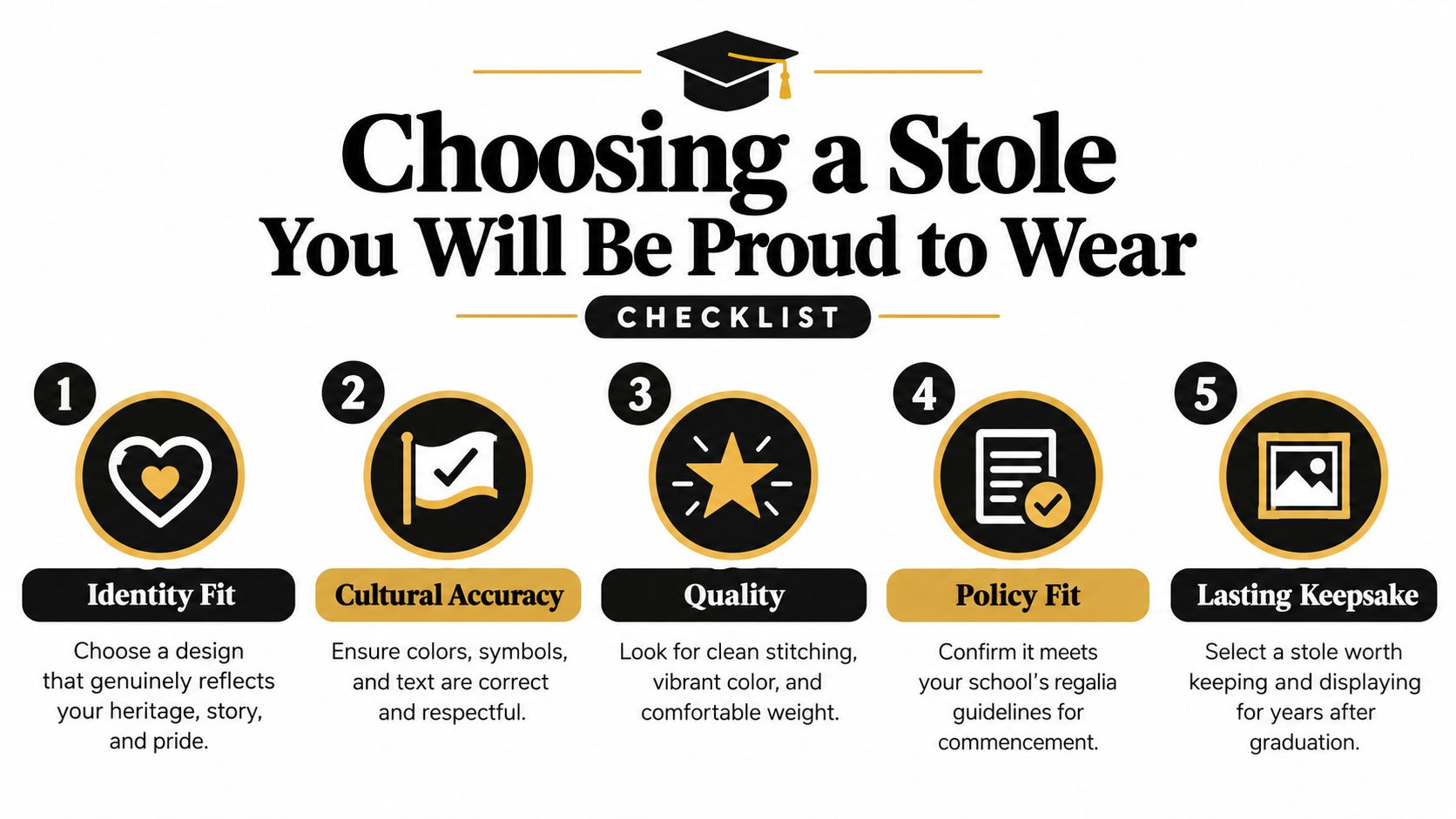
The three questions that settle most decisions
If you're still uncertain, ask yourself:
- Does this stole represent who I am?
- Have I confirmed it meets my school's regalia policy?
- Have I ordered with enough lead time to receive, inspect, and steam it before the ceremony?
If all three answers are yes, you're usually on solid ground.
One last point matters. A graduation stole can start as ceremonial wear and end as a family object. It may be photographed with parents, folded beside a diploma, or kept for younger relatives to see later. That's why students rarely regret choosing carefully. They usually regret rushing.
Stoles.com® offers graduation stoles, graduation sashes, honor cords, flag graduation stoles, Greek stoles, and custom embroidered options for students, families, and schools that want identity and achievement represented clearly on commencement day. If you're comparing cultural graduation stoles or planning a group order for a ceremony, visit Stoles.com® to explore country, cultural, honor, and personalized designs.