

That cap, gown, and stole you’ll wear on graduation day? They’re part of a tradition that stretches back nearly a thousand years. The history of academic regalia didn't start as a symbol of achievement, though. It began as a practical solution for scholars studying in the unheated, drafty stone halls of medieval universities. Long robes and hoods weren't for show—they were essential for staying warm.
Over the centuries, those humble garments slowly transformed, making way for modern symbols of achievement like graduation stoles and honor cords.
From Ancient Halls to Modern Commencements
The story of academic regalia is a fascinating journey from pure function to prestige. What started as simple clerical clothing has evolved into a complex system that tells a graduate's entire academic story at a glance. Accessories like graduation sashes and cords are now central to this tradition, allowing graduates to showcase personal achievements and affiliations.
This tradition has deep roots in the very first universities of the 12th and 13th centuries, which were often extensions of the Roman Catholic Church. The scholarly dress of the time was just a variation of clerical robes, serving the dual purpose of keeping academics warm and marking their connection to the church. By 1321, institutions like the University of Coimbra in Portugal made it official, requiring all degree-holders to wear gowns.
The Original Components of Regalia
At first, the core pieces were simple and all about utility. They weren't saved for a special ceremony but were worn every day in the scholarly environment.
- The Gown (Cappa Clausa): Think of this as a long, heavy overcoat, usually made of wool. Its main job was to provide as much warmth as possible in chilly lecture halls and chapels.
- The Hood (Capitium): This was originally a separate head covering with a cape attached. Scholars could pull it up over their heads for extra protection from the elements.
- The Cap: Early headwear came in a few styles, but the ancestor of the modern mortarboard was a simple skullcap, the kind often worn by clergy.
As time went on, these practical items started to carry symbolic weight. As universities became more organized, the regalia began to signify rank and field of study. For a deeper dive into the pieces that make up today's commencement look, check out our guide on what is academic regalia.
The core idea was simple: to create a uniform that identified a community of scholars. This visual identity set them apart from the general populace and underscored the seriousness of their academic pursuits.
While gowns and caps laid the foundation, accessories like the academic stole or sash eventually became a vital part of the tradition. These additions brought a new layer of personal and academic distinction, giving graduates a way to showcase specific honors, memberships, or affiliations. This evolution—from a uniform born of necessity to a personalized statement of achievement—is a key part of the history of academic regalia, connecting ancient scholars to the proud graduates of today.
Decoding the Symbols of Your Graduation Attire
Every piece of your graduation outfit tells a story. Think of it as a silent language understood across the entire academic world. This isn't just formal wear; it’s a detailed resume of your journey, broadcasting your achievements, field of study, and alma mater without you saying a single word. Modern additions like graduation stoles and honor cords are especially important for telling your unique story.
The history of academic regalia shows a clear line from purely practical clothing to the powerful symbols we see today. This flowchart maps out that journey.
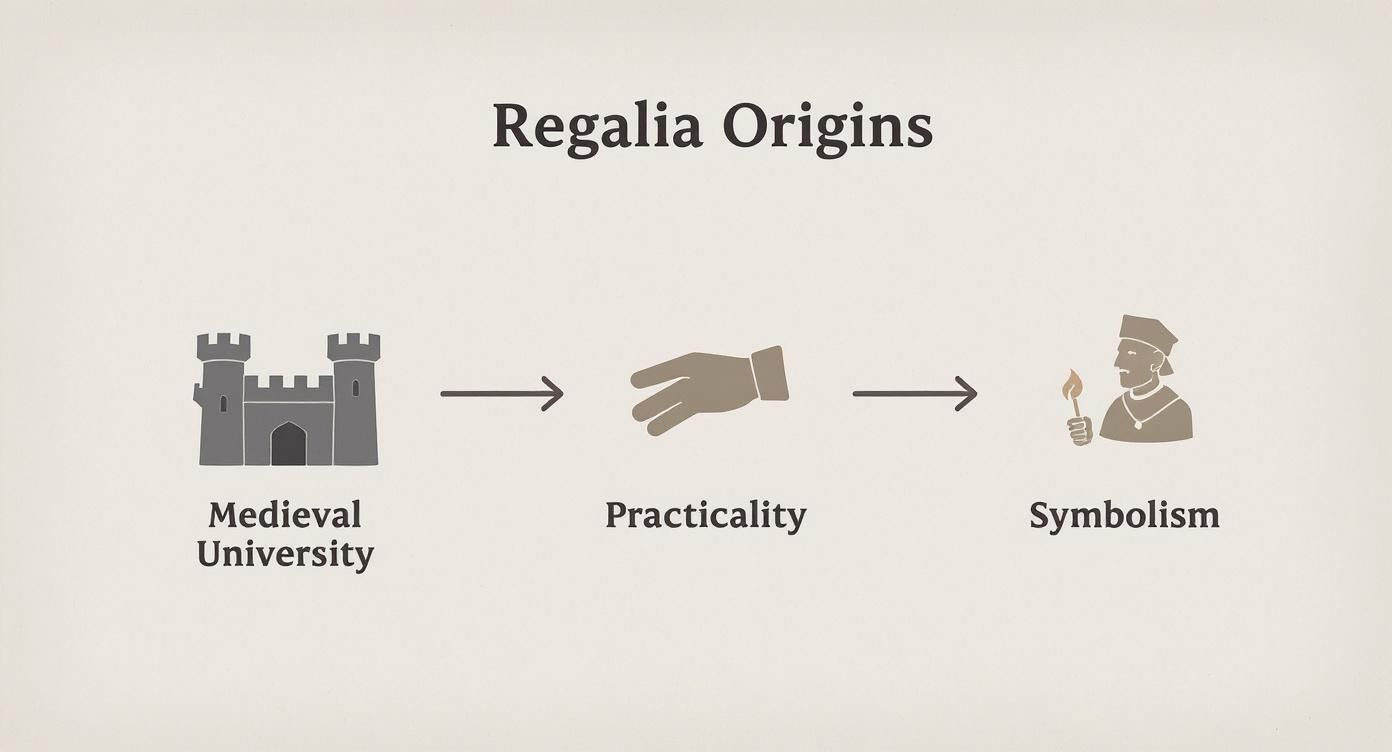
As you can see, what started as a way for medieval scholars to stay warm in drafty university halls has blossomed into the rich, symbolic attire we recognize now. Every color, cut, and fabric is intentional, carrying on a tradition that’s hundreds of years old.
Gowns: Sleeve Styles and Their Meanings
The gown is the foundation of your look, and it immediately signals your level of academic achievement. The easiest way to tell them apart? Look at the sleeves.
- Bachelor’s Gown: These gowns have simple, pointed sleeves. It's the classic look representing the first level of higher education.
- Master’s Gown: The sleeves here get more interesting. They are long and oblong, often with a slit for your arm to pass through. Fun fact: historically, these long sleeves might have doubled as pockets.
- Doctoral Gown: This is the most ornate of the three. It features full, bell-shaped sleeves decorated with three velvet bars, known as chevrons. These chevrons are a clear sign of the highest academic degree.
The Academic Hood: A Colorful Story
If the gown is the foundation, the academic hood is the vibrant billboard of your scholarly background. It’s arguably the most detailed part of your regalia, communicating three specific things at a glance:
- Degree Level: The length tells the story. A master’s hood is longer than a bachelor’s, and a doctoral hood is the longest and most full of them all.
- Field of Study: This is where the color comes in. The velvet trim’s color corresponds to your academic discipline. For example, light blue is for education, science gold signals the sciences, and citron is for social work.
- Granting Institution: The satin lining of the hood proudly displays the official colors of the university or college that awarded you the degree.
The combination of these colors creates a unique visual signature for every single graduate. To dive deeper into what each color means, check out our complete breakdown in our guide to understanding graduation hood colors.
The Cap and Tassel Tradition
And finally, we have the mortarboard cap, a nearly universal symbol of graduation. The real magic, though, is in the tassel. The tradition of turning the tassel is a rite of passage for graduates everywhere.
You’ll typically wear the tassel on the right side before your degree is conferred. Afterward, you move it to the left side, a simple physical act that symbolizes your official transition from candidate to graduate. The distinct fabric, style, and color of academic attire are rich with symbolism. You can find excellent guidance on choosing attire based on these visual characteristics that can give you a deeper appreciation for the thought behind regalia.
While the mortarboard is the most common, some doctoral graduates wear a soft, multi-sided tam, another nod to historical academic headwear. Each element, from the shape of a sleeve to the placement of a tassel, is a piece of a much larger story—your story of academic success.
How Academic Dress Varies Around the World
While the gown, cap, and hood are recognized almost everywhere, academic dress is far from a one-size-fits-all tradition. Think of it as a universal language with distinct regional dialects. Over the centuries, the core concept has branched out, creating a rich tapestry of customs that show off unique institutional and cultural identities.

Here in the United States, things are pretty straightforward. The Intercollegiate Code of Academic Costume (ACE Code) creates a standardized system, making it easy to spot a graduate's degree level and field of study no matter where you are in the country. This code dictates everything from the shape of the sleeves to the specific colors on a hood's velvet trim. But this kind of uniformity is actually the exception, not the rule.
Contrasting Global Traditions
Once you step outside the U.S., the world of academic dress becomes much more diverse and complex. In the United Kingdom, for example, there is no single national code. Each university—especially ancient ones like Oxford and Cambridge—proudly maintains its own distinct system. This means unique gown shapes, specific colors, and different hoods for various degrees and colleges. A graduate’s gown can tell you not just their degree, but their specific academic home within the university.
Other countries have even more unique practices. Harvard, with commencement traditions dating back to 1642, uses embroidered "crow's-foot" symbols on its gowns to distinguish between earned and honorary degrees. And while the U.S. relies on simple color-coded trim, you'll find traditions like Finland's doctoral sword ceremony or Oxford's incredibly detailed gown system. It's a fascinating look at how different cultures celebrate academic achievement. You can explore more about the fascinating global history of academic regalia to see these differences in action.
To get a clearer picture of how these traditions stack up, let's compare some of the key features side-by-side.
Global Academic Regalia Traditions
| Feature | United States (ACE Code) | United Kingdom (Varies) | Other Notable Traditions |
|---|---|---|---|
| Gowns | Standardized shapes by degree level (Bachelor's, Master's, Doctoral). Usually black. | Highly varied by university and degree. Colors and shapes are unique to the institution (e.g., Oxford's "sub fusc"). | Crimson gowns at Harvard for doctorates; specialized gowns for university officials in many European countries. |
| Hoods | Length and shape indicate degree level. Velvet trim color signifies the field of study. | Unique shapes, sizes, and color schemes for each university and degree. Often more elaborate and colorful. | Scandinavian countries often use hats or swords instead of hoods for doctoral ceremonies. |
| Headwear | Mortarboard (cap) is standard for most degrees. Soft tam is used for some doctoral degrees. | Mortarboards are common, but some universities use unique headwear like the Tudor bonnet or John Knox cap. | The doctoral hat in Finland is a top hat; birettas are used in some Catholic universities in Europe. |
| Colors | Standardized colors for academic fields (e.g., light blue for Education, gold for Science). | No national standard. Colors are specific to the university's own traditions and heraldry. | Colors often reflect national or institutional identity rather than a specific academic discipline. |
This table just scratches the surface, but it highlights the incredible diversity in how academic success is symbolized across the globe.
The Rise of Stoles as a Global Connector
Amidst all these different traditions, one modern piece of regalia has emerged as a unifying force: the graduation stole.
Whether it's worn in the standardized American system or the highly specific European models, the stole offers a universal way for graduates to express their personal story.
A graduation stole acts as a personal banner, allowing graduates to showcase their unique heritage, affiliations, and achievements. It adds a layer of individuality to the formal, often uniform, academic dress.
For instance, a student in the U.K. might wear a stole representing their home country, while a student in the U.S. could wear one celebrating their fraternity. Some stoles carry powerful cultural symbols that cross all borders. A perfect example is the Kente stole, whose rich history and meaning are recognized in ceremonies worldwide. To learn more, you can explore the significance behind what is a kente stole.
This shared practice connects graduates on a global scale, reminding us that while our traditions may differ, the pride in who we are and what we've accomplished is universal.
The Modern Rise of Stoles and Honor Cords
If the traditional gown and hood are the historical bedrock of academic regalia, then modern accessories like stoles and honor cords are the personal stories built upon that foundation. These vibrant adornments are where a graduate’s individual journey truly shines through. They allow you to showcase unique achievements, cultural pride, and personal identity, adding layers of meaning to the classic commencement look.

Unlike the strictly regulated gown and hood, stoles and cords offer a wonderful degree of flexibility. They represent a shift in focus—from celebrating the institution alone to honoring the complete story of the person wearing the cap and gown. This is where academic honors, club memberships, cultural backgrounds, and personal milestones get their moment in the spotlight.
Distinguishing Achievements with Cords and Sashes
Honor cords are one of the most familiar sights at any graduation. These braided ropes, draped elegantly over the shoulders, are typically reserved for recognizing specific academic accomplishments. Think of them as a color-coded system for excellence, often worn by honor society members or those graduating with Latin honors.
- Academic Honors: Different colors often signify levels of scholastic achievement, like cum laude, magna cum laude, and the prestigious summa cum laude.
- Society Membership: Groups like the National Honor Society or specialized academic fraternities provide cords in their official colors to graduating members.
- Military Service: It's also common to see graduates who are veterans or active-duty service members wearing red, white, and blue cords to proudly acknowledge their commitment.
The graduation sash, more commonly known as a stole, provides a much broader canvas for personal expression. This long, scarf-like cloth hangs down the front of the gown and serves as a highly visible display of affiliation and pride.
A graduation stole is like a personal billboard. It transforms the uniform gown into a narrative of individual success, cultural identity, and group membership, making each graduate's story visible from every seat in the auditorium.
The Graduation Stole: A Symbol of Personal Pride
The stole has quickly become one of the most meaningful modern additions to commencement attire. Because it's so versatile, it can represent a huge range of accomplishments and identities, turning it into a cherished keepsake long after the ceremony is over.
Graduates use stoles to celebrate all kinds of things. A student might wear a stole displaying their Greek letters to represent their fraternity or sorority. Another might wear a stole featuring their home country's flag to honor their heritage. Others customize them to signify their involvement in student government, athletic teams, or volunteer groups. This is what makes the stole so special—it’s all about personalization.
To help you find the perfect way to tell your story, we offer a huge variety of ways to celebrate your journey. You can browse our complete collection of custom graduation stoles and design a piece that truly captures your unique accomplishments.
To clarify what each of these modern accessories represents, here’s a quick guide.
A Guide to Graduation Stoles Sashes and Cords
| Accessory | Primary Meaning | Common Examples |
|---|---|---|
| Honor Cord | Signifies specific academic achievements or membership in an honor society. | Summa cum laude (often gold), National Honor Society (blue and gold), military service cords. |
| Graduation Stole/Sash | Represents personal identity, cultural heritage, or affiliation with a specific group or organization. | Kente cloth stoles, flag stoles, Greek letter stoles for fraternities/sororities, club affiliations. |
| Medallion | Often awarded for specific high honors, leadership roles, or as a university-wide recognition. | Presidential honors, valedictorian medal, specific departmental awards. |
Ultimately, these modern additions have beautifully enriched the long history of academic regalia. They bridge the gap between ancient tradition and contemporary values, ensuring every graduate feels seen not just as a scholar, but as an individual with a unique story worth celebrating.
How to Wear Your Regalia with Confidence
Your graduation day is a massive moment. The absolute last thing you should be worrying about is whether your cap is on straight. Feeling good in your regalia lets you soak it all in, so getting the hang of how it all comes together is a game-changer. This quick guide will walk you through it, making sure you look sharp from the moment you walk in to that final, glorious cap toss.
Every piece you're wearing, from the gown itself to the smallest honor cord, has a specific place. Getting it right isn't just about looking good; it's a nod to the long history of academic regalia that you're now officially a part of.
The Foundation: Your Gown and Hood
First thing's first: slip on your graduation gown and zip it up completely. It should hang somewhere between your knee and your ankle. Now for the trickiest part—the academic hood. Drape it over your head so the velvet trim faces forward, framing your face. The colorful satin lining, which represents your university, should be resting against your back for now.
Take a look inside your gown near the collar; most have a small loop or cord. This is your best friend. Hook the front of your hood onto it to keep it from sliding back during the ceremony. A small safety pin works just as well in a pinch.
Pro tip: Grab a friend or family member to help adjust the back of your hood. The satin lining needs to be flipped or turned out to show off your institution's colors. This creates that iconic slash of color everyone recognizes.
Placing Your Graduation Stole and Honor Cords
With the hood settled, it's time to add your personal flair. Your graduation stole goes around your neck, draping down the front of your gown. Let it lie flat right over your hood, making sure both sides hang at the same length. Your stole is your story, so make sure it’s centered and easy to see.
Honor cords are draped right over your shoulders, hanging down on either side of your stole. If you've earned multiple cords, they usually get grouped together. You can even pin them neatly to the inside of your gown to keep them from tangling. There isn't a strict rule for which side they should be on, but keeping them symmetrical looks best.
- Step 1: Drape your stole evenly around your neck, over the hood.
- Step 2: Layer your honor cords on top of the stole, letting them hang neatly.
- Step 3: If you're worried about them shifting, use a small pin inside your gown to secure the cords in place.
The Finishing Touch: The Cap and Tassel
The last piece of the puzzle is the mortarboard, or cap. The key is to wear it flat on your head, perfectly parallel to the ground—no tilting it back! The front point should be centered on your forehead.
Now for the tassel, the most symbolic piece of all. Before your degree is officially conferred, the tassel hangs on the right side of your cap. Listen for instructions during the ceremony; at the right moment, you'll be told to move it to the left side. It's a simple, powerful gesture that marks your official transition from candidate to graduate, connecting you to centuries of scholars.
By following these simple steps, you'll be able to wear your entire set of regalia—especially your custom stoles and honor cords—with the pride and confidence you've earned. Now go celebrate your incredible achievement
Your Academic Regalia Questions Answered
As your graduation day gets closer, it's completely normal to have a few last-minute questions about your cap, gown, and all the accessories that go with them. The world of academic regalia is full of fascinating history, and we want to clear up some of the most common questions, especially about modern pieces like stoles and cords.
Getting these details right will help you feel confident and ready when you walk across that stage.
Who Is Responsible for the Hooding Ceremony?
For anyone earning a doctorate, the hooding ceremony is a huge moment. Traditionally, the person who places the doctoral hood over the candidate's shoulders is their dissertation advisor or mentor. This gesture is symbolic—it's about welcoming a new peer into the highest level of academia and celebrating the close bond between the scholar and their guide.
In some ceremonies, a university official like a dean might do the honors instead.
What Do the Colors on a Graduation Stole Mean?
While academic hoods use a standardized color system to represent fields of study, the colors on a graduation stole or sash are much more personal. They don't follow that same historical academic code. Instead, stole colors usually tell a story about the graduate.
- Cultural Heritage: A graduate might wear a stole with the colors of their home country’s flag to honor their roots.
- Organizational Membership: Fraternity, sorority, or academic club colors are often displayed proudly on a stole.
- Academic Honors: While honor cords are more common for this, some honor societies do provide stoles in their official colors, like the blue and gold for the National Honor Society.
Ultimately, the meaning is defined by you or the group you belong to, making the stole a true expression of your personal journey.
Why Do Some Graduates Wear So Many Cords?
When you see a graduate decorated with multiple honor cords, you're looking at a serious record of achievement. Each cord represents a different accomplishment or group affiliation, and it's not unusual for a top-performing student to wear several at once.
For example, a single graduate might wear one cord for graduating summa cum laude, another for being in a specific academic honor society, and a third red, white, and blue cord to show their military service.
Each cord adds another layer to their academic story, creating a colorful display of all their hard work. When combined with a meaningful graduation stole, the regalia becomes a complete picture of their unique path to graduation.
At Stoles.com, we believe every graduate's story is worth telling. From honor cords that show off your academic success to beautifully made stoles that celebrate your heritage, we have everything you need to make your commencement look your own. Celebrate this incredible achievement with regalia that is as unique as your journey by visiting us at https://www.stoles.com.