

Walk across any graduation stage, and you’ll see a vibrant rainbow of colors draped around the graduates' necks. Those aren't just for decoration; they're graduation honor cords, and each one tells a story. Think of them as a visual language, a silent but powerful way to communicate a student's unique journey, achievements, and affiliations. Along with graduation stoles and sashes, these cords are a key part of the academic regalia that makes commencement so special.
Decoding the Colors of Graduation Day

As graduates file into the ceremony, their honor cords offer an immediate glimpse into their hard work. These symbolic ropes are a university's nod to a student's dedication, whether it's for outstanding grades, leadership in a campus club, or commitment to community service.
The array of colors is like a visual resume. A flash of forest green might signal an achievement in environmental science, while a bold crimson cord could represent a future journalist or musician. This system lets everyone—from proud family members to faculty—instantly recognize the diverse accomplishments woven into the fabric of the graduating class.
The Language of Academic Colors
The meaning behind each honor cord color is steeped in academic tradition. While schools have their own specific rules, there’s a generally accepted color code used to distinguish different fields of study and types of honors. This brings a layer of rich visual storytelling to the whole commencement ceremony.
You'll see a few common colors again and again:
- Gold Cords: This is the big one. Gold is almost universally recognized for high academic success. It often signifies membership in prestigious groups like the National Honor Society or graduation with Latin honors (summa cum laude, magna cum laude). It’s the color of wisdom and distinction.
- Blue Cords: Often tied to leadership, community service, and achievements in fields like education or the social sciences.
- Red Cords: You’ll frequently see this color on graduates from journalism, music, public health, and various humanities programs.
- White Cords: Traditionally represents accomplishments in the arts, humanities, or letters.
Understanding the Broader Context
Honor cords are just one piece of the puzzle. They’re part of a larger tradition of academic regalia that includes graduation stoles and the elaborate hoods worn by master's and doctoral graduates. Each item has its own history and purpose.
To get the full picture, it helps to explore the meaning behind different graduation hood colors. This entire system is designed to visually communicate a graduate’s story and achievements during ceremonies all over the world. It’s a shared language that ensures a student's hard work is seen and celebrated, no matter where they are.
The Story Behind Academic Honor Cords
Those colorful ropes draped over a graduate's shoulders are more than just a finishing touch to their cap and gown. They're honor cords, and they carry a rich tradition with roots stretching deep into academic history. It all started back in the early 20th century, when universities were looking for a clear, visual way to spotlight students who had truly excelled in their studies.
The idea was simple but powerful: a colored cord to signify academic brilliance. This concept caught on fast. What began as a straightforward marker for a high GPA has since blossomed into the intricate and meaningful system we see at commencements today, linking modern graduates to a long line of scholarly achievement.
From Simple Marker to Complex Symbol
Over the years, the honor cord took on a much bigger role. It wasn't just about grades anymore. Universities and honor societies quickly saw the potential of this visual symbol and began assigning specific colors and combinations to a whole spectrum of accomplishments. This turned the simple cord into a richer tapestry of meaning at every ceremony.
Today, the honor cord color meaning goes far beyond general academic merit. A cord can represent so much more about a student’s journey:
- Membership in National Honor Societies: Groups like Psi Chi (psychology) or Sigma Tau Delta (English) have their own signature color combinations.
- Leadership Roles: You might see a royal blue cord on a student who served in student government or held another key leadership position.
- Community Service: Silver or white cords are often awarded to recognize students who dedicated significant time to volunteer work.
- Military Service: The patriotic red, white, and blue cord is a common sight, proudly honoring graduates who are active service members or veterans.
This detailed system allows schools to celebrate the whole student, not just their transcript.
The tradition of using distinct cord colors goes back to early collegiate customs when schools started standardizing their regalia. It was a way to instantly differentiate graduates' accomplishments, and it has since become a core part of academic culture.
A Modern Tradition with Global Reach
Wearing honor cords has grown into a cherished tradition at ceremonies all over the world. Just how common are they? In the US alone, an estimated 20% of graduating college students are eligible to wear cords for honor society membership. The number of cords can even signify different levels of Latin honors: one pair for cum laude, two for magna cum laude, and three for the highest distinction, summa cum laude.
This visual hierarchy makes it easy to spot various tiers of academic success at a glance. As a result, the market for custom honor cords and graduation stoles has expanded globally, serving tens of thousands of graduates each year who want to celebrate their unique achievements. To dive deeper, you can learn more about the meanings behind different cord colors and their history at various institutions.
Your Guide to Honor Cord Color Meanings
Think of a graduation ceremony as a sea of black gowns, punctuated by vibrant splashes of color. Those brilliant ropes draped over graduates' shoulders are honor cords, and each one tells a story. They're a quick, visual language that speaks to a student's unique academic journey and hard-earned accomplishments.
While the exact meaning can differ a bit from one school to another, there's a widely understood symbolism behind the most common colors. This guide is your translator. Whether you're a graduate figuring out your own regalia or a guest in the audience, knowing what the colors mean adds a whole new layer of appreciation to the ceremony.
Here's a quick look at how common honor cords are and what they can signify.
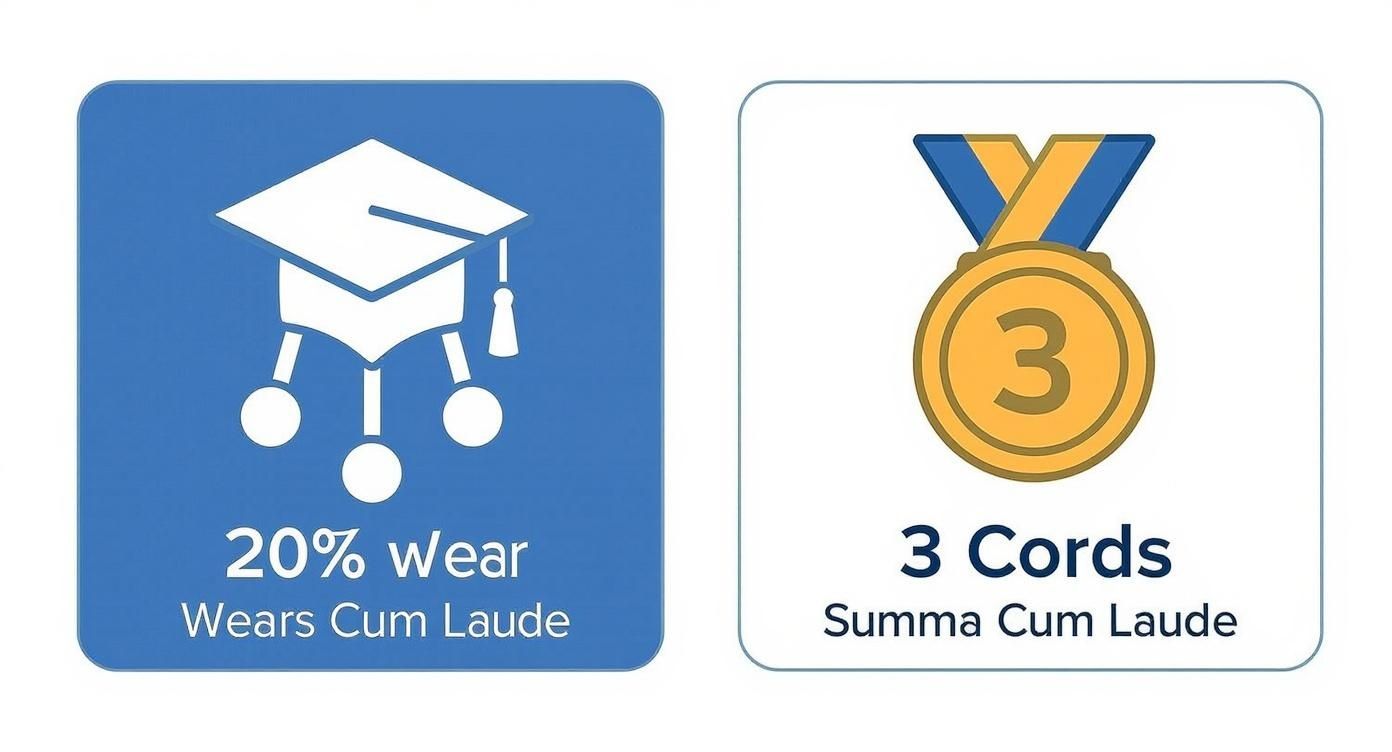
As you can see, a good chunk of graduates—around 20%—wear cords. The number of cords they wear often signals the level of academic distinction. For example, it’s common to see three cords for the highest honor, summa cum laude.
Common Honor Cord Colors and Their Meanings
To help you quickly decode the colors you'll see on graduation day, here’s a handy reference chart. It breaks down the most frequently seen honor cord colors and the symbolism they usually carry.
| Color(s) | Common Meaning or Field of Study | Associated Honor Societies or Groups |
|---|---|---|
| Gold | High academic achievement, Latin honors (summa, magna, cum laude), general excellence | National Honor Society (NHS), Phi Kappa Phi |
| Royal Blue | Leadership, community service, social sciences, political science | Pi Sigma Alpha, National Student Leadership Association |
| Red | Journalism, music, public health, humanities, conservation | Gamma Sigma Alpha, Spanish National Honor Society |
| White | Arts, English, humanities, history, purity of knowledge | Sigma Tau Delta (English), Phi Alpha Theta (History) |
| Green | Medicine, environmental studies, agriculture, physical education | Kappa Delta Pi (Education), Beta Beta Beta (Biology) |
| Silver | Oratory, public speaking, physics, veterinary science, service | Alpha Lambda Delta, community service awards |
| Purple | Law, architecture, dentistry, fine arts, academic leadership | Phi Beta Kappa (often purple & gold), university leadership roles |
| Red, White & Blue | Military service (veteran or active duty), patriotism | University-specific veteran associations, ROTC |
This chart is a great starting point, but remember that traditions can vary. Always check with a specific school or honor society for their official color designations.
The Power of a Single Color
The most straightforward cords you’ll spot are the single, solid-colored ones. These are the foundational vocabulary of graduation day honors, typically tied to a specific field of study or a quality the university wants to celebrate.
Here are a few of the heavy hitters:
- Gold: This is the universal symbol of top-tier academic success. Gold cords are almost always linked to Latin honors (cum laude, magna cum laude, summa cum laude) and prestigious national honor societies.
- Royal Blue: You'll often see this color on graduates recognized for their leadership roles and dedication to community service. It’s a color that speaks to trust and sophistication.
- Red: A bold, powerful color, red frequently pops up for majors in journalism, music, and public health. It’s all about passion, courage, and drive.
What Multi-Colored Cords Mean
When you see a graduate with a cord braided from two or three different colors, it usually points to a very specific or multi-layered achievement. These intricate combinations often represent membership in a particular honor society, a double major, or a special award designated by the university itself.
A red, white, and blue cord, for instance, is instantly recognizable. It's worn with immense pride by graduates who are military veterans or active-duty service members, honoring their incredible service and dedication to the country.
An honor cord isn't just an accessory; it's a wearable testament to late-night study sessions, challenging projects, and personal growth. Each color, whether single or combined, is a badge of honor earned through persistence.
Other combinations are the unique signatures of well-known honor societies. A blue and gold cord, for example, might signal membership in a group that values both academic excellence and leadership. These unique cords are great conversation starters, giving graduates a chance to share the story behind their hard-won recognition.
Whether you're celebrating your own accomplishments or cheering on a loved one, understanding what the colors mean makes the whole experience richer. If you’re a coordinator or a student looking for the perfect symbol of your academic journey, you can browse a full collection of graduation honor cords to find the perfect match for the big day.
How Honor Cords Are Awarded and Worn
Understanding the beautiful symbolism behind all those different cord colors is one thing, but how do they actually end up around a graduate's neck? It's not random. The process for awarding honor cords is just as structured as their meanings, making sure every cord represents a real, hard-earned achievement.
The journey to wearing an honor cord starts long before you ever order your cap and gown. Students earn them by hitting specific benchmarks set by their school or an organization they belong to. These aren't just handed out—they're the finish line of a marathon of effort and dedication.

Who Awards the Honor Cords
Where your honor cord comes from usually tells you what it's for. Generally, there are three main places a student will get their cords, and each has its own set of standards.
- The Institution: Many universities and high schools award cords directly for campus-wide academic honors. Think cum laude, magna cum laude, or summa cum laude. The registrar's office or a senior awards ceremony is typically where these are distributed.
- Academic Departments: A specific college or department—like the College of Engineering or the History Department—might award cords to its top students. This could be for excelling in that field, finishing an honors thesis, or taking part in a special research program.
- Honor Societies: National groups like Phi Beta Kappa or the National Honor Society provide cords directly to their members. In these cases, it’s the local student chapter of the society that handles getting the regalia to its graduates.
This organized system is a big deal. Every year, tens of thousands of honor cords are made and sold in the U.S. alone, with around 20-25% of high school graduates wearing at least one. It’s a huge part of what makes commencement feel so special.
The Proper Way to Wear Your Cords
Once you’ve got your hard-earned cords, you’ll want to wear them correctly. It’s a simple sign of respect for the tradition and your own achievement, and it helps you look polished and put-together on the big day. A standard honor cord is about 62 inches long, with a tassel at each end.
To put it on, just find the center of the cord—there’s usually a small knot there. Drape the cord over your shoulders so the knot sits neatly at the back of your neck. The two sides should then hang down the front of your gown, perfectly even, with the tassels displayed for everyone to see.
Wearing an honor cord is more than just another accessory. It’s a public nod to your entire journey—all the late nights, the hard work, and the passion that got you to this point. Wear it with pride.
If you’ve earned multiple cords (go you!), arrange them neatly so that each one is visible. For a more detailed guide to make sure you have everything just right, check out our post on how to wear honor cords for graduation. By following these easy steps, you can walk across that stage looking and feeling your best, proudly showing off everything you've accomplished.
Finding the Perfect Cords for Your Achievement
While many honor cord colors are tied to long-standing academic traditions or national honor societies, that’s not the whole story. These days, schools, clubs, and all sorts of organizations are creating custom cords and graduation sashes to recognize a much wider range of achievements. This ensures every graduate’s unique journey gets its moment in the spotlight.
This flexibility is a game-changer. Now, student groups—from the debate team to a campus volunteer league—can carve out their own visual identity on graduation day. It's a fantastic way to acknowledge contributions that don't fit into a neat academic box but are just as crucial to a student's experience and the campus community.
Creating a Meaningful Symbol
For student leaders or faculty advisors, picking out the right colors is an opportunity to tell your group's story. So, what does your organization represent? A cord in your school’s official colors can spark a powerful sense of school pride. On the other hand, a completely unique color combination can represent the specific mission of your club or program.
Think about the symbolism behind different shades to craft a powerful message. Here are just a few ideas:
- Royal Blue and Silver: This combination could represent leadership (Royal Blue) and dedicated community service (Silver). It's a perfect fit for a student government association.
- Green and Gold: This pairing brings together environmental advocacy (Green) with academic excellence (Gold), making it ideal for an ecology club.
- Red and Black: A bold mix suggesting passion (Red) and prestige (Black) would be fitting for a competitive team or a performing arts group.
Choosing a custom cord isn’t just about accessorizing a gown; it’s about crafting a lasting symbol that honors a specific legacy of hard work and camaraderie. It gives members a tangible reminder of their shared experience.
This practice empowers graduates to wear a symbol that truly reflects their personal story. It ensures every significant milestone, from leading a student organization to completing a special research project, is visibly recognized during the ceremony. Your achievement is unique, and your honor cord can be, too.
Find the Right Cords for Your Ceremony
Whether you're looking for a traditional color to represent your field of study or aiming to create a custom symbol for your organization, finding the right regalia is key. The goal is simple: select a cord that not only looks great but also carries the weight of your accomplishment with pride and dignity.
If you’re ready to find that perfect representation of your academic journey, you can explore our full collection of high-quality graduation honor cords to find the perfect match for your special day.
Got Questions About Graduation Cords? We’ve Got Answers.
Alright, now that you’ve got a handle on what all those colors mean, let's talk about the practical side of things. Knowing the symbolism is one thing, but figuring out the logistics for the big day is another.
We get these questions all the time from students, parents, and even the folks coordinating the ceremonies. Here are quick, clear answers to the most common queries we see.
Can You Wear More Than One Honor Cord?
Yes, absolutely! It’s actually very common for graduates to wear multiple honor cords at the same time. Think of it this way: each cord represents a different story, a unique accomplishment.
If you’ve earned more than one, you should wear them all with pride. Just drape each cord around your neck so they hang neatly down the front of your gown. This way, every single one of your achievements gets its moment in the spotlight.
Who Actually Buys the Cords?
This is a great question, and the answer really depends on who is giving out the honor. There isn't a single rule, but here’s how it usually breaks down:
- For University-Wide Honors: When it comes to big academic awards like summa cum laude, the school or department itself typically provides the cords to the student, usually at no cost.
- For Honor Societies: Most national honor societies have their members purchase the official cords through their local chapter. This is often done when you pay your membership dues.
- For Student Clubs: If a specific student organization or club has its own cord, that group is responsible for ordering them and getting them to their graduating members.
When in doubt, just ask the group or department awarding the honor. They’ll tell you exactly what to do.
What’s the Difference Between Honor Cords and Stoles?
While they both celebrate your accomplishments, honor cords and graduation stoles (sometimes called sashes) are two totally different things.
Honor cords are the thin, twisted ropes, usually with tassels on the ends. They’re meant to signify a very specific achievement—like graduating with honors, being part of a society, or your field of study.
On the other hand, graduation stoles are the wide, scarf-like pieces of fabric worn over your shoulders. They have a lot more space, so they’re often used to show off fraternity or sorority letters, cultural heritage (like a flag stole), or other major affiliations. You can definitely wear both at the same time to celebrate everything you’ve accomplished!
At Stoles.com, we know every cord and stole tells a story of hard work and success. We offer a huge selection of top-quality graduation gear to help you celebrate every milestone. Find the perfect symbol of your journey right here: https://www.stoles.com.