

When you see a sea of graduates in their caps and gowns, the splashes of color from their honor cords, graduation sashes, and stoles really stand out. At their heart, these items of regalia are a visual language, a vibrant shorthand that tells the story of each graduate's unique journey. The colors can represent anything from high academic honors (like a killer GPA) to the specific field of study they mastered or their membership in a prestigious honor society.
While some colors are pretty universal—gold almost always means top scholars—the specific rules for graduation honor cords are ultimately up to the graduating institution itself.
Deciphering the Language of Graduation Cords and Stoles
Graduation day is packed with symbols, but the colorful cords draped around a graduate's shoulders are among the most personal and telling. They're way more than just a decorative accessory; they're badges of honor, each graduation stole or honor cord telling a story of dedication, specialization, and achievement.
Think of them as a silent announcement. They instantly communicate the hard work and unique path a student took to get to that commencement stage.
What the Colors Represent
Learning what the different honor cord colors mean is like learning a new dialect spoken only on graduation day. Each color, or combination of colors, points to a specific accomplishment the university wants to recognize. These achievements typically fall into three main categories, with each adding another layer of distinction to the graduate's regalia.
- Academic Field of Study: Lots of colors are tied directly to an academic discipline. You'll often see green for medicine, orange for engineering, and a sharp royal blue for philosophy or the arts. These are often represented on a graduation stole or sash.
- Level of Academic Achievement: This is where you'll see a lot of gold honor cords. It’s the go-to color for Latin honors like cum laude (with honor), magna cum laude (with great honor), and summa cum laude (with highest honor).
- Honor Society Membership: Prestigious national and international honor societies have their own unique color combinations for their graduation honor cords. Earning these cords means a student has met some seriously rigorous standards, like maintaining a high GPA in their major.
This diagram breaks down how these different achievements come together visually.

As you can see, a single graduate might be rocking cords for their major, their GPA, and their honor society membership all at once—a true testament to their hard work.
To give you a head start, here’s a quick-reference table for some of the most common honor cord colors you’ll see and what they traditionally represent.
Quick Guide to Common Honor Cord Colors and Fields
| Color | Primary Academic Field or Discipline | Common Alternative Meanings |
|---|---|---|
| Gold | High Academic Honors (e.g., summa cum laude) | Often used by National Honor Society chapters |
| Silver | Oratory, Public Speaking, Eloquence | May also signify high honors, second to gold |
| Royal Blue | Philosophy, Political Science, Foreign Affairs | Leadership, service, justice administration |
| Light Blue | Education | Counseling, youth leadership |
| Green | Medicine, Pharmacy, Physical Education | Environmental science, agriculture |
| Orange | Engineering, Technology | Civil service, architecture |
| Red | Journalism, Public Health, Music, Theology | Courage, passion, community service |
| White | Arts, Letters, Humanities | Purity, a new beginning, social sciences |
| Purple | Law, Jurisprudence, Dental Surgery | Royalty, leadership, architecture |
Just remember, this is a general guide. Your own school's commencement program is the final authority on what each color means for your ceremony.
While academic honor cord colors carry specific symbolic meanings, understanding the broader principles of color theory in clothing can offer a foundational perspective on how colors are generally perceived and combined. These academic traditions help create a rich tapestry of achievement that makes every ceremony unique. To celebrate your own story, find the perfect graduation honor cords and wear your success with pride.
Decoding the Colors of Academic Achievement
Walk into any commencement ceremony, and you'll see a sea of black gowns brought to life by a vibrant splash of honor cords and graduation stoles. Each one tells a silent story of dedication. These colors are far more than just decorative flair; they're a rich visual language, turning a graduate's regalia into a personalized record of their academic journey. Understanding what these honor cord colors mean is the key to appreciating the depth of achievement on display.
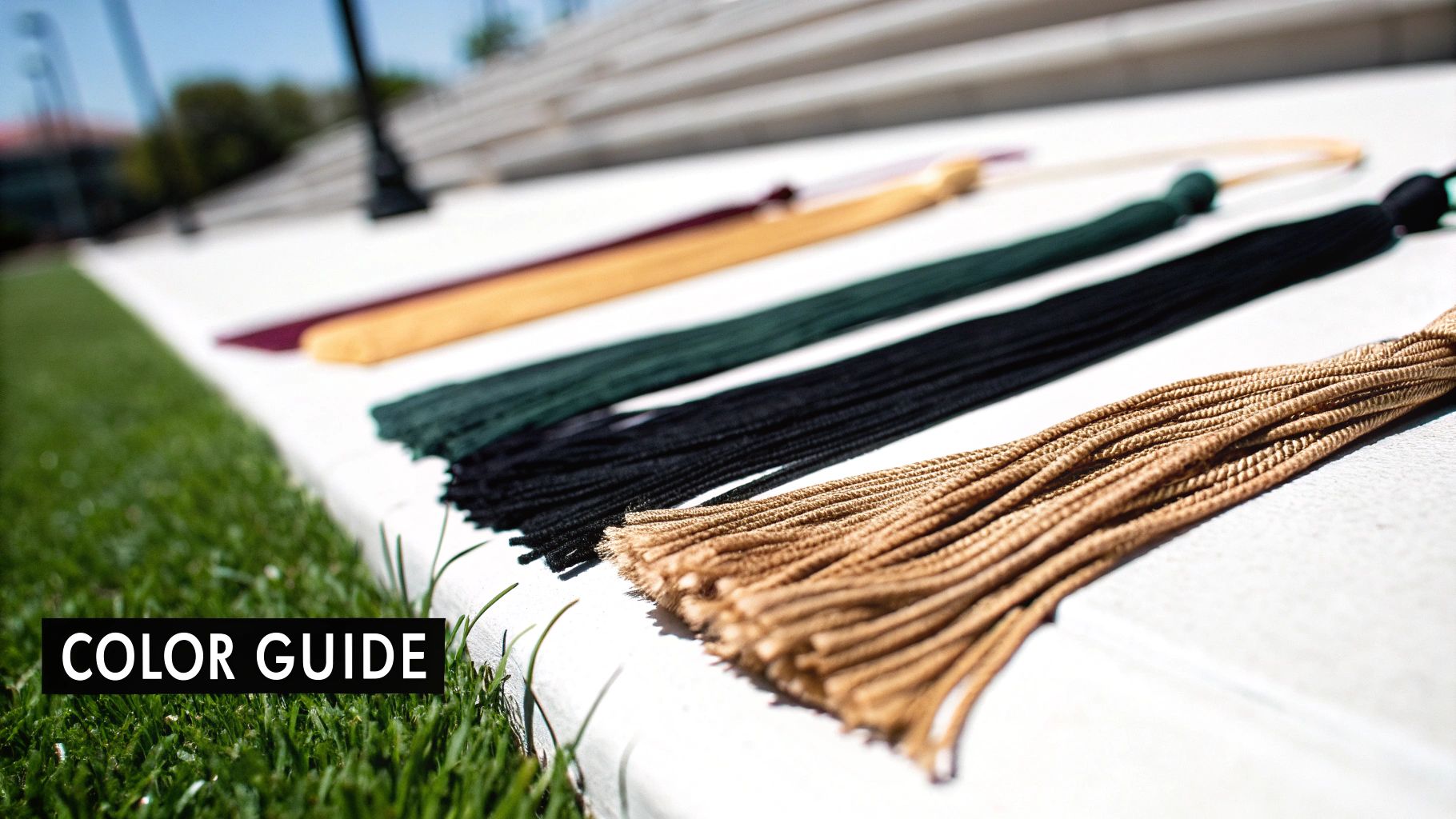
This tradition isn't new. It connects today's graduates to centuries of academic history, where colors were first used to distinguish scholars by their field of study. Today, that system has grown to recognize everything from a high GPA to leadership roles and community service, all displayed on graduation honor cords and sashes.
The Foundation of Academic Colors
At the heart of this tradition is a system designed to represent different fields of learning. You can think of it as a coat of arms for academia, where each color proudly announces a specific discipline. This standardization helps create a sense of order and shared meaning at ceremonies across the country, even if specific shades and rules for graduation sashes and cords vary from school to school.
For instance, the brilliant gold cord is almost universally understood as the symbol for the highest academic honors. When you see a graduate wearing gold honor cords, it’s a safe bet they’ve earned summa cum laude, magna cum laude, or cum laude status. Gold has always been linked to prosperity, wisdom, and value, making it the perfect choice to signify top-tier scholastic success.
Other colors have similarly deep roots in their respective fields. This historical context really enriches the graduation experience, turning a colorful display into a meaningful tribute to hard work.
Colors Representing Specific Disciplines
Beyond general honors, many colors are tied directly to a graduate's major or college. This allows faculty and peers to instantly spot a student's area of expertise. It’s a visual celebration of the knowledge and skills they've poured years into mastering, often displayed on a graduation stole or sash.
Here are some of the most common academic color associations you'll see:
- Royal Blue: Often representing the liberal arts and philosophy, this color signifies wisdom, loyalty, and intelligence. It’s a classic choice for graduates in fields like political science and the humanities.
- Green: Strongly tied to medicine and environmental sciences, green symbolizes growth, renewal, and well-being. You'll frequently see it on the honor cords and stoles of graduates from medical schools, nursing programs, and environmental studies.
- Purple: With its historical links to royalty and authority, purple is the designated color for law and jurisprudence. Graduates earning a Juris Doctor (JD) degree often wear this distinguished shade on their graduation regalia.
These are just a handful of examples in a much larger system. You’ll also see orange for engineering, light blue for education, and white or pink for the fine arts.
The symbolism isn't just random; it’s a reflection of the core values and history of each discipline. A purple cord on a law graduate doesn't just mean they studied law—it connects them to a long tradition of justice and authority.
Beyond the Major: Personal and Symbolic Meanings
While academic fields form the backbone of the color system, many shades also carry broader symbolic weight. This adds a more personal layer of meaning, celebrating character traits and values a graduate has developed during their time in school, often represented by a unique graduation stole or honor cord.
For example, a red cord can symbolize courage, passion, and strength. This makes it a great fit for fields like public health or journalism, but also for students recognized for their leadership or sheer willpower. A white cord, on the other hand, can signify purity and new beginnings, often associated with the arts and humanities. For a deeper look into the variety of colors and what they represent, our guide on color cords for graduation meaning offers even more insight.
This dual system of meaning—both academic and symbolic—is what makes graduation regalia so powerful. A student might wear a green cord for their degree in medicine and a silver one for their community service, creating a complete picture of who they are and what they’ve accomplished. Once you understand the story behind each color, the seemingly confusing display of cords transforms into a beautiful tapestry, celebrating the hard work, diverse knowledge, and personal growth of every single graduate.
Understanding Honor Society Cords and Stoles
Beyond the general colors for your major or a high GPA, you’ll definitely notice graduates sporting honor cords with very specific, unique color combos. These aren't handed out by an academic department. They’re a powerful symbol of membership in a prestigious honor society, marking a specialized kind of academic excellence.

Think of these graduation cords as a badge of honor for the intellectually dedicated. Each honor society has its own signature colors that act as a visual handshake, instantly identifying its members. This branding is a huge part of their identity and turns a simple rope into a nationally recognized mark of distinction.
The Colors That Define Excellence
Getting into an honor society is a big deal and goes way beyond just pulling good grades. These organizations set the bar high, often requiring you to maintain a top-tier GPA within your specific field, show real leadership qualities, and prove your commitment to research or community service. The graduation honor cords they award are a testament to that deeper level of dedication.
The color combinations are never random; they're carefully chosen to reflect the society's history, its core values, and the discipline it champions. For graduates, wearing these cords is a moment of immense pride, signaling their entry into a nationwide community of high-achievers.
For example, at Frostburg State University, blue and silver cords identify members of Psi Chi, the national psychology honor society, which requires at least a 3.0 cumulative GPA and a 3.2 GPA in psychology courses. In the same vein, red and black cords belong to Sigma Tau Delta, the English honorary, which also requires a minimum 3.0 GPA.
Common Honor Society Cord Colors
While there are hundreds of honor societies out there, you'll start to recognize some of the more common ones at commencement. Knowing what they mean gives you a better appreciation for the incredible range of achievements walking across the stage.
Here are a few prominent examples:
- Psi Chi (Psychology): Members of this international society are easy to spot with their distinctive blue and silver cords.
- Sigma Tau Delta (English): This society for English majors uses bold red and black cords, reflecting the passion of studying literature and language.
- Alpha Kappa Delta (Sociology): Graduates who excelled in sociology wear teal cords—a unique color that really stands out.
- Phi Alpha Theta (History): This honor society uses red and blue cords to recognize its members' dedication to the study of the past.
These examples show how honor cord colors create a visual language that speaks volumes about a student’s focus and hard work.
Earning an honor society cord isn't just about what you know. It's about being recognized by a national or international body for your exceptional commitment to a specific field. It elevates your graduation look from a record of your coursework to a symbol of true scholarly prestige.
The Prestige of Honor Society Stoles
Along with cords, many honor societies also offer graduation stoles. These provide a much larger canvas to display the society's crest, name, and colors, making for a truly distinguished addition to a graduate's regalia. A graduation sash or stole often feels more substantial and can become the centerpiece of the whole outfit.
Wearing an honor society stole is a clear, proud declaration of your affiliation. It adds another layer of visual distinction that beautifully complements your honor cords. For many students, figuring out the specific National Honor Society stole requirements is a key part of prepping for the big day.
Whether a student chooses graduation cords, a stole, or both, these items all serve the same incredible purpose: to celebrate the hard work, intellectual curiosity, and high standards it took to get into these exclusive academic circles. They turn a simple black gown into a personalized story of accomplishment.
The History Behind Graduation Cords and Stoles
The tradition of wearing academic regalia—those vibrant honor cords and elegant graduation stoles we see every graduation season—is much older than you might think. Its story doesn't start in a modern university bookstore, but in the cold, drafty halls of Europe's first medieval universities. What began as a simple, practical solution has evolved into the rich system of symbolic dress we know today.
Believe it or not, the original long robes and hoods weren't about ceremony at all. They were purely functional, designed to keep scholars and clergy from freezing during their long hours of study. These weren't decorative items; they were the everyday uniform for academics, a simple way to identify a person as a scholar.
From Practicality to Prestige
As universities grew more organized, their dress codes followed suit. The plain, functional robe started to get some upgrades. This is where the real shift towards modern regalia began. Hoods, graduation sashes, and honor cords were added, not for warmth, but to show who was who.
Suddenly, you could tell a scholar’s academic rank—bachelor's, master's, or doctoral—just by the cut of their robe and hood. This visual ranking system was the first major step in turning everyday academic wear into a meaningful uniform.
The big idea was simple: make academic achievement visible. By adding color and specific accessories like graduation stoles and cords, a practical garment became a public announcement of a graduate's hard-won expertise and intellectual journey.
This evolution from functional clothing to symbolic regalia is the foundation of the traditions we still carry on. The practice of wearing honor cords, for example, dates back to this era when they were first used to signify incredible academic achievements, membership in an honor society, or participation in special university groups. If you're curious, you can find more fascinating facts about the history of graduation cords and their symbolism. This deep history connects every modern graduate to centuries of scholarly celebration.
Standardizing the Symbols
When the tradition made its way to America and universities began popping up everywhere, it became clear that some consistency was needed. To help standardize the meanings behind all the different colors and symbols on graduation stoles and cords, organizations like the Association of College Honor Societies (ACHS) were formed in the 20th century.
Their work brought some much-needed order to the honor cords color meaning, making sure that certain achievements were recognized in a similar way from one campus to the next.
But this standardization didn't stamp out individuality. Universities still have the freedom to assign their own colors for specific degrees or create new honors altogether, mixing historical tradition with their own unique campus culture. It's this balance that allows the legacy of academic regalia to keep evolving, making every graduation ceremony a special reflection of its school and its students.
How University Rules and Personal Cords Differ
One of the biggest sources of confusion around graduation regalia is the idea that there's a single, universal rulebook for honor cord color meaning. The truth is, while many colors do have traditional associations, the final say always comes down to your specific school. Getting this part right is the key to making sure your graduation look is both accurate and personal.
Think of the national standards as a general dictionary, but your university's guidelines are the local dialect. Before you buy a single honor cord or graduation stole, your very first step should be to find your university's official commencement guide. This document, usually on the registrar's or graduation services website, is your ultimate source of truth.
It will spell out exactly which colors are approved, what they mean on your campus, and who is allowed to wear them. Skipping this step can lead to a lot of frustration on the big day if you show up with regalia that isn't approved.
University-Specific Color Meanings
Many schools put their own spin on academic colors to better reflect their unique programs and campus culture. This is where you'll see the biggest differences from the traditional color charts. A university might use certain shades on their graduation stoles and cords to celebrate achievements that are totally unique to its student body.
This level of personalization just makes the ceremony that much more meaningful for graduates. Here are a few common ways schools adapt the system:
- College-Specific Colors: Instead of one general color for "Engineering," a university might use a distinct orange cord for the College of Engineering and a separate silver one for the College of Technology.
- Program-Specific Recognition: You might find a unique cord color just for students graduating from a special interdisciplinary program or a specific research track.
- Campus-Based Honors: Schools often create honor cords to recognize students for their work in student government, for completing a leadership program, or for logging significant volunteer hours with a campus group.
The key takeaway? Your school has the final authority. An honor cord color meaning at one university might signify something completely different at another. Always, always check your institution's official guidelines before you buy anything.
Recognizing Diverse Achievements
In recent years, universities have really broadened their use of honor cords and graduation stoles to celebrate a much wider range of student experiences and identities. It’s a great way to acknowledge that a student's journey is about more than just their GPA or major. These special cords add a powerful layer of personal storytelling to the graduation gown.
It's now common for institutions to offer cords recognizing things like:
- Veteran Status: Red, white, and blue honor cords are a popular way to honor students who have served in the armed forces.
- First-Generation Graduates: A specific color might be designated to celebrate students who are the first in their family to earn a college degree.
- Study Abroad Programs: Students who spent time in international study programs might receive a graduation stole or cord with the colors of their host country's flag.
Incorporating Personal and Cultural Cords
Beyond what the university officially sanctions, many graduates want to wear cords or stoles that represent their personal heritage, fraternity or sorority, or cultural organizations. These items, like a beautifully crafted graduation sash, can make the day feel even more special and complete.
Whether you can wear these personal items depends entirely on your school's policy. Some institutions are very strict, allowing only university-issued regalia. Others are more flexible and welcome these personal touches.
If your school allows them, these personal graduation stoles and honor cords are a fantastic way to celebrate your full identity as you walk across that stage. Just be sure to check the rules first so your regalia is both meaningful and compliant.
How to Properly Wear Your Graduation Regalia
You did the work, you earned the honors, and now it’s time to show them off. Wearing your graduation regalia the right way isn't just about rules; it’s about looking sharp and feeling confident as you finally walk across that stage. The whole idea is to layer your honor cords and graduation stoles over your gown so everything looks neat, symmetrical, and polished.

First things first, get your gown on and zipped up. If you have a graduation stole or sash, that’s your next layer. Just drape it evenly over your shoulders so that both sides hang down the front at the same length. You want it to lie flat and smooth against your chest.
Now for the honor cords. Your cord will have a knot right in the middle with a tassel on each end. It’s simple: place that central knot at the back of your neck and let the cords hang down the front of your gown. If you're also wearing a stole, the cords go right on top of it.
Arranging Multiple Honor Cords
It’s common for graduates to earn more than one honor cord, and getting them to look right is a breeze. You can either use a small safety pin to secure them together behind your neck (hidden from view, of course) or just carefully layer them.
The goal is a clean, organized look where the cords hang parallel to each other on both sides of your chest. Give the tassels a quick check to make sure they’re straight and not tangled up.
A quick mirror check before you head out is always a smart move. Here's your final checklist:
- Gown: Zipped up and hopefully not too wrinkled.
- Stole/Sash: Perfectly centered and hanging evenly.
- Cords: Draped smoothly over the stole, with the knot behind your neck.
- Tassels: All cords and tassels are hanging freely without any tangles.
Knowing how to wear your regalia properly takes away any of that last-minute "Am I doing this right?" stress. Your look on commencement day should reflect the dignity of your achievements, and taking a moment to get it right helps you walk in with total confidence.
For an even closer look with more tips and visuals, check out our complete guide on how to wear graduation honor cords. Following these simple steps ensures you’ll look fantastic for all the photos and, more importantly, lets you focus on celebrating this huge milestone.
A Few Common Questions About Graduation Cords and Stoles
As commencement gets closer, a lot of questions pop up about the whole tradition, especially when it comes to the regalia. Getting the basics down about what honor cord colors mean will help you feel confident and ready for the big day. Let’s clear up a few of the most common queries.
Can I Wear More Than One Honor Cord?
Yes, you absolutely can! In fact, most universities encourage it. Think of each graduation honor cord as a badge of honor for a specific achievement.
Whether it’s for your GPA, a specific honor society, or your involvement in a unique university program, wearing all of them together shows the full picture of your hard work and dedication.
What’s the Difference Between a Stole and an Honor Cord?
It really comes down to their appearance and what they represent. An honor cord is that classic thin, twisted rope with tassels on the ends. It almost always signifies a specific academic achievement, like graduating with honors or membership in a society like Phi Beta Kappa.
A graduation stole, on the other hand, is the wider, scarf-like piece of fabric that drapes over your shoulders. These typically represent something broader, like your major, your cultural heritage, or your membership in a fraternity, sorority, or student organization.
Where Can I Find the Official Color Meanings for My School?
The best place to look is always your school’s official website. This is the single most reliable source. Head to the web pages for the registrar's office, commencement services, or student affairs.
Universities almost always publish a detailed guide that spells out the approved honor cords color meaning for every single department and recognized campus organization. A quick search there will give you the definitive answer.
A graduation ceremony is a celebration of a significant life milestone. To further enhance the celebration, explore creative graduation card ideas for commemorating this achievement in a personal and memorable way.
At Stoles.com, we provide premium, customizable graduation stoles and honor cords to help you celebrate your unique journey with pride. Find the perfect regalia to represent your achievements by visiting our collections at https://www.stoles.com.