

Maya is sitting at her kitchen table with a B+ in organic chemistry, a 3.68 GPA, and the same question I hear every spring: is honors still realistic, or did one rough class knock it out of reach?
Usually, the answer isn't about one grade. It's about whether the student understands the rules early enough to make smart moves. That means knowing the exact GPA line at your school, knowing whether honors depends on residency credits or a thesis, and knowing what will show up at commencement. It also means being honest about the visual payoff. Students work for years to earn cum laude, magna cum laude, or summa cum laude, then realize too late they never confirmed which graduation sash, stole, or graduation honor cords their school recognizes.
If you want to know how to graduate with honors, stop thinking in vague terms like “keep my grades up.” That's too soft. Honors is a system. Schools define it differently, departments pile on extra requirements, and commencement regalia turns that academic distinction into something visible the second you cross the stage.
What Graduating with Honors Really Means in 2026
You finish senior year with a GPA that looks strong on paper, your family expects to hear “magna” when your name is called, and then the registrar applies a rule you never checked. That is how students miss honors. Not because they were lazy. Because they treated honors like a compliment instead of a classification.
In 2026, graduating with honors means your school has formally placed you into a defined academic tier at degree conferral. The label might be cum laude, magna cum laude, or summa cum laude. It might also depend on more than GPA. Some colleges use fixed cutoffs. Some use class rank or percentile formulas. Some tie the top tier to extra academic work. The result is visible at commencement because the honor on your transcript often determines whether you wear a cord, sash, or stole, and which one.
At the University of Tennessee, the system is straightforward. Cum laude requires 3.50 to 3.64, magna cum laude requires 3.65 to 3.79, and summa cum laude requires 3.80 to 4.00, according to the University of Tennessee honors history and GPA bands. UT also traces the practice back to April 19, 1880, when faculty approved honors for graduates earning 80 or above. That history matters because it shows what honors is. A school-defined credential with rules, thresholds, and a paper trail.

What students get wrong
Students usually make the same bad assumptions.
They assume a solid GPA is enough. It often is not. Honors can depend on residency credits, college-specific formulas, departmental approval, thesis completion, or timing rules tied to graduation clearance.
They assume the standard is the same everywhere. It is not. A 3.70 can put one student in magna territory at one school and leave another student short at a school that uses percentile-based cutoffs.
They assume the stage version will sort itself out. Wrong again. The transcript decision comes first. The regalia follows from that decision, not from what a student orders online or what friends wore last year.
The three choices that usually decide the result
For a student like Maya, three choices matter.
-
Check whether a retake changes the honors GPA
Retaking a class only helps if the repeat policy affects the GPA used for graduation honors. Some schools replace the grade. Some average both attempts. Some exclude transfer work or calculate honors on a narrower set of credits. Read the rule before you spend a semester trying to repair one course. -
Find out whether top honors requires more than grades
At some institutions, the highest distinction is partly academic performance and partly a final evaluative step. That changes your strategy. A student aiming for the top line may need to plan for an examination, thesis defense, or departmental review long before senior spring. -
Match your current transcript to the exact system your school uses
“Around a 3.7” is useless as a planning standard. You need the actual calculation, the actual cutoff, and the actual residency or program requirements attached to it.
Advisor rule: If you have not read your registrar's honors policy yourself, you are guessing.
What counts in practice
The students who earn honors usually do four things well.
- They protect the first 60 credits. Early A and A minus work gives you margin later.
- They schedule for GPA control. They do not stack every known weed-out course into one term.
- They verify which credits count toward honors. Transfer credit, repeats, withdrawals, and study abroad credits can be treated differently.
- They confirm the ceremony piece early. If your school recognizes honors with a specific stole, sash, or cord, you need to know what you are eligible to wear before commencement week.
The students who fall short usually waste time on lower-return moves. They add a minor that drags the GPA. They confuse Dean's List with Latin honors. They assume one extra activity will outweigh a transcript that sits below the line. It will not.
Why 2026 is less predictable
The old advice was simple. Hit a published GPA band and you were done. That advice is getting weaker.
More schools now adjust honors by percentile, college, or graduating cohort. Grade inflation has also changed the math. At campuses where large numbers of students cluster near the top, fixed GPA bands can produce too many summa graduates, so institutions tighten the rules or switch systems. That shift affects more than the diploma line. It affects what students can reasonably target, how much buffer they need, and what recognition they will wear on stage.
Treat honors as a full plan, not a vague ambition. Know the academic threshold, know the administrative rule, and know the visual payoff at commencement. That is how students finish with both the transcript distinction and the right regalia to show it.
Latin Honors Tiers and the GPA Bands Behind Them
A senior with a 3.78 can walk into commencement expecting magna, then find out too late that their college uses a different cutoff, a percentile system, or a separate rule for final-semester grades. That mistake is avoidable. Latin honors are simple only from a distance.
Most schools use the same three labels: cum laude, magna cum laude, and summa cum laude. The meanings are familiar. The rules are not. U.S. News explains that Latin honors standards vary by institution and that some colleges use class rank rather than a single GPA formula. If you have not checked what cum laude means at your school, you are guessing.
The GPA bands students see most often
Published GPA bands still exist at many universities, and they usually follow a recognizable pattern. UT San Antonio, for example, lists 3.50 to 3.74 for Cum Laude, 3.75 to 3.89 for Magna Cum Laude, and 3.90 to 4.00 for Summa Cum Laude in its University Latin Honors requirements.
Use ranges like that as a planning tool, not a promise.
| Latin Honor | Typical GPA Range | What it usually signals on stage |
|---|---|---|
| Cum laude | Often starts around the mid-3.5 range | Honors recognition, sometimes a cord, stole, or notation in the program |
| Magna cum laude | Often falls in the upper-3.7 to upper-3.8 range | A higher tier of recognition, often with distinct regalia depending on campus rules |
| Summa cum laude | Commonly begins near 3.9 | The top Latin honors tier, usually the most visible graduation distinction |
| No Latin honors | Below the school's cutoff or outside eligibility rules | No Latin honors notation, even with a solid GPA |
That last column matters more than students expect. The transcript distinction and the visual payoff are tied together. At one school, magna may come with a specific cord. At another, only summa gets a separate stole. At another, all Latin honors students wear the same item and the exact tier appears only in the program. If you care about what you will wear across the stage, stop treating honors as an abstract GPA goal.
Fixed labels, shifting standards
The labels have stayed the same for decades. The standards behind them have not.
Grade inflation has pushed more students into the high-3.7 and high-3.8 range at some campuses. Schools respond in different ways. Some keep fixed cutoffs. Some tighten them within individual colleges. Some switch to percentile-based honors so the top slice of each graduating class gets the distinction even if average GPAs rise. That is why a GPA that earned magna a few years ago may only clear cum laude now, or miss entirely in a school with a rank-based system.
Do not build your plan around a generic chart from social media. Build it around your registrar's current rule.
Four labels students confuse all the time
Students regularly lump together awards that have nothing to do with each other.
Latin honors are graduation distinctions tied to final academic standing.
University honors usually means an honors college, honors curriculum, or both.
Dean's List is term-by-term recognition.
Honor societies are separate memberships with separate entry rules.
A student can make Dean's List for several semesters, join an honor society, and still graduate without Latin honors. I see that mistake every year.
The only question that matters here
What exact line does your school use, and what does that line get you on commencement day?
Find the answer in writing. Check whether the rule is university-wide or college-specific. Confirm whether the honor is fixed by GPA, determined by percentile, or finalized after the last term posts. Then check the ceremony page or commencement office materials so you know whether that distinction comes with a cord, stole, sash, or only a diploma notation.
That is how you set a real target.
Building the Transcript That Earns Honors
A student walks into advising in junior year with a 3.42, one bad science sequence, and a plan to "bring it up later." That plan usually fails. Honors are built early, then protected.
By the end of sophomore year, your transcript has already done most of the heavy lifting. Senior spring does not create Latin honors. It confirms whether you kept yourself in range for the tier that shows up at commencement, whether that means a plain diploma notation or the stole, cord, or sash tied to your school's rules.
Your first four semesters set the ceiling
Students waste too much time hunting for heroic comeback strategies and too little time protecting the first 45 to 60 credits.
Do three things from the start:
- Keep your opening schedule sane: Do not stack your first term with multiple labs, weed-out courses, and a job schedule that leaves no study time.
- Delay problem classes until you're prepared: Taking calculus, chemistry, or a writing-intensive requirement too early can leave a grade on the record that keeps dragging your average down.
- Use help before the first bad exam becomes a final grade: Office hours, tutoring, study groups, and professor feedback work best early.
This is plain math. A strong first year gives you room for a harder major sequence later. A weak first year forces you to spend the rest of college repairing damage instead of building distinction.
Build around the policy your registrar actually uses
Emotion leads students into bad decisions. Policy decides whether those decisions help.
A C+ can feel like an emergency. A retake can still be a poor move.
Check these questions before you repeat anything:
- Does the original grade stay on the transcript, or does the school replace it in the GPA?
- Does Latin honors use all graded credits, only residency credits, or a college-specific calculation?
- Will the retake displace a course where you are more likely to earn an A?
At the University of Minnesota, degree honors are based on GPA after 60 graded semester credits, with published thresholds of 3.500 for cum laude, 3.666 for magna cum laude, and 3.750 for summa cum laude, and some campuses may set higher standards under the University of Minnesota degree honors policy. That is the kind of rule you plan around. You do not treat every credit the same if your school does not treat every credit the same.
The course-planning choices that actually raise your odds
Honors students usually do boring things well. That is why they cross the stage in the right tier.
- Front-load courses where you can earn strong grades: Gen eds are not glamorous, but early A-range work raises your margin for error.
- Sequence prerequisites early: Waiting too long can block upper-division seminars, honors sections, capstones, or thesis prep.
- Add a minor only if it helps the transcript: A minor that produces B-minuses across four terms is not "well rounded." It is GPA drag.
- Treat requirements as fixed rules, not intentions: Students coming straight from weighted high school systems should read high school graduation requirements the same way they should read college honors policies. Line by line.
One more point matters in 2026. Grade inflation has made honors less forgiving at many schools, especially where colleges compare students against one another or raise internal expectations. That means your transcript strategy is not just about clearing a number. It is about staying competitive for the honors tier that determines what you wear on stage.
Protect the tier once you have it
Once you are above an honors line, your job changes. Stop taking avoidable GPA risks.
That does not mean ducking every hard class. It means choosing difficulty with a purpose. Take the course that advances the major, opens the thesis path, or satisfies a graduation requirement. Skip the vanity overload semester that looks ambitious and drops you from magna to cum laude.
The transcript is blunt. It records grades, credits, and completed requirements. If you want the honors notation and the visible payoff at commencement, build for it early and defend it every term.
Fixed GPA vs Percentile Honors and Why Schools Switch
You can finish senior year with a 3.88, show up expecting magna, and find out your school only gives that tier to the top slice of the class. Another student at a fixed cutoff school can post the same GPA and know months in advance which honor will print on the diploma and which distinction they will likely wear on stage. If you want the right stole, cord, or sash at commencement, you need to know which system your school uses long before final semester.
Some colleges use fixed GPA bands. The rule is simple: hit the published cutoff, satisfy residency and credit requirements, and you qualify. Other colleges use percentile honors. Your Latin honors depend on how your GPA ranks against other graduates in your college, school, or cohort.
That difference changes how you plan.
The clearest examples
NYU uses a percentile-style model by school. Its honors cutoffs are based on the combined GPA distribution from the preceding academic year, and for September 2024 to August 2025 the summa cum laude threshold ranged from 3.900 in Dentistry to 4.000 in Nursing, with other examples including 3.954 in CAS and 3.969 in Gallatin, according to NYU graduation honors thresholds.
The University of Maryland also uses a rank-based system, but it states the rule more plainly. Summa cum laude goes to the highest 2% of GPAs in a college or school, and magna cum laude goes to the next highest 3%, as outlined by the University of Maryland commencement honors policy.
Notre Dame's registrar shows why more schools keep revisiting these policies. Its Latin honors policy page reflects an active response to grade inflation, selectivity concerns, and uneven grading across programs.
| Institution | System Type | Cum Laude | Magna Cum Laude | Summa Cum Laude |
|---|---|---|---|---|
| University of Tennessee | Fixed GPA bands | 3.50 to 3.64 | 3.65 to 3.79 | 3.80 to 4.00 |
| NYU | Percentile-based by school using prior GPA distribution | Varies by school | Varies by school | Ranged from 3.900 in Dentistry to 4.000 in Nursing for Sept. 2024 to Aug. 2025 |
| University of Maryland | Percentile-based by college or school | Defined by institutional distribution | Next highest 3% | Highest 2% |
| University of St. Thomas Minnesota | Fixed GPA bands with extra review at the top tier | 3.50 to 3.69 | 3.70 to 3.89 | 3.90 or above, plus oral examination |
Why schools move away from fixed cutoffs
Fixed cutoffs are easy to explain and easy to market. They also get soft over time if average grades rise. A 3.70 once marked clear distinction at many schools. At some campuses now, it barely separates you from a large block of the class.
Percentile systems let schools keep honors selective without rewriting the policy every few years. They also make the outcome less predictable for students. That unpredictability matters because the honors tier is not just a line on the transcript. It usually determines the commencement recognition attached to it, whether that means a Latin honors stole, an additional cord, or a school-specific sash.
This is the part many generic honors guides miss. The academic rule and the visual payoff are tied together.
How to plan under each system
If your school uses fixed GPA bands, treat the cutoff as a hard target with a buffer. Do not aim to finish exactly on the line. Aim above it, because one bad semester can change what appears on the diploma and what you are cleared to wear at graduation.
If your school uses percentiles, stop asking only, "What GPA do I need?" Ask better questions. How often are cutoffs recalculated? Are they set by the full university, by college, or by school? Does a heavily inflated program change the competition inside that unit?
Those answers decide whether a GPA is safe or shaky.
A student who understands the honors model can plan course risk, graduation timing, and commencement expectations with accuracy. A student who does not usually finds out too late, often after the honors list is final and the regalia order is already in motion.
Honors Programs, Theses, and Capstone Projects That Move the Needle
A lot of students think honors begins when the registrar labels the diploma. It starts much earlier. The students who stand out at commencement usually built that outcome through structured academic choices, not last-minute GPA math.
The highest-value move is simple. Join the right academic track early enough for it to matter.
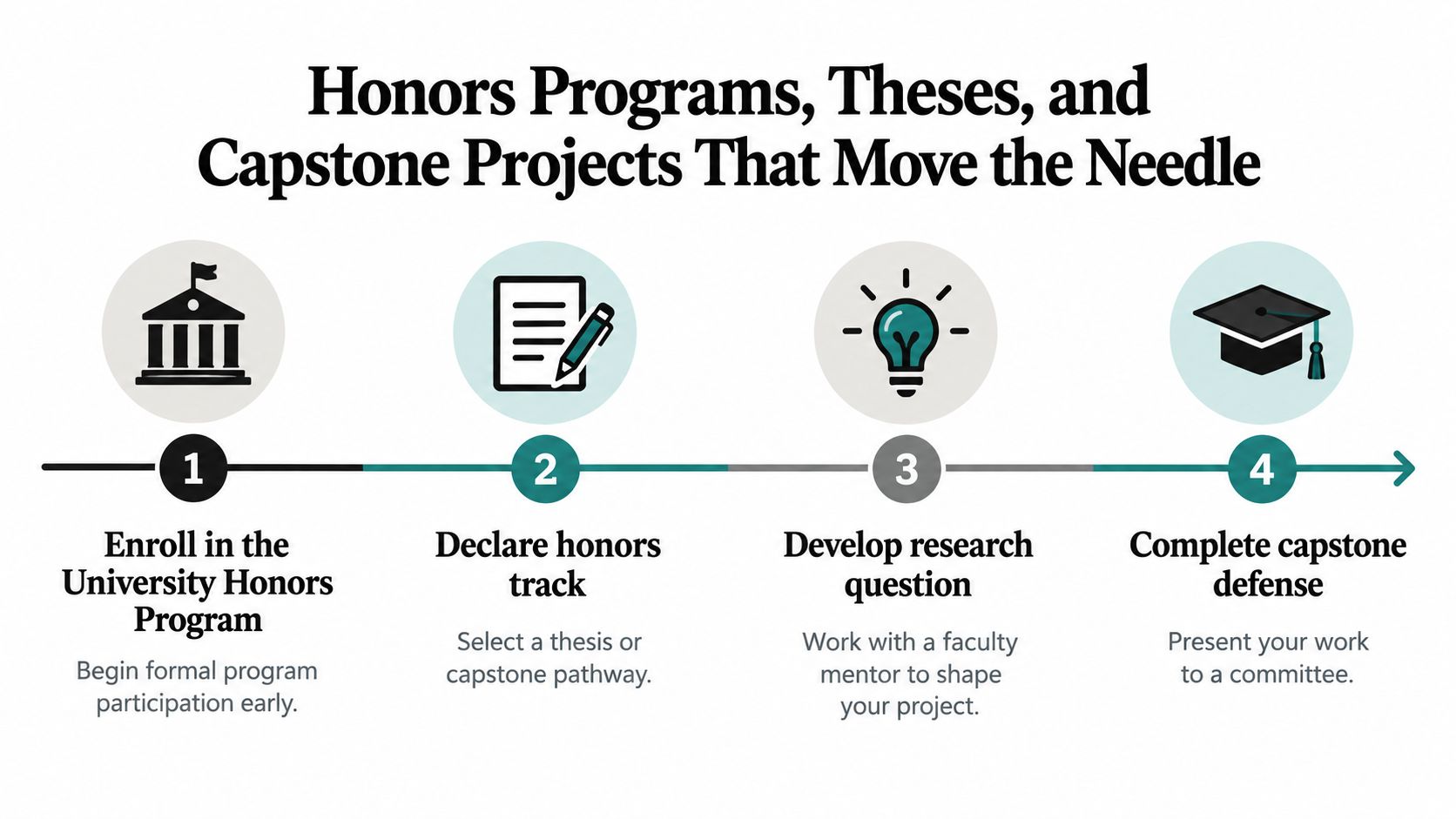
Four moves worth the extra work
First, enter the university's formal honors program or scholars track if you're eligible. Those programs often create the structure students need: smaller seminars, stronger advising, and clearer thesis pathways.
Second, declare honors intent early. Waiting until senior year usually means you missed prerequisites, faculty mentoring time, or departmental deadlines.
Third, commit to a thesis or capstone if your school ties advanced honors to original academic work. At St. Thomas, summa cum laude includes that added oral review layer, which is exactly the kind of requirement students miss when they assume GPA alone decides everything.
Fourth, convert strong course work into a longer project. A strong term paper can become the backbone of a thesis, conference talk, or departmental honors project if you start refining it soon enough.
Students who already have a faculty mentor are almost always in better shape than students with a slightly higher GPA and no academic advocate.
The workload is real
Honors pathways sound glamorous. In practice, they add deadlines, reading, faculty meetings, revision cycles, and sometimes an extra layer of review.
That doesn't mean you should avoid them. It means you should choose them deliberately.
- Good fit: You like research, can manage long projects, and want stronger graduate school materials.
- Bad fit: You're already stretched thin, your GPA is fragile, or you're adding honors just for the label.
- Worth asking: Whether the thesis counts toward major requirements or sits on top of them.
For some students, the smarter path is keeping the GPA high and skipping a heavy thesis track. For others, the thesis is exactly what lifts them into the highest distinction available at their institution.
A quick visual can help you think through the sequence:
A clean timeline that works
Use a rough progression like this:
- Sophomore year: Ask about honors eligibility, thesis options, and faculty supervisors.
- Late sophomore or early junior year: Declare the honors track if your department requires formal entry.
- Junior year: Develop the research question, finish prerequisite methods courses, and secure a mentor.
- Senior year: Draft, revise, submit, and defend the capstone or thesis on time.
That's the reality behind the polished graduation sash or honor stole people see on stage. The visual recognition is the end product. Work happened semesters earlier.
The Administrative Playbook Most Students Forget
You finish senior spring with the GPA for honors. Then the registrar says your designation is still pending because a transfer-credit rule, an incomplete grade, or one missing approval kept your record from clearing. That is how students lose the cords or stole they expected to wear on stage.
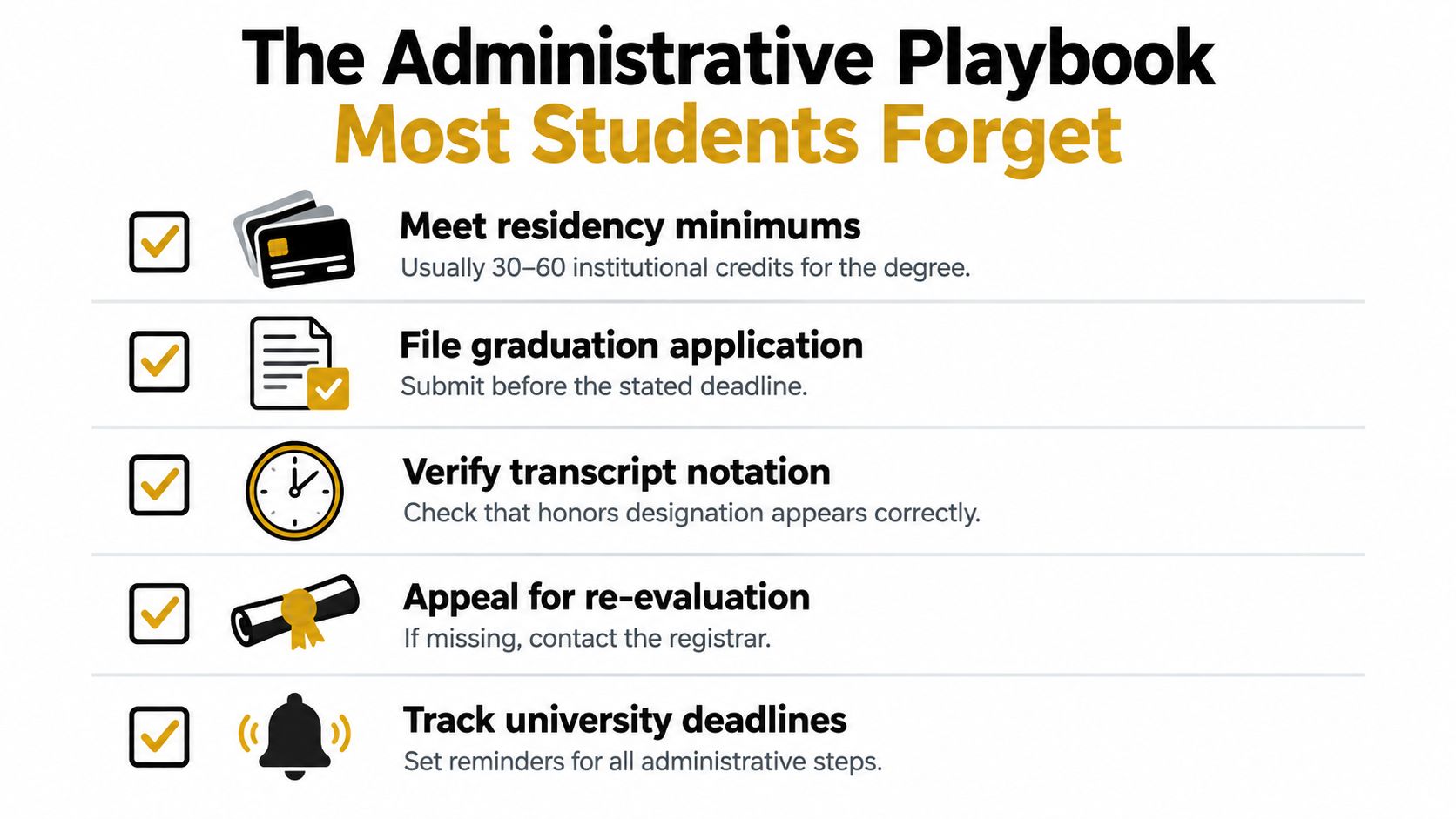
Residency and credit rules can shut the door late
Honors is never just GPA. Schools also screen for residency, graded credit, eligible coursework, and whether your degree record is finalized on time.
Residency is the trap that catches transfer students and study-abroad-heavy schedules. One university may require a large block of credits earned in residence for Latin honors. Another may exclude pass/fail work, exam credit, or certain transferred hours from the count. A student can be sitting at magna or summa range on paper and still miss the designation that determines which sash, cord, or stole they are approved to wear at commencement.
Do not guess. Read the exact policy for your campus and your college.
The audit that actually prevents problems
Run a real audit before your final term starts, then run it again after registration locks.
- Pull the official honors policy. Use the registrar page first. Then check your college, department, and honors program pages for extra conditions.
- Count residency and graded credits. Transfer hours, credit by exam, and pass/fail courses may not help your honors calculation.
- Check every required approval. Departmental honors, theses, and capstones often need faculty sign-off or a separate submission form.
- Review your live transcript. Incompletes, late grade postings, and course repeats can change how your final GPA is certified.
- Verify your graduation application and diploma record. A clerical error will not usually change your honors tier, but it can slow clearance at exactly the wrong time.
One sentence from an advisor saying you are probably fine means nothing during a final audit.
Ask the right office in the right order
Students waste weeks by emailing five offices at once and getting five partial answers. Use a sequence.
Start with the registrar. That office controls the published rule and the degree audit. Next, contact the honors program director if you are in a university, college, or departmental honors track. After that, go to the department chair, thesis director, or capstone coordinator if your distinction depends on a defense, final project approval, or departmental vote.
Keep academic certification separate from regalia ordering. The registrar decides whether you earned cum laude, magna cum laude, or summa cum laude. The bookstore or approved vendor handles what you wear on stage.
That visual payoff matters. Families see the difference immediately, even when they do not know your exact GPA band. Some students order through the campus bookstore, while others use approved outside vendors for items such as a custom graduation stole, honor stole, or graduation honor cords. Stoles.com® is one example. Check your school's regalia rules before you buy anything, because approval matters more than style.
Wearing Your Honors on Graduation Day
Students care about honors for the transcript. Families notice it when the graduate walks across the stage.
The academic plan becomes visible. The distinction you've been chasing turns into a graduation stole, graduation sash, tassel, or graduation honor cords that people can identify in photos. That's not superficial. Commencement is a ceremony, and regalia is the language of that ceremony.
What the colors usually signal
Color traditions vary, but some patterns are common. One graduation guide notes that gold is used for high academic achievement, including Summa Cum Laude and Magna Cum Laude; silver is also linked to distinction and some honor societies; and white is associated with academic purity and often Cum Laude or humanities-related recognition, according to the graduation cord color meanings guide.
That means a student's honors tier often has a visible counterpart:
| Honors Tier | Standard Regalia | Color/Variant |
|---|---|---|
| Cum laude | Honor cords or honor stole, depending on school | Often white or another school-approved distinction color |
| Magna cum laude | Honor cords, stole, or sash | Often silver or gold variants depending on campus tradition |
| Summa cum laude | Highest-tier honor cords, stole, or both | Commonly gold, sometimes paired with added distinction markers |
| Departmental honors or honor society recognition | Additional cords, medallions, or special stole | School and organization specific |
If you want a quick primer on honor cords at graduation, learn the difference between what the school officially awards and what outside organizations recognize. Students mix those up constantly.
High school and college don't always use the same regalia logic
High schools often use a wider mix of visual distinctions. You may see NHS stoles, valedictorian cords, AP or IB recognition items, and class-rank distinctions alongside general honor cords.
Colleges are usually stricter. They tend to separate:
- Latin honors regalia
- Departmental honors items
- Honor society cords
- Cultural or identity-based graduation stoles
- Greek stoles or organization sashes
That separation matters when you're ordering. A student can absolutely wear both an academic honor stole and a cultural graduation sash if the institution permits it, but permission varies by campus.
How to avoid regalia mistakes
This is the part students rush, and rushing creates the most avoidable errors.
- Verify certification first: Don't assume your projected tier is final until the school confirms it.
- Check order deadlines: Commencement ordering windows close faster than students expect.
- Ask who approves what: The registrar may certify honors, while another office distributes cords.
- Match the item to the policy: Some campuses issue the cords themselves and don't allow substitutions.
A final practical point. A plain stole isn't the same thing as an honor stole, and a decorative sash isn't the same thing as school-approved graduation honor cords. If the point is to display earned distinction accurately, precision matters.
You worked for the transcript. Make sure the regalia tells the truth about it.
If you're getting ready for commencement, don't leave the visual side of honors until the last week. Stoles.com® offers graduation stoles, honor stoles, graduation sash options, and graduation honor cords that fit the way students mark academic achievement, identity, and organization membership on stage. Visit Stoles.com® after you've confirmed your school's rules, then order the regalia that matches what you've earned.