

Draping your academic hood might seem tricky, but it's a lot simpler than you'd think and really pulls your whole graduation look together.
Here’s the secret: place it over your head with the velvet side up. The V-shaped point should sit at the front of your neck, letting the longer, colorful part hang down your back. The single most important step is securing the front loop to a shirt button or your gown’s zipper—this keeps it from sliding around all day.
Your Quick Guide to the Academic Hood

Your academic hood is so much more than another piece of your graduation outfit. It’s a symbol of years of hard work, dedication, and everything you’ve accomplished. This traditional piece of regalia tells a very specific story about your academic journey, and when you understand what each part means, you can wear it with the pride it deserves.
Every element has a distinct meaning, from the fabric itself to the specific colors on display. At its core, the hood has three main parts, each carrying its own weight in academic tradition: the shell (the black fabric), the lining (your school colors), and the velvet trim (your field of study).
Understanding the Key Components
To wear your hood correctly, it really helps to know what you’re working with. Getting familiar with these parts beforehand will make getting ready on commencement day much smoother.
- The Shell: This is the main body of the hood, almost always made of black fabric to match your gown.
- The Velvet Trim: This is the colored band running along the outer edge. The color signifies your specific academic discipline. For example, light blue represents Education, while a rich golden yellow is for Science.
- The Lining: The satin interior is where your university’s official colors are showcased, often in a pattern like a chevron or split down the middle to show both.
Before we get into the details, let's break down the parts of the hood in a simple table so you know exactly what you're looking at.
Academic Hood Components at a Glance
| Component | Significance | What to Look For |
|---|---|---|
| Shell | The main body of the hood | Black fabric that matches the material of your graduation gown |
| Velvet Trim | Represents your specific degree or field of study | A colored band of velvet along the edge of the shell |
| Lining | Displays the official colors of your institution | The satin interior, often with one or two colors in a pattern |
| Front Loop | A small cord used to secure the hood | A thin cord or loop at the "V" point that sits on your chest |
| Rear Button | Connects the lining to the shell on the back | A small button and loop on the back to help turn the colors out |
Knowing these parts will make positioning the hood a breeze when the big day arrives.
A common mistake I see graduates make is forgetting to secure the front of the hood. There’s a small cord or loop at the V-point designed to fasten to your shirt button or gown zipper. Skipping this step is what causes the hood to slide backward and feel uncomfortably tight around your neck.
Personalizing Your Graduation Look
While the hood itself is steeped in tradition, you can still add personal flair to your overall regalia. For a complete and distinguished look, many graduates pair their hood with other meaningful accessories. You can dive deeper into the history and symbolism of each part in our guide on what a hood is for graduation.
Adding items like custom graduation stoles or honor cords lets you showcase personal achievements, cultural heritage, or affiliations. These pieces are worn underneath the hood, sitting closer to your gown, and add layers of meaning to your attire. This combination turns your regalia from a simple uniform into a personalized story of your success.
Decoding the Colors and Dimensions of Your Hood
Your academic hood is so much more than just part of the uniform. It's packed with tradition, and its colors and size tell the specific story of your academic journey. Understanding what it all means connects you to a legacy that graduates have shared for centuries.
The first thing most people notice is the velvet trim running along the edge. That color isn't just for looks; it's a universal code that instantly signals your academic discipline. Each field of study has its own designated color, creating a vibrant sea of scholarly diversity during the commencement ceremony.
The Language of Velvet Trim
That velvet band is the key to identifying your field of study at a glance. It's a system that brings a beautiful and symbolic order to the pageantry of graduation day.
You'll see a whole rainbow of colors on stage, but here are a few of the most common ones:
- Arts, Letters, Humanities: Crisp White
- Science: Brilliant Golden Yellow
- Education: Light Blue
- Business/Commerce: Drab (a specific tan or beige color)
- Fine Arts: Rich Brown
- Nursing: Apricot
- Theology: Scarlet
- Medicine: Kelly Green
This color-coding is a visual shortcut, allowing faculty, friends, and family to immediately recognize the academic community you're now a part of.
Size Matters: Your Degree Level
Beyond the colors, the physical size of the hood is just as important. The length is strictly determined by the degree you've earned, making it easy to spot the different levels of academic achievement, even from the back of the auditorium.
Believe it or not, this tradition dates all the way back to the Intercollegiate Code of Academic Costume established in 1895. Under these guidelines, a Bachelor's hood is precisely 3 feet long, a Master's hood is 3.5 feet, and a Doctoral hood reaches a full 4 feet in length. This standardization is why everyone on stage can instantly recognize the achievement your regalia represents.
Your university's official colors are displayed on the satin lining inside the hood. During the ceremony, there's often a moment when a faculty member or marshal will "turn out" the colors, flipping the velvet edge to reveal that satin lining. It's a symbolic gesture to officially welcome you into the academic fold.
Bringing It All Together
Once you know the code, you see your regalia in a new light. The velvet speaks to your discipline, the lining to your university, and the length to your degree level. It all comes together to transform a simple garment into a meaningful emblem of your success.
Each piece tells part of your academic story. For a more detailed look at what to expect for advanced degrees, check out our complete guide on Master's degree graduation regalia.
You can also pair your hood with accessories that celebrate your unique path. A custom honor stole, for instance, can complement your discipline's colors while highlighting your specific accomplishments, making your graduation look entirely your own.
Draping and Securing Your Hood Like a Pro
Getting your academic hood to sit perfectly is far easier than it looks. Once you master this final step, your regalia will look polished and professional all day long. It just takes a few key movements to keep your hood secure and comfortable from the initial processional to the very last photograph.
First things first, let's get oriented. Hold the hood out in front of you. You want the velvet trim facing up and the satin lining facing down. The narrow end forms a "V"—that’s the front. The wider, fuller part is the back.
Now, just drape the hood over your head. Let that V-point rest comfortably at the base of your throat, kind of like you'd wear a scarf. The longer part of the hood should hang down your back, lying flat against your graduation gown.
The Most Important Step for a Secure Fit
Now for the most critical detail—and the one that prevents that dreaded "choking" feeling many graduates get. Look at the V-point of the hood. You'll find a small fabric loop or cord there. This little thing is your anchor.
That small cord is designed to fasten to a button on your shirt. If you're not wearing a button-down, you can loop it directly onto the zipper tab of your graduation gown. Securing this loop is absolutely essential. It stops the weight of the hood from pulling backward, which keeps it from tightening around your neck and ensures it stays centered on your shoulders.
A lot of graduates skip this step, thinking the hood just rests on their shoulders. Trust me, fastening this front loop is the single best trick for wearing your academic hood correctly and comfortably all day long.
The academic hood's black shell has been a unifying element for 99% of U.S. institutions since the Intercollegiate Bureau mandated it back in 1895. But the finesse of wearing it right—especially fastening those cords—prevents wardrobe mishaps for the 2.5 million students who earn master's and doctoral degrees each year.
Doctoral hoods are unique, featuring side panels that lie cape-like across the back, a feature you won't find on bachelor's versions. This is all part of a codified system of lengths: 3.5 feet for master's and 4 feet for PhDs. You can dive deeper into these official guidelines and see more visuals on how to wear your academic hood on CapGown.com.
This chart gives you a quick look at the standardized lengths for different academic hoods, making it easy to see how your degree level is represented.
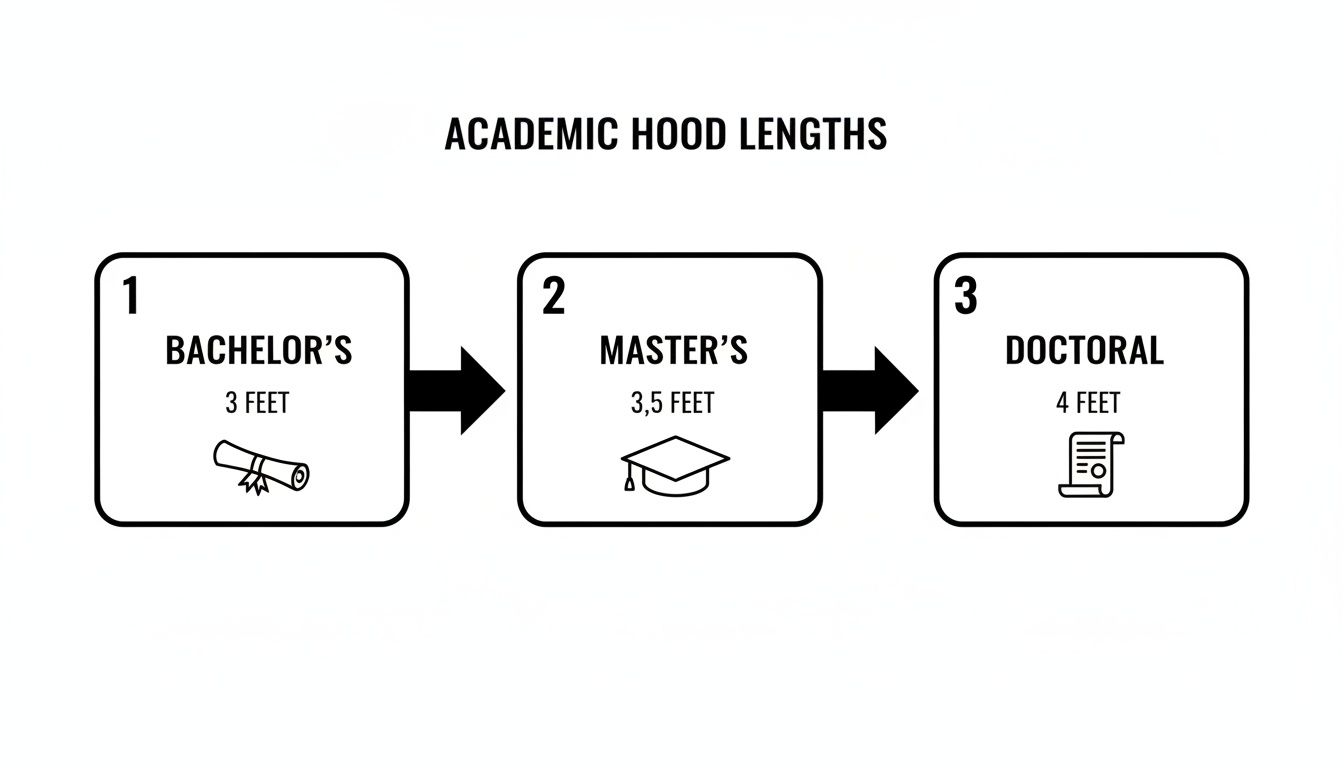
As you can see, the length of the hood directly corresponds to the level of academic achievement. It creates a clear visual hierarchy during commencement ceremonies.
Adjusting the Back for the Final Look
With the front secured, the final adjustment happens on your back. This step is often easiest with a little help from a friend, but you can definitely manage it on your own with a bit of practice. The goal here is simple: to display your university’s colors, which are on the satin lining.
Here's how to get the back of the hood looking just right:
- Reach behind you and find the velvet trim at the base of your neck.
- Gently flip the velvet trim outward, all the way down the length of the hood.
- This motion will cause the satin lining to roll into view, revealing your school's beautiful colors.
Some hoods also have a small button and cord on the back, usually near the midpoint. This is designed to help keep that lining turned out and looking neat. If your hood has this feature, go ahead and fasten it after you've flipped the lining out to hold everything in place.
Once it's adjusted, your hood should lie flat against your back, with the velvet border framing the vibrant satin colors of your institution. This not only looks sharp but also completes the symbolic representation of your academic journey. For a truly personalized touch, you could also add custom graduation stoles that complement your school colors and highlight your unique achievements.
The Final Touch Displaying Your School Colors
After getting the front of your hood secured, the last adjustment is what really makes your academic regalia pop. This is the moment you finally reveal your school's colors, turning the hood from a simple black drape into a vibrant symbol of your alma mater. It’s a step many graduates miss, but it's the absolute key to a picture-perfect look on your big day.

Tucked inside your hood is a satin lining that holds your school's official colors, often in a bold chevron or split design. Showing them off correctly is what truly completes the look and honors your university's tradition.
Turning Out Your Colors
This part is much easier with a friend's help, but you can definitely do it yourself with a little practice in front of a mirror. The main goal is to flip the velvet trim outward so the colorful satin lining rolls beautifully into view.
Have a friend stand behind you and find the velvet trim where the hood rests on your shoulders. Starting from the center of your back, they should gently flip that velvet edge outward, working their way down the length of the hood. This simple motion elegantly rolls the satin lining into view, creating a brilliant cascade of color down your back.
Wearing your hood correctly also showcases its velvet trim, which represents your specific field of study—a color code established way back in 1895 that’s still used by 95% of American universities. You'll see this in practice everywhere; for instance, 22% of doctoral hoods feature the lilac of medicine, while 15% display the bright orange for engineering. It's a tradition that matters, which is why universities are so specific about displaying the school's colors properly.
The biggest mistake graduates make is leaving their hood flat and black. That burst of color down your back is the grand finale. It’s what makes your regalia feel complete and shows off your school pride in every photo.
Securing the Final Look
Once the colors are visible, you want them to stay that way through all the handshakes and photos. Some hoods are designed with a small button and cord on the back, specifically to hold the turned-out lining in place. If your hood has this feature, use it! It will keep everything looking sharp and prevent the lining from flipping back inside while you're walking.
If your hood doesn't have a button, a couple of small safety pins can work wonders. Just pin the lining to the shell from the inside to keep those colors displayed perfectly throughout the entire ceremony.
With your school's colors proudly displayed, your academic hood is now perfectly worn. You're ready to walk across that stage with confidence, representing your hard work, your discipline, and your institution. If you're curious about how your specific discipline's colors were chosen, check out our detailed guide on graduation hood color meanings. This final touch ensures your regalia tells the full story of your incredible achievement.
Common Hood Mistakes and How to Fix Them
Even the most prepared graduate can run into a few snags with their academic regalia on the big day. Knowing the most common hood mishaps—and how to fix them in seconds—can save you a ton of stress right before you walk across the stage. Think of this as your emergency troubleshooting guide for a flawless look.
The number one complaint I hear from graduates is that their hood feels like it's choking them. This happens almost every time for one simple reason: the front loop isn't attached to anything. That little cord at the V-neck of your hood is designed to hook onto a shirt button or even the tab of your gown's zipper. This anchors the hood, preventing its weight from pulling backward against your throat.
Another classic issue is a hood that just won't stay put, constantly slipping off one shoulder. This usually means the hood isn't centered or secured properly on the back of your gown. The fix is often as simple as finding the small button and loop sewn onto the back of your gown's yoke—many gowns have this specifically to stabilize the hood and keep it perfectly centered.
Quick Fixes for a Flawless Look
For that smooth, picture-perfect appearance, a few simple tools and tricks can make all the difference. Don't be afraid to use a couple of safety pins for extra security. Honestly, they're the unsung heroes of every graduation day.
Here are some pro tips for tackling those last-minute issues:
- Lining Won't Stay Turned Out: If your school's beautiful colors keep flipping back inside the hood, just grab a small safety pin. Discreetly pin the satin lining to the black shell from the inside, right around your shoulder blades. This will keep it perfectly displayed.
- The Hood Bunches Up: This is an easy one. After you put on your hood, just ask a friend to give the back of it a gentle tug downward so it lies flat against your gown. This simple adjustment smooths out any bunching and lets the colors drape correctly.
- Velvet Trim Looks Wrinkled: You should never iron the velvet on your hood. Instead, hang your hood in a steamy bathroom for about 20 minutes. The steam will help release any minor wrinkles from the packaging.
A quick practice run a day or two before the ceremony can prevent nearly all of these issues. Taking just five minutes to try on your full regalia will help you spot any potential problems before you're in a rush.
At the end of the day, these small adjustments are what create a polished and professional look. Wearing your regalia correctly is a sign of respect for the academic tradition it represents. A perfectly draped hood, maybe even paired with one of our sharp custom graduation stoles, ensures your moment in the spotlight is captured beautifully.
Your Academic Hood Questions Answered
Let's wrap things up by tackling some of the most common questions graduates have about academic hoods. Getting these details right can make all the difference in feeling confident and comfortable on your big day. Think of it as a final check-in before you walk across that stage.
Do I Wear My Hood for the Entire Ceremony?
This is a great question, and the answer usually comes down to your degree level and the specific traditions of your school.
- Bachelor's Graduates almost always wear their full regalia—gown, cap, and hood—for the entire event, from the processional to the recessional.
- Master's and Doctoral Graduates often have a different experience. It's common to carry your hood, usually draped over one arm, until you get on stage. A faculty member or dean will then formally place it over your shoulders in a special "hooding ceremony."
The best advice? Always check the official commencement guide from your university. They'll lay out the exact procedure for your specific degree.
What Is the Difference Between a Hood and a Stole?
While they're both worn over your gown, a hood and a stole serve very different purposes.
An academic hood is a formal piece of regalia with a history stretching back centuries. Its specific length, lining colors, and velvet trim are all dictated by academic code, telling a story about your degree level, field of study, and the university that granted it.
A stole, on the other hand, is a more personal accessory. Think of it as a decorative sash that showcases individual achievements or affiliations. This could be anything from an honor society stole (like for Summa Cum Laude), membership in a fraternity, or a beautiful international flag stole celebrating your cultural heritage.
How Should I Care for My Hood After Graduation?
Your hood is a memento of a huge achievement, so you'll want to keep it looking great. Since they are typically made from delicate satin and velvet, the most important rule is to never put it in a washing machine or use an iron. The heat will almost certainly ruin the fabric.
If you get a small stain, just spot-clean it gently with a damp cloth and maybe a tiny bit of mild soap. For storage, either hang it in a closet to avoid wrinkles or fold it carefully along its natural seams. The key is to keep it in a cool, dry spot away from any direct sunlight, which can make those vibrant colors fade over time.
Can I Wear Honor Cords or Stoles with My Hood?
Yes, absolutely! Honor cords and stoles are meant to be worn right alongside your hood.
The proper order is to put your stoles and cords on first. Let them lie flat against your gown. Then, you'll drape your academic hood over the top, making it the final, outermost layer of your regalia. It creates a distinguished, layered look that showcases all of your accomplishments.
Academic hoods are a key part of formal academic life and are proudly worn at many university events, not just on graduation day.
At Stoles.com, we believe every graduate's story is unique and deserves to be celebrated. From representing your heritage with a flag stole to showcasing your academic achievements with a custom honor stole, we have everything you need to make your graduation day unforgettable. Explore our collection and wear your story with pride at https://www.stoles.com.