

A Magna Cum Laude stole is a commemorative sash worn by graduates whose institution has awarded magna cum laude Latin honors, and the exact color, wording, and approval depend entirely on the awarding school. At many campuses, the honor sits in the middle of the Latin-honors ladder, and the garment is there to show that recognition clearly at commencement.
You're usually figuring this out at the same time you're booking travel, renting a gown, or helping a student compare regalia options online. That's why this gets confusing fast, especially when one store sells a “magna cum laude stole” like it means the same thing everywhere.
The Moment You Realize You Need a Graduation Stole
The confusion usually starts with a simple question. Someone in the family sees “magna cum laude” on a diploma audit, then sees a stole, a cord, and a sash on different pages, and assumes they all mean the same thing. They don't.
For students and parents, the safest first step is to separate the honor from the item. Magna cum laude is the academic distinction, while the stole is one possible way a campus might display it at commencement. On some campuses, the school issues the item. On others, the school allows it only in a specific color or not at all.
That's why this phrase can't be treated like a universal product category. The honor itself is established, but the physical regalia depends on the institution's rules, ceremony style, and approval process. If you're buying for a graduate, that means the question isn't just “Do they have magna cum laude?” It's “What does their school allow them to wear?”
Practical rule: start with the registrar or commencement office, not the shopping cart.
For a broader look at who can wear a graduation stole, this guide from Stoles.com's explanation of stole eligibility helps frame the basics without assuming one campus rule fits all.
What Magna Cum Laude Means in Plain English
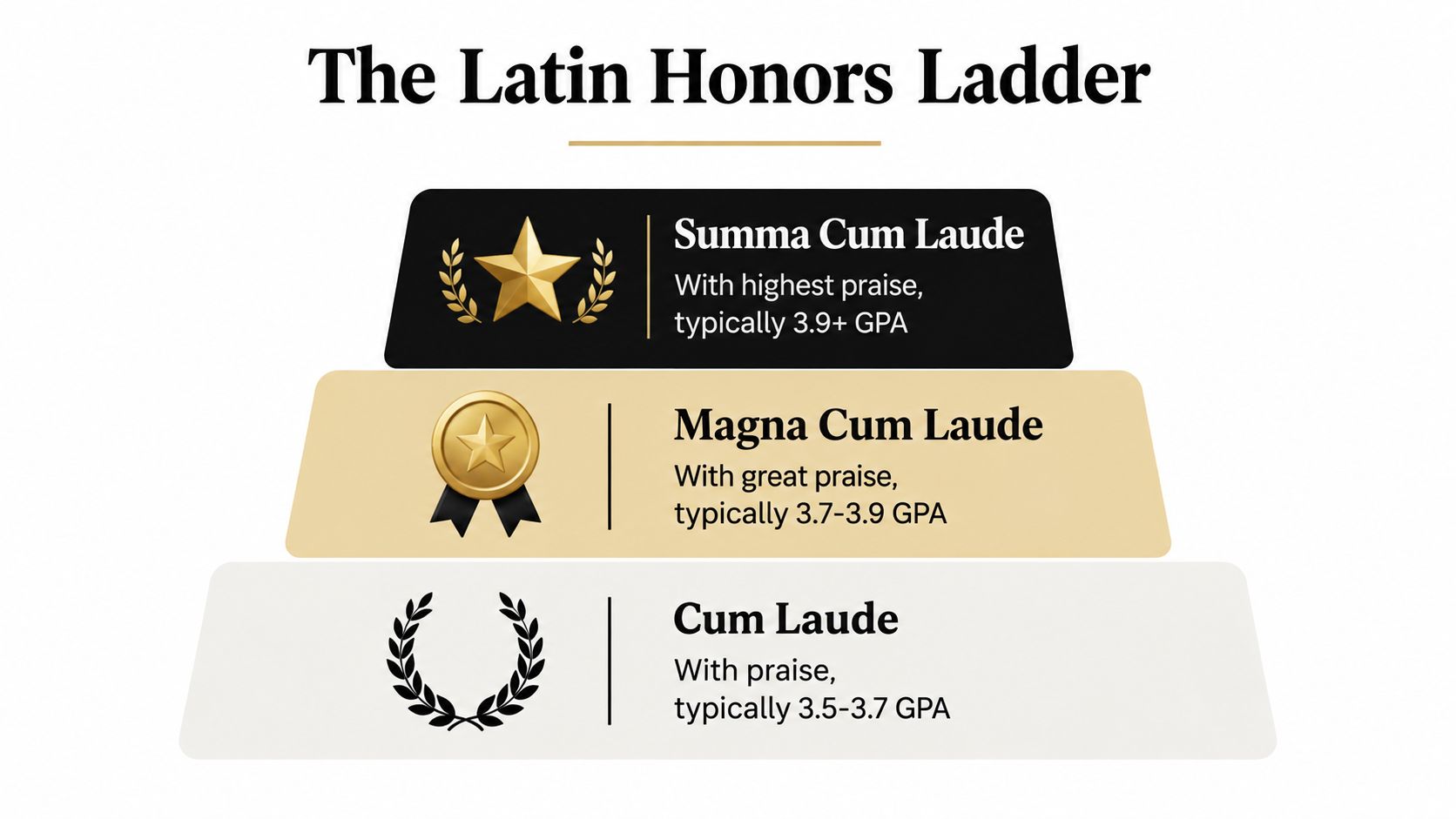
A graduate may see magna cum laude on a transcript, then see a “magna cum laude stole” sold online and assume every school treats that honor the same way. The honor itself is a Latin distinction, and the phrase means “with great praise” (Wikipedia's magna cum laude overview). The stole is a separate item, and whether it is allowed depends on the campus.
Why schools don't use one national rule
Colleges and universities set their own rules for Latin honors. Some rely on a GPA band. Others use class rank, honors-program participation, a thesis, or a combination of those factors. Two students can both earn magna cum laude and still reach it through different academic paths.
The history is long, but the rules are not universal. Harvard introduced final honors in 1869 and added magna cum laude in 1880, which shows how early the Latin-honors system took root in American higher education (Wikipedia's magna cum laude overview). The title carries tradition, yet no single national cutoff controls it.
What that means for families ordering regalia
That difference matters at graduation. One school may award magna cum laude through a GPA band, while another may base it on percentile ranking or additional academic requirements. UCLA's engineering guidance uses percentile-based Latin honors, while other campuses publish their own GPA cutoffs (UCLA engineering Latin honors guidance). A simple “3.8 means magna” shortcut can lead families in the wrong direction.
The same care applies to the wording on a résumé or CV. The honor should match the way the school records it, especially in the education section for ATS resumes. A clean, accurate entry helps the graduate present the distinction exactly as the institution recognizes it.
For a quick refresher on the full Latin-honors ladder, this explanation of what cum laude means helps place magna cum laude in context.
Stoles vs Cords vs Sashes and What Each One Signals
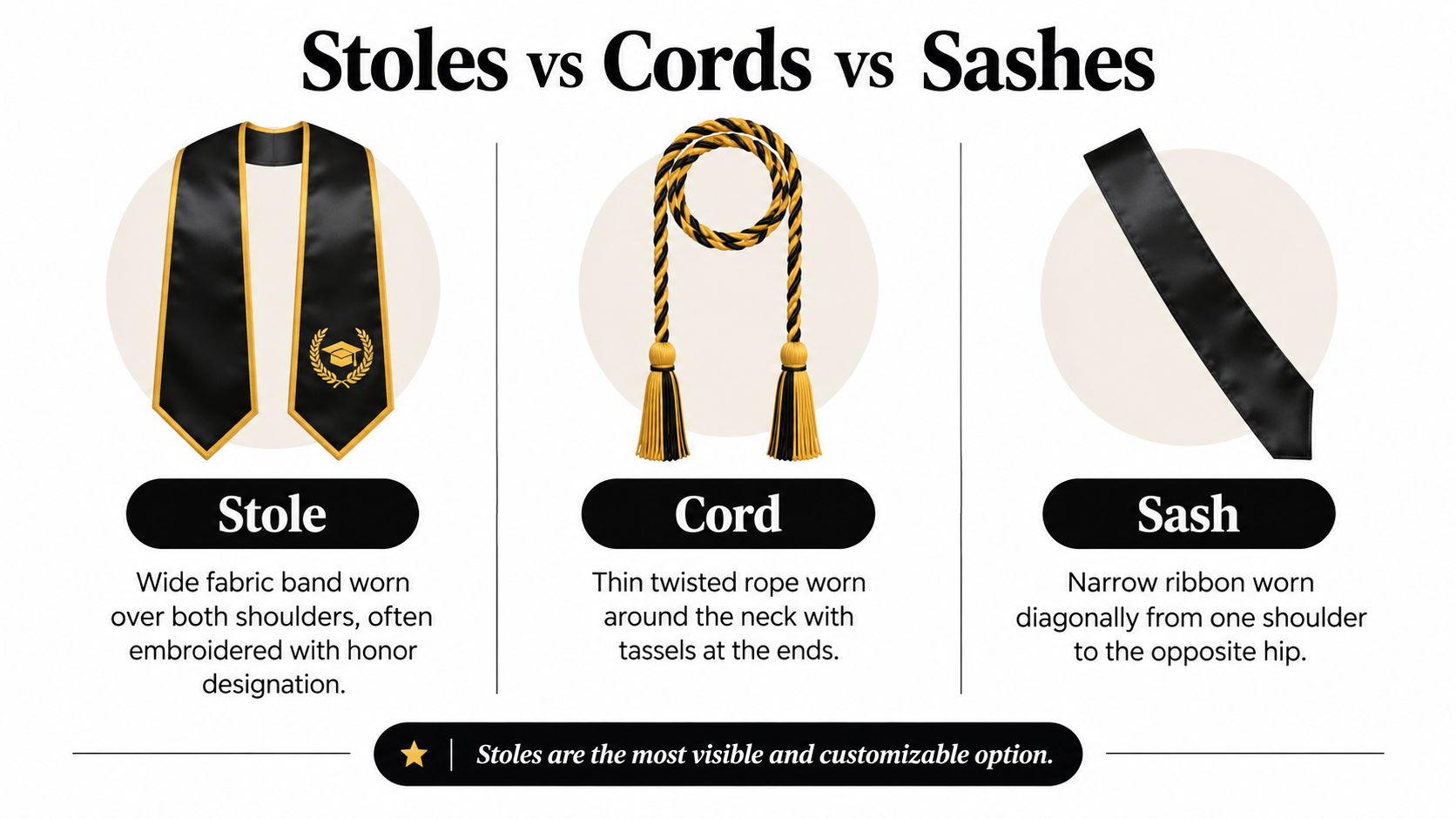
A stole is the wide fabric piece draped over the shoulders. A cord is the thinner, braided item often worn around the neck. A sash usually describes a similar draped accessory, but campuses and vendors don't always use the word the same way, which is why buyers get tripped up.
Why the same honor can appear in different forms
Some schools mark magna cum laude with cords. Others use stoles. Kansas State describes cords, not stoles, as the official markers for its Latin-honors levels, while the University of Southern Indiana assigns a solid red stole and red tassel to magna cum laude recipients (source). Those are both valid campus systems, but they are not interchangeable.
That difference matters because a graduate can buy the wrong item very easily. A student may see a “magna cum laude stole” online and assume the school uses that format, when the campus issues a cord. In that case, the garment becomes extra regalia rather than the official honor marker.
How to read the campus signal correctly
The cleanest rule is to ask which item the school uses to represent the honor. The University of Southern Indiana also shows how specific the visual code can be, since the stole and tassel are tied to the academic distinction there. Elsewhere, institutions may use cords only, or allow both a cord and a stole for different purposes.
For a simple comparison of ceremonial accessories, this page on graduation sash vs stole is useful when you're trying to match the product name to the school's language.
Practical rule: if the school says “cord,” don't assume a stole is acceptable just because the honor title is the same.
Typical Colors, Embroidery, and Placement
A color can look familiar and still mean something different from one campus to the next. A blue cord at one school, a red stole at another, and another cord pattern elsewhere can all point to magna cum laude, so the color alone does not prove eligibility.
Texas A&M University–Corpus Christi identifies magna cum laude with a blue cord and requires a cumulative GPA of 3.70–3.899. The University of New England also uses blue honors cords for magna cum laude (regalia history overview). The lesson is simple: read the color through the school's own policy, not through a universal chart.
How schools usually label the item
If a school allows embroidery or printing, the wording often reads Magna Cum Laude. Some campuses add a graduation year, an institution name, or an approved insignia. Use the version the school has already published or approved, because that is the safest match for ceremony regalia.
Placement matters too. A stole drapes over both shoulders and hangs evenly in front. A cord sits higher and reads more like a trim than a panel. When a campus issues both, they usually serve different purposes, and one does not replace the other.
| Institution | GPA Range | Regalia Used | Color |
|---|---|---|---|
| Texas A&M University–Corpus Christi | 3.70–3.899 | Cord | Blue |
| University of New England | Varies by program, check current policy | Cord | Blue |
What to check before ordering
Check the school's published honor title, the exact color, and whether it wants a cord or a stole. If the campus does not publish embroidery rules, keep the wording simple and legible, then confirm approval before customizing anything.
For students comparing product styles, Stoles.com® offers customizable honor stoles and honor cords, which can be useful when a campus allows personalized regalia and the wording needs to stay aligned with the school's terminology.
Ordering Your Stole Without Getting It Wrong
A graduation stole only works if it matches the school's rules and arrives on time. Louisiana State University requires adornments to be approved at least 30 days before commencement, so the campus deadline is the priority, not your own calendar (LSU's academic regalia requirements).

The ordering checklist that prevents last-minute problems
Start with approval. If the school has a form, deadline, or approved-vendor list, use that first. Then confirm the honor wording exactly as the university writes it, because capitalization and spacing can matter on ceremony regalia.
After that, check the fabric, lettering, and placement of the text. A pale font can disappear against a dark gown, and a crowded layout can look messy in photos. Keep the design simple if the item is meant to show academic distinction. The honor should be easy to read at a glance, the way a name tag works at a formal event.
What schools and groups need to confirm
Bulk orders need the same care. A commencement office, honors program, or Greek organization should verify who is approved to wear the item, whether the school supplies it, and whether multiple adornments are allowed together. That avoids the common mistake of ordering one style for everyone when the campus uses different honor markers for different groups.
Practical rule: confirm the registrar's wording, the approval deadline, and the allowed accessory type before anyone places an order.
If the school permits a custom piece, ask whether the supplier can match the approved wording and garment type. For students comparing product styles, Stoles.com® offers customizable honor stoles and honor cords, which can help when a campus allows personalized regalia and the wording still needs to stay aligned with the school's terminology.
Layering Honor Regalia With Cultural, Flag, and Greek Stoles
A lot of graduates need more than one piece of regalia. A student may have an academic honor item, a cultural stole, a flag stole, or a Greek-letter accessory, and the question becomes whether they can all be worn together without causing a problem on stage.

The rule is campus approval, not personal preference
The University of Memphis limits stoles to registered organizations, recognized honor societies, and approved programs, while academic distinctions are represented through GPA-based cords (source). That kind of policy shows why layering has to be checked in advance. An item that is fine for one ceremony may be restricted at another.
The easiest way to think about layering is to separate categories. Academic honor, identity, and organization affiliation can all be valid, but they often need different items or different approval paths. Some schools allow identity-based stoles and still require that the university seal remain visible. Others ask for advance approval before anything with institutional branding is worn.
How to avoid a stage-day surprise
If a graduate is wearing both an honor cord and a cultural stole, the order, placement, and visibility usually follow school rules. That means no one should guess based on pictures from another campus. The commencement office is the only reliable source for how multiple items should sit together.
For families ordering more than one accessory, the safest plan is to confirm every piece separately, then check whether the school allows them to be worn at the same time. That one step prevents a lot of last-minute removal before walking across the stage.
Common Questions and Smart Next Steps
Is a Magna Cum Laude stole universally recognized? No. The honor is recognized, but the garment form, color, and approval depend on the institution's policy.
Should you choose a cord instead? If the school uses cords for Latin honors, yes. If it uses a stole, the cord may be the wrong item for the official recognition.
Will a custom-stitched stole be accepted? Only if the school permits it. Some campuses approve custom or organizational pieces, while others limit stoles to specific recognized groups.
How do you confirm eligibility before ordering? Check the registrar or commencement office, then match the wording, color, and wear rules to that school's current policy. Academic honor cords can represent multiple Latin-honors levels, and institutions publish detailed regalia policies specifying color, configuration, and whether stoles or cords are the official marker for magna cum laude (source).
If you're ordering for a graduate, Stoles.com® carries graduation stoles, honor stoles, Greek stoles, flag stoles, and honor cords that can be matched to approved campus regalia needs. Visit Stoles.com® to compare options and choose the item that fits your school's commencement rules.