

You're standing in the campus bookstore, cap and gown already in your cart, and the last thing left is the stole. That's the piece that turns a standard graduation outfit into something that looks like you, whether you're honoring your major, your chapter, your culture, or a family milestone.
An embroidered graduation stole is the part of regalia that lets you say more than “I graduated.” It can carry names, dates, symbols, flags, or letters stitched into the fabric, which is why it often becomes the keepsake people keep after the ceremony. A plain gown tells the school's story, but the stole tells the student's.
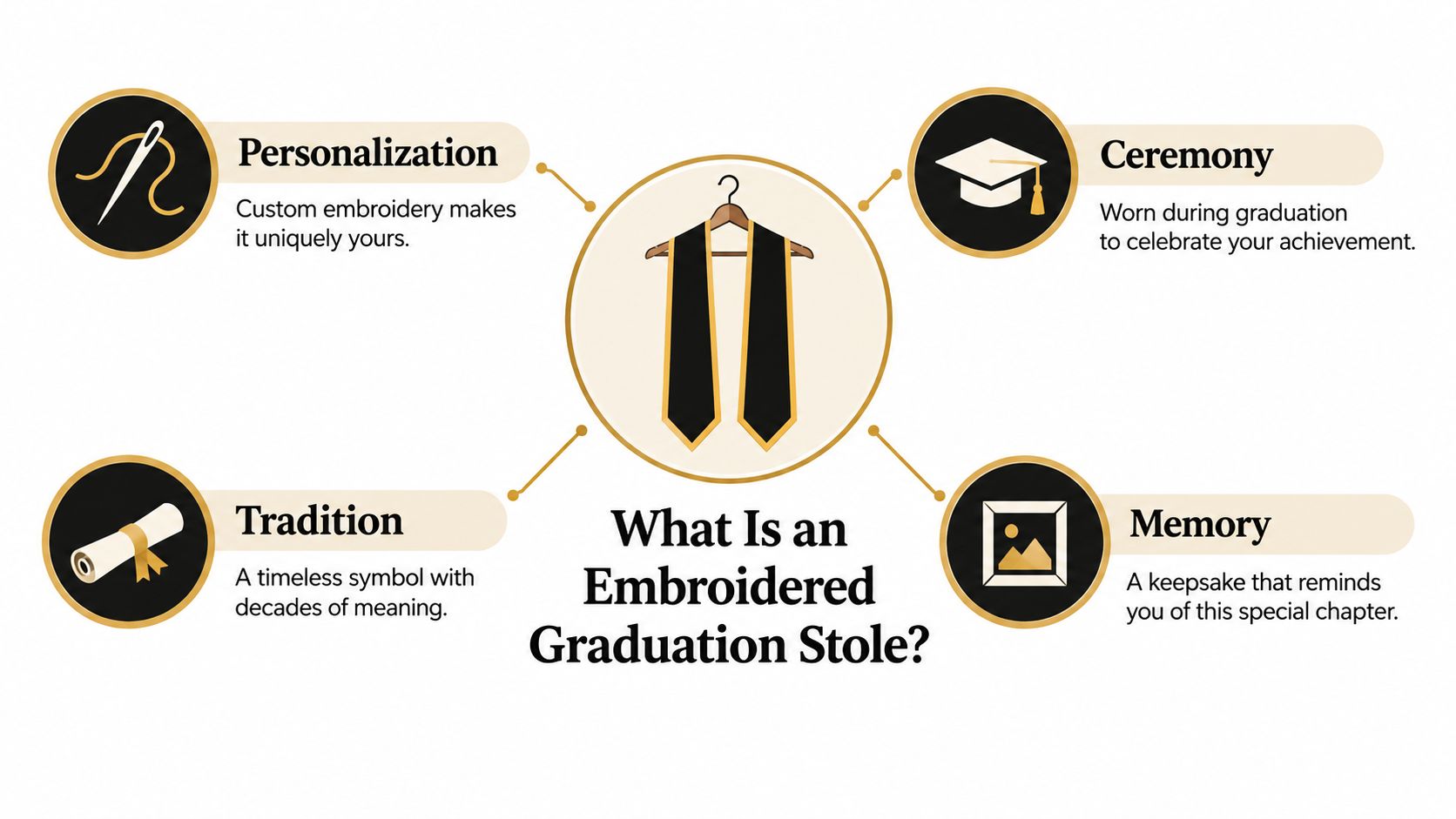
What an Embroidered Graduation Stole Actually Is
A stole is a scarf-like garment worn over the shoulders, and in graduation settings it sits on top of the gown so its design stays visible in photos and on stage. An embroidered graduation stole takes that same ceremonial shape and adds stitched lettering, symbols, or borders directly into the fabric instead of putting the design on as a surface print.
Why embroidery feels different
Embroidery has texture. You can feel the raised stitching with your fingers, and that matters because the stole is meant to be seen from a distance and handled over and over on commencement day. A printed stole can look sharp in a product photo, but embroidery usually gives the piece a more finished, keepsake-like feel.
A plain satin stole gives you color and shine without much detail. A printed stole can carry more graphics, but the artwork sits on top of the cloth. An embroidered stole is built more like a garment with identity stitched into it, which is why many students choose it for names, years, Greek letters, cultural symbols, and honor marks.
Practical rule: if the stole needs to survive photos, handshakes, storage, and maybe framing later, stitching is often the part that makes it feel worth keeping.
For buyers comparing options, that difference matters. A graduation sash can look similar at a glance, but a stole usually reads as more traditional in academic settings, while the embroidery gives it a more personal finish. If you want a quick overview of how a stole functions in graduation attire, this guide on what a stole is for graduation is a useful companion read.
The easiest way to think about it is simple. The gown says “ceremony.” The embroidered stole says “this ceremony belongs to me.”
Where the Graduation Stole Comes From
Academic dress began as everyday university clothing in medieval Europe, not as special occasion costume. At schools such as Oxford, Cambridge, and the University of Coimbra, long gowns and related garments signaled scholarly status while also serving practical needs. Over time, a garment that began as daily scholarly dress gradually became reserved for a single public moment of recognition, and its meaning shifted with it.
From uniform to identity marker
A school uniform that later appears only on one important day follows the same pattern. The shape stays familiar, but the purpose changes. The garment comes to stand for recognition in public, not routine wear.
The United States later shaped academic dress into a more shared system when leading institutions adopted an intercollegiate code at Columbia University in 1895. That code helped standardize the cut, color, and materials of gowns, hoods, and other regalia. Schools then had a common visual language, so clothing could signal field of study and degree level in a consistent way.
That shared system still left room for institutional and personal expression. Once the rules made the language recognizable, schools, honor groups, churches, and cultural organizations could add their own symbols without confusing the ceremony. An embroidered stole can carry a national flag, school name, Greek letters, or a religious emblem and still read as graduation attire.
An embroidered stole works because it sits inside the academic-dress tradition, not outside it.
The stole functions as part of a long-running system of wearable identity, where color and textile choices let people read achievement and belonging at a glance. That history gives a modern stole its legitimacy, even when the design feels personal.
Materials and Embroidery Methods That Matter
The fabric is the first quality choice buyers notice, even before the design. Satin gives the stole a smooth, glossy look, while polyester usually feels lighter and more practical for repeated wear. Think of satin like a dress shirt you'd save for a formal dinner, and polyester like a performance polo you'd be comfortable moving in all day.
What to look for in the fabric
A good stole should drape cleanly, not fight the shoulders or twist when you walk. If the base fabric feels too stiff, the embroidery can look crowded. If it feels too thin, the stitching may pull or show backing through the front.
The embroidery itself matters just as much as the cloth. Flat embroidery works well for clean lettering and small symbols. Denser satin-stitch lettering gives the design more visual weight, especially for names or organization initials. Metallic thread can add shine, but it also asks more of the fabric underneath, so construction quality matters.
If you want a plain-language look at how decorative stitching can add character to garments, add character to plain garments offers a useful sewing-focused perspective. It's a helpful reminder that stitching changes not just the look, but the feel of a piece.
Quick quality checklist
- Check the backing: a neat backing usually supports better structure and less puckering.
- Look at the edges: clean finishing helps the stole hang evenly instead of curling.
- Ask about stitch density: denser embroidery usually reads more clearly from a distance.
- Review a finished sample, not loose thread: thread alone won't show how the full stole handles, especially where stitching meets satin or adhesive support.
For buyers who want a closer look at stitching as a design choice, this overview of graduation sash embroidery is worth comparing with stole construction. It helps separate simple decoration from a piece made to last.
A useful shorthand is this, the fabric carries the stole, but the embroidery gives it its voice.
Customization Options from Fonts to Placement
Once the base material makes sense, the fun part starts. Customization is really a series of small decisions, and each one changes how the stole reads from across a stage or in a family photo. Font, thread color, and placement all shape whether the final piece looks bold, elegant, or understated.
Start with the words
Names and graduation years are the most common choices because they're the easiest to recognize and the hardest to regret later. Some buyers also add a major, an organization name, or a short phrase that means something to their chapter or family. A stole doesn't need a lot of text to feel personal.
Font choice changes the tone right away. Block letters feel direct and easy to read. Script feels softer and more formal. Serif styles tend to read as classic and academic. If you want to compare lettering styles before you order, this guide to compare embroidery machine fonts gives a practical way to think about shape and readability.
Think about where the design sits
Placement matters because the stole has to show over the gown. Most designs work best near the ends, where they stay visible when the garment hangs naturally. Logos, crests, and symbols usually belong in a spot where they won't get lost in the folds.
A fictional honor society stole might use a school name on one end, a crest on the other, and the graduation year underneath. That kind of layout keeps the design balanced without making either side feel crowded. If the design has too many elements, the eye doesn't know where to land.
For anyone building a custom piece, it helps to prepare three things before ordering, the exact wording, the font style you want, and where each element should sit. That saves back-and-forth and makes the proof review much easier. A product like a custom graduation stole works best when the buyer already knows what must be included and what can be left out.
Color, Symbolism, and What Schools Actually Allow
Color on graduation regalia functions as a shared language, and schools set the rules for how it is used. In American academic dress, certain colors have long been associated with specific fields, such as white for arts and humanities, light blue for education, orange for engineering, purple for law, golden yellow for science, and scarlet for theology. That code helps a crowd recognize degree-related meaning at a glance.
Read color as policy, not taste
A first-time buyer can like a mockup and still run into a campus rule. Many institutions reserve certain combinations for honors, specific programs, or university-issued items, so color has to be checked against school policy before production starts.
| Common Stole and Cord Color Meanings | Common Association | Important Caveat |
|---|---|---|
| White | Arts, letters, humanities | Field meanings are part of academic dress, but schools can set their own rules |
| Light blue | Education | Some schools reserve accessory colors for specific honors or programs |
| Purple | Law | A school may limit who can wear purple stoles or cords |
| Golden yellow | Science | Color alone doesn't authorize a claim of a field or honor |
| Solid gold, red, blue | Commencement honors at some institutions | At the University of Southern Indiana, these are reserved for specific honors |
| Purple and gold | Latin honors at some institutions | LSU reserves these combinations for defined honors and requires approval at least 30 days before the ceremony |
The safest habit is to confirm before production. According to the University of Southern Indiana's published regalia guidance, solid gold, red, and blue stoles are reserved for commencement honors, and Louisiana State University says adornments, including stoles, need approval at least 30 days before the ceremony while purple, gold, and white are reserved for specific honors. A custom design should never assume a color combination is available just because it looks good.
If a color implies honors, a school has to say yes first.
Symbols follow the same rule. A Greek letter set, a crest, or a heritage mark can fit one campus and be restricted at another. If you want a clearer starting point on meaning-driven color choices, this guide to graduation stoles meaning gives useful context before you submit artwork.
Sizing, Fit, and How It Drapes on Graduation Day
Fit is easy to ignore until you try the stole on over a gown. Then the question becomes simple, does it sit flat, stay visible, and move well when you walk? A good fit makes the embroidery readable in photos and keeps the stole from slipping out of place.
What should fit mean here
A stole should hang evenly over both shoulders and fall cleanly down the front. If it's too short, the design may land too high or look cramped. If it's too long, it can interfere with walking or with the rest of the regalia.
Height, body shape, and what else you're wearing all matter. Students who plan to wear multiple cords or another stole need enough room at the neckline so the garments don't bunch together. Graduates using adaptive clothing or mobility devices should pay extra attention to where the ends fall and whether the fabric gets in the way during transfer or seated positioning.
A simple pre-order checklist helps a lot:
- Confirm the length with your school or chapter: some groups prefer a specific drape.
- Check how many accessories are allowed: not every campus treats stoles, cords, and sashes the same way.
- Test the neckline area: make sure the stole won't press awkwardly against collars, ties, or adaptive clothing.
- Think about photos first: if the embroidery disappears under folds, the design isn't placed well.
A stole should look intentional standing still and stay comfortable while moving.
If you're ordering for a chapter, the group should decide on one standard fit before anyone places an individual order. That avoids mismatched lengths and makes the ceremony look coordinated. A custom size is worth asking about when the wearer has unique needs or when the school's regalia rules are especially specific.
Pricing Factors and Ordering Timeline
A custom stole costs more or less for the same reasons any made-to-order garment does. Base fabric, stitch count, the number of custom elements, metallic thread, quantity, and rush production all shape the final price. A plain stole has minimal production cost. Every added name, logo, border, and metallic thread increases stitch count, machine time, and price.
What changes the total
More stitching means more labor and more material. A single name is usually simpler to produce than a name, year, logo, and border combination, because each extra element adds setup and embroidery time. Metallic thread can also add complexity, since it changes how the embroidery behaves during stitching and finishing.
Timing matters just as much as design. Published commencement guidelines at Louisiana State University, the University of Southern Indiana, and the University of Wisconsin–Eau Claire show why the safest schedule starts early. LSU lists a 30-day rule, USI uses a 60-day approval window, and UW–Eau Claire gives 90-day approval guidance. Working backward from the ceremony date helps avoid last-minute revisions and approval problems.
A practical order path usually runs through design review, proof approval, production, quality check, and shipping. If you are ordering for a Greek chapter or an honor society, build in extra time for group approvals, corrections, and distribution. A small delay at the proof stage can matter more than people expect, especially when several names or logos are involved.
Care, Keepsake Tips, and How to Order from Stoles.com
An embroidered stole lasts longer when you treat it like a textile, not a disposable accessory. Gentle hand washing or a delicate cycle is usually the safest starting point, especially if the design uses metallic thread. Flat drying helps the shape stay smooth, and storing it flat or gently rolled is kinder to the stitching than folding it sharply.
After commencement
Many regalia pieces get used once and then tucked away, which is why end-of-life planning matters. Some families keep the stole as a keepsake, some donate it to another student, and some repurpose it into a shadow box or memory display. If the embroidery carries a name or year, that can make donation less practical, but preservation can still make sense.
That's where a family gift guide can be helpful too. For readers thinking about a graduation package alongside the stole, That Blanket Co graduation picks offers a different angle on commemorating the day without overbuying things that won't get used again.
A straightforward ordering path
Start with the custom graduation stole category, then choose a base style that matches your school's rules and your ceremony look. Next, add the text, symbols, or colors you want, request a digital proof, and confirm the final layout before production begins. If you're buying for a chapter or organization, make sure the delivery plan matches how the group wants to distribute the stoles.
Stoles.com® offers custom graduation stoles, honor stoles, Greek stoles, and flag stoles that can be built around names, years, symbols, and approved colors. If you want a ceremonial piece that feels personal while still fitting your school's rules, visit Stoles.com® and start with the stole style that matches your ceremony, your group, and your keepsake goals.