

The music starts, the lights warm the stage, and you notice the fabric lying across your gown. Is it a stole, a sash, or both? If you're a first-time buyer, choosing a flag sash for graduation can feel surprisingly complicated, especially when you're also wearing honor cords, a school stole, or cultural regalia.
The right choice should do more than look attractive in photographs. It should represent your story, fit your gown, coordinate with your other graduation accessories, and comply with your school's ceremony rules. This guide will walk you through those decisions clearly, from meaning and sizing to approval, ordering, wearing, and care.
What a Flag Sash for Graduation Actually Is
A graduate steps onto the stage in a required cap and gown, then adds a strip of fabric that carries a second message. A flag sash for graduation is that strip. It is a narrow stole worn over the gown, decorated with a national, regional, cultural, or combined flag design. The pattern can point to heritage, family history, identity, or a community the graduate belongs to.
Retail listings often use sash and stole interchangeably. In practice, a stole usually means the wider, scarf-like fabric worn over the shoulders. Sash may describe a similar piece with more emphasis on decoration or identity. Both terms can refer to the same type of graduation accessory, so inspect the product's measurements and photos rather than relying on its title.
A flag sash adds to academic regalia. It does not replace the cap, gown, hood, or another item required by the institution. Worn over the gown, it functions like a headline on a page. It draws attention to one personal connection while the official regalia establishes the ceremony's academic setting.

How it differs from other graduation accessories
Each accessory occupies a different visual and symbolic role:
- Graduation stole or sash: A broad fabric garment that communicates identity, affiliation, culture, or recognition.
- Honor cord: A thin braided rope with tassels, generally used for academic honors, leadership, service, an honor society, or a field of study.
- Medal or medallion: A smaller award worn near the chest, often tied to a particular institutional recognition.
- Pin: A compact emblem representing an organization, service, academic program, or personal affiliation.
The sash's width and length help it remain visible from the audience and in family photographs. Commercial flag stoles commonly fall within a general range of roughly shoulder-to-waist coverage, with enough fabric to hang down both sides of the gown. Exact fit depends on the graduate's height, gown cut, and whether another stole sits underneath.
A student may choose a country's flag to honor family roots, a regional design to represent home, or a combined pattern to show more than one identity. A first-generation graduate might connect the sash with family sacrifice, while a military-family student may select a flag associated with home or service. Cultural organizations and graduates with multiple identities may choose a custom design.
Practical rule: Choose the sash for the story people should understand first. Then arrange cords, medals, pins, and any school stole so that message remains clear rather than crowded.
The Centuries-Old Story Behind Graduation Sashes
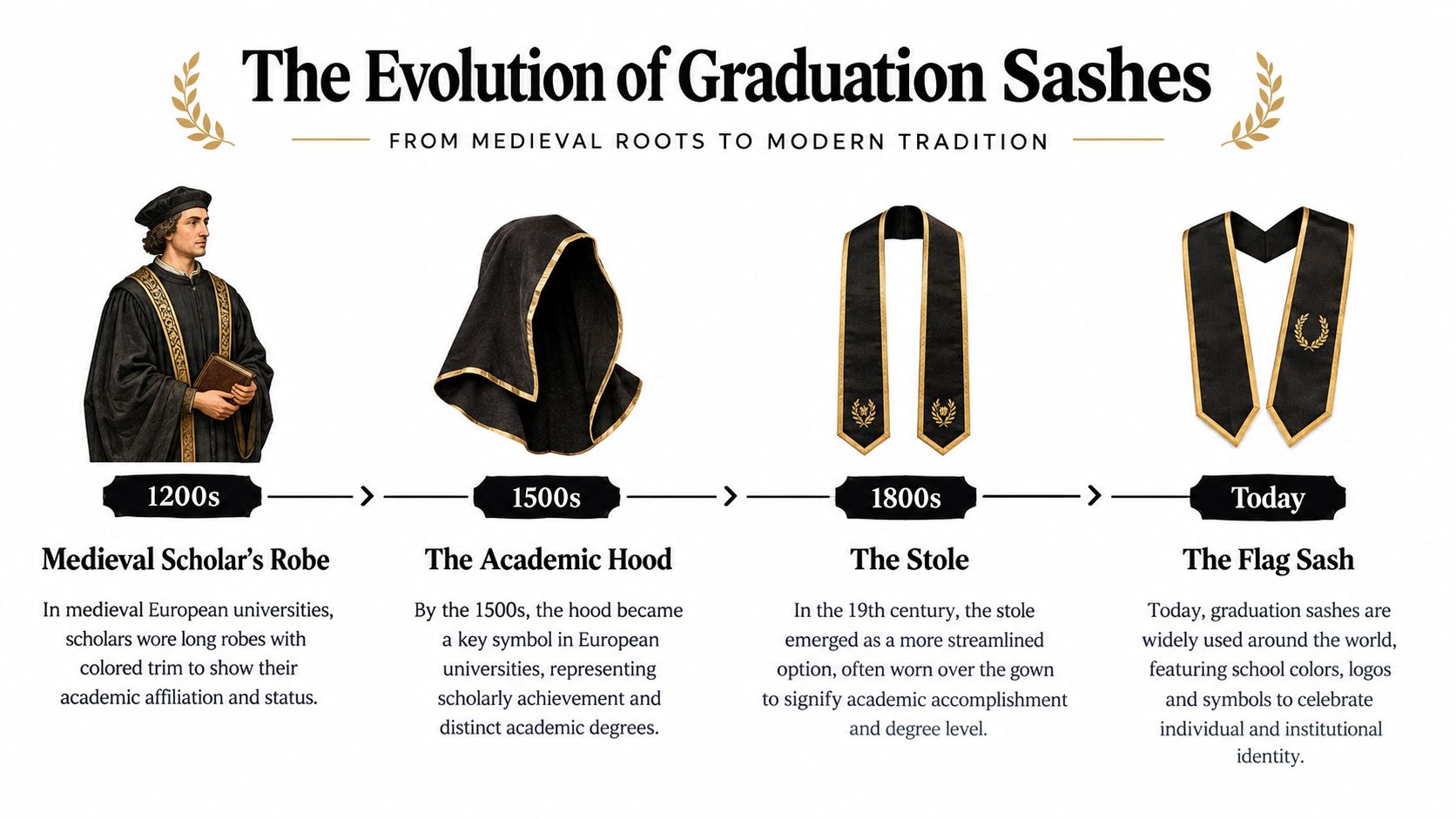
Graduation regalia didn't begin as a modern photo accessory. Its roots reach back almost 1,000 years, to clothing associated with Catholic and Anglican priests and the early European university tradition. Scholars and clergy shared formal garments, so academic dress originally reflected the close relationship between religious institutions and medieval education, as described in the history of graduation stoles and sashes.
In the 1400s, scholars in England began adding mortarboards to distinguish themselves from clergy. By the late 1700s, caps and gowns were required for graduation in the American colonies and early United States. Universities moved toward more consistent academic dress in the late 1800s, and a standing committee was created in 1959 to help maintain clear, consistent rules.
From scholarly garment to identity marker
The stole developed as a narrower band of cloth associated with clergy and scholars. Modern academic ceremonies adapted that form into a garment that could signal achievement, membership, and belonging. Educational guidance describes graduation stoles as pieces worn around the neck to display academic organizations, honors, and individual accomplishments. Fraternity and sorority members may also wear stoles in group colors, as outlined in this educational overview of graduation stole meanings.
The flag sash is a natural extension of that tradition. Instead of using fabric only to identify a discipline or organization, it uses the fabric to represent a country, heritage, or community. A student wearing an international flag stole isn't abandoning academic tradition. They're adding a personal chapter to a ceremonial form that has always helped viewers understand who the graduate is and what communities shaped them.
International flag graduation stoles are commonly marketed to represent a student's country or heritage. Commercial descriptions also use standardized dimensions such as approximately 72 inches by 4.5 inches, giving the modern flag sash a recognizable shape while allowing the design to remain visible during the ceremony.
That continuity explains why a flag sash can feel both formal and personal. The gown connects you to the academic institution. The sash connects the achievement to the people, places, and identities that helped make it possible.
What Your Flag and Color Choices Communicate
Your design choice acts like a visual introduction. Before anyone reads your name, they may notice the colors, symbols, or flag across your gown. A strong design helps the audience understand the main message quickly, while an overcrowded sash can make every message compete for attention.
Start by identifying the primary connection you want to honor:
- National flags usually express country of origin, citizenship, family roots, or international identity.
- Regional and ethnic flags can represent indigenous or cultural heritage, such as the Navajo Nation, Cherokee identity, or Puerto Rican heritage.
- State flags often communicate hometown pride or a connection to the place where the graduate was raised.
- Combined designs may pair a national flag with a school-color stripe, Greek letters, a country name, or an honor-society element.
A Mexican flag stole may communicate family heritage and cultural pride. A Filipino flag sash may connect the graduate to family origin or community. A Navajo design may honor indigenous identity, while a Puerto Rican flag can express cultural belonging and family history. The meaning depends on the wearer's story, so you don't need to force a design into a category that doesn't fit.
Common Flag Sash Designs and What They Signal
| Flag or Design | Typical Message Conveyed |
|---|---|
| Italian flag | Italian heritage, family roots, or cultural pride |
| Mexican flag | Mexican heritage, national identity, or community belonging |
| Filipino flag | Filipino heritage, family connection, or international identity |
| Nigerian flag | Nigerian roots, citizenship, or cultural pride |
| Navajo Nation design | Navajo identity and indigenous heritage |
| Puerto Rican flag | Puerto Rican heritage, cultural identity, or family connection |
| National flag with school-color stripe | Country or heritage combined with institutional belonging |
| Flag with Greek-letter overlay | Cultural or national identity combined with fraternity or sorority membership |
| Flag with honor-society color | Heritage or national identity combined with academic recognition |
Color meanings matter, but they aren't universal. One guide notes that schools may deviate from common conventions, while widely used associations include white for humanities, beige for business, green for medicine, pharmacy, or physical education, orange for engineering, blue for education, purple for law, silver for medical science, mathematics, or agriculture honors, black for business or economics honors, and gold for Latin honors and other high-achievement recognition. Review the graduation stole color meanings guide as a starting point, then confirm your school's own system.
For more design context, this guide to graduation flag stoles can help you compare national and custom options. If your sash includes multiple symbols, select a fabric and layout that keeps the dominant flag readable from a distance. A country name, Greek letters, or honor color should support the main design, not cover the emblem that carries the most meaning.
Choosing the Right Size, Fabric, and Customization
A flag sash should follow the gown's shape without bunching at the neckline or vanishing beneath the sleeves. Check the manufacturer's finished dimensions rather than relying on the product name alone. A sash that looks balanced on a product photo may sit differently once you add a gown, hood, cultural stole, or honor cords.
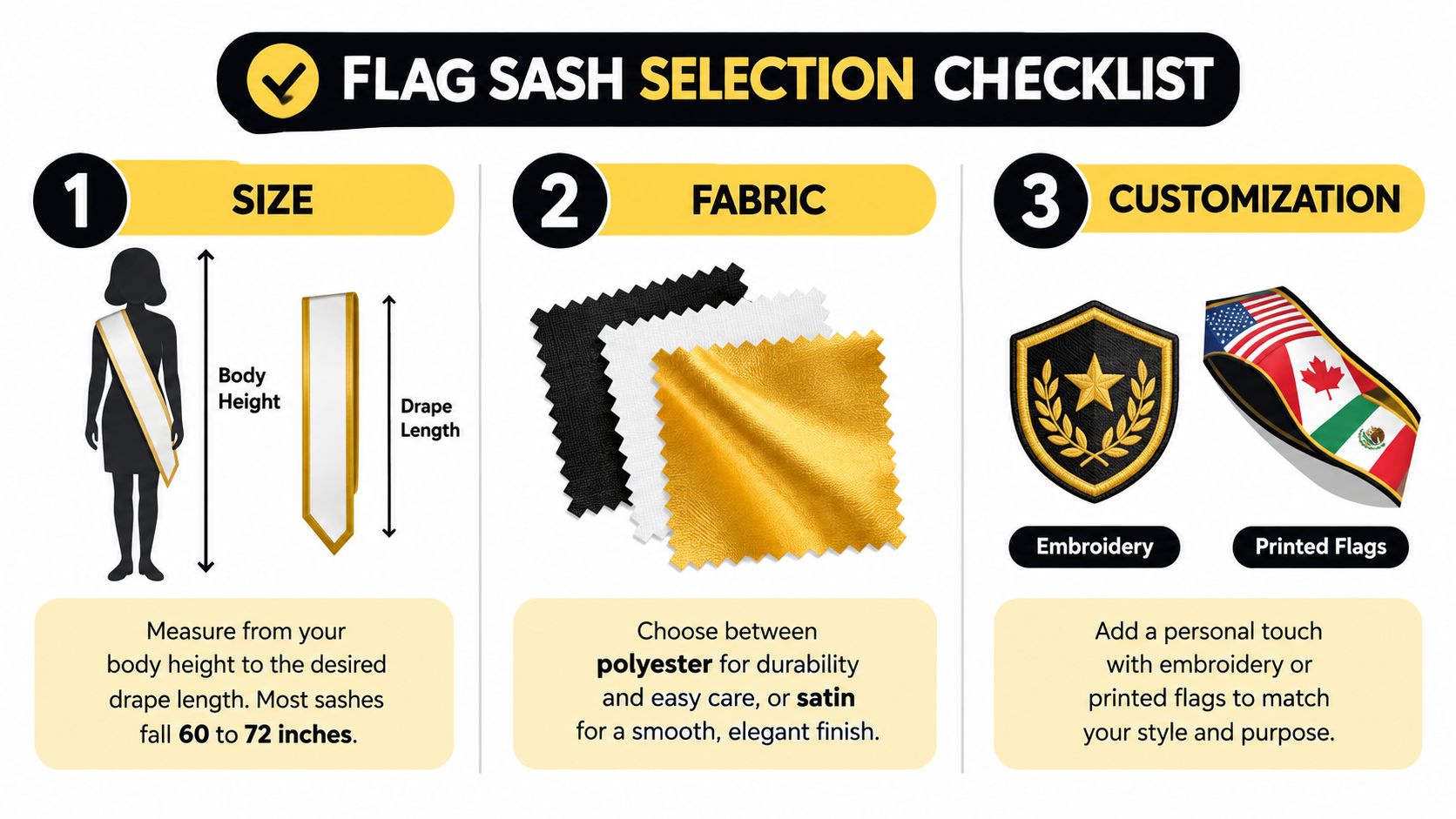
Most flag stoles use 60 to 72 inches in length and approximately 4.5 to 5 inches in width. A 60-inch stole drops about 30 inches per side, while a 72-inch stole drops about 36 inches per side. These measurements usually bring the ends toward waist level on many adults, but your height, gown cut, and preferred placement still affect the result. Use this length and width guide for graduation stoles as a sizing reference.
Match the dimensions to your gown
Put on the gown, or measure a similar garment, before ordering. Check whether both ends reach a similar position and whether the sash remains visible below the hood or neckline. A short sash can disappear into the gown. An overly long one may twist as you walk or sit.
Width controls how much visual space the flag receives. A narrower sash may pair more comfortably with a cultural stole or a gown carrying other decoration. A broader sash gives a multicolor flag room to remain recognizable, especially when it contains a detailed emblem. Treat the sash and the rest of your regalia like a readable page. Each piece needs enough space for its message to remain clear from the audience.
Select fabric for the ceremony environment
Polyester satin or bridal satin is commonly used for graduation flag stoles. Technical guidance describes 100% polyester as practical because it offers a noticeable sheen, resists wrinkling better than many natural fibers, dries quickly, and resists stains. Its satin weave also supports strong color saturation and photographic reflectivity, helping flag colors remain distinct under stage lighting. The custom honors graduation stole material guide provides further material context.
Polyester satin tolerates little heat. If the sash needs finishing, use controlled low temperatures and keep the iron away from printed areas. Matte fabric can reduce glare when several regalia pieces already reflect light. Shinier satin can make one flag sash stand out when the overall outfit is otherwise simple.
Customization may include a printed flag, embroidered country name, Greek letters, or a school-color stripe. Give each element room to stay legible. Before checkout, confirm:
- Finished dimensions: Verify the full length and width.
- Gown pairing: Check that the sash will not hide a required hood or stole.
- Design hierarchy: Decide which flag or symbol viewers should notice first.
- Fabric handling: Review care instructions and heat limits.
- Approval status: Ask your school before ordering a personalized design.
How to Wear Your Flag Sash on Graduation Day
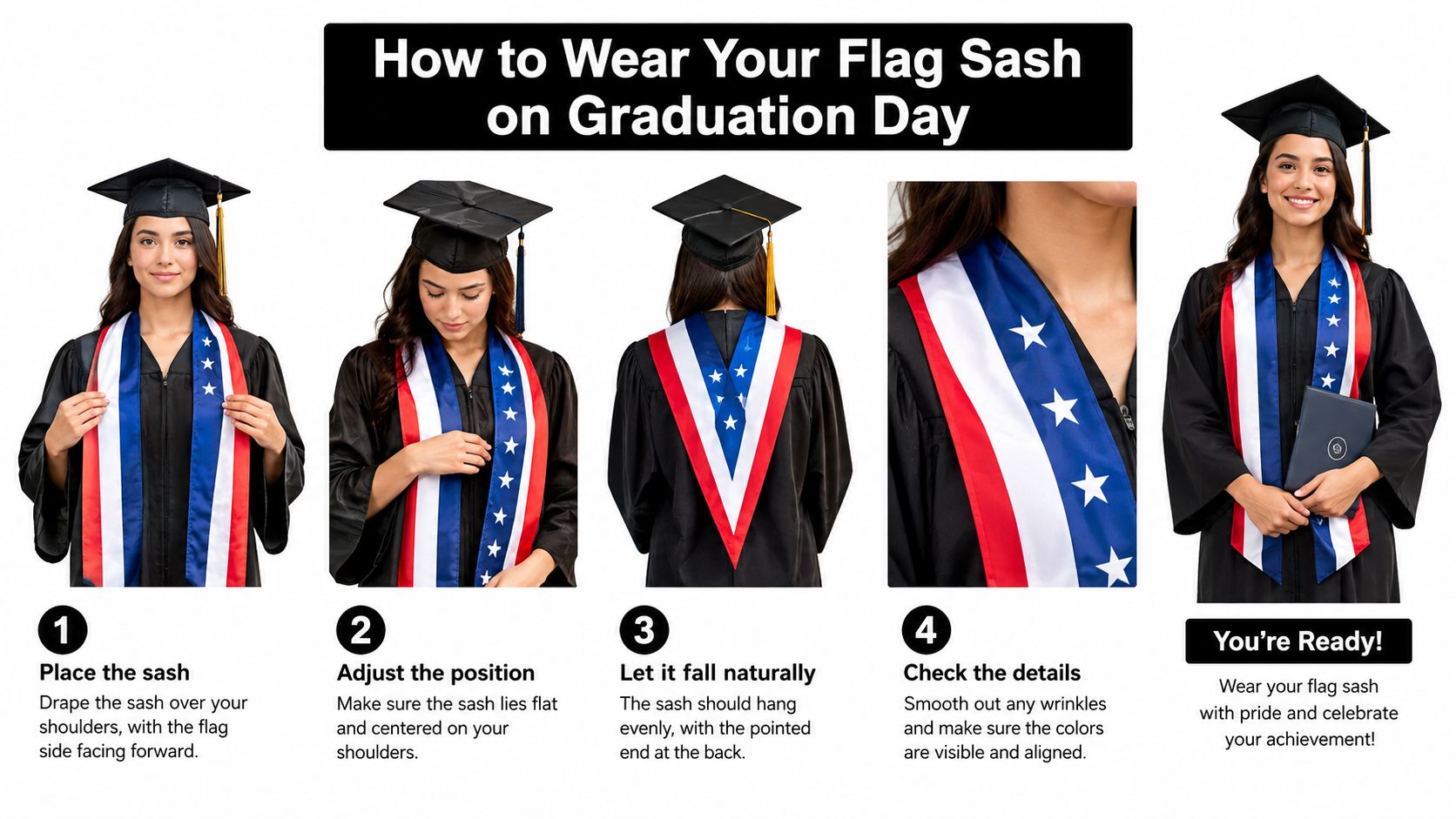
Lay the gown flat before you put on the cap. Find the center of the sash, then place it over your right shoulder unless your school or organization specifies another arrangement. Position the flag face-out so the emblem or color pattern points toward the audience and the ends fall evenly near the hips.
A single discreet pin at the collar can prevent a satin sash from sliding during a long ceremony. Place the pin through the sash and the inside edge of the gown, rather than through a prominent printed emblem. Test the placement while standing, sitting, walking, and reaching forward for a handshake.
Build a clean regalia stack
If you're wearing a cultural stole as well, decide which item carries the primary message. You might place the cultural stole closer to the gown and the flag sash over it, or reverse that order if the flag needs to remain dominant in photographs. Avoid placing two competing flags on the same shoulder, because the patterns can overlap and become difficult to read.
Honor cords sit differently from stoles. They're thin braided ropes with tassels worn around the neck, and they commonly represent academic honors, honor-society membership, leadership, service, military affiliation, or a field of study. Gold cords are often associated with high academic achievement, including summa, magna, and cum laude recognition, as explained in this honor cord color guide.
Wear the cords around the neck and over the gown, allowing them to rest beneath or beside the sash without covering the central flag. A university may use paired school-color cords to distinguish cum laude, magna cum laude, and summa cum laude, so follow the institution's instructions rather than relying only on general color charts.
For a visual reference on placement, review this guide to how to wear a graduation stole or sash. Before entering the venue, practice walking with your arms relaxed, shaking hands without grabbing the sash, and holding your cap or tassel without pulling the fabric out of position.
School Approval Rules Students Often Overlook
A beautiful flag sash can still create a problem if your commencement policy prohibits it. Schools may approve international or heritage stoles, restrict unapproved accessories, limit the number or width of stoles, or ban flags from being worn during the ceremony. Policy examples from Drury, Lamar State College Port Arthur, Auburn, and South Dakota show why students should check current rules for 2026 rather than assume another campus follows the same standard, as summarized in this overview of changing graduation regalia policies.
Start with the commencement office or registrar. If the sash represents a recognized student organization, contact student affairs or the organization's adviser. Ask for the written policy, the approval form, and any design requirements. A school may want a photograph, a description of the flag or emblem, proof of organization membership, or confirmation that the item doesn't contain prohibited branding.
School Approval Touchpoints for Flag Sashes
| Office to Contact | Typical Question Asked | Review Window |
|---|---|---|
| Commencement office | Are personal flag stoles permitted during the ceremony? | Ask for the current ceremony policy |
| Registrar | Does the sash affect official academic regalia requirements? | Confirm before ordering |
| Student affairs | Is an organization, cultural, or heritage stole recognized? | Request written approval |
| College or department | Are there local rules for the department ceremony? | Check separately from campuswide rules |
| Venue or event staff | Are flags, signs, or additional accessories restricted? | Review venue requirements before arrival |
Schools may also restrict visible logos, religious symbolism, oversized designs, or accessories that could block another graduate's view. For design inspiration that keeps school spirit visible without making the garment chaotic, explore this pride-worthy design advice from Raccoon Transfers.
Ask for approval before personalization begins. It's easier to revise a mockup than to explain a prohibited accessory at the auditorium entrance.
Record the person who approved the design and keep the email with your order details. If the school denies the design, you'll have time to choose a plain heritage sash, a different flag treatment, or an approved honor stole.
Pricing Tiers, Lead Times, and Ordering Strategy
The price of a flag sash depends on the amount of customization, the fabric, the construction method, and the time available. A stock flag sash is usually the simplest option, while a fully bespoke piece may combine embroidery, dual flags, Greek letters, and an institutional crest.
Flag Sash Pricing and Lead Time Comparison
| Tier | Typical Price | Customization | Lead Time Before Ceremony |
|---|---|---|---|
| Stock flag sash | Roughly $20 to $40 | Standard flag design and size | Same-week or 2 to 3 week delivery |
| Semi-custom sash | $40 to $75 | Added name, color, or limited text | 3 to 5 weeks |
| Fully bespoke sash | $75 to $150 or more | Embroidery, dual flags, or institution crest | 6 to 10 weeks |
These planning ranges come from the provided graduation sash purchasing guidance. They aren't guarantees, so confirm the production schedule with the seller before paying. Rush fees may add 25% to 50%, and overseas production can establish the minimum practical lead time even when a retailer offers expedited shipping.
Back-plan from the ceremony date:
- Write down the ceremony date and the date you need the sash in hand.
- Subtract the stated production period.
- Subtract shipping time.
- Keep a one-week buffer for alterations, replacement, or approval changes.
- Order only after the final design and school policy are clear.
For a broader look at graduation headwear and sourcing considerations, this Dirt Cheap Headwear sourcing guide offers useful context for comparing suppliers and production choices. Schools, fraternities, and honor societies ordering 10, 25, or 50 or more sashes should ask whether setup, artwork, embroidery digitizing, shipping, and individual packaging are included in the quote.
Use this guide to where to buy graduation stoles when comparing vendors. A lower per-unit price doesn't always reduce the final invoice if the supplier adds a separate artwork or digitizing charge.
Care, Storage, and Last-Minute Buyer Questions
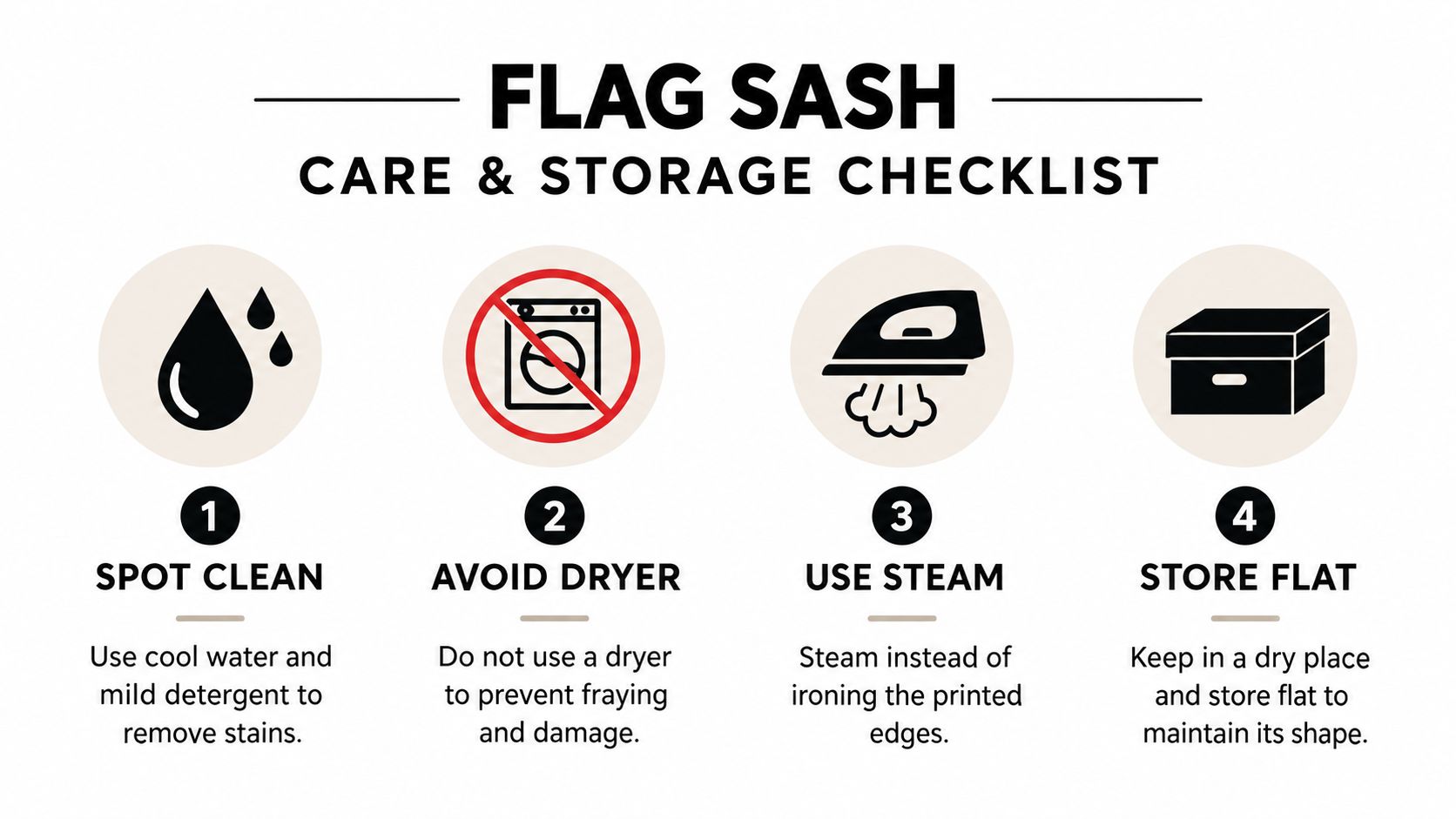
Treat the sash gently from the moment it arrives. Spot-clean polyester and satin with cool water and mild detergent, and test an inconspicuous area first. Avoid the dryer, especially when the sash has embroidered edges, because heat and tumbling can encourage fraying.
Printed flag colors need careful handling. Steam the sash from a safe distance instead of ironing directly over printed areas, which helps protect the surface from cracking. Hang it briefly before the ceremony, then store it flat after the event inside acid-free tissue or a garment bag in a dry place.
Answers for the final week
A crease appears in the package. Let the sash hang, then use gentle steam. Don't press a hot iron directly onto a printed flag.
You need a safety pin. Pin through an inside edge near the collar, avoiding the central artwork. Use one small pin first, then check movement before adding another.
You want two flags. Choose a purpose-built dual-flag design if the flags are equally important. Otherwise, use one dominant flag and a smaller name, stripe, or emblem so the sash remains readable.
You're wearing cords too. Keep honor cords around the neck and let the sash remain the main fabric layer. If the cords knot, separate them before photos and before lining up for the procession.
Before placing the order, confirm the finished size, flag orientation, personalization spelling, fabric type, delivery date, return or correction policy, and school approval. Save the approved mockup and order confirmation where you can access both on graduation morning.
Stoles.com® offers international flag stoles, custom graduation stoles, honor stoles, Greek-letter stoles, and honor cords for students and organizations planning meaningful commencement regalia. Visit Stoles.com® to compare flag sash designs and choose a piece that honors your identity while fitting your school's ceremony requirements.