

A family leans toward the graduate just before the applause begins, trying to read the colored stole across the gown. Is it an honor stole, a cultural sash, a Greek-letter stole, or a marker for the graduate's field? That question explains why searches for graduation sash colors meaning rarely have one universal answer.
A graduation sash, also called a stole, is a fabric band worn over the shoulders. Honor cords are tasseled ropes worn around the neck. Both communicate information at a glance, but their meanings can come from different systems. A color may represent a major, academic achievement, cultural heritage, faith, military service, student organization, or personal identity.
The historical foundation is the Academic Costume Code, adopted by the American Council on Education in 1895 and still influential in U.S.-style regalia (history of academic regalia colors). Yet the chart is only a starting point. Your registrar or commencement office has the final authority for your ceremony.
What a Graduation Sash Actually Says
On a crowded commencement stage, a sash functions like a short visual sentence. A gold cord may tell guests that the graduate received an academic honor, while a flag stole may speak about heritage. A Greek stole can identify organizational membership, and a custom graduation stole can combine a name, degree, year, or community affiliation.
That layered meaning is why a stole shouldn't be treated as decoration alone. It broadcasts part of the wearer's story before the graduate says a word. The same fabric can carry identity, achievement, affiliation, or tradition, depending on who assigned its color and design.

Sash, stole, cord, and hood
The terms can overlap in everyday conversation, but the garments serve different purposes:
- Graduation sash or stole: A broad fabric band draped over both shoulders, often showing colors, embroidery, lettering, or a flag pattern.
- Honor cord: A tasseled rope that hangs around the neck and usually marks academic distinction, service, membership, or another approved recognition.
- Academic hood: A structured garment associated with degree level and discipline, especially in graduate regalia.
- Gown and cap: The primary commencement garments, usually governed by the institution's dress code.
A national or historical color chart can help you form a reasonable interpretation, but it can't guarantee that interpretation is correct at your school. One university may use gold for science, another may reserve it for commencement honors, and a third may assign it to a particular organization.
Practical rule: Treat a color chart as a translation guide, not a contract. Your institution's published regalia policy decides what you may wear and what the color officially means.
The rest of the meaning depends on the layer being communicated. The discipline code explains traditional field colors. Honor societies and academic programs add achievement markers. Cultural, religious, military, and organizational stoles add forms of belonging that a major-based chart can't decode.
Where the Color System Comes From
A student may choose an orange stole for engineering, then discover that the university reserves orange for a student organization. That confusion comes from treating graduation colors as one universal chart. The traditional system supplies a historical starting point, while each school decides how that language appears on its own ceremony garments.
The modern U.S.-style system traces to the Academic Costume Code adopted in 1895 by the American Council on Education. It created a shared visual language for academic dress, allowing regalia to communicate degree level and field of study across institutions (Academic Regalia Colors).
Gown styles can distinguish degree levels, while velvet trim, hoods, and related academic colors can identify a discipline. That structure explains why these colors carry meaning rather than serving as decoration alone. Colleges and universities later adapted the tradition for sashes, stoles, cords, and other accessories.
Academic discipline colors
| Discipline | Sash or velvet color | Historical rationale |
|---|---|---|
| Arts and humanities | White | Linked with the scholarly and artistic fields traditionally grouped within the liberal arts |
| Education | Light blue | Associated with the teaching profession and the academic study of education |
| Business | Drab | Reflects the traditional regalia category for commerce and business studies |
| Engineering | Orange | Connected with heraldic associations between orange and applied science |
| Medicine | Green | Follows a tradition associated with medieval European medical faculties |
| Law | Purple | Draws on purple's long association with authority, legal study, and jurisprudence |
| Science | Golden yellow | Represents the traditional academic category for science and mathematics |
These remain widely recognized discipline colors in American academic regalia. The historical code has influenced hoods and velvet trim most directly, while schools may reinterpret the same colors on sashes or stoles.
The boundary matters. A discipline color may belong to an official academic hood or velvet system, whereas a stole can represent an honor society, cultural organization, military affiliation, or campus program. Gold might identify academic achievement in one ceremony and a field of study in another.
Historical context: The 1895 code established a common visual language. It did not create a universal rulebook for every modern sash sold or worn at every commencement.
Before ordering, compare the traditional discipline color with your school's published regalia policy. The chart explains the historical code, but your institution's policy is the final authority.
Common Graduation Sash and Cord Colors Explained
The most familiar color associations fall into three layers. Discipline colors describe a field of study, honor colors describe achievement, and recognition colors identify service, community, or affiliation. These layers can appear together, but they shouldn't be assumed to have the same source.
Gold illustrates the problem well. It is broadly associated with academic excellence, high GPA recognition, honor societies, and science or mathematics awards, while other colors may be more closely tied to a discipline (graduation regalia color meanings).
| Color | Typical meaning | Layer |
|---|---|---|
| White | Arts and humanities, or a school-specific nursing or society distinction | Discipline or recognition |
| Golden yellow | Science, mathematics, or academic excellence | Discipline or honor |
| Drab | Business or commerce | Discipline |
| Light blue | Education | Discipline |
| Green | Medicine, service, or another local distinction | Discipline or recognition |
| Orange | Engineering | Discipline |
| Purple | Law, or a school-specific service or identity category | Discipline or recognition |
| Gold cord | Academic honors or honor society membership | Honor |
| Silver cord | A secondary academic distinction at some schools | Honor |
| Crimson cord | A high-honor category at some institutions | Honor |
| Red, white, and blue cord | Military service or veteran recognition | Recognition |
| Rainbow stole or cord | LGBTQ+ identity or allyship, depending on the program | Identity |
| Teal cord | A campus-specific awareness or service distinction | Recognition |
The table is useful for interpretation, but it isn't a purchasing specification. Some colleges reserve gold for the highest academic distinction, while others use it for a broader honors category. A color that suggests one field in a traditional chart can identify an organization or service program in a campus handbook.
The graduation honor cords and stoles guide can help you compare common academic and recognition accessories, but your registrar's list should control the final choice. Check whether the item is awarded by the school, supplied by an honor society, or permitted as a personal accessory.
Why online charts disagree
Online charts combine historical academic colors, vendor conventions, honor society practices, and local campus rules. Those sources may describe different systems without clearly labeling them. The result is a chart that looks definitive even though its meaning may change by institution.
A red, white, and blue cord, for example, can be connected to military service in a published university policy, but another campus may use a similar combination for a different recognition. The visual similarity doesn't prove shared meaning.
Before ordering a custom graduation stole, send the color, wording, and design to the commencement office if the school requires approval. Ask specifically whether the institution recognizes the color, restricts certain symbols, or limits which cords and stoles may be worn.
Cultural, Religious, and Flag Stoles Beyond the Academic Chart
A flag stole usually answers a different question from an academic discipline color. It tells observers where a graduate feels connected, not what the graduate studied. A Mexican tricolor, Puerto Rican design, Italian flag, Filipino flag, or another international pattern can represent national origin, family heritage, or global identity.
Heritage stoles can also use broader cultural designs rather than a literal flag. A Kente-inspired stole, for example, can communicate African heritage, achievement, solidarity, and pride. It shouldn't be decoded through a table that assigns white to humanities or orange to engineering. For background on the cultural meaning of this style, see what a Kente stole represents.
Meaning comes from community
Religious stoles follow their own traditions. A Christian clergy stole is different from a graduation sash, while Jewish tallit-inspired designs, Muslim graduation stoles, Hindu motifs, and Buddhist symbols can express faith and community rather than coursework. The design, lettering, symbols, and institutional setting all matter.
Identity stoles can recognize first-generation graduates, LGBTQ+ communities, affinity groups, and student support programs. A rainbow stole may express LGBTQ+ identity or allyship, but the exact status depends on the organization or campus that issued it.
| Stole category | What it communicates | Source of meaning |
|---|---|---|
| International flag stole | National origin, heritage, or global pride | Flag and community identity |
| Cultural stole | Ancestry, history, solidarity, or achievement | Cultural tradition |
| Religious stole | Faith affiliation or ministry tradition | Religious symbolism |
| First-generation stole | Shared educational experience or community | Campus or student program |
| LGBTQ+ stole | Identity, allyship, or inclusion | Affinity group or institution |
| Greek stole | Fraternity or sorority membership | Organization's letters and bylaws |
| Academic discipline stole | Field of study | Academic regalia tradition or school policy |
Sorority and fraternity stoles deserve particular care. Their Greek letters and colors usually come from organizational rules, not the Academic Costume Code. A chapter may approve a particular layout, embroidery placement, or color combination, even when a generic graduation sash color chart suggests another interpretation.
The safest approach is to identify the stole's category before interpreting its color. Ask whether it was issued by the college, an honor society, a cultural organization, a faith community, or a student chapter. Once you know the source, the symbolism becomes much easier to read.
How Schools and Universities Assign Their Own Meanings
A student checks a general color chart, orders a stole, and then learns that the same color means something different at commencement. Institutional policy can change the answer completely. The chart is a starting map, while the school's regalia guide is the final authority.
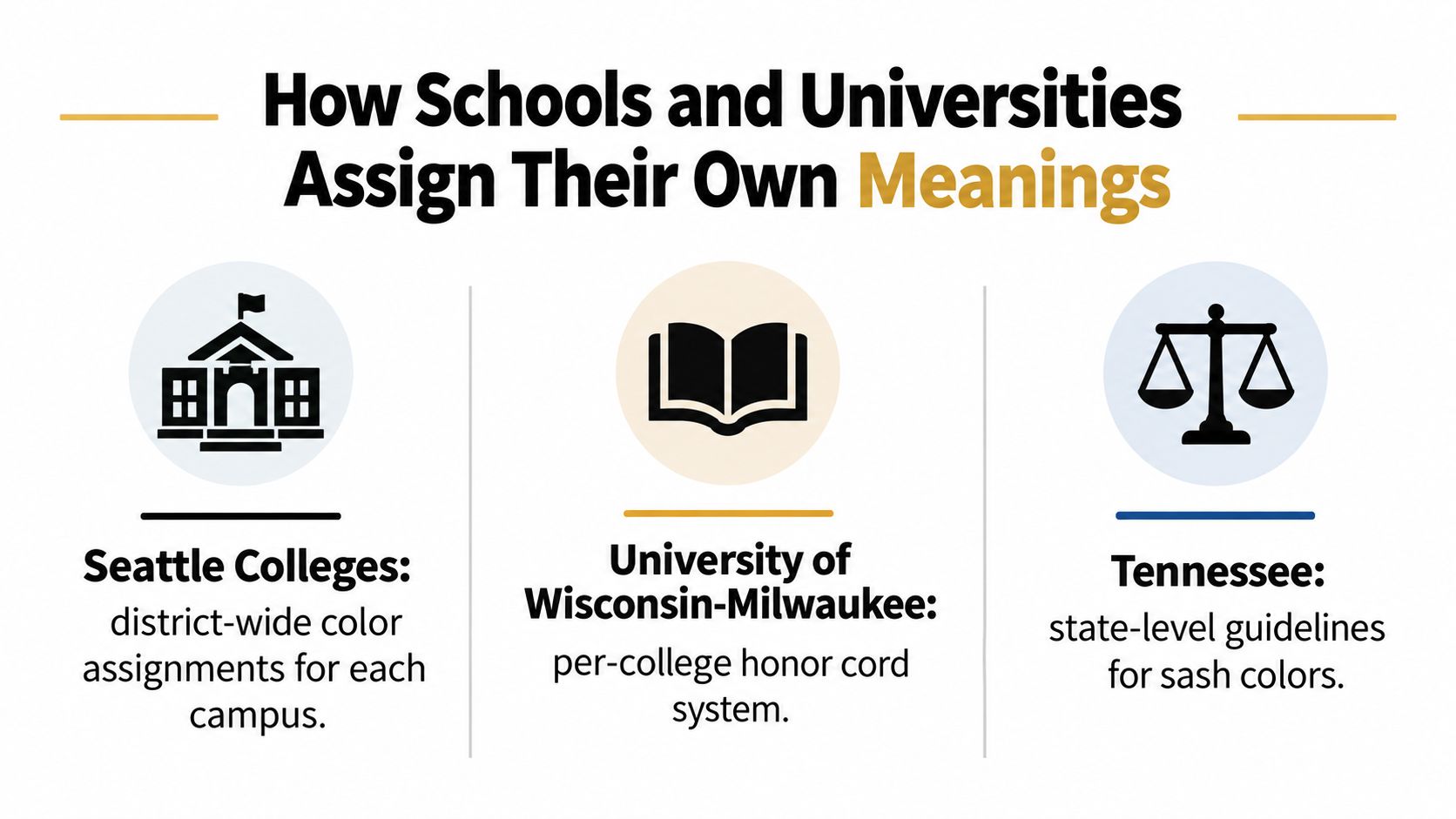
Seattle Colleges illustrates this layered system. Its guidance covers student groups, specific honors, degree types, student support programs, and affinity groups. It also describes multicolor flag-based stoles as signs of connection with, or heritage from, a country. In that guide, white stoles identify international students, while gold stoles identify Phi Theta Kappa Honor Society membership (Seattle Colleges regalia guidance). Because this link leads to Thomas Edison State University, readers should verify the applicable Seattle Colleges policy directly before relying on those assignments.
Three local systems
UWM uses a detailed item-by-item system. Its guide associates gold cords with commencement honors for high academic achievement, a pewter-colored stole with the Honors Degree, red-white-blue cords with veterans and military service members, teal cords with student donors supporting the senior class gift, and a black-and-gold stole with McNair Scholars (UWM color cord meanings).
A third-party regalia guide attributes additional meanings to Tennessee State University: a red, white, and blue cord for graduates who have served, or currently serve, in a branch of the U.S. military, and a green cord for graduates who made a monetary gift symbolic of their graduation year toward the TESU Foundation (Tennessee State honor cord meanings). Confirm these details with Tennessee State University before ordering.
The same color can therefore speak different dialects at different schools. Gold may refer to science in a traditional discipline system, high academic honor at UWM, or Phi Theta Kappa membership in the Seattle Colleges guidance. Color alone cannot settle the meaning.
Where to verify the rule
Check these sources before ordering:
- Registrar handbook: Review academic regalia and degree-color information.
- Commencement website: Confirm approved stoles, cords, hoods, and accessories.
- Student affairs pages: Search for affinity, leadership, service, veteran, and organization regalia.
- Direct confirmation: Email the commencement office with a product mockup or photograph.
Some schools reject store-bought stoles, limit width, require pre-approval, or permit only items awarded through an official program. A custom design can express the right identity and still violate the dress code. Local policy outranks any general internet chart.
Choosing the Right Colors for a Custom Stole
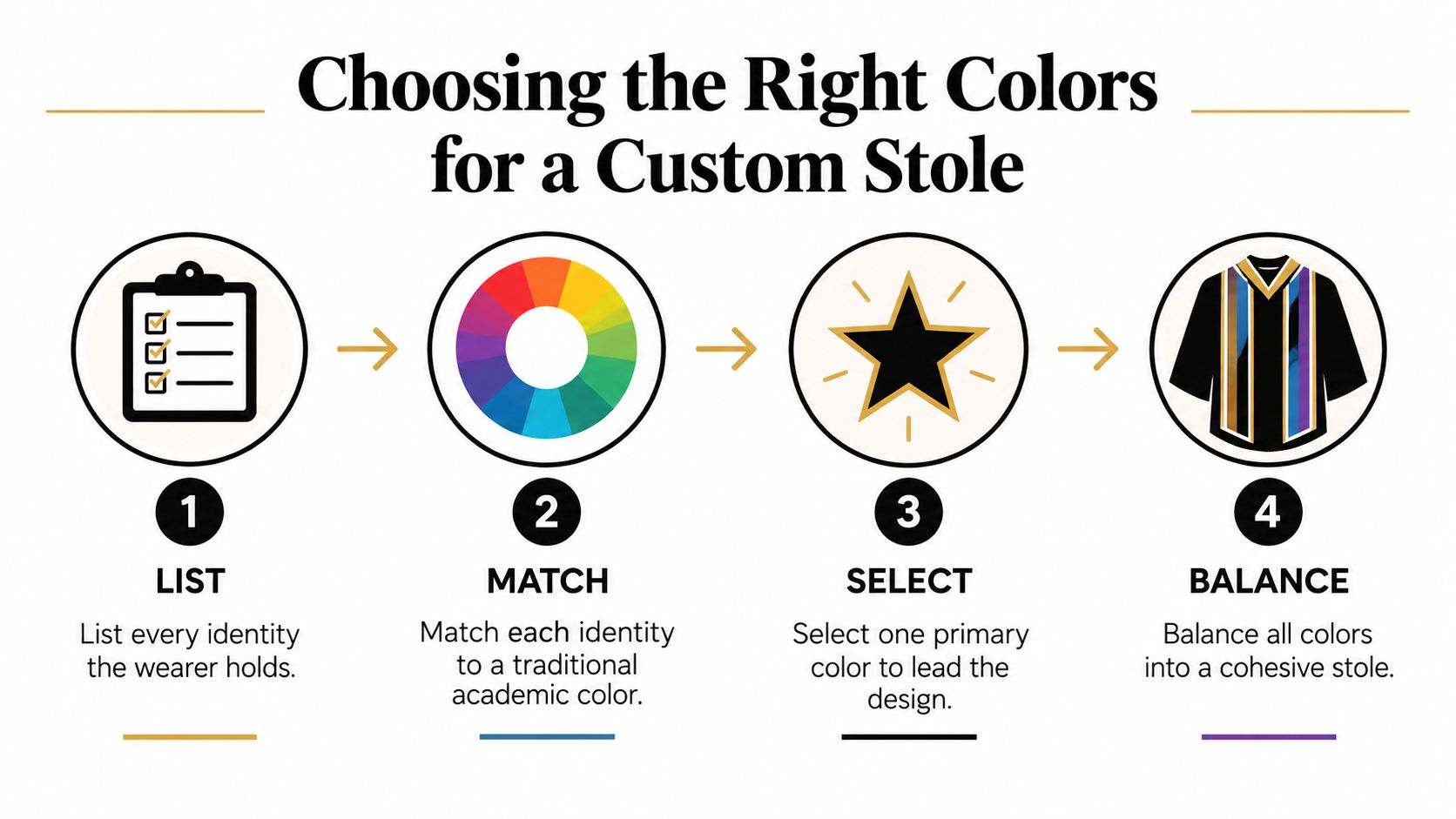
Start with the story, not the color wheel. A graduate may want to represent a major, family heritage, faith, organization, academic honor, and personal achievement. Trying to force every meaning into one crowded design can make the stole difficult for guests and photographers to interpret.
Four decisions before production
- List the identities that matter. Write down the major, honor, cultural background, faith tradition, organization, service history, and family connection the wearer wants represented.
- Separate the garments when necessary. A discipline may belong on the academic hood, an honor may belong on a cord, and a cultural affiliation may belong on a flag or heritage stole. Giving each message its own visual space often creates a clearer result than putting every symbol on one sash.
- Verify colors with the institution. Compare your proposed design with the published commencement policy. If the school assigns a specific shade to an honor, don't assume a similar shade from a vendor's catalog will carry the same meaning.
- Confirm production details. Ask about the customization process, embroidery placement, shipping schedule, and return policy before approving the design. A custom item may have different return conditions from a standard stole.
Let the material support the message
Satin creates a stronger sheen, polyester offers a familiar lightweight regalia finish, and eco-friendly fabric may suit a graduate who wants a different material choice. The surface changes how color appears under ceremony lighting and in photographs. A dark blue that looks nearly black indoors may read differently in direct sunlight, so review a digital mockup and, when possible, a physical sample.
Personalization can include a name, graduation year, degree, organization letters, flag pattern, or symbolic artwork. Keep the most important message near the front shoulder area, where family members and cameras can see it.
A custom stole expresses personal meaning, but it doesn't override a commencement dress code.
If the institution approves only one stole, choose the message with the clearest official connection. If multiple accessories are permitted, use the gown, hood, stole, and cords as separate layers rather than competing designs.
Ordering, Wearing, and Ceremony-Day Checklist
The week before graduation is the wrong time to discover that your color choice isn't approved. Begin by confirming the school's rules, then inspect the physical regalia before ceremony morning.
Verify before you buy
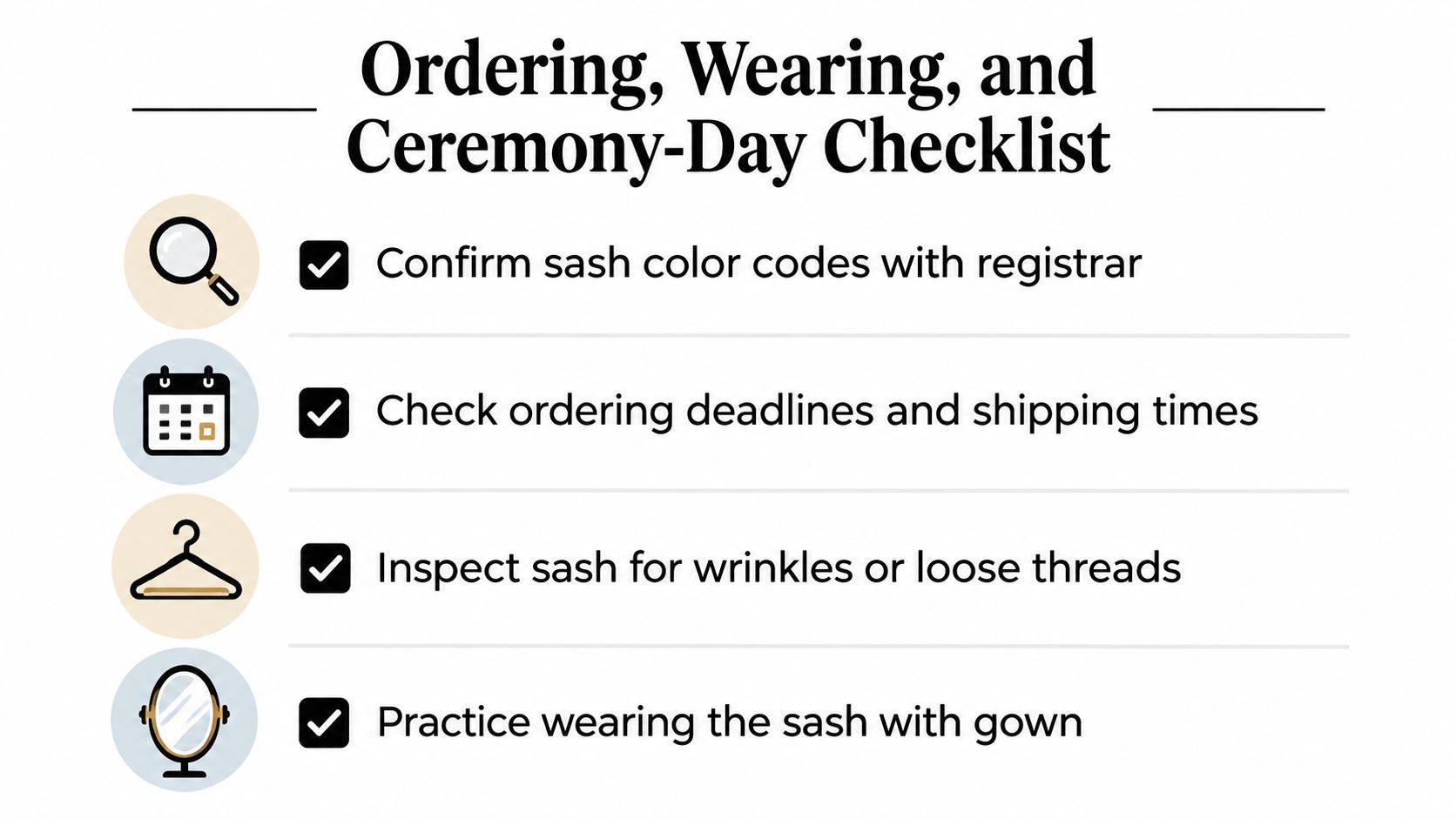
- Confirm the color code: Ask the registrar or commencement office what the color represents at your campus.
- Check cord distribution: Find out whether honor cords are awarded automatically, collected from a department, or ordered separately.
- Review stole restrictions: Confirm whether non-discipline stoles, cultural designs, Greek letters, or custom embroidery require approval.
- Check the deadline: Review production and shipping time for a custom graduation stole, especially if names or artwork are embroidered.
- Inspect the mockup: Verify spelling, degree wording, color placement, and embroidery location before production.
Fabric choice affects appearance and handling. Satin can reflect bright light, while polyester may look more matte. Check whether the stole sits comfortably over the gown and whether its width or length fits the school's expectations.
Put the layers in place
Start with the gown and zip it fully. Place the academic hood as directed by the school, then add the sash or stole over both shoulders. The front ends should hang evenly, and the V-shaped back should rest flat rather than twist beneath the hood.
Honor cords usually sit around the neck and over the gown and stole, but ceremonies can specify a different order. For practical guidance on arranging the layers, use this guide to wearing a graduation stole and sash.
Before leaving home, check the fit in a mirror, secure the cap if needed, and photograph the front and back of the completed regalia. Pack small pins, remove wrinkles according to the fabric instructions, and keep the stole on a hanger until departure. After commencement, store it clean and flat or hanging so the embroidery and trim remain presentable.
Stoles.com® offers customizable graduation stoles, international flag stoles, honor stoles, Greek-letter stoles, religious stoles, and honor cords for students and organizations. If you've confirmed your school's color policy and want a sash that reflects your heritage, achievement, or affiliation, visit Stoles.com® to explore the available designs.