

The most common advice about an RN graduation stole starts in the wrong place: choose a nursing color, add an RN symbol, and order. Your school's ceremony policy should come first. A stole that looks appropriate in a graduation photo may not be approved for your commencement, pinning, or hooding ceremony.
The useful question isn't just which nursing sash to buy. It's which accessory your program recognizes, what you're eligible to wear, and whether a personalized design belongs at the ceremony or only in your keepsake photographs.
What an RN Graduation Stole Is and Where It Came From
An RN graduation stole is a decorative sash draped around the neck and over the shoulders, usually over a commencement gown. It carries nursing-related lettering or an emblem, such as the Rod of Asclepius or Nightingale lamp, selected by the school or, when permitted, the graduate.
Think of it as a ceremonial name badge. It can identify your professional field, school, or training route, but it isn't a nursing license. RN lettering and degree lettering also communicate different things: RN identifies professional status, while BSN, MSN, and DNP identify academic degrees.
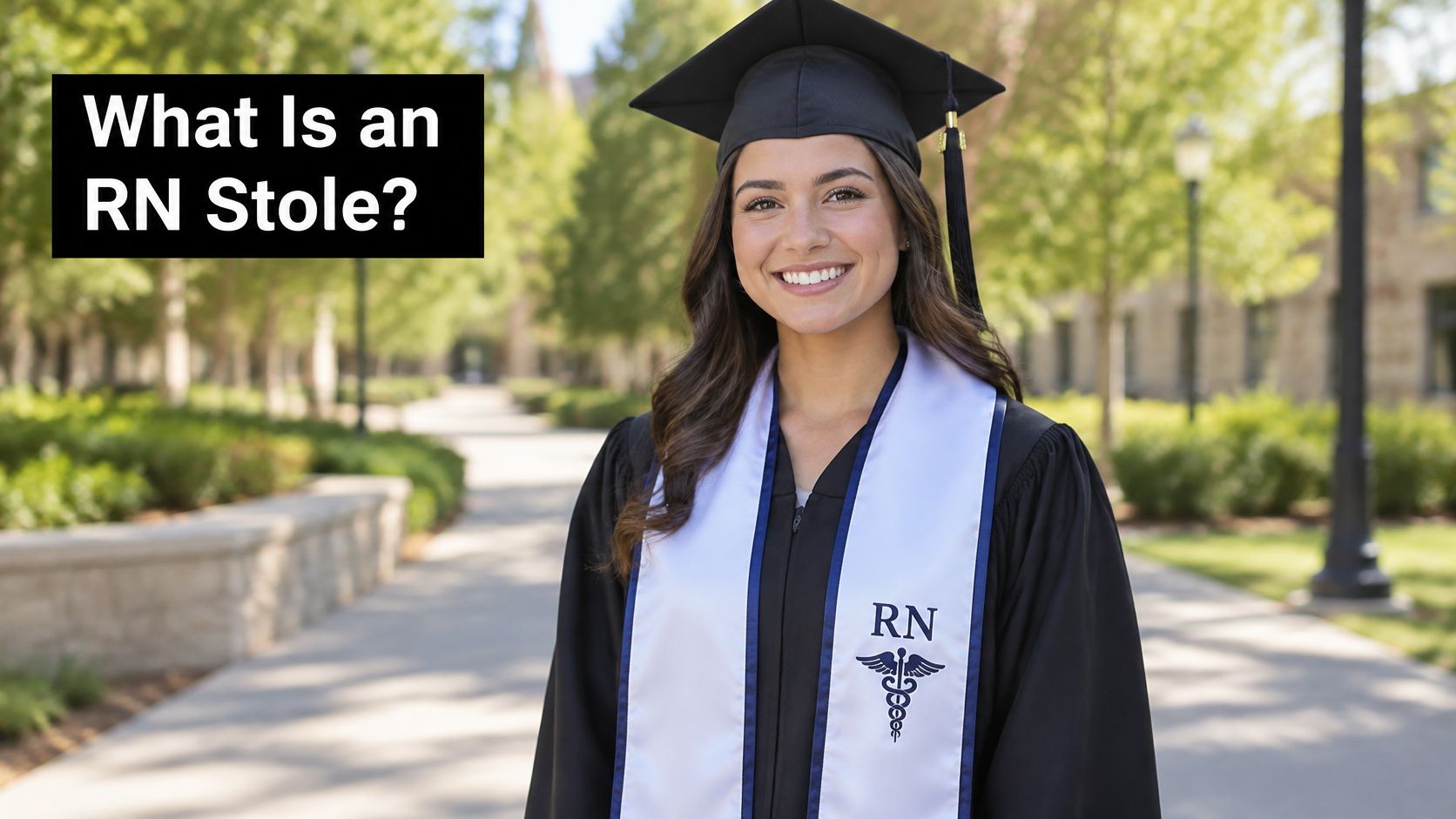
A nursing graduation sash can look like this, although the displayed design doesn't establish what your school permits.
Academic completion and professional identity
The diploma marks completion of an academic program. The stole or nursing pin can symbolize professional identity, institutional belonging, and a commitment to nursing service. For someone already practicing as an RN, that symbolism may recognize further education rather than initial entry into nursing.
The gown supplies the broader academic context. The history of academic regalia helps explain why graduates combine university dress with accessories that identify a discipline or organization.
The connection to nursing pinning
Nursing pinning developed from nineteenth-century traditions associated with Florence Nightingale, including accounts of her receiving the Royal Red Cross for Crimean War service and presenting medals or pins to outstanding students; King University's nursing pinning history describes nursing pins as standard recognition for United States nursing graduates by 1916.
That history explains the professional meaning surrounding modern nursing regalia, but it doesn't make every contemporary stole an official nursing symbol. A school-issued sash, an honor-society stole, and a commemorative RN sash may look similar while representing different affiliations.
Practical distinction: A stole identifies something about the wearer. The issuing school or organization determines what that identification means.
Which Symbol Fits Which Nursing Ceremony
Will you attend commencement, pinning, hooding, or a separate recognition event? Each event can require a different outfit, even when the same nursing department organizes them. Your school's instructions decide which symbols belong at each ceremony, because an RN stole works as an institutional identifier rather than a universal nursing credential.
The symbols send three separate messages. The gown and hood report your degree level. The stole or cord reports your program, honor, or affiliation. The pin marks your welcome into the profession. Schools combine those messages differently, so find your ceremony or pathway below and read the symbol alongside the school example. These examples illustrate institutional choices, not a universal dress code.
Nursing ceremony, typical symbol and school example
| Ceremony | Typical Symbol | Who Wears It | School Example |
|---|---|---|---|
| Degree commencement | Stole or honor cord over the gown | Undergraduates and graduate students | Each campus publishes its own approved-regalia list |
| Nursing pinning ceremony | Pin, often presented on the stole | BSN and ADN students | University of Maryland presents its pin on a red stole |
| RN-to-BSN and RN-MSN | Pin and stole only where the school includes them | Working RNs returning for a degree | UTHealth Houston includes RN-to-BSN students and separates regalia from pins |
| Graduate-entry pinning | Pin, plus a stole or regalia only where the program approves them | Graduate-entry students | Follow the school's approved-regalia policy |
| MSN and DNP hooding | Apricot hood worn over any stole or cords | MSN and DNP graduates | University of Cincinnati College of Nursing |
| PhD in nursing hooding | Dark-blue hood worn over any stole or cords | PhD graduates | University of Cincinnati College of Nursing |
The University of Florida's pinning guidance frames pinning as an undergraduate transition into nursing and encourages stoles and cords. That combination is common at pinning events, but it reflects a choice the school made, not a rule every program follows. Recognition events can also run less formally than commencement, which is why the printed instructions for your own ceremony outrank any general pattern.
Read the instructions for your pathway
Undergraduate ceremonies may emphasize the pin and an approved stole or cord. Graduate hooding adds a different academic symbol: the University of Cincinnati College of Nursing specifies apricot hoods for MSN and DNP graduates, dark-blue hoods for nursing PhD graduates, and placement over any stole or cords. The hood identifies the discipline and degree, so it stays consistent even when the accessories beneath it differ.
A white coat isn't interchangeable with these accessories. Wear one only when the event instructions call for it, rather than substituting it for a gown or pinning outfit.
RN-to-BSN, accelerated, bridge, and graduate-entry students should confirm whether they're included in each recognition event. Don't assume a ceremony announcement for traditional BSN students covers your pathway, and don't add cords from a previous institution without approval. A cord earned elsewhere still counts as institutional identification at your new school, so it needs the same clearance as anything else worn on the gown.
What Stole Colors and Emblems Signal at Nursing Schools
Color is evidence before it is decoration. A red, apricot, or purple RN graduation stole can identify a school in one ceremony and carry no official meaning in another, so treat color as an institutional identifier until the program documents otherwise. Buying by color alone can confuse a program identifier with an honor you have not earned.
Break the design into two signals before you read it. RN lettering, a nursing lamp, or another approved nursing emblem identifies the discipline. A cord, trim pattern, or society emblem may point to membership, service, or academic achievement, and each one needs its own permission trail.
Documented nursing stole and cord colors by institution
| Color or Emblem | Institution and Group | Who Qualifies | Meaning Note |
|---|---|---|---|
| Red stole with nursing logo | University of Maryland School of Nursing | BSN, RN-BSN and RN-MSN graduates | Pin presented on the stole |
| Purple stole with white trim and emblem, or purple-and-white cord | Montana State University Nursing Honor Society | Students with at least a 3.5 GPA who completed more than half of nursing courses, according to Montana State's regalia guidance | Defined academic benchmark |
| Lavender-and-white cord | Sigma Theta Tau International at University of South Carolina Aiken | Sigma honor-society members | Organization regalia limited to members |
| Blue-and-white cord | Student Nurses' Association at University of South Carolina Aiken | Association members | Recognized-organization regalia |
| Burgundy-and-gold stole | Student Nursing Government at University of South Carolina Aiken | Student government members | School-approved accessory |
The University of Maryland's graduation materials document its red nursing stole. The University of South Carolina Aiken's regalia policy separates organization accessories and limits organization regalia to eligible members. When a policy names an organization rather than a color, the member list controls who may wear it.
Translate meaning into a design specification
For an order, record the issuing organization, qualification, accessory type, and approved color reference. Ask the program to point to the written line that authorizes each element; a verbal “purple is fine” does not settle shade, trim, or emblem placement. A general guide to graduation stole colors and their meanings gives context, while the school document gives permission.
If an approved design includes an applied patch, attachment deserves separate attention. You can compare varsity patch backing options to understand backing choices before discussing suitability for satin; permission to use an emblem does not automatically authorize heat application.
If you cannot find the color's meaning in the school's written policy, do not assign one yourself.
Customization Options and the Approval Limits Schools Set
A personalized nursing graduation stole isn't automatically ceremony-approved. You may be able to design a meaningful keepsake that your school won't allow over the gown. Design freedom and ceremony permission are separate questions.
The customization choices below should be reviewed against your program's requirements before production.
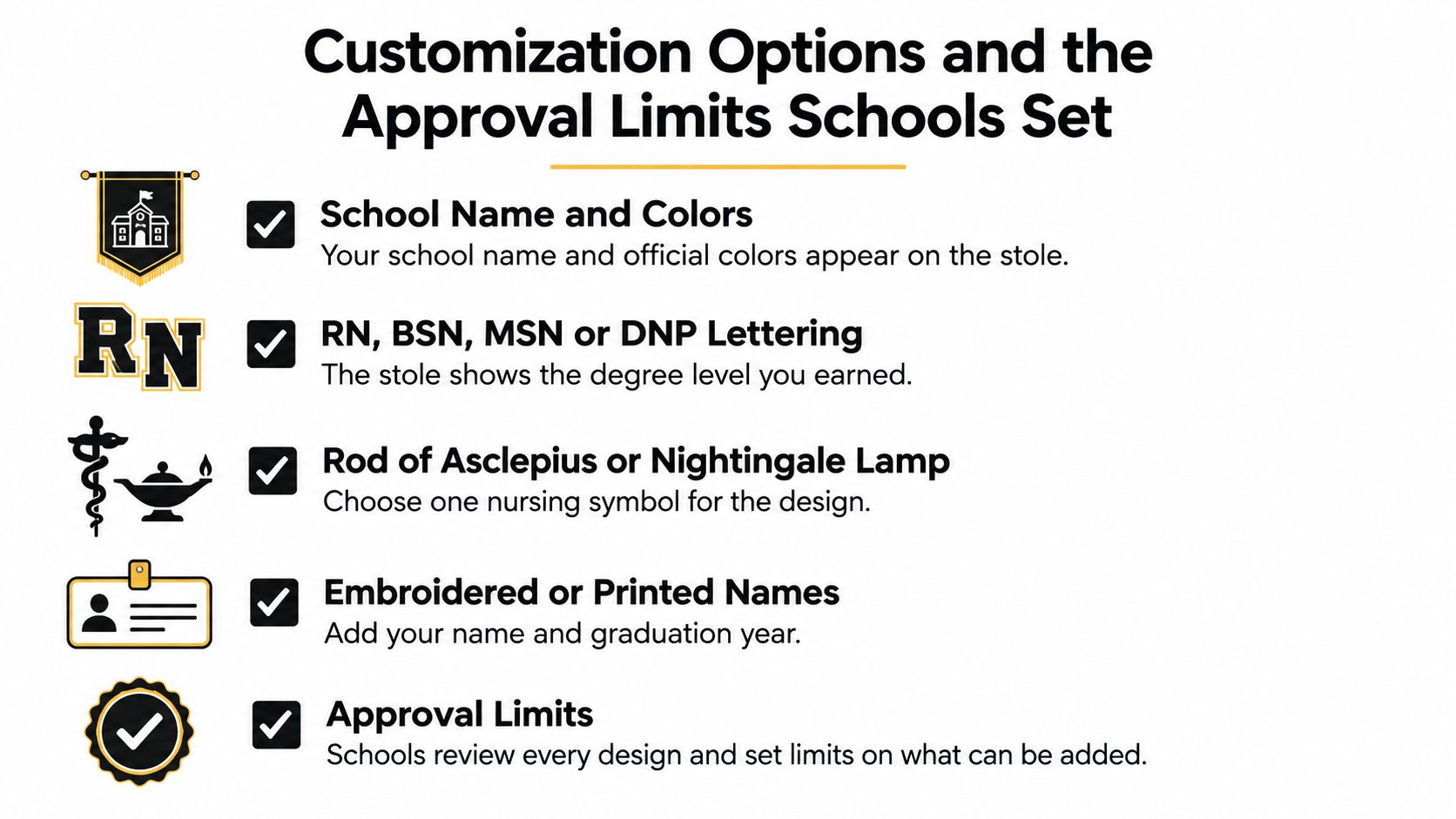
Options and their limits
- School name and colors. Request the official wording and approved color reference. Use the institution's supplied logo file rather than redrawing or stretching its mark.
- RN, BSN, MSN, or DNP lettering. Match the wording to the wearer's actual professional status and earned degree. Completing a nursing program doesn't by itself make RN lettering accurate.
- Nursing symbols. Ask whether the school approves the Rod of Asclepius, Nightingale lamp, or a specific institutional emblem.
- Names and graduation years. Check spelling against the graduate roster and confirm that personal text is permitted.
- Trim, lining, and decoration. Confirm the allowed layout before choosing contrasting panels, flag designs, patches, or extra embellishments.
Creating a custom graduation stole involves more than selecting attractive lettering. The artwork has to communicate the right identity without implying a degree, license, or honor-society membership the wearer doesn't hold.
Make the proof the approval checkpoint
Sigma's guidance on honor cords and stoles-new-chapter-development-process/sigma-honor-cord-stole-significance.pdf?sfvrsn=92720bf2_2) states that institutions determine whether its accessories may be worn, how they're positioned, and whether they represent nursing scholarship. A society's permission therefore doesn't override the university's ceremony rules.
Northeastern State University's approved nursing-association design combines RN lettering, the Rod of Asclepius, and the Nightingale lamp. That's an example of a school-defined design, not authorization to use the same combination elsewhere.
Some schools allow only college-approved accessories, and UTHealth Houston prohibits unapproved regalia and alterations. An attractive custom sash can therefore be refused at the ceremony.
For an institution-wide order, send the actual digital proof to the nursing office before production. Ask the reviewer to approve wording, marks, color placement, shoulder orientation, and eligibility, not merely the general idea of a nursing stole.
Sizing, Materials, Pricing and Lead Times for Your Order
Approval can take longer than choosing the fabric. The University of Colorado Anschutz accessory policy requires requests for new accessories at least three months before commencement. That deadline applies to new-accessory approval, not to placing a purchase order.
Build the schedule backward from ceremony day. The later windows below are recommended planning targets, not school rules or production guarantees.
Ordering milestones for an RN graduation stole
| Milestone | Target Window | Why It Matters |
|---|---|---|
| Request approval for a new accessory | By the institution's published deadline, including the advance requirement described above at Anschutz | Some schools won't accept later requests |
| Confirm colors, insignia and eligibility with the nursing department | Before ordering, at the start of the planning cycle | Policies can change between cohorts |
| Approve the digital proof | 6 to 8 weeks before commencement, recommended planning target | Catches protected-mark and RN/BSN/MSN errors |
| Production and shipping buffer | After proof approval, with margin before the fit check, recommended | Bulk orders need time for corrections |
| Distribute and check fit | 1 to 2 weeks before commencement, recommended planning target | Check length, trim and lining on arrival |
Check fit before comparing finishes
Measure the gown's shoulder-to-hem length and compare it with the school's specified stole dimensions. Then check the vendor's measuring convention, including whether a listed length covers the entire sash or its hanging portion. Don't choose length solely from a photograph of another graduate.
Try the stole with the actual gown when possible. Look for ends that hang evenly, lettering that remains visible, and fabric that rests flat rather than bunching at the neck. Graduate students should also check the arrangement with their hood.
Heavyweight bridal satin gives a glossy appearance. A matte finish looks more understated, while full lining keeps the reverse side neat when the sash moves or turns.
Compare equivalent quotes
Material, embroidery versus printing, trim, lining, personalization, and quantity all affect the order specification. Request an itemized quote so you can distinguish the base stole from optional work.
A single personalized stole and a coordinated cohort order shouldn't be treated as interchangeable quotes. Ask for the cost of the actual roster, artwork, and finish you intend to order, including shipping.
Ordering safeguard: Confirm the production schedule and delivery expectations in writing before committing to a ceremony-dependent order.
A proof-approval target isn't a promised arrival date. Leave room for school review, artwork changes, distribution, and inspection rather than treating shipping day as the end of the process.
How to Wear and Care for Your RN Stole
Prepare the complete outfit before ceremony day. A fitting lets you check lettering, pin placement, and shoulder alignment without trying to solve them in the graduate lineup.
Use the visual sequence as a dressing reminder, but let the garment's care label control cleaning. Hand washing isn't suitable for every decorated stole.
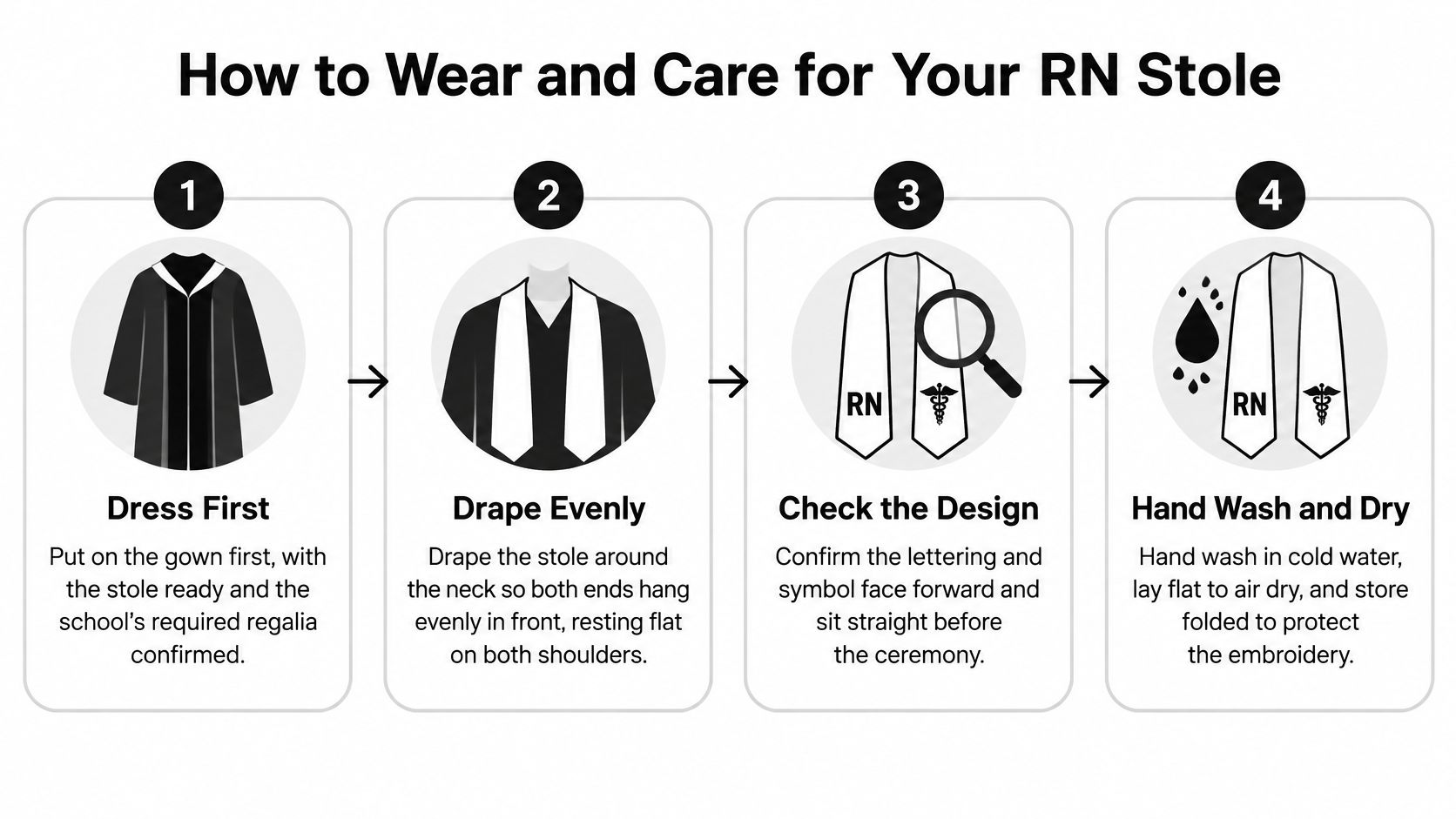
Dress and check placement
- Put on the gown first. Have the approved accessories ready and check the event instructions. A pinning outfit may differ from commencement dress.
- Drape the stole around your neck with both ends hanging evenly in front. Smooth the shoulders and follow any required left-right orientation so the lettering and emblem face forward.
- Add the hood when required. Arrange it over the stole and cords, then ask someone to check the back. Don't pull the stole outward over the hood just to expose more embroidery.
- Add only the honor cords your school permits. Multiple cords may be accepted, but traditionally only a single stole is worn, so don't stack nursing, cultural, and honor stoles without authorization.
- Attach the nursing pin exactly where the ceremony directs. Avoid piercing dense embroidery or creating unnecessary holes in satin; ask the nursing office about an approved attachment point.
A video demonstration can help you rehearse the arrangement before your fitting.
Clean and store without damaging decoration
- Remove the stole gently. Lift it from the shoulders while supporting the ends rather than dragging it over your head. Remove pins before cleaning or storage to avoid snags and pressure marks.
- If the care label permits, spot clean with a damp cloth and mild detergent. Test an inside corner first, blot rather than rub, and stop if dye transfers or the finish changes.
- Press only when the fabric and decoration allow it. Use low heat on the reverse with a pressing cloth between the iron and fabric, avoiding embroidery, printed areas, and attached embellishments.
- Store it clean and dry. Hang it flat against a clean backing or use a padded hanger away from direct sunlight. Keep pins separately, and avoid sharp folds across lettering if you plan to preserve the stole as a keepsake.
Confirm the Policy Before You Place Your RN Stole Order
The school's written policy comes before the shopping cart. Treat approval as part of ordering, not something to resolve after a personalized sash arrives.
For an individual graduate, use this sequence to turn the ceremony requirements into an accurate order.
Your individual order sequence
- Read the written regalia policy. Identify approved colors, insignia, and accessories for the specific event you'll attend. Check whether the school supplies the stole or expects you to purchase it.
- Ask your nursing advisor which symbol matches your pathway. Get a clear answer about whether a stole, pin, cord, or hood is expected.
- Confirm eligibility. If the accessory represents honors or society membership, verify that you qualify under the issuing organization's rules.
- Choose the permitted length, material, trim, and embroidery or printing. Keep the school-approved design requirements with your order notes.
- Approve the proof before production. Read every name and degree abbreviation, and check emblem placement against the approved artwork.
- Place the order with enough time for delivery and inspection. Keep the written approval and order confirmation together so you can resolve questions efficiently.
Coordinate a bulk nursing stole order
Institutions and chapters need a roster, not just a quantity. Build it with each graduate's name, degree, RN status where applicable, and graduation year; keep professional status separate from academic abbreviations.
- Centralize artwork. Send a single approved color reference and insignia file so different order contacts don't introduce conflicting versions.
- Review a sample. Check the fabric, lettering, lining, and placement before authorizing the full run.
- Plan spare stock deliberately. As a hypothetical planning allowance, a coordinator might budget 5 to 10 percent extra for late additions or replacements. Confirm that spare items can serve those needs, especially when names are personalized.
- Reconcile deliveries. Match every shipment against the roster and record distribution before ceremony day.
Nursing stole options to consider
At Stoles.com®, our 2026 RN Nursing Graduation Stole with Trim has a list price of $34.95, with an as-low-as price of $27.96. Our Nursing Graduation Stole has a list price of $24.95, with an as-low-as price of $19.96. We also offer custom graduation stoles and sashes in heavyweight bridal satin or matte finish, and every stole is fully lined, whether stocked or custom ordered.
Before budgeting, confirm the current listing, any sale price, and the conditions attached to as-low-as pricing. Match the approved specification to the available item rather than assuming a nursing product name guarantees ceremony acceptance.
Stoles.com® offers nursing graduation stoles and customizable graduation sashes for recognizing your nursing pathway. Bring your school-approved colors, lettering, and insignia to Stoles.com® to explore an RN graduation stole that fits both your achievement and your ceremony's requirements.