

A graduation hood is so much more than a colorful accessory—it’s a storyteller. When it's draped over your shoulders, this single piece of academic regalia instantly communicates your degree level, your field of study, and the university that granted you the honor. In a way, it’s a diploma you can wear. Understanding what is a graduation hood adds significant meaning to your commencement ceremony.
Decoding Your Academic Storyteller

As you get ready for commencement, you might be asking, "What exactly is a graduation hood, and why is it such a big deal?" Unlike a stole or cord, which celebrates specific achievements or affiliations, the hood is a formal symbol of your core academic journey. It's a tradition with roots stretching back centuries, designed to visually represent the culmination of all your hard work.
Think of it as a uniform that connects you to generations of scholars before you. Every part of the hood has a specific job, from its length and shape to the exact colors of its fabric. This standardized system allows anyone familiar with academic regalia to understand your accomplishments with just a single glance.
The Key Elements of a Graduation Hood
At its core, the hood uses a visual language to share the most important details about your degree. This language is made up of three main parts, each telling a piece of your unique academic story. The meaning of a graduation hood is woven into its very fabric.
To make it simple, let's break down what each component of the hood represents.
Graduation Hood Key Components at a Glance
| Component | What It Signifies | Example |
|---|---|---|
| Shell | The standard base of the hood. | Typically black fabric, matching the graduation gown. |
| Lining | The university that granted the degree. | The interior satin shows your school colors, often in a chevron pattern. |
| Velvet Trim | The specific academic field of study. | A light blue velvet band represents education, while a golden yellow represents science. |
Each of these elements comes together to create a complete picture of your academic identity.
Understanding these components transforms the hood from a simple garment into a meaningful emblem. It’s a public declaration of your discipline, institution, and the advanced knowledge you’ve worked so hard to acquire.
While the hood formally represents your degree, many graduates choose to add some personal flair with other accessories. For instance, you can complement your regalia with custom graduation stoles from Stoles.com to celebrate your unique heritage, club memberships, or personal milestones, creating a look that honors both tradition and individuality.
The Centuries-Old Story Behind Your Graduation Hood
That hood draped over your shoulders is more than just a piece of fabric—it's your connection to a tradition that stretches back nearly a thousand years. It wasn't invented for modern graduations; its story begins in the cold, drafty halls of medieval European universities. Just picture it: scholars and monks in the 12th and 13th centuries, huddled over texts.
Originally, the hood wasn't a separate item at all. It was a practical part of a cloak called a cappa clausa, essentially a built-in cowl that could be pulled over the head for warmth, just like a modern hoodie. For the scholarly class, it was simply part of the daily uniform.
As centuries passed and buildings got better heating, the hood's practical purpose faded. But as its function diminished, its symbolic importance grew. It slowly transformed from everyday clothing into a powerful marker of academic achievement.
From Practicality to Prestige
The shift from a functional garment to a ceremonial one didn't happen overnight. By the 14th century, universities in England began writing statutes that required specific long gowns and hoods to formally identify who was a student and who was a professor.
Early on, these hoods were pretty simple and dark. But soon, a visual hierarchy started to take shape. While undergraduates stuck with plain black, those with higher degrees were allowed to line their hoods with expensive materials like silk or fur. This made it easy to see who was who at a glance. You can dive deeper into this evolution by exploring the complete history of academic regalia in our guide.
This system of using different materials and designs became a language of its own, signaling a graduate's rank and field of study long before any official color code existed.
The American Standardization
For hundreds of years, academic dress in the United States was a free-for-all. Every college had its own rules, which led to a lot of confusion. That all changed in 1895 when the American Intercollegiate Commission got together to create a unified system for academic regalia.
This commission created the Intercollegiate Code, which set the standards for the shapes, sizes, and colors of hoods that we still use today.
The code established that a hood's length and shape would show the degree level (bachelor's, master's, or doctoral). The color of the velvet trim would represent the field of study, and the satin lining would display the official colors of the university granting the degree.
This was a game-changer. It brought a sense of order to graduation ceremonies across the country, creating a shared visual language of academic success. Now, a hood from any U.S. university could be instantly "read" and understood. This tradition is so powerful that today, over 85% of the world's top universities feature hoods in their ceremonies, a true testament to its enduring legacy.
Decoding the Colors and Meaning of Your Hood
Every single color on your graduation hood tells a part of your academic story. It’s like a visual language—once you learn to read it, you can instantly understand where someone went to school and what they studied. This system turns your regalia into a wearable credential, making your hard-earned degree recognizable with just a single glance.
The meaning of what is a graduation hood is all wrapped up in three key elements: the black shell, the satin lining, and the velvet trim. Each part has a specific job in telling your story, and together they create a complete picture of your academic identity. Knowing what they mean adds a much deeper appreciation for the tradition you're about to join.
The Foundation: The Black Shell
The outermost part of the hood is the black shell, which is almost always made from the same fabric as your graduation gown. Think of this as the classic, formal foundation of your whole look.
Its uniform black color represents the seriousness and dignity of your scholarly work. It provides a traditional backdrop that really makes the other colors pop.
Your University Colors: The Satin Lining
Now for the fun part. The most vibrant section of the hood is the satin lining, which gets folded outward to show off the official colors of your university.
For instance, a graduate from Stanford University would have a bold cardinal red, while a Yale graduate would display a deep Yale blue. These colors are often arranged in a specific pattern, like a chevron, to make them even more distinct. This lining is a powerful symbol of school pride, connecting you to your alma mater and all the graduates who walked the stage before you.
Your Field of Study: The Velvet Trim
The final piece of the puzzle is the velvet trim—that colored band that runs along the edge of the hood. This color is arguably the most important because it tells everyone what you actually studied. This color code is standardized across nearly all universities, making your academic discipline universally recognizable.
This system creates a shared language across all of academia. To see what these colors mean for different majors, you can check out our detailed guide on graduation hood colors.
For example, light blue represents the field of Education, while golden yellow signifies Science. A graduate with a Master of Arts in English would wear a hood trimmed in white, the designated color for Arts and Letters.
This color-coding allows your friends, family, and professors to immediately recognize your area of expertise. It's a visual celebration of all the specialized knowledge you’ve gained. You can even coordinate this velvet color with other accessories, like a custom honor stole from Stoles.com, to create a sharp, personalized look that tells your complete academic story.
How Hoods Differ by Degree Level
Not all graduation hoods are the same, and that’s entirely by design. The size and shape of a hood are carefully standardized to communicate your academic rank, creating a clear visual hierarchy for everyone in the room. This system, largely guided by the American Council on Education, allows anyone to quickly recognize the level of achievement a graduate has earned.
Think of it like the stripes on a military uniform—academic regalia uses the length and width of the hood to distinguish between bachelor's, master's, and doctoral degrees. The progression just makes sense: as the degree level goes up, the hood gets longer and more elaborate, showing the greater time and effort you’ve put in. This system makes sure the highest academic honors are instantly recognizable during the commencement ceremony.
This hierarchy is built from a few core components that create the hood's symbolic meaning.
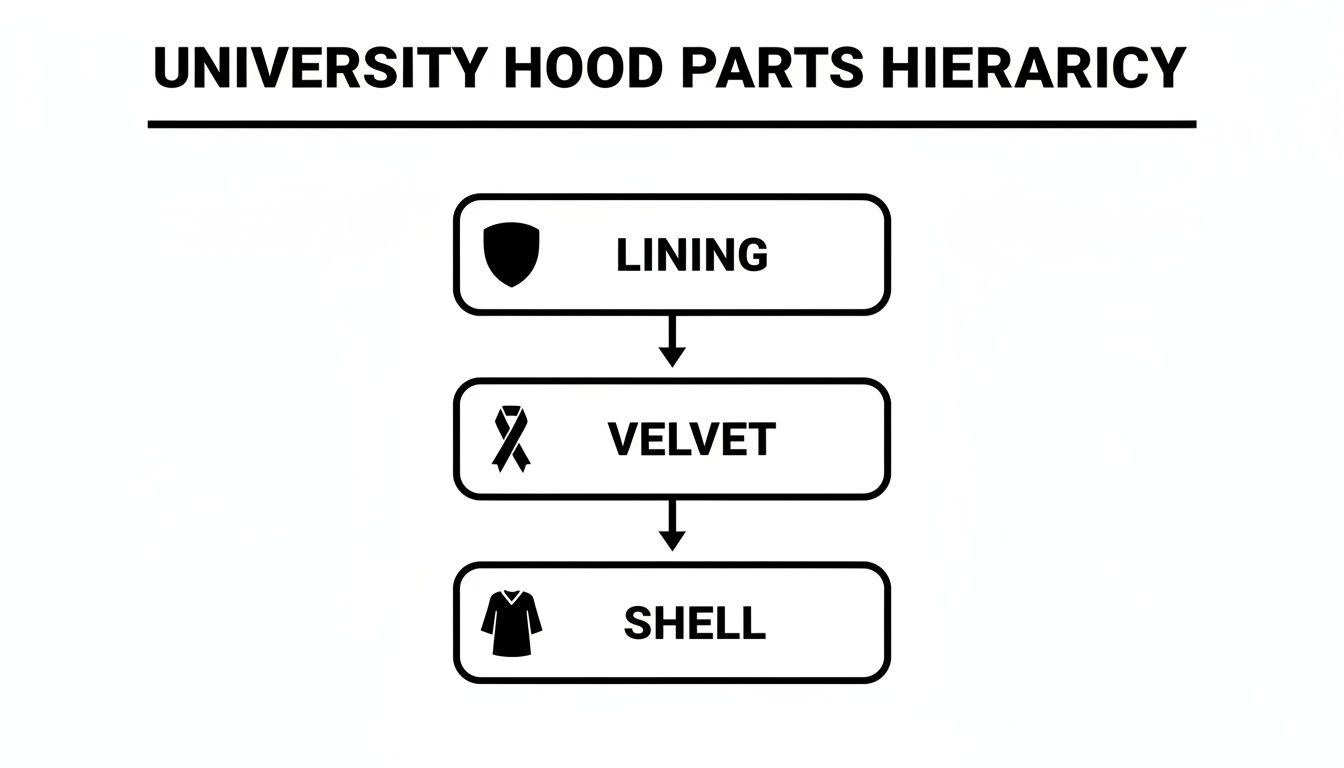
As the diagram shows, the shell, velvet, and lining all work together to tell your story, with each piece playing its own distinct role in the final look.
A Clear Academic Progression
You can see this story play out clearly as you move up the academic ladder. Each degree has its own specific hood that reflects its place in the hierarchy.
To make these differences crystal clear, here’s a simple breakdown of what to look for at each level.
| Feature | Bachelor's Degree | Master's Degree | Doctoral Degree |
|---|---|---|---|
| Length | 3 feet | 3.5 feet | 4 feet |
| Velvet Trim Width | 2 inches | 3 inches | 5 inches |
| Overall Shape | Simple, short | Longer, fuller shape | Longest, with wide panels |
| Commonality | Less common; many schools don't issue them | Standard for most master's programs | The highest standard for doctoral grads |
This table shows just how intentional the design is. Let's look a little closer.
Bachelor's Hood
The bachelor's hood is the simplest and shortest of the bunch, measuring three feet long. It has a narrow, two-inch velvet trim that signals the foundational nature of an undergraduate degree. Honestly, you won’t see them as often these days, as many universities have stopped issuing hoods for bachelor's degrees.
Master's Hood
The master's hood is a serious step up. It's noticeably longer at three and a half feet and features a wider, three-inch velvet trim. That extra size and more prominent velvet band are there to signify a deeper level of specialized knowledge.
Doctoral Hood
Sitting at the top of the academic ladder is the doctoral hood. This one is the most impressive, coming in at a full four feet in length. It boasts wide, five-inch velvet panels and a broader shape that opens up to display the university’s colors more dramatically.
The doctoral hood's grand size and prominent velvet panels aren't just for show; they are a direct visual representation of the highest level of scholarly achievement.
Understanding these differences helps you appreciate where your own degree fits into the larger academic world. And while the hood’s design is standardized, you can always add a personal touch with other regalia. For instance, pairing your hood with custom flag stoles lets you celebrate your heritage alongside your academic success, creating a look that is both traditional and deeply personal.
How to Wear Your Graduation Hood Correctly
Let's be honest, figuring out how to put on your graduation hood can feel a little clumsy, especially with all the pre-ceremony chaos. But don't worry, a few simple steps are all it takes to wear this important piece of regalia with the confidence your achievement deserves.
This guide will walk you through it, no guesswork involved.

First things first: get your graduation gown on and zipped up completely. The hood is designed to go over the gown, so having that base layer secure is step one.
Positioning the Hood
Drape the hood over your head. You want the velvet trim closest to your neck, letting the rest of the fabric hang down your back. The small, pointed tail of the hood—that’s the liripipe—should be at the front.
Think of it like putting on a very fancy, symbolic scarf. The velvet side should face up, clearly visible from the front, while the main part of the hood lies flat against your back.
At this stage, your hood will probably just look like a black shell with a velvet border from behind. If you're wondering where all the color is, you're on the right track! The big reveal comes in the final step.
For a more detailed look, you can check out our full guide on how to wear academic regalia like a pro. It'll give you that extra bit of confidence for the big day.
Securing the Hood in Place
To keep your hood from slipping around, you need to anchor it. Look at the front part near the velvet trim and you should find a small loop or cord. This is made to fasten to a button on your shirt or dress.
No button? No problem. A simple safety pin can be used to attach the loop to the inside of your gown. This little trick is a lifesaver—it keeps the hood from sliding back or feeling like it’s choking you mid-ceremony.
Turning Out the Colors
This is the final and most satisfying step—it's time to show off those school colors. Reach behind you to the black shell of the hood and gently flip the colorful satin lining outward, starting right in the middle of your back.
You're just turning out the top portion of the lining so it drapes over the black fabric. This creates that iconic, layered look that really showcases the meaning of what is a graduation hood. Once that's done, you're all set.
Personalizing Your Look Beyond the Hood
While the academic hood is definitely the centerpiece of your formal graduation attire, it’s not the only piece that tells your story. Think of the hood as the official record of your degree and university. Now, you get to add your own personal chapters.
This is where graduation stoles and honor cords come into play. They’re fantastic ways to personalize your look, letting you showcase the groups, achievements, and heritage that made your time at school so memorable. They work right alongside your hood to create a look that's both traditional and uniquely you.
Beyond the regalia itself, many graduates and their families also want to find ways to mark the occasion. Finding meaningful graduation keepsakes can be a wonderful way to hold onto the memories of the big day.
Stoles and Cords: An Extension of Your Story
Graduation stoles and cords essentially turn your gown into a canvas of your college experience. Unlike the hood, which follows a very strict symbolic code, these accessories give you the freedom to express your individuality.
- Graduation Stoles: These are the wide sashes you see draped over the shoulders, and they're perfect for making a bold statement. You can celebrate your background with an international flag stole, show pride in your fraternity or sorority with a Greek stole, or represent your academic department.
- Honor Cords: These are the twisted ropes, usually in specific colors, that signify membership in an honor society or high academic achievement. They add a simple but distinguished touch to your outfit.
Creating a Cohesive Look
The secret to personalizing your regalia without it looking messy is coordination. You want your stoles and cords to complement your hood, not clash with it.
A smart move is to match an accent color from your stole to the velvet trim of your hood. For instance, if your hood’s velvet is light blue for the field of education, choosing a custom stole that features light blue embroidery creates a look that feels polished and intentional.
By thoughtfully selecting stoles and cords, you can weave your personal narrative into the formal tradition of commencement. This creates an unforgettable look that honors both your academic achievement and your individual path to success.
Got Questions About Graduation Hoods? We've Got Answers.
As your big day gets closer, it's totally normal for questions about graduation regalia to pop up. Getting a handle on the details of your academic hood now will help you feel cool, calm, and collected when you walk across that stage. Let’s tackle some of the most common things graduates wonder about.
From whether you can keep it to why there's a whole ceremony for it, getting these details straight means you'll know exactly what to expect.
Do I Get to Keep My Graduation Hood?
This really comes down to your university's policy. Lots of schools rent regalia to students, which means the cap, gown, and hood have to be returned right after the ceremony. You'll see this a lot, especially for undergraduate programs.
However, for master's and doctoral degrees, many institutions give you the option to buy your regalia. Owning your hood turns it from a one-day rental into a permanent reminder of a massive academic achievement.
What Is a Hooding Ceremony?
A hooding ceremony is a pretty special event, usually held for students earning master's or doctoral degrees. It’s often a more personal and intimate gathering than the main commencement and is packed with tradition.
During the ceremony, a faculty mentor or dissertation advisor is the one who places the academic hood over the graduate's shoulders. It’s a powerful moment that signifies the student's journey is complete—they are no longer just a mentee, but a true peer in their academic field. It’s a formal welcome into the community of scholars and a beautiful way to honor both the graduate's hard work and the mentor who helped them get there.
What’s the Difference Between a Hood and a Stole?
The biggest difference between a graduation hood and a stole is what they represent.
A graduation hood is a formal piece of your academic uniform. It’s standardized to show your degree level (bachelor's, master's, or doctoral), your specific field of study, and the university you graduated from. Its colors and design follow a strict, centuries-old academic code.
A graduation stole, on the other hand, is all about personalization. It's a decorative sash that lets you celebrate your unique story—your individual achievements, affiliations, or identity. You might wear a stole to represent:
- Membership in an honor society
- Your fraternity or sorority
- Your cultural or national heritage
Stoles aren't a required part of the formal regalia, but they've become an incredibly popular way for graduates to showcase the experiences that made their time at school truly their own.
Can High School Students Wear Hoods?
Nope, graduation hoods are strictly for higher education. The entire system—the colors, the lengths, the shapes—is tied directly to the structure of bachelor's, master's, and doctoral programs. High school grads wear the classic cap and gown and can add accessories like stoles or cords to show off honors, but the hood is a tradition that belongs uniquely to the university world.
At Stoles.com, we believe every part of your story deserves to be celebrated. While your hood represents your formal degree, a custom graduation stole can showcase your personal journey. Explore our collection to find the perfect stole to complement your regalia and tell your complete story on graduation day. https://www.stoles.com