

Does a black stole for graduation signify an honor, or does it just look official? That's the question to answer before choosing embroidery, matching accessories, or placing an order.
A graduation stole can express something personal, but commencement is also a school-governed ceremony. The right choice should reflect your story, fit your regalia, and meet your institution's requirements.
What a Black Graduation Stole Means
Consider a graduate choosing a black stole with gold lettering. It looks formal beside the cap and gown, so the family assumes it represents academic honors. Before ordering, however, the graduate discovers that the design needs to identify an approved organization, not just look ceremonial.
That's an illustrative situation, not a universal school rule. It highlights the central distinction: appearance and official meaning aren't the same thing. Color alone doesn't reliably establish academic achievement, cultural identity, or recognition; the embroidery, insignia, authorization, and ceremony rules determine how a stole should be understood. Check the institution's requirements, such as Purdue's graduate attire guidance, rather than relying on color assumptions.
Start with the graduate's story
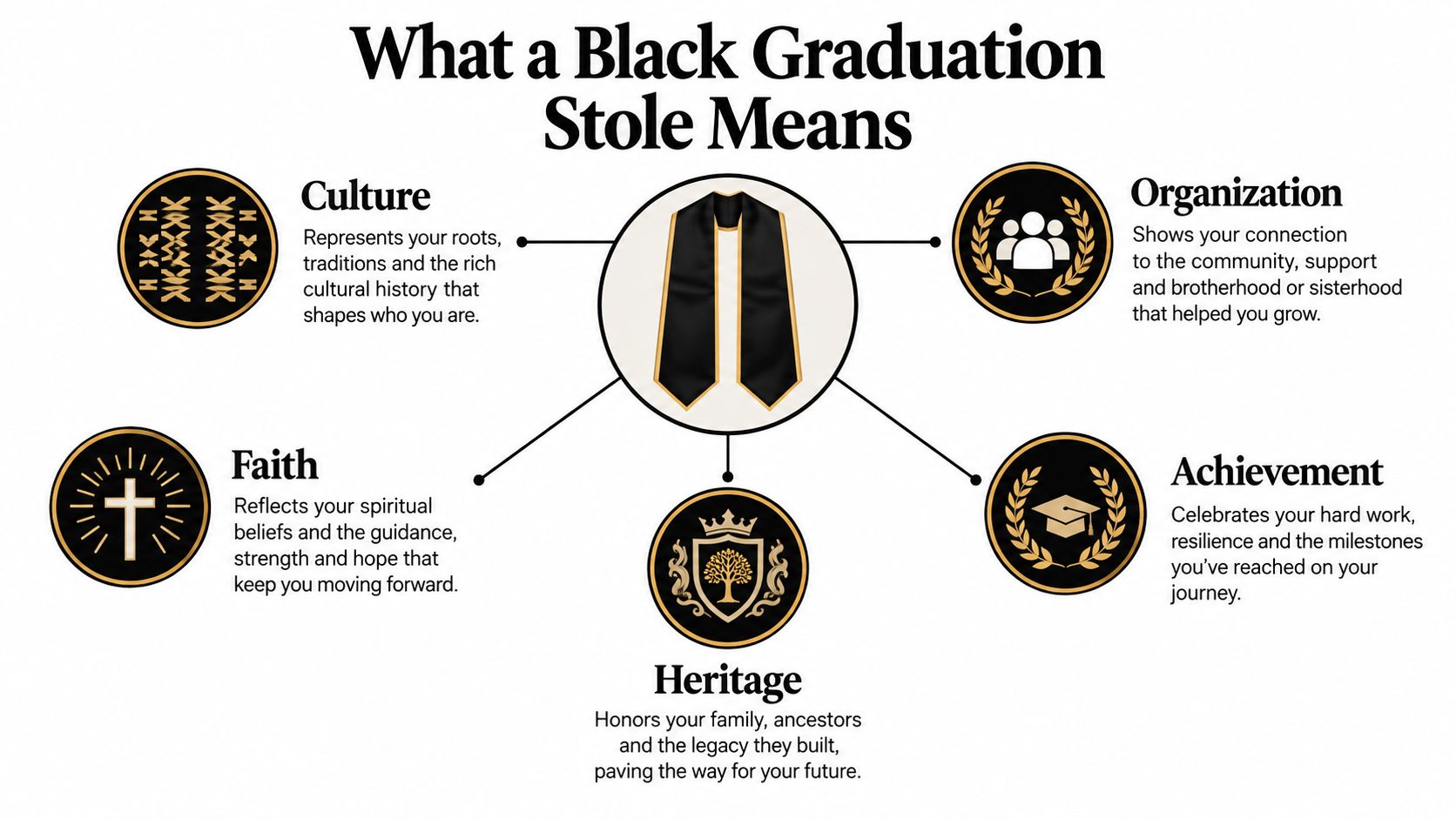
A black graduation stole can provide a background for a family name, cultural design, faith symbol, organization emblem, or recognition earned through school. The useful question isn't just whether black looks appropriate. It's what the finished accessory should communicate.
- Personal identity: A heritage design can acknowledge the people and traditions that supported the graduate.
- Group affiliation: An approved emblem can identify participation in an organization.
- Achievement: Authorized wording or insignia can identify a particular recognition.
The concept map below separates these possible meanings without assigning a universal status to black.
For a family-designed celebration certificate, CertSeal's modern high school diploma template offers a related black-and-white design reference. Keep a commemorative certificate separate from an official school credential, just as you'd distinguish a personalized stole from school-awarded recognition.
Choose the message first. Then determine which approved design communicates it clearly.
The History of Black Academic Dress
Black academic clothing predates today's personalized graduation accessories. Its roots lie in medieval European universities, where academic dress developed partly from the ecclesiastical clothing worn by scholars. That connection helps explain the formality associated with black regalia, as described in USC Aiken's history of academic dress.
The history matters because a black stole sits within an established ceremonial appearance. A graduate may choose contemporary lettering or a flag design while retaining a traditional foundation.
From university practice to a shared code
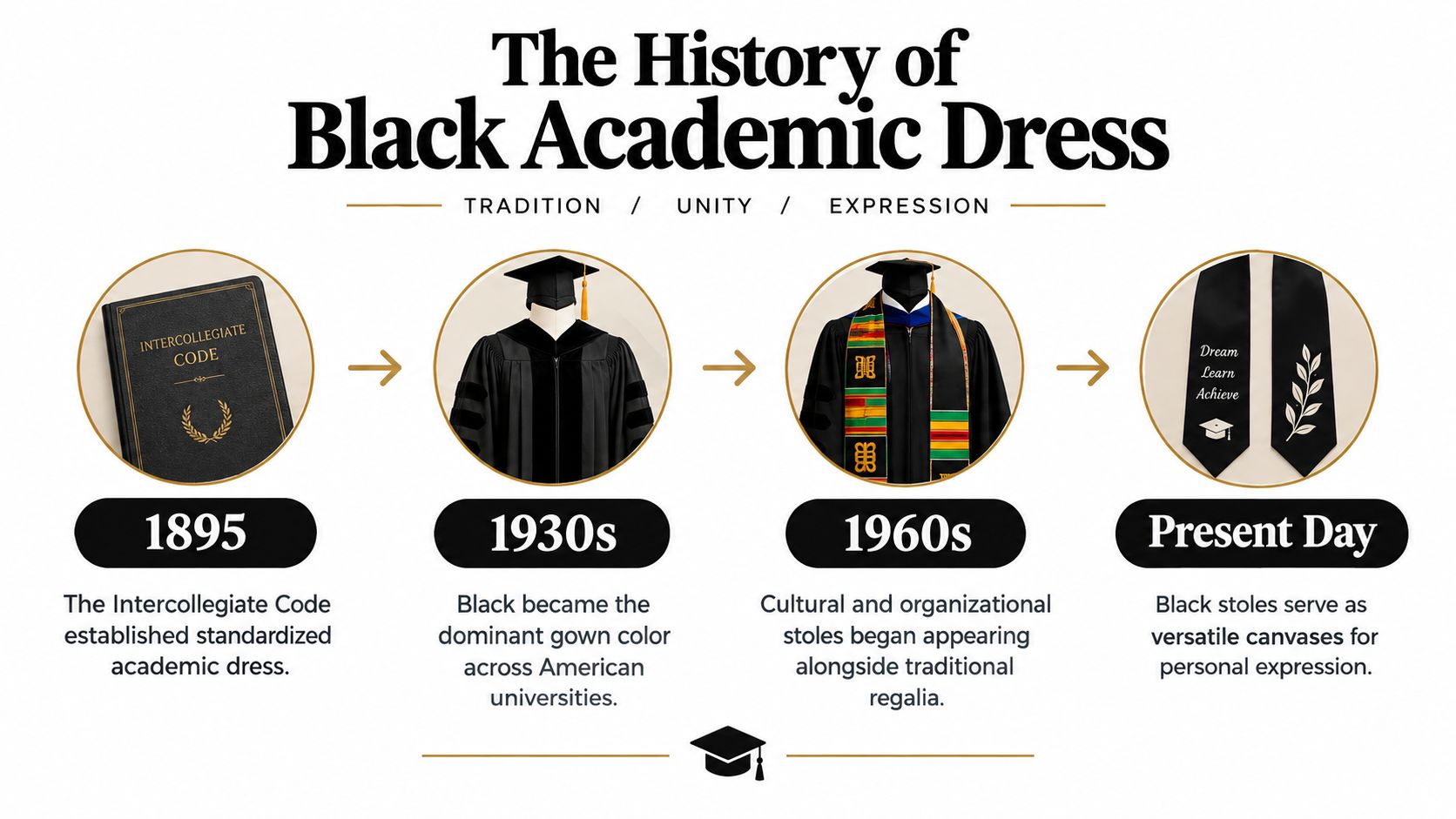
Black garments appeared in American higher education before a national academic costume system existed. Harvard permitted a black commencement gown in 1807, and Princeton adopted black gowns and square caps, according to the history of academic regalia in the United States.
The same historical account identifies 1895 as the year the Intercollegiate Code of Academic Costume standardized American academic dress, sanctioning black as the base color for gowns, caps, and hood shells. Representatives from Princeton, Yale, Columbia, and New York University helped develop the code in response to variation in academic clothing.
Historical distinction: The tradition explains why black looks familiar at commencement. It doesn't establish the meaning of every modern black stole.
The timeline graphic provides a visual companion to that history. Its broader stylistic milestones shouldn't be treated as a universal adoption schedule across institutions.
What that history means for your choice
Think of the traditional black foundation and the personalized stole as related but distinct. The gown connects the wearer to the academic ceremony; the stole's approved design can add an individual or organizational story.
For more context, the history of academic regalia is a useful starting point. When shopping, use that background to choose intentionally, not to assume that a historically familiar color automatically satisfies current school rules.
Choose the Right Size and Material
A stole can look balanced in a product photograph and hang differently over your actual gown. Evaluate it on the intended wearer, with the approved hood and accessories in place, rather than judging length against everyday clothing.
Begin with the school's specifications. Some guidance describes stoles approximately 3–5 inches wide and 68–74 inches long, with decoration around 12 inches on each side, but these are examples to verify, not universal sizing rules, as explained in this graduation stole sizing and construction guide.
Measure the complete outfit
Use a flexible tape to follow the path the stole will take around the back of the neck and down the front. Ask someone to check the position while you stand naturally.
- Check the endpoints: Both panels should fall evenly without covering an important medal or approved garment detail.
- Inspect the shoulder position: Look for bunching near the neck or panels that slip outward.
- Test movement: Sit, stand, and walk in the gown before accepting the fit.
- Photograph the layout: Review a full-length image, not only a close-up of the embroidery.
A product described as a universal fit still needs this check. Treat that description as a starting point, not a promise that the stole will suit every wearer or regalia combination.
Separate fabric appearance from construction
Satin describes an appearance and weave, while polyester and nylon describe fibers. A satin-like stole and a polyester stole therefore aren't necessarily competing categories. Ask the seller to identify both the fabric composition and its finish.
| Feature to evaluate | What to look for |
|---|---|
| Smooth, reflective finish | Whether the appearance suits the gown and photographs |
| Fabric and lining | Whether the panels feel balanced and hang comfortably |
| Embroidery density | Whether heavily decorated areas pull, twist, or become stiff |
| Thread contrast | Whether names and symbols remain readable against black |
| Seams and edges | Whether stitching is secure and edges lie flat |
Metallic gold, white, silver, or a bright approved school color can provide contrast on black. Don't judge readability only from an enlarged digital proof.
For a chapter or institutional order, request a preproduction sample. Inspect its drape, seam strength, colorfastness, and lettering before committing to the full order, using the construction considerations in the sizing guide above.
Customize and Order a Black Stole
A graduate can sketch a black stole that honors her grandmother's flag, then learn at rehearsal that unassigned personal stoles are restricted. The color did not cause the problem. Approval did.
Treat ordering as three gates: message, permission, production. First write one sentence naming what the stole should communicate, such as “family heritage on the left panel, authorized society letters on the right.” Second, send that sentence to the office or chapter that controls regalia and ask what is reserved, what needs written approval, and what deadline applies. Third, give the seller only the approved version. That sequence keeps identity and compliance in the same decision instead of letting a pretty mockup make the decision for you.

Make the proof do real work
Use the proof to freeze every changeable detail: spelling, accents, dates, name order, flag orientation, emblem permissions, thread colors, placement, dimensions, and material. Ask for the file name, date, and approver to be shown on the final version so a buyer, coordinator, and producer cannot circulate three different “final” designs. The custom graduation stole guide can help turn those choices into a single specification.
A digital preview confirms layout. It cannot certify that an organization's letters may be used, that a flag is oriented correctly for your school, or that a last-minute discount matches the approved fabric. Keep answers in writing.
Plan for the arrival window
Order early enough to allow one correction cycle. When the package comes, match each stole to the approved proof and recipient list before removing tags. Photograph any mismatch beside the proof, keep the invoice and authorization together, and contact the seller with a precise description. Small fixes are easier before the lineup photo than after the procession starts.
Compare Black Stole Styles and Meanings
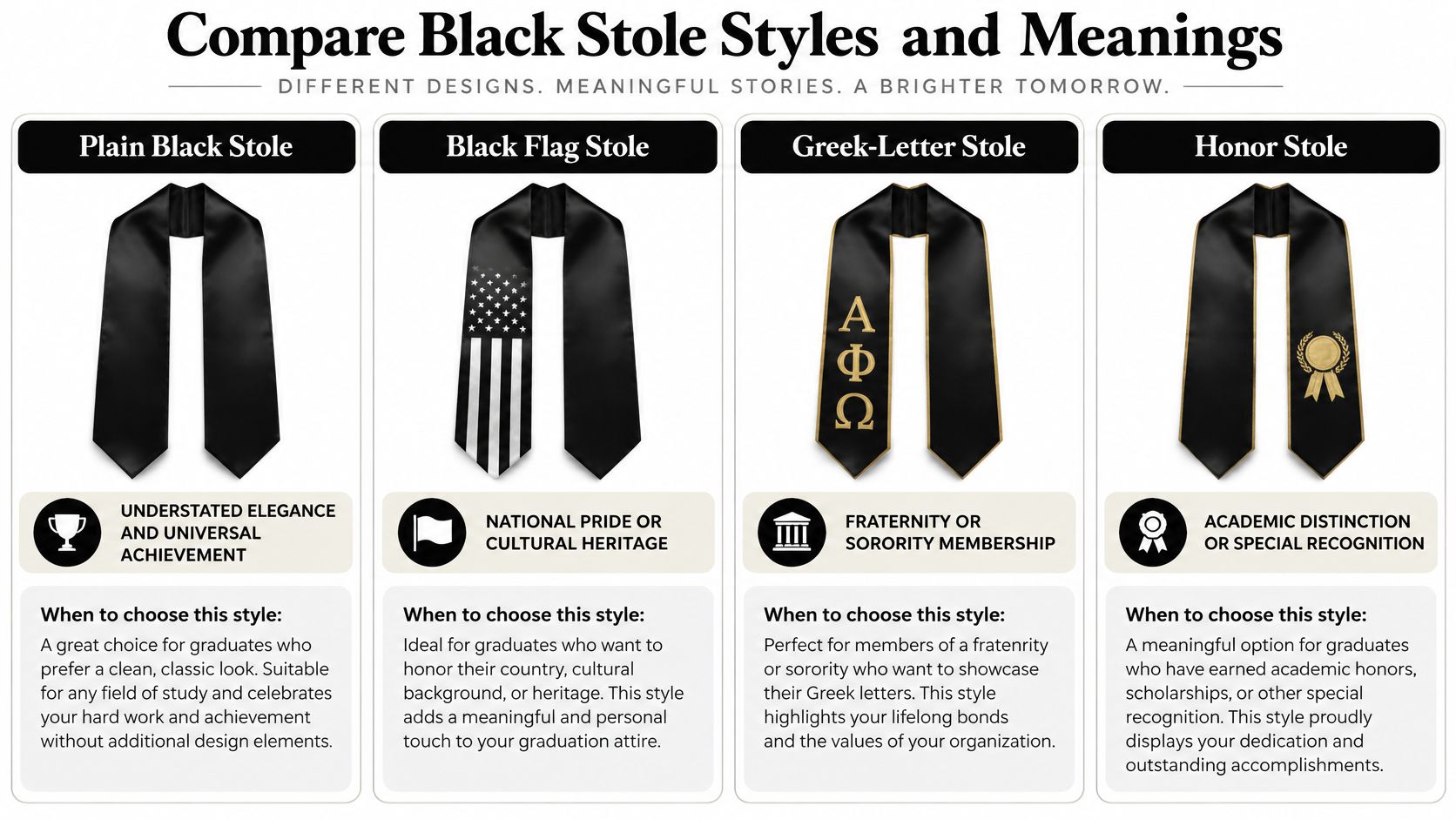
Choose a style by the message you want others to understand. A plain black stole, international flag stole, Greek-letter stole, and honor stole may share a base color while serving different purposes.
The comparison graphic introduces common categories. Read any association between plain black and achievement as a styling interpretation, not an official award designation.
Match the style to the intended message
| Style | Why a graduate might choose it | Question to resolve before ordering |
|---|---|---|
| Plain black stole | An understated accessory without prominent graphics | Are unassigned personal stoles allowed? |
| Black-and-gold stole | Contrasting trim or lettering within a coordinated design | Are those colors or markings reserved locally? |
| Black flag stole | National heritage, family roots, or an international connection | Is the proposed flag design approved? |
| Greek-letter stole | Fraternity or sorority affiliation | Has the chapter authorized the letters and emblem? |
| Black honor stole | A specific academic or organizational recognition | Is the wearer eligible for that exact designation? |
| Cultural or religious stole | A meaningful tradition, community, or faith connection | What approval applies to the symbol and garment? |
A plain black graduation stole suits a graduate who wants restraint. Without an emblem or explanatory wording, however, an audience may not know why it's being worn. Choose it for its intended appearance, not as a substitute for a documented honor.
A black flag graduation stole puts heritage at the center of the design. If the graduate wants to acknowledge different family connections, resolve the layout carefully rather than crowding panels with competing graphics.
Distinguish affiliation from recognition
A Greek stole should communicate the graduate's actual fraternity or sorority relationship. Confirm the exact organization name and chapter-approved presentation before sending artwork to production.
An honor stole requires a different conversation. Ask the awarding office or society which item accompanies the recognition, rather than selecting wording such as summa cum laude because it appears in a catalog.
Cultural and religious designs deserve equally careful treatment. Discuss the intended symbol with the relevant community or organization, and distinguish a graduation accessory from attire intended for another ceremonial role.
The decision rule is straightforward: buy the design that accurately describes the wearer. A visually impressive stole isn't a better choice if its wording, insignia, or implied status doesn't fit.
Pair It With Your Gown, Sash, and Honor Cords
Commencement regalia works like a layered uniform, and every layer already carries a message. The gown comes first, the hood follows if your degree uses one, and approved accessories take their places last. A black stole joins at the end of that order, so its job is to sit comfortably in the arrangement without covering the details that identify your degree.

The gown itself already says plenty. Bachelor's gowns use pointed sleeves, master's gowns use oblong sleeves, and doctoral gowns use bell-shaped sleeves; hood edging identifies disciplines, while the lining identifies the degree-granting institution, according to Valdosta State's explanation of academic regalia.
Each accessory you add raises a different placement question. A hood shares the same space at the back of your neck, so confirm which layer rests on top. A sash may count as the same accessory category as a stole under your school's rules, so ask before assuming you can wear both. A medal hangs on a ribbon that a stole panel can cover or pull against. Honor cords are lighter, but they still need an arrangement that keeps them flat and untangled.
Choosing black settles only the look. The color does not signal a specific honor on its own, and it does not decide whether the item is allowed, so the pairing has to clear the same checks as any other accessory. Cords make that distinction easiest to see. Siena University publishes distinct cord combinations for recognized organizations and reserves its red, white, and blue cord for specified military-connected graduates, as detailed in its commencement cords, stoles, and regalia policy. Give each cord the position its credential calls for.
Rehearse the full outfit
A fitting on a hanger tells you little. Put the entire outfit on, then walk, sit, and climb a step while someone watches how the layers behave.
The graduation stole and sash wearing guide shows the standard placement for each component. Follow your institution's arrangement whenever it differs from general styling advice.
Finish with a front and side photograph. Check that required regalia remains visible and that no accessory shifts when you move.
Check School Rules Before the Ceremony
Can a graduate add a black stole to the lineup on ceremony day? Sometimes. Whether it is allowed depends less on the color than on who issued the accessory, what it says, and when the request reaches the right office. The University of Southern Indiana permits one personally chosen approved stole or cord alongside university-provided items, prohibits alterations, and requires approval of new designs at least 60 days before commencement, according to its approved commencement stoles and cords policy.
Ask early, and ask in writing.
A question like "are black stoles allowed" works like asking whether vehicles are allowed in a campus lot: staff can only give a real answer once they know which vehicle, which permit, and which space. Send the actual design with its dimensions, wording, symbols, and the organization behind it, then cover the points that decide approval. Confirm whether personal stoles are permitted for your ceremony and degree level, whether a graduate may wear more than one accessory or must choose, and whether a club needs official recognition. Ask about limits on length, width, and decoration, about restricted phrases or insignia, and about who signs off and by what deadline. If the design fails, find out whether it may still appear in separate photographs.
Before you pay: Get written approval for the proposed design itself. A reply acknowledging your email does not grant it.
Written answers matter because the limits get specific. Elon University requires Provost's Office permission for group accomplishment or affiliation symbols, and its general guidelines cap stoles at 5 inches wide and 6 feet long, with maroon, gold, and white listed as the standard colors unless another design is approved, per its caps and gowns requirements.
Save the written decision together with the final artwork, and for a club order include the organization's advisor so every member receives the same guidance. Assign one person to confirm the delivered items match what was approved. If a design is rejected, ask whether a compliant revision or photo-only use is possible rather than assuming an exception exists, and before the event confirm alteration rules plus the return process and condition requirements for any borrowed or rented piece.
Wear and Care for Your Graduation Stole
Dress in the required gown first, then arrange the hood and accessories in the order approved by your school. Place the stole around the back of your neck and adjust its panels while standing upright.
Ask someone to check symmetry from a short distance. Look down only briefly, since bending your head can change how the neckline and panels sit.
Make the final wearing check
Walk and sit in the complete outfit. Untangle cords from medals, confirm that the hood remains properly positioned, and check that the stole doesn't catch on another accessory.
- Before leaving: Carry the stole in a way that avoids crushing its decorated areas.
- Before photographs: Straighten the panels and check for turned-under edges.
- During the event: Handle adjustments gently rather than pulling against embroidery.
- Afterward: Remove accessories separately so cords and fastenings don't snag.
Follow the maker's material-specific care instructions. Don't assume that a cleaning method suitable for the gown is also safe for the stole's thread, print, lining, or attached decoration.
Preserve the finished piece
Inspect embroidered and embellished areas before cleaning or folding. If care instructions are missing, ask the seller before applying heat, water, stain remover, or adhesive.
Store the stole away from heat and crushing, with delicate decoration protected from pressure. If it belongs to an organization, return it according to the agreed process rather than cleaning it without authorization.
A confident purchase comes down to a compact decision check: accurate meaning, written permission, suitable fit, approved artwork, and a workable delivery plan. Keep those decisions together with the finished stole's care information.
The accessory can then serve both purposes well. It can meet the needs of the ceremony and remain a personal reminder of the graduate's achievement.
Stoles.com® offers customizable graduation stoles, including flag, Greek-letter, and honor designs for different identities and occasions. Visit Stoles.com® to explore options for a black stole for graduation, then compare your preferred design with your school's approved specifications before ordering.