

Forget the colorful chart you bookmarked last week. It probably told you blue means one thing, gold means another, and every graduate everywhere follows the same code. That's the most popular advice about college graduation stole colors, and it'll mislead you on commencement day. A color only makes sense once you know who assigned it, why it was assigned, and whether your school allows it on stage. Think of your gown like a short biography, not a paint swatch. Once you learn how to read that biography, you'll choose a graduation stole, graduation sash, or graduation honor cord with confidence instead of guesswork.
Why a Single Color Chart Will Mislead You
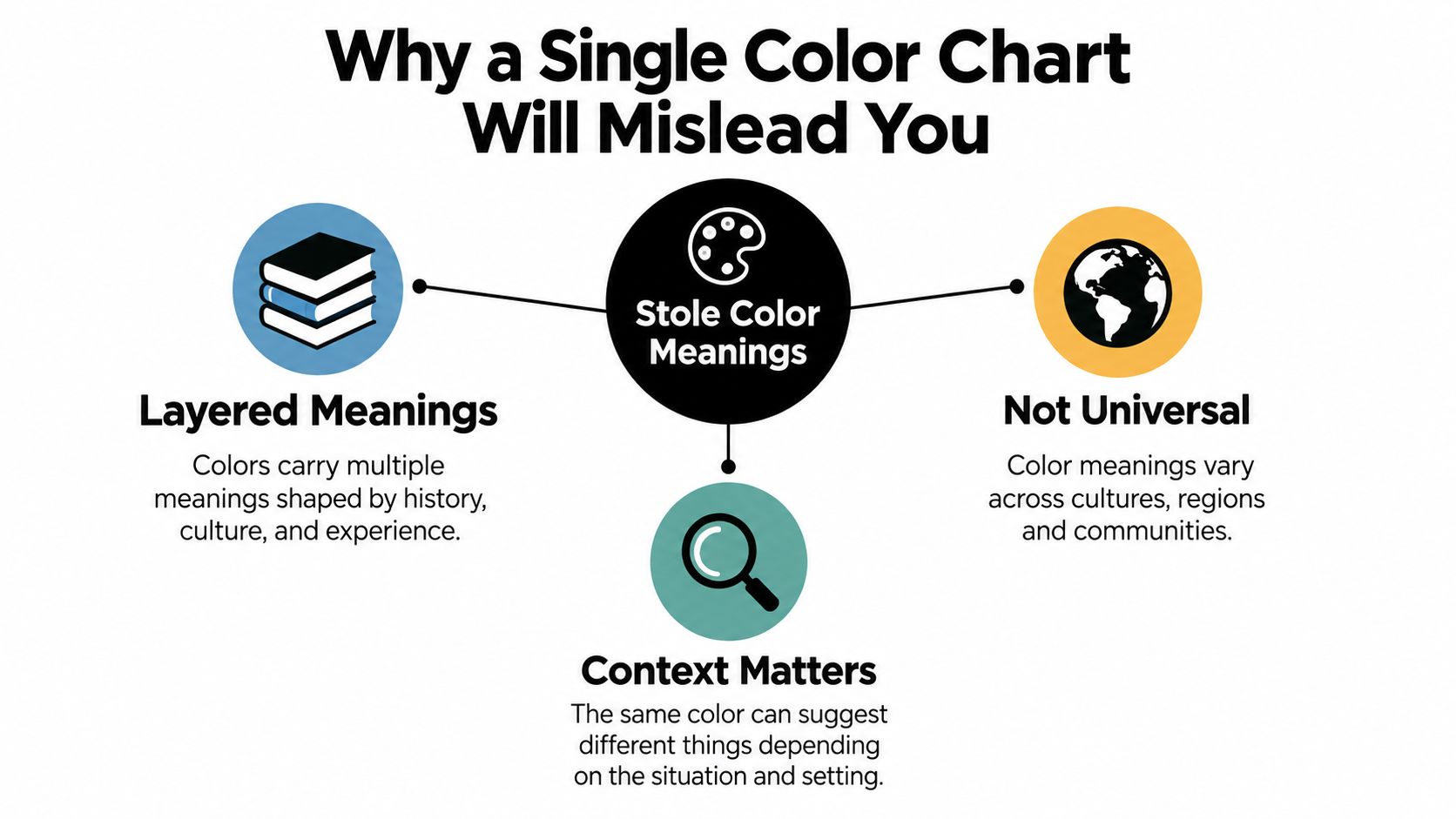
A single chart treats color as a universal language. Commencement doesn't work that way. The same blue graduation stole might signal your major at one school, an honor society at another, and a purely decorative custom graduation stole at a third. Families get confused because they're trying to decode a local message with a generic dictionary.
Look at the picture this way:
Three Layers Are Speaking at Once
Layer one is your institution. Your college sets the rules that govern your ceremony, including which colors are reserved and which accessories need approval. The University of Arkansas commencement regalia policy reserves red and white cords or stoles for university honors, while allowing other organization regalia only when it's affiliated with the university.
Layer two is your organization. A Greek stole, honor society sash, cultural group stole, or service cord carries colors chosen by that group, not by a national chart. Those colors announce membership and belonging.
Layer three is academic tradition. Older conventions link certain colors to fields of study. That tradition is helpful background, but it's not a permission slip for your specific ceremony.
You can't reliably determine what a stole means from color alone. Ask who issued it and under what rule.
International examples make this even clearer. The University of the Sunshine Coast academic dress policy assigns violet for natural and physical sciences and agriculture and academic green for information technology and commerce, with exact references such as BCC 179 for violet and BCC 203 for academic green. That's formal, local, and specific. It's not interchangeable with a U.S. chart.
Ask a simpler question before you order anything. Can I wear this color at my ceremony? If a chart can't answer that, it hasn't given you what you need.
Where Academic Regalia Colors Actually Come From
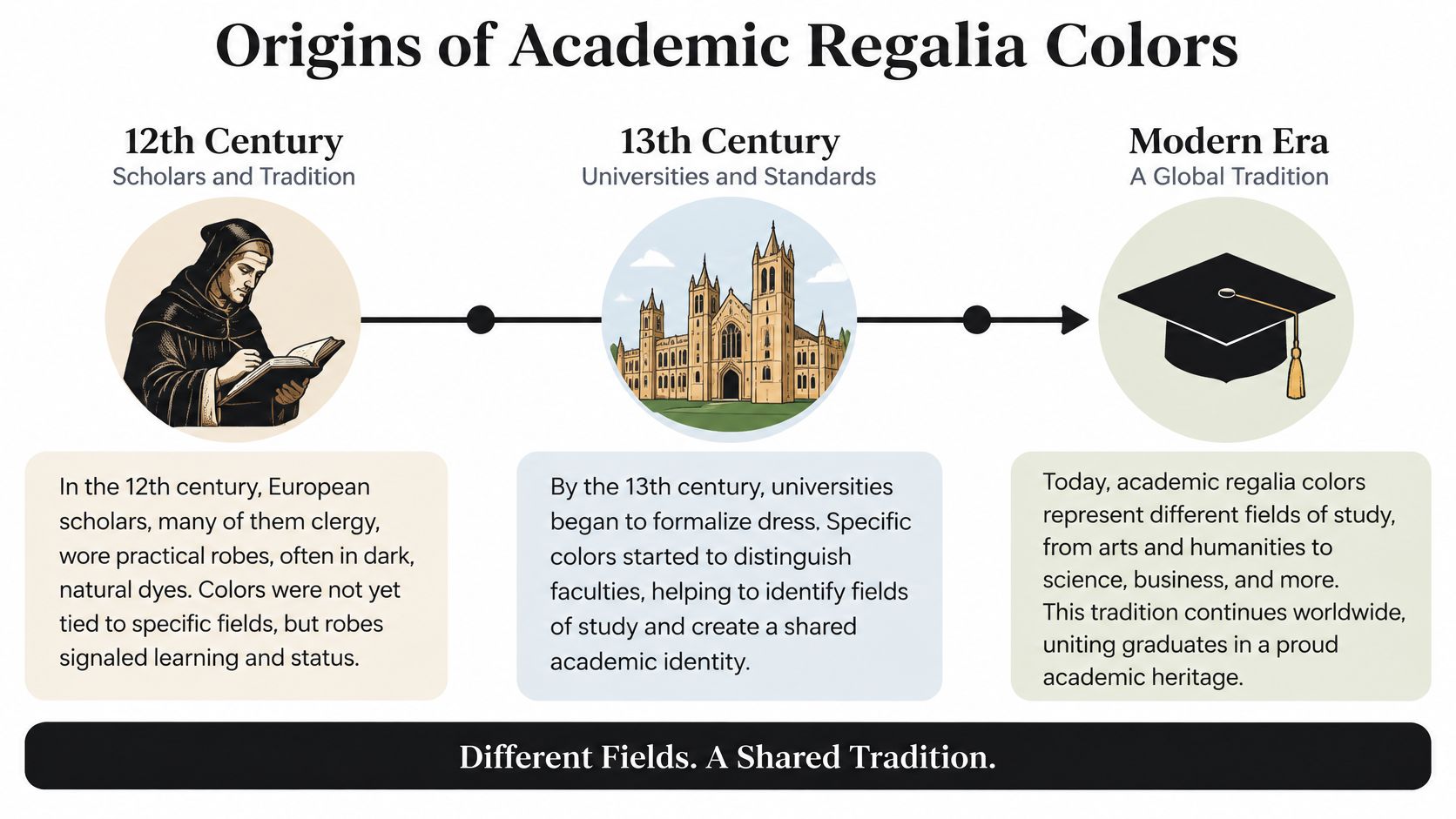
The long gowns you see at commencement started as practical clothing. The history of regalia from the University of South Carolina Aiken traces academic dress to the first European universities of the 12th and 13th centuries, where scholars and clerics wore gowns and hoods partly for warmth in unheated buildings. Over time, the hood stopped being just warm clothing and became a mark of scholarly status and field.
That timeline is easier to follow visually:
How the United States Standardized Field Colors
American colleges wanted order as ceremonies grew. In 1895, institutions adopted an intercollegiate code for academic designs and colors, and the American Council on Education later revised it in 1932 and 1959. Those dates come from the same regalia history cited above, and they explain why so many U.S. hood colors still look familiar across campuses.
Common standardized examples include:
- White for arts, letters, and humanities: A classic color for broad liberal arts fields.
- Light blue for education: A color many education graduates recognize right away.
- Orange for engineering: A bold field color that's hard to miss in a procession.
- Purple for law: A traditional professional color tied to legal study.
- Green for medicine: A longstanding signal for medical fields.
- Golden yellow for science: A bright color associated with scientific disciplines.
A graduation stole isn't identical to a degree hood, even though both use color to communicate. A hood usually follows stricter degree rules. A stole or graduation sash gives schools and organizations more flexibility. For a fuller walk through that lineage, read the history of academic regalia and how it shaped modern graduation dress.
Watching regalia explained can also help the pieces click into place before you compare products:
The Major Color Categories You Will See at Commencement
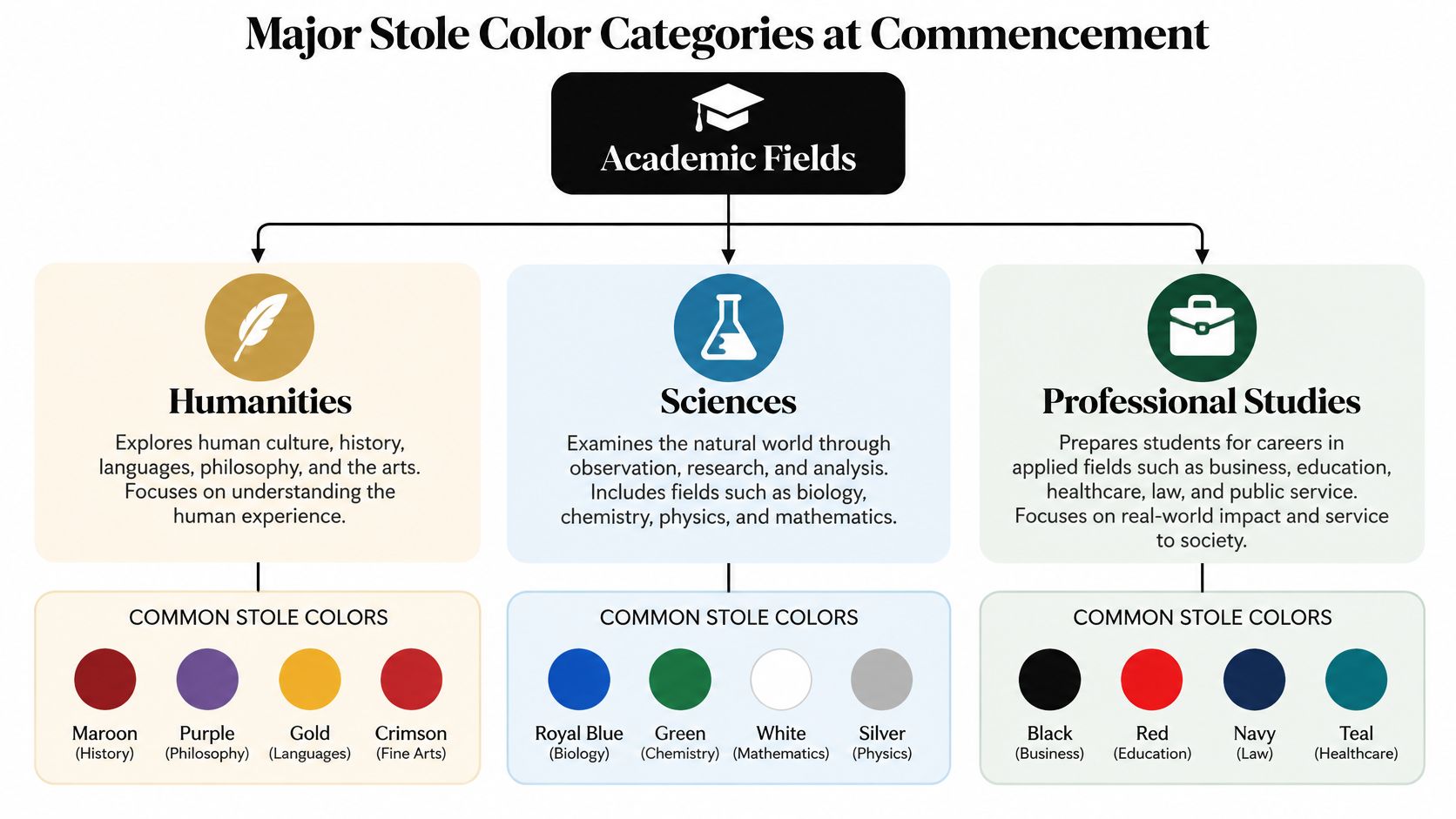
You'll spot patterns once you sort colors into categories instead of memorizing every shade. Most stoles and cords on graduation day fall into four groups: academic field, Latin honors, organization membership, and cultural or identity recognition. The category tells you what question to ask next.
This hierarchy gives you a quick visual map before the details:
Academic Field Colors From U.S. Conventions
Established U.S. conventions cover a wide field list. The United States academic dress code summary lists maize for agriculture, white for arts and humanities, drab for commerce and business, light blue for education, orange for engineering, purple for law, green for medicine, pink for music, apricot for nursing, golden yellow for science, citron for social work, and scarlet for theology or divinity, among others. Schools often use these colors most directly on hoods, then adapt them for a graduation stole or tassel. Don't assume every campus copies the list exactly.
Latin Honors and Academic Distinction
Honors colors work differently. They signal rank or GPA, not subject matter. That same U.S. academic dress summary notes that summa cum laude graduates at the University of Louisville receive red and gold cords, so the color combination encodes distinction rather than a major. A summa cum laude stole, honor stole, or set of graduation honor cords in this category should come from the school or match its published rule exactly.
Organization, Service, and Identity Colors
This category is the fastest growing source of confusion, and joy. A Greek stole shows fraternity or sorority pride. A flag graduation stole or international flag stole can represent your roots. Cultural stoles, first-generation recognition, military service, donor programs, and scholar programs also use color to tell a personal story.
Practical rule: If the color represents who you are or where you belonged, the organization defines it. If it represents academic rank, the institution defines it.
That distinction protects you from a common mistake. You don't pick an honors color because it looks good, and you don't need a field chart to justify a country flag stole for graduation that your school has approved for cultural recognition.
Stoles Versus Cords and How They Layer on Your Gown
Students often ask whether a stole and a cord do the same job. They don't. Each accessory has its own lane, and trouble starts when two pieces try to say the same thing, or when a student wears a reserved color by accident.
What Each Graduation Accessory Typically Communicates
| Accessory | Typical Signal | Layer With |
|---|---|---|
| Degree hood velvet | Academic field | Gown and institution lining |
| Hood lining | Institution | Hood velvet |
| Tassel | Field or institution | Cap |
| Graduation honor cords | Honors, service, membership | One approved stole where allowed |
| Graduation stole or sash | Identity, culture, organization, honors | Cords, subject to local limits |
Morgan State's overview of academic regalia colors and accessory roles separates these systems clearly: hood velvet generally identifies the degree field, hood lining identifies the institution, and tassels may represent the field or institution. Stoles and cords are more varied. They can identify honors, veterans, donors, first-generation programs, or cultural organizations.
Real campus rules show why layering isn't automatic. Boise State's commencement regalia and accessories policy states that bachelor's degree candidates with a 3.5 GPA or higher at the end of the term before graduation qualify for academic honor cords, that students may wear more than one honor cord, but only one stole may be worn. Boise State also prohibits solid blue for custom adornments because blue matches the undergraduate gown, and prohibits solid orange because orange is used for a stole available to all graduates.
Utah State gives a precision example for cords. Its adornment guidelines and procedures for Latin honors assign gold to summa cum laude at 3.95 to 4.00, silver to magna cum laude at 3.80 to 3.94, and navy to cum laude at 3.50 to 3.79, calculated from the fall semester before graduation or the last attended semester. It also bars organizations from using solid gold, silver, or navy because those colors are reserved.
If you're still sorting placement and etiquette, this guide to wearing cords and stoles together without breaking ceremony rules walks through the pairing step by step.
How to Choose the Right Color for Your Custom Stole
Meet Maya in your head for a minute. She's a first-generation graduate, a sorority member, and proud of her family's heritage. She wants one personalized graduation stole that says all of that. Her challenge is normal: three true stories, limited space on her gown, and a commencement office that may allow only one stole.
This is the kind of blank canvas many custom orders start from:

A Decision Path That Prevents Regret
Start with the message, not the shade. Decide whether your stole should communicate heritage, major, honor, membership, service, or gratitude. Maya might choose heritage for the stole and let a cord carry an honor, instead of cramming every symbol onto one sash.
Check the institution's published policy. Look for reserved colors, width limits, approved organizations, and limits on extra items. Southern Indiana offers a clear warning sign. Its approved commencement stoles and cords policy reserves solid gold, red, and blue stoles for its three Commencement Honors categories, allows only one additional approved stole or cord beyond university-provided honors or military regalia, and limits stoles to a maximum width of 5 inches.
Verify organization eligibility. Northern Iowa's caps and gowns regalia guidance requires organization cords or stoles to connect to a registered organization with a clear, consistent eligibility policy, and it bars solid gold and solid purple for organizations because purple marks magna cum laude in the top 4% through top 8% and gold marks cum laude in the top 9% through top 15% of the major college or division. UNI also recognizes Kente cloth stoles, lavender stoles, serapes, and country-of-origin stoles, which shows how identity recognition fits inside a formal system.
For Maya, the answer becomes practical. If her school permits only one stole, she picks the story that matters most for the ceremony and saves other symbols for photos, receptions, or keepsakes. A custom graduation stole should feel personal, but it shouldn't put you in an awkward conversation at check-in.
Customization Options Worth Considering Before You Order
Color gets you to the right neighborhood. Customization decides how clearly people can read your message from ten feet away, and in photos years later.
Use this screenshot as a starting point for comparing styles side by side:

Methods and Materials Compared
- Embroidered stoles: Best for names, graduation years, Greek letters, and simple symbols you want raised and durable. A fraternity stole or sorority stole often looks sharpest with embroidery.
- Custom printed stoles: Better for flags, detailed artwork, and photo-based designs. A flag graduation stole, custom flag sash, or photo stole usually needs printing for detail.
- Woven designs: Useful when a pattern or traditional textile look matters more than text.
- Satin fabric: Offers sheen that photographs well and drapes smoothly over a gown.
- Polyester fabric: Often feels lighter and can be a practical choice for vivid printed color.
Don't choose by decoration alone. Ask how the method handles contrast. Light lettering on a pale stole may vanish in sunlight, while dark lettering on a deep graduation sash can disappear indoors. If you're ordering for a chapter or cohort, confirm that every personalized graduation stole uses the same color reference so the group matches.
Stoles.com® offers custom graduation stoles, flag stoles, Greek stoles, honor stoles, and honor cords, so you can compare those product types in one place before you commit. If you want help turning an idea into a wearable design, read how to design a custom graduation stole that reflects your story before you finalize colors, text, or trim.
Ordering, Lead Times, and Etiquette for Graduation Day
Order early enough that a small problem stays small. A misspelled name, wrong shade, or missing approval is fixable weeks ahead. It's stressful the night before. Give yourself time to receive the stole, try it on with your gown, and confirm it doesn't hide your graduation honor cords.
Before You Click Order
Confirm four things with your registrar or commencement office:
- Approval status: Is a custom graduation stole from an outside retailer allowed at your ceremony?
- Reserved colors: Does your chosen color conflict with honors, a college, or an official stole?
- Quantity limits: Can you wear the stole with cords, a hood, and other recognition items?
- Exact wording and symbols: Are Greek letters, flags, photos, or messages permitted on stage?
If an answer isn't in writing on a commencement page, email the office and keep the reply. A screenshot on your phone can save your morning.
Wearing It Well on the Day
Put your gown on first, then center the stole around your neck so both sides hang evenly down the front. Place cords so they're visible and not tangled under the stole. If you're wearing a hood, follow your school's instruction for order of pieces, since graduate and undergraduate ceremonies handle this differently.
A stole can be worn with a rented gown as long as you don't pin, tape, or alter the rental in a way the provider prohibits. Ask a friend to straighten the back before photos. For pictures, turn slightly toward the camera and make sure lettering, flags, cords, and tassel aren't twisted or covered. That simple check is why some graduates look polished in every photo and others spend years wishing one side hadn't flipped over.
Your Quick-Start Checklist Before You Order
Use this short checklist before you pay for any graduation stole, graduation sash, or honor cord:
- Name your message: Major, honor, heritage, membership, service, or personal story.
- Check your school rule: Confirm reserved colors, approval needs, width, and how many items you may wear.
- Verify eligibility: Make sure the organization is recognized and you're eligible to wear its colors.
- Match the product to the story: Choose a custom graduation stole for a personal design, a flag stole for country pride, a Greek stole for chapter identity, or an honor stole for school-issued distinction.
- Order with buffer time: Leave room for proofing, shipping, and a gown try-on.
Color meaning is local and layered. Confirm it first, then celebrate loudly.
Ready to turn your approved color into a stole you can wear and keep? Visit Stoles.com® to explore custom graduation stoles, international flag stoles, Greek stoles, honor stoles, and graduation honor cords for college and university commencement. Choose your colors, add your name or design, and order early so graduation day is about celebrating, not troubleshooting.