

Commencement is six weeks out, the gown is ordered, and someone in the family group chat just asked for a custom kente stole with a name, a class year, and the school colors. That request is easy to say yes to and easy to get wrong. The registrar may not allow a personalized design on stage. The cloth you were shown online may be a print, not hand-woven kente. Production can still be running while the ceremony program is already locked.
A stole that cannot be worn is still useful for portraits. It is a poor surprise on the morning of the ceremony. Treat the order as regalia planning, not as a last-minute decoration.
How to Order a Custom Kente Stole in Seven Steps
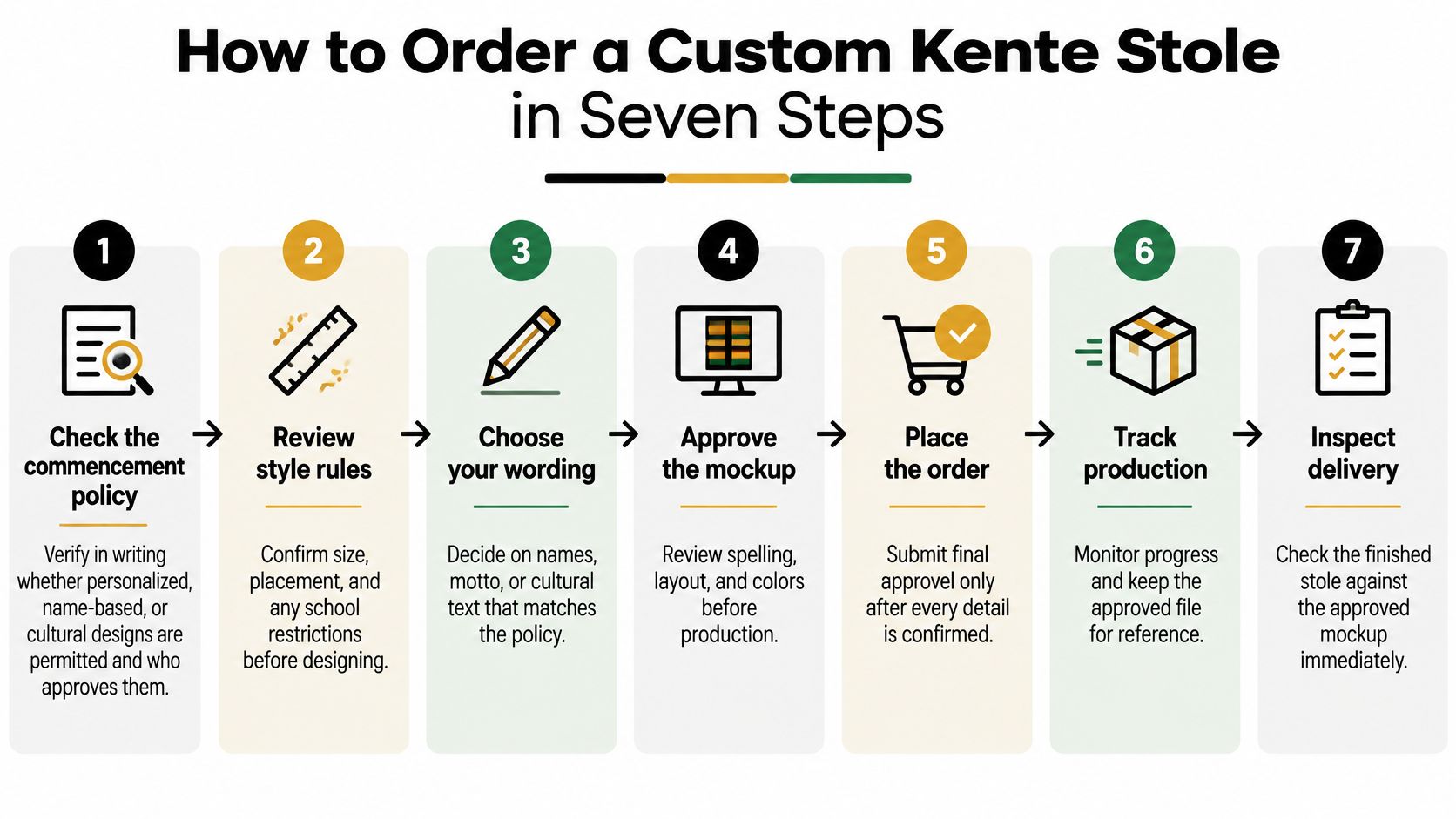
Run these seven steps in this order. Skipping ahead is how groups pay for a design they later cannot wear.
- Check the commencement policy in writing. Confirm whether personalized, name-based, or cultural designs are permitted, who approves them, and the deadline. Some schools want approval 30 days before the ceremony.
- Choose the authenticity tier. Decide among hand-woven, Ghana-made, or kente-inspired cloth so the product wording matches what you are buying.
- Lock the palette and motif. Assign every color a number or a physical swatch before anyone talks about fonts.
- Pick the decoration method. Embroidery, screen printing, or a custom transfer each fail in a different way.
- Confirm width and length against any school maximum before artwork is finalized.
- Approve a digital mockup, then a physical sample where the calendar allows it.
- Place the order and count backward. Production plus shipping should finish with a buffer of at least one week before the ceremony.
Each step should leave a paper trail. You want a written policy note, a wording decision, a numbered color standard, a signed mockup, and a confirmed delivery date. Keep those five items in one folder.
Practical rule: Approval and lead time cannot be fixed once production starts. Palette and motif can still change at the mockup stage.
Steps one and seven are the ones that strand an order. A beautiful file does not override a handbook, and a rush label does not create days that the dye house does not have. I would not send artwork until the approval office has answered in writing.
Institutional Rules, Sizing and Approval Windows
A custom stole can be ready for commencement and still be barred from the ceremony. Check the school's rules before approving a design or placing an order. Each institution sets its own limits on personalization, outside regalia, dimensions, and approval deadlines.
Biola University's commencement regalia page says stoles cannot be customized and outside stoles are prohibited at its ceremonies. Some schools need custom regalia produced well in advance, so check each school's published lead time before ordering. A stole that is not permitted on stage may still be suitable for portraits or a family event.
| Institution | Rule for a custom stole | Lead time or limit |
|---|---|---|
| Biola University | Stoles cannot be customized; outside stoles prohibited | No custom option at ceremonies |
| University of Southern Indiana | One approved stole or cord; designated groups only | Approval through Marketing and Communication |
| Louisiana State University | All stoles and sashes need approval | At least 30 days before the ceremony |
| Elon University | Provost's Office permission for group symbols | Maximum 5 inches wide and 6 feet long |
Read each school as a different constraint
The University of Southern Indiana commencement policy allows one approved stole or cord, in addition to university-provided adornments. Approved pieces are limited to designated groups, including registered student organizations, recognized honor societies, students with international affiliations, fraternities and sororities, and athletic teams. Marketing and Communication handles approval. Cultural significance does not automatically exempt a stole from that process.
Louisiana State University's academic regalia page requires approval from the Office of Academic Affairs for all adornments, including stoles, ribbons, and sashes, at least 30 days before the ceremony. It reserves purple and gold cords for Latin honors candidates and white cords for undergraduate Upper Division Honors. Avoid color combinations that could make a stole look like an award the graduate did not receive.
Elon University's caps and gowns guidance requires Provost's Office permission for symbols of accomplishment or group affiliation. Stoles may be no more than 5 inches wide and 6 feet long, so leave enough room for names and insignia within those dimensions.
What to get in writing
Before design work begins, ask the appropriate office for written answers to these questions:
- Who approves: Is the decision made by the registrar, commencement office, student affairs, or another office?
- How many pieces: Is there a limit on stoles or cords beyond the adornments the university provides?
- What may appear: Are personal names, national flags, Greek letters, and organization marks permitted?
- Marks and colors: Do logos or trademarks need clearance, and are any colors reserved for honors?
- The deadline: What is the last date an approval request will be accepted?
A classmate's reassurance is not a policy. If the school says no, keep the stole for photos rather than ordering it for the ceremony.
Kente Heritage and Honest Wording for Your Stole
The most common mislabel is a printed stole sold as hand-woven. A graduation stole can be culturally meaningful without being a museum textile. It cannot carry both descriptions at once.
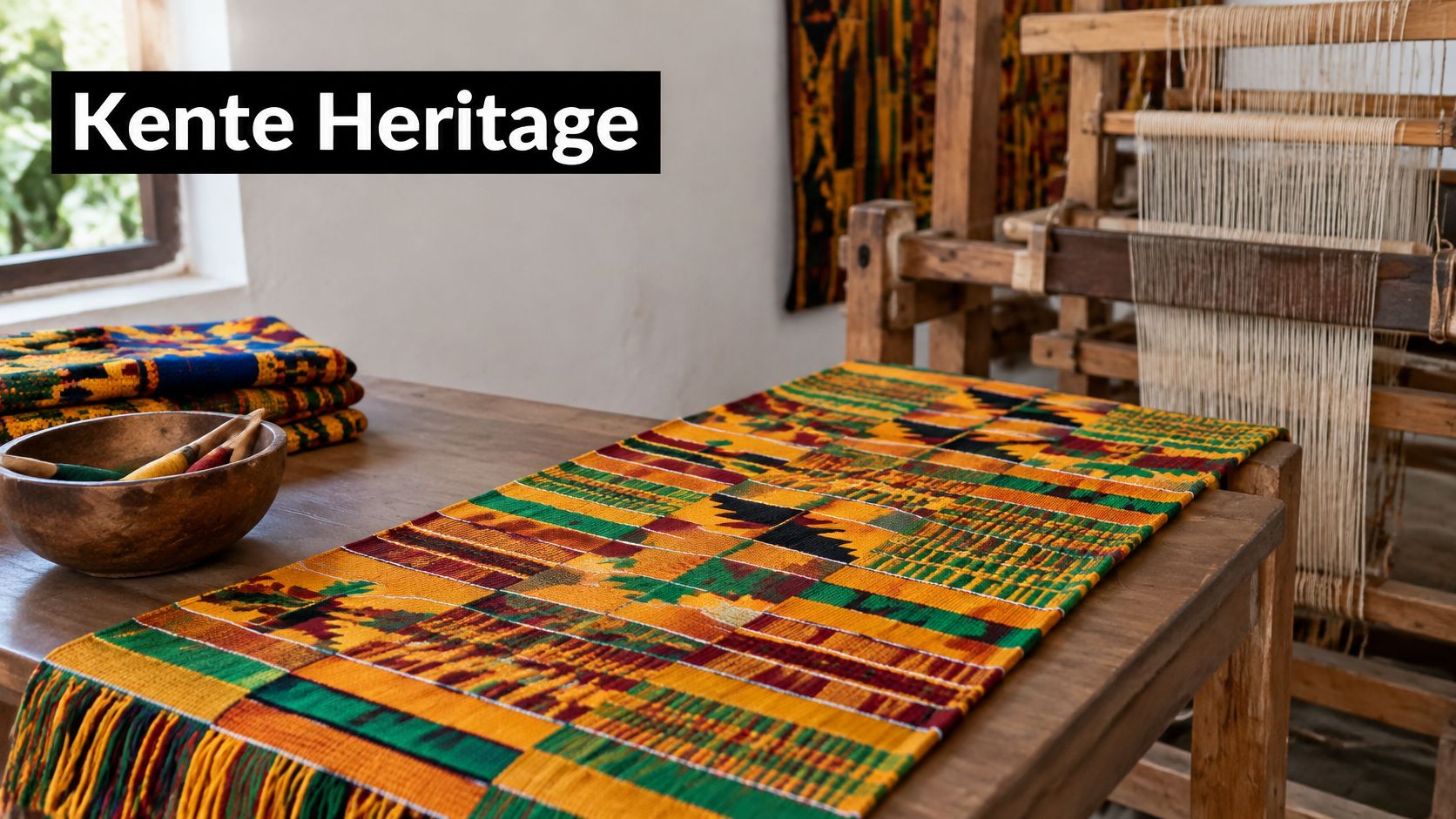
Kente is a Ghanaian textile tradition with a history of about 400–500 years, and the Cambridge study of Akan and Ewe weaving notes that Asante cloth was historically produced for kings and court ceremonies, with access to particular designs reflecting social rank. Colors and patterns communicate identity, social position, gender, age, occasion, and cultural messages. UNESCO added the craftsmanship of traditional woven kente to the Representative List of the Intangible Cultural Heritage of Humanity in 2024. A stole adapts that format into a visible ceremonial garment. Names and class years should connect an achievement to that heritage, not replace it. A plain account of what a kente stole is is a useful starting point before you write product copy.
Cooper Hewitt's account of kente's wider symbolism ties the cloth's modern global role to Ghana's independence in 1957, when images of President Kwame Nkrumah helped move kente from court regalia toward a pan-African emblem of identity and pride. That history is why the stole fits a public ceremony. It is also why a random geometric print should not be given a fake “traditional” name.
Three tiers and the words each one can carry
Wikipedia's kente cloth entry records that kente is traditionally hand-woven in narrow strips from silk and cotton, and that Ghana received geographical-indication protection in September 2025. That protection limits use of the name to cloth made with traditional techniques in approved Ghanaian communities. A printed stole should never be sold as hand-woven.
| Tier | How the cloth is made | Accurate wording | Best fit |
|---|---|---|---|
| Authentic hand-woven kente | Narrow strips woven by hand from silk or cotton in Ghana | Hand-woven Ghanaian kente | Heritage displays and museum-grade pieces |
| Ghana-made commercial cloth | Machine-made cloth produced in Ghana | Ghana-made kente-pattern cloth | Stoles with a documented Ghanaian origin story |
| Kente-inspired printed fabric | Printed or factory-made pattern that echoes kente | Kente-inspired stole | Most graduation orders |
Only expensive hand-woven cloth is culturally legitimate is a false binary. Honest labeling is the standard, not price.
Do not invent a traditional meaning for a modern geometric pattern, and do not mix Akan and Ewe symbolism without saying so. The practical test is short. Name the motif, verify its meaning with a Ghanaian cultural specialist, an elder, or a reputable textile scholar, and label the product with the tier you can prove. Country of weaving, fiber, weave versus print, and whether customization is embroidered, printed, or sewn onto the cloth all belong on the spec sheet.
Choosing Colors, Patterns and Decoration Methods
A school approves a stole design, then the finished lettering disappears into a fold or a dark pattern. Set the palette and decoration method around the words and artwork that must remain readable.
Kente palettes include red, black, white, green, yellow, blue, gold, orange, purple, brown, gray, and pink. A study of kente color meanings notes that meanings vary by cultural context. Choose colors for the message you intend, and record each shade clearly. Check that the motif repeats cleanly at stole scale. Keep names, years, and logos away from folds and pointed ends, where drape can obscure detail.
Specify the fabric, lining, and weight alongside the design. Set the stole's width and length within the school's written limits before finalizing the artwork. Choose trim from a physical swatch where possible; colors on screens can vary.
Decoration methods side by side
Embroidery, screen printing, and custom transfers suit different artwork. Stoles.com offers all three. Choose based on the detail, texture, and color consistency the design requires.
| Method | Best for | Detail limit | Main risk |
|---|---|---|---|
| Embroidery | Names, years, and logos | Fine lettering can close up at small sizes | Puckering or abrasion of metallic thread |
| Screen printing | Bold motifs and large color blocks | Proof colors may be difficult to match across a run | Color drift from the approved proof |
| Custom transfer | Photos and complex artwork | Surface can feel flatter than stitched work | Edges may lift with repeated washing |
For embroidery, confirm thread type, stabilizer, and stitch density with the provider, and review how lettering holds its shape at the intended size. Metallic gold thread can look different on the finished stole than on a digital proof. Before reducing a motto to fit, review this guide to graduation sash embroidery.
Screen printing suits bold artwork, but color can vary from the approved proof to the production run. A custom transfer can reproduce photos or detailed crests that are difficult to stitch, though its surface has a different feel. Choose the method that keeps the most important wording and artwork legible.
Colorfastness and the strike-off
Ask the decoration provider for colorfastness test results for the thread or ink being used. Treat any wash rating as a supplier claim to confirm before ordering, not as a guarantee about the finished stole.
Approve a physical sample or strike-off before production. Check spelling, placement, contrast, and dimensions against the approved design, and ask that a production sample be retained for reference. Watch closely for color drift, lettering that closes up, and artwork placed too near a fold.
Timeline and Pricing for a Custom Order
A ceremony date gives the order its real deadline. Custom stoles take 2–3 weeks to process and produce, plus shipping time. Shipping time depends on the carrier and destination, so allow for transit after production. Add the school's approval window and a buffer of at least one week for a spelling or sizing correction. If the school publishes a longer custom-regalia window, plan around that.
| Phase | Typical duration | What changes it |
|---|---|---|
| School policy review and approval | Before design starts; up to 30 days where required | Approval office response time |
| Design and mockup | Confirm timing when requesting a mockup | Artwork and design details |
| Production | 2–3 weeks | Decoration method and order quantity |
| Shipping | Allow additional time after production | Carrier and destination |
| Buffer before ceremony | At least 1 week | Corrections, sizing or delivery delays |
Minimums and what a mockup request must include
Custom stoles require a minimum order of 6, with exactly the same design on all six. Any variation means ordering six of each design. A chapter that wants three name layouts needs eighteen stoles, not one mixed order.
To request a mockup, provide the quantity, needed-by date, stole color, trim color, embroidery or print choice, length, width, and any images or logos. Include each detail in the request so the proposed design reflects the order you need.
What actually moves the price
The Kente Factory listed its Class of 2025 custom kente graduation stoles at $21.75 in 2025, at 4.5 inches by 72 inches. Use that as a reference for that listing, not as a current or guaranteed price.
Compare quotes against the specifications that affect the finished stole:
- Decoration and colors: Embroidery, screen printing, and custom transfers suit different artwork and layouts.
- Cloth and lining: Stoles.com offers custom graduation stoles and sashes in heavyweight bridal satin or matte finish, and every stole is fully lined.
- Artwork: A name and year, a crest, and a photo require different artwork and decoration choices.
- Quantity and design: The minimum is six stoles per identical design. Variations require six of each design.
- Quote details: Request a custom quote and confirm what it covers before placing the order.
Set the budget against the ceremony deadline. A low unit price does not help if production and shipping cannot meet the date.
Care, Storage and Commencement Etiquette
Wear the stole only in the form the school already approved. If the rule is one stole or cord, do not add a second. Never wear an altered or unapproved design because the photos will be nicer.
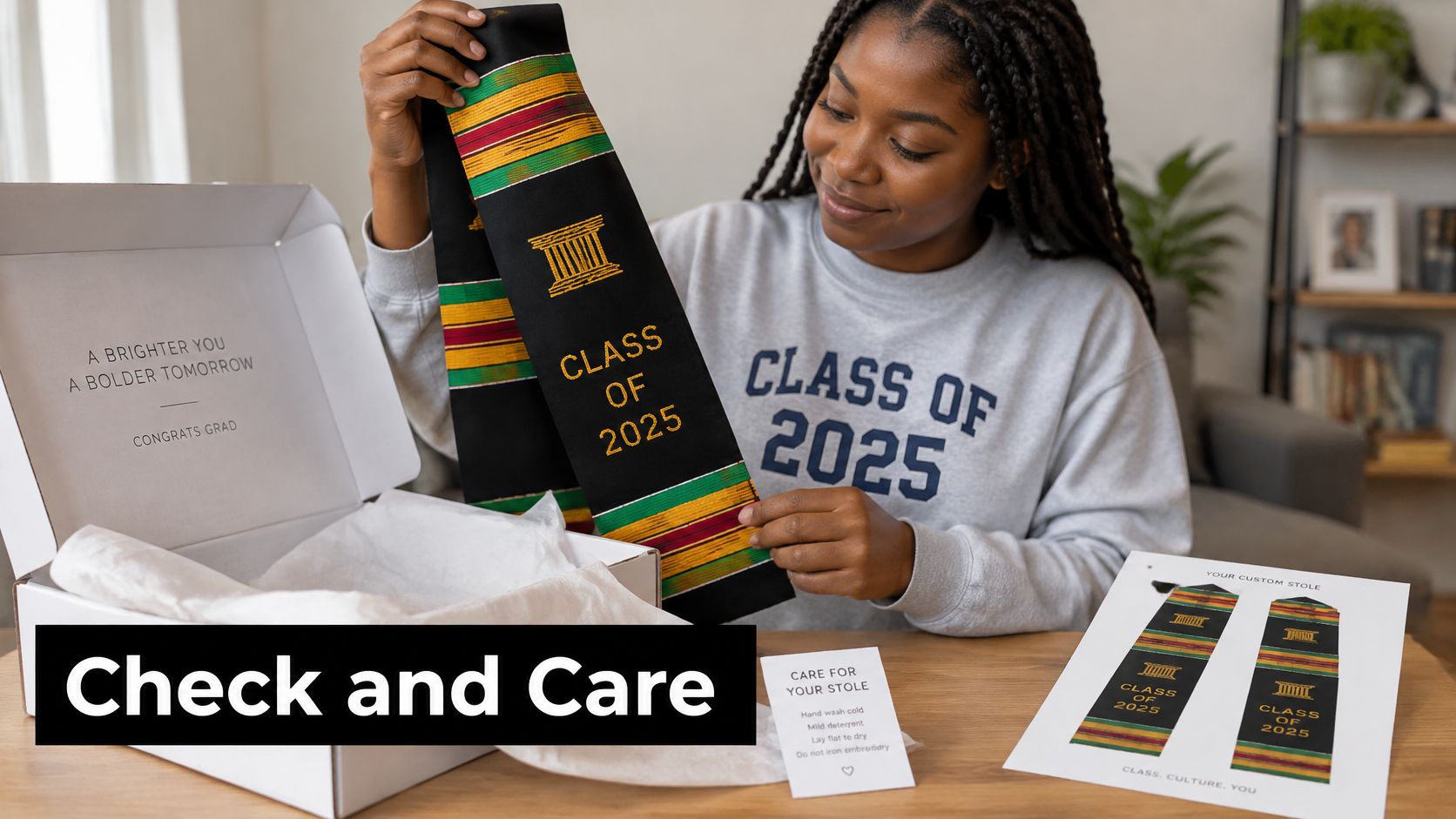
Unpack it the day it arrives and check it against the signed mockup. Spelling, colors, width, and placement are still correctable only while there is time left in that one-week buffer. Waiting until rehearsal turns a fixable error into a story you tell later.
Care in the order you will handle it
Follow the care label. Most fully lined satin or matte stoles do best with gentle hand washing in cool water and drying flat, away from direct heat. Do not steam metallic embroidery directly. Heat dulls gold thread and can pucker a dense stitch field.
If the stole needs a fuller clean before it is framed or worn again, a specialist such as Tumble Laundry's door-to-door dry cleaning services is a safer route than a home iron. Store the stole flat or loosely rolled in a breathable bag, out of sunlight, so dyes and metallic thread hold their color.
On the day
Our guide to how to wear a graduation stole and sash matches what marshals expect. The stole goes over the gown with the lettering facing forward. When you are also wearing double honor cords, keep the knot at the back of the neck so the cords hang even.
If the school forbids custom designs, bring a compliant stole for the ceremony and wear the kente piece for portraits and family photos. Keep the approval email and the signed mockup with the stole. A registrar who asks at the door should not have to take your word for it.
A stole that fails the handbook still belongs in the photos. It does not belong in a line where marshals are pulling unapproved regalia.
Confirm the Design and Place Your Order
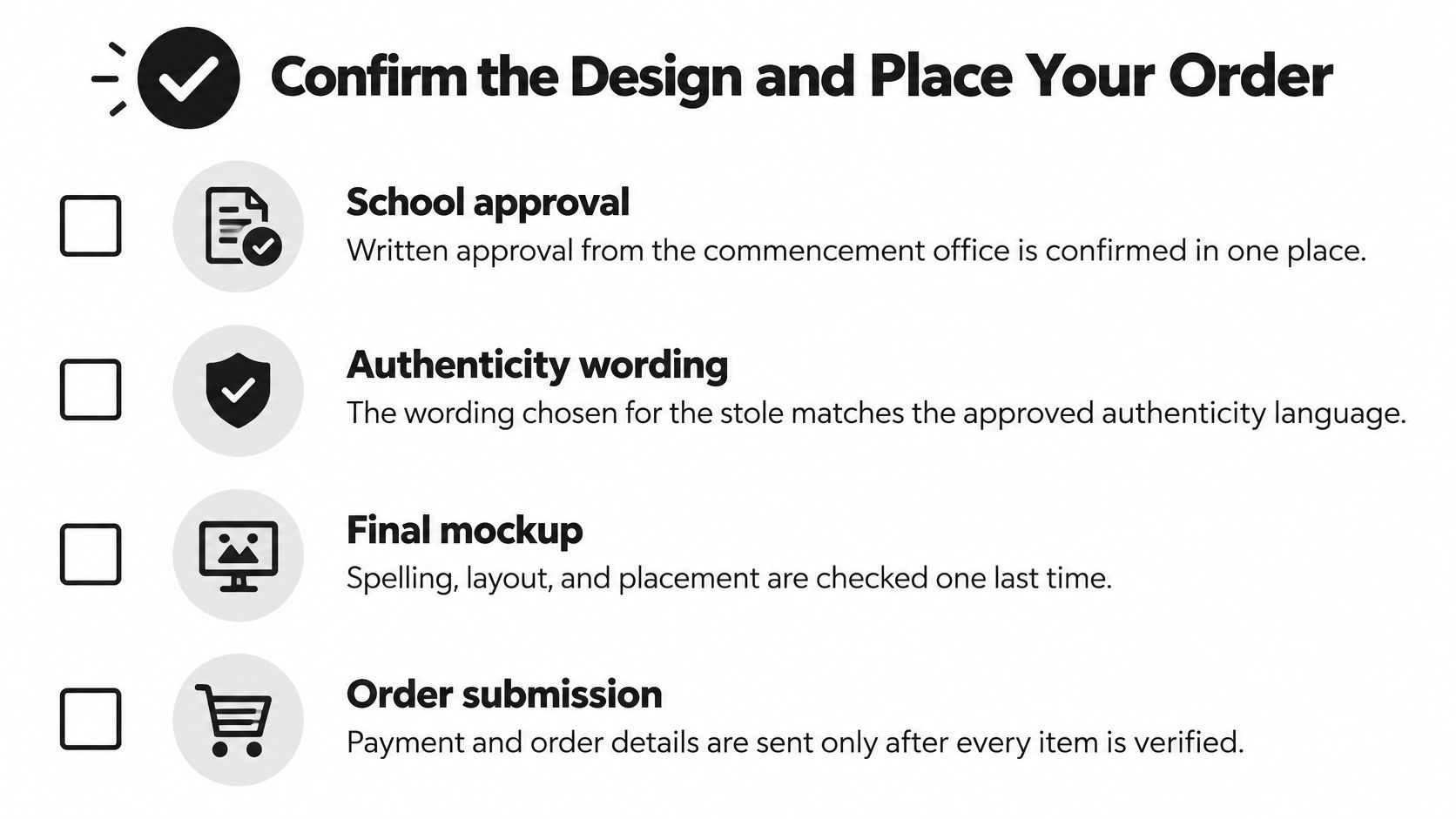
Before paying, put four decisions in writing: school approval and the number of stoles allowed; wording that accurately describes the cloth; the selected colors and decoration method; and the final size within the school's limits. Check that lettering will remain clear of folds and pointed ends.
Confirm the mockup before ordering. Custom stoles are non-refundable, so check every name, color, measurement, and image against the approved design.
To request a mockup from Stoles.com®, email the quantity, needed-by date, stole and trim colors, embroidery or print choice, length, width, and any images or logos. The custom stole generator lets you create and share a design, use exclusive art and fonts, and upload your own artwork or photos. Custom orders require a minimum of six stoles with the same design; if designs vary, order six of each. Allow 2–3 weeks for processing and production, plus shipping time.
Stoles.com offers custom graduation stoles and sashes in heavyweight bridal satin or matte finish, and every stole is fully lined. Once the school has approved the wording, size, and wearing rules, save the approval and final mockup with your order details. Visit Stoles.com® to begin.