

A first gen graduation stole is a decorative sash worn at commencement to recognize a graduate whose parents or guardians didn't complete a four-year degree. Campus definitions vary, so confirm your school's eligibility policy before ordering.
The milestone deserves thoughtful recognition. U.S. longitudinal data show that 24% of first-generation students earned a bachelor's degree within six years, compared with 59% of continuing-generation students, according to FirstGen Forward's degree-attainment fact sheet announcement.
For students and families, the practical questions matter just as much as the symbolism: Who qualifies? Can you wear the stole with graduation honor cords? Should you buy one, customize one, or collect one from campus? The best choice starts with your institution's rules, not the checkout page.
What a First Gen Graduation Stole Means
A graduate steps toward the stage while a parent watches from the audience. The parent may never have attended college, but they recognize the work behind this moment. A sash across the graduate's shoulders can make that family milestone visible without requiring a speech.
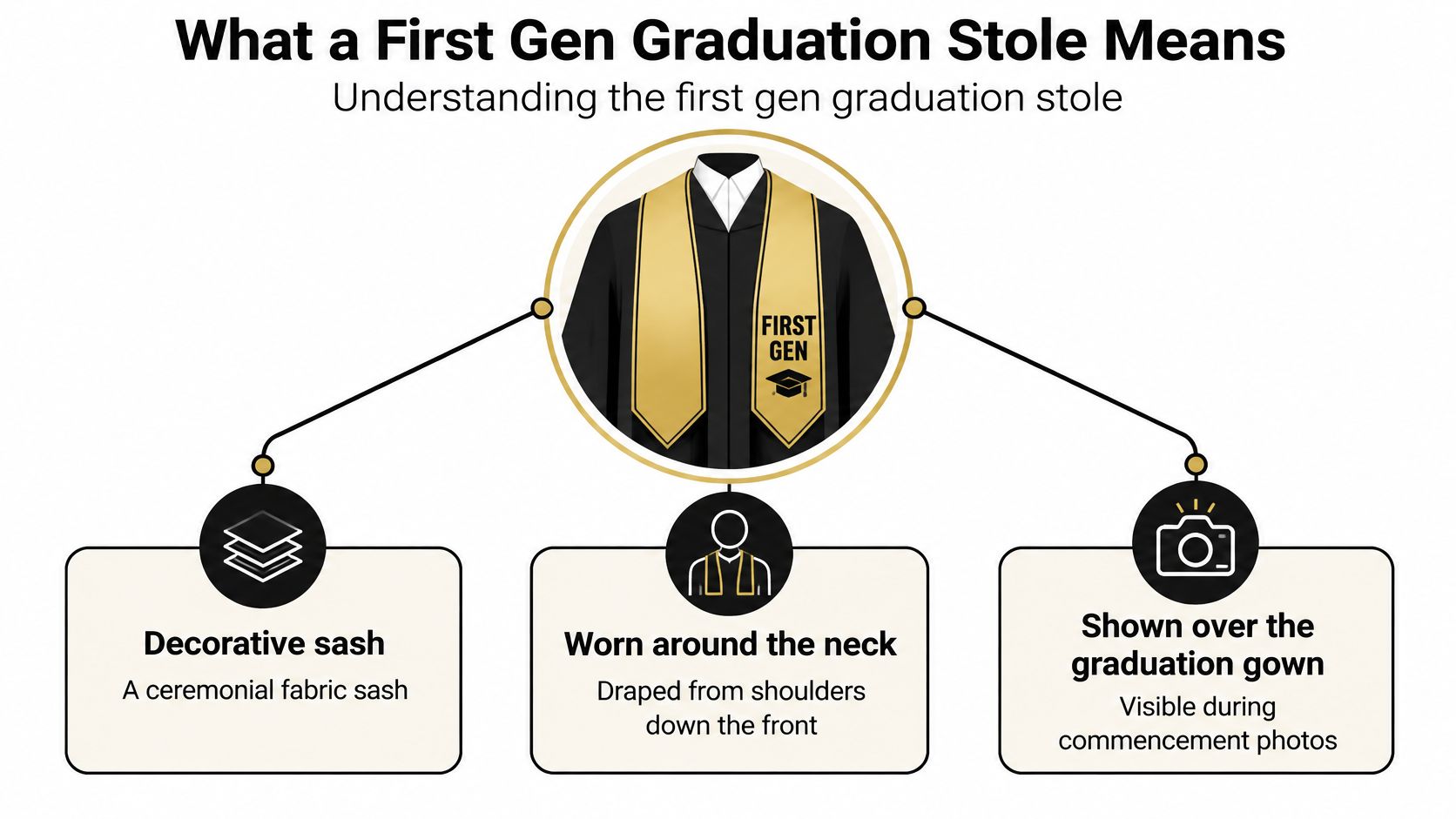
A graduation stole, also called a graduation sash, is a decorative fabric accessory, often made from silky or satin-like material. It drapes around the neck and over the shoulders, with the ends hanging down the front of the gown.
A first-generation graduation stole recognizes first-generation identity and educational achievement. It isn't a separate degree, an academic award, or proof of financial hardship.
The illustration below shows how the stole sits on the gown.
A stole isn't the same as an honor cord
A stole is a broad sash; an honor cord is a narrower cord accessory. Don't assume either item automatically signals academic honors. Institutions use these accessories for different forms of recognition, including affiliation, service, honor-society membership, and student identity.
By contrast, the gown, hood, and tassel generally communicate degree or discipline information within academic regalia systems. The University of South Carolina Aiken's history of academic regalia provides useful context for understanding those distinctions.
For a family, the important message may be simple: this graduate has completed an educational milestone their parents didn't. That recognition needn't diminish anyone else's accomplishments or suggest that every first-generation student followed the same path.
Recognition belongs alongside academic preparation
The stole marks the celebration, not the academic requirements that come before it. A graduate student preparing for a defense, for example, may also find Thesis Book Project's guidance to build effective dissertation defense slides useful while finishing that separate milestone.
Keep those purposes distinct. Your academic work earns the qualification; approved graduation regalia helps you express what the occasion means.
The History Behind the First Generation Designation
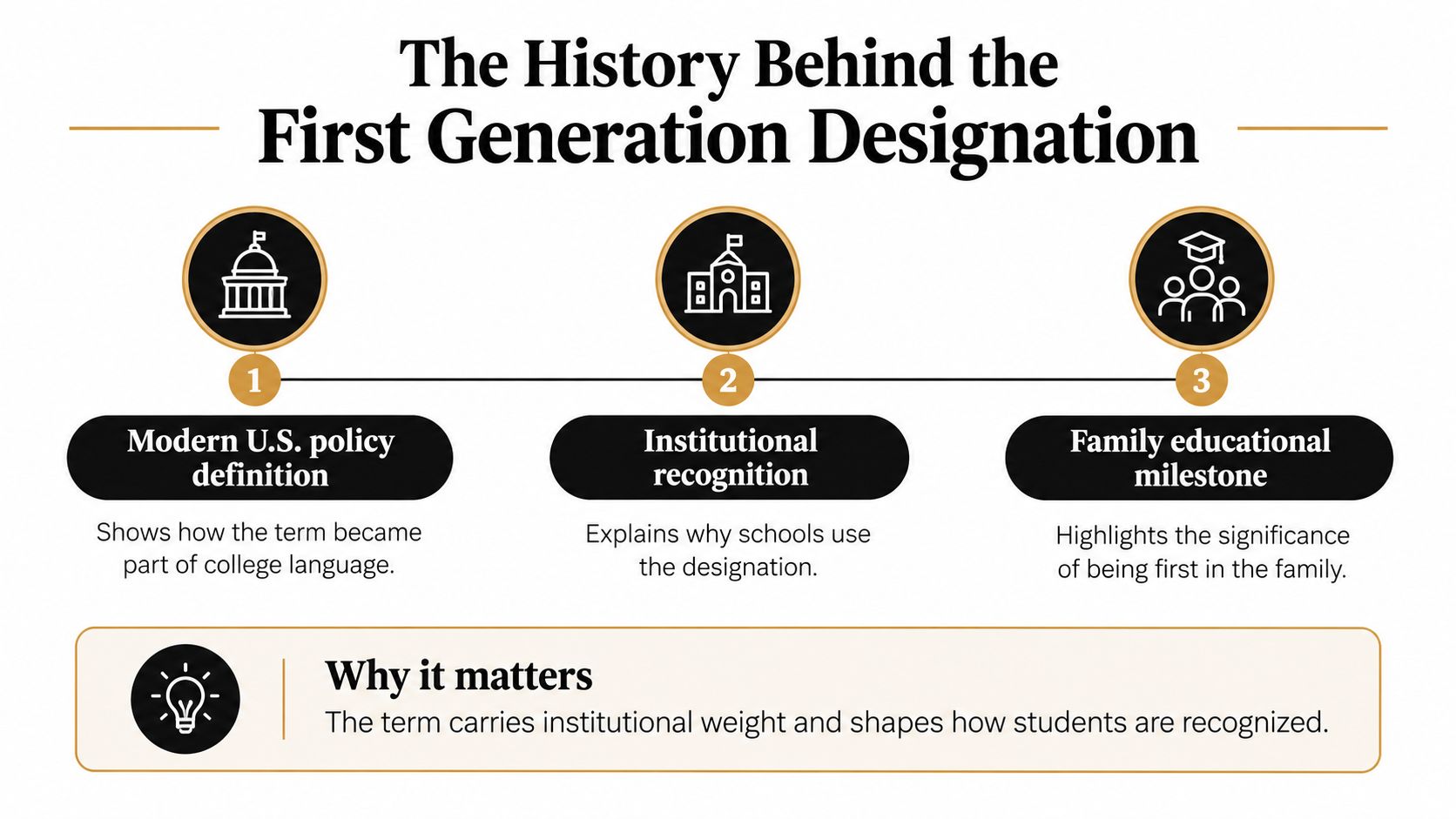
First-generation isn't just a phrase created for graduation merchandise. Its modern U.S. policy meaning developed through federal programs intended to expand access to higher education.
The term emerged from federal TRIO programs during the late 1970s and was codified in the 1980 reauthorization of the Higher Education Act of 1965, according to the Council for Opportunity in Education's explanation of first-generation status. The law focused on whether a student's parents had completed a baccalaureate degree. For a student supported by only one parent, the relevant standard concerned that parent's completion of a bachelor's degree.
From a family description to an eligibility framework
That policy milestone gave colleges and support programs a shared starting point. Rather than treating first-generation status only as a personal description, institutions could use it to identify students eligible for particular forms of support.
The historical connection matters when choosing a first gen graduation stole. The garment represents an educational identity associated with access and persistence, not a universal assumption about a student's income, upbringing, or academic ability.
Recognition should honor a graduate's achievement without requiring them to turn their family history into a hardship story.
This visual connects the policy background with the meaning families bring to commencement.
Read completion figures carefully
The completion gap introduced above helps explain why institutions recognize this milestone. It doesn't mean a stole improves graduation outcomes, and it doesn't predict what an individual student can accomplish.
Different studies also measure different outcomes. An analysis of students beginning postsecondary education in 2003–04 found that 56% of first-generation students had earned a credential or remained enrolled within six years, compared with 63% among students whose parents had some college education and 74% among those whose parents held a bachelor's degree, as discussed in research on first-generation persistence and completion.
Those figures shouldn't be substituted for bachelor's-degree attainment rates. “Earned a credential or still enrolled” asks a different question from “completed a bachelor's degree.”
These are also U.S.-specific findings. A school or organization serving graduates elsewhere should use locally relevant eligibility criteria rather than presenting U.S. statistics as worldwide benchmarks.
Who Qualifies as First Generation
Start with the definition published by the office distributing or approving your stole. A family description that feels accurate may not resolve a campus eligibility question.
The University of Mary Washington explicitly includes parents or legal guardians and states that a sibling's degree doesn't disqualify a student. Its commencement regalia guidance illustrates why students should read the actual policy rather than interpret “first in the family.”
Common First-Generation Eligibility Definitions by Institution
| Institution | Parent/Guardian Standard | Sibling Degree Effect | Notes |
|---|---|---|---|
| University of Mary Washington | Includes parents or legal guardians who haven't completed a four-year degree | A sibling's degree doesn't disqualify the student | Use the institution's published eligibility criteria |
| University of California | Uses a parent-or-guardian four-year-degree definition | Confirm with the relevant campus program | Don't infer an answer from the family label alone |
| Your institution | Obtain the exact operational definition | Ask if the policy doesn't specify | Recognition-program eligibility and ceremony permission may be separate |
Work through family circumstances without guessing
Consider these as questions to take to your campus coordinator, not automatic eligibility decisions:
- Siblings: If your older sister graduated before you, ask whether the policy focuses on parental education rather than graduation order among siblings.
- Legal guardians: If a guardian raised you, confirm whether their education is included and what information the program needs.
- Blended or adoptive families: Ask which parents or guardians count under the institution's definition. Don't assume a stepparent's or adoptive parent's education is automatically included or excluded.
- Immigrant families: If a parent earned a degree outside the United States, ask how the institution evaluates that qualification.
- Graduate students: Distinguish being a first-generation college graduate from being the first person in your family to earn a graduate degree. Ask whether the recognition program includes your degree level.
A useful message is straightforward: “I'm graduating from this program, and my family circumstances are as follows. Does your first-generation stole policy include me?”
For broader questions about who may wear different kinds of sashes, our guide to whether anyone can wear a graduation stole offers additional context. Buying a stole doesn't establish eligibility or ceremony approval.
You don't need to compare your family's achievements with another graduate's. You need a clear answer from the campus office responsible for this recognition.
Design and Customization Options for Your Stole
Clear wording matters more than an assumed color meaning. A viewer should be able to understand the stole without knowing your campus's traditions.
“First-Generation Graduate” is an explicit design choice. A graduation year, institution name, or approved program emblem can support that message, but avoid letting secondary details overwhelm it.
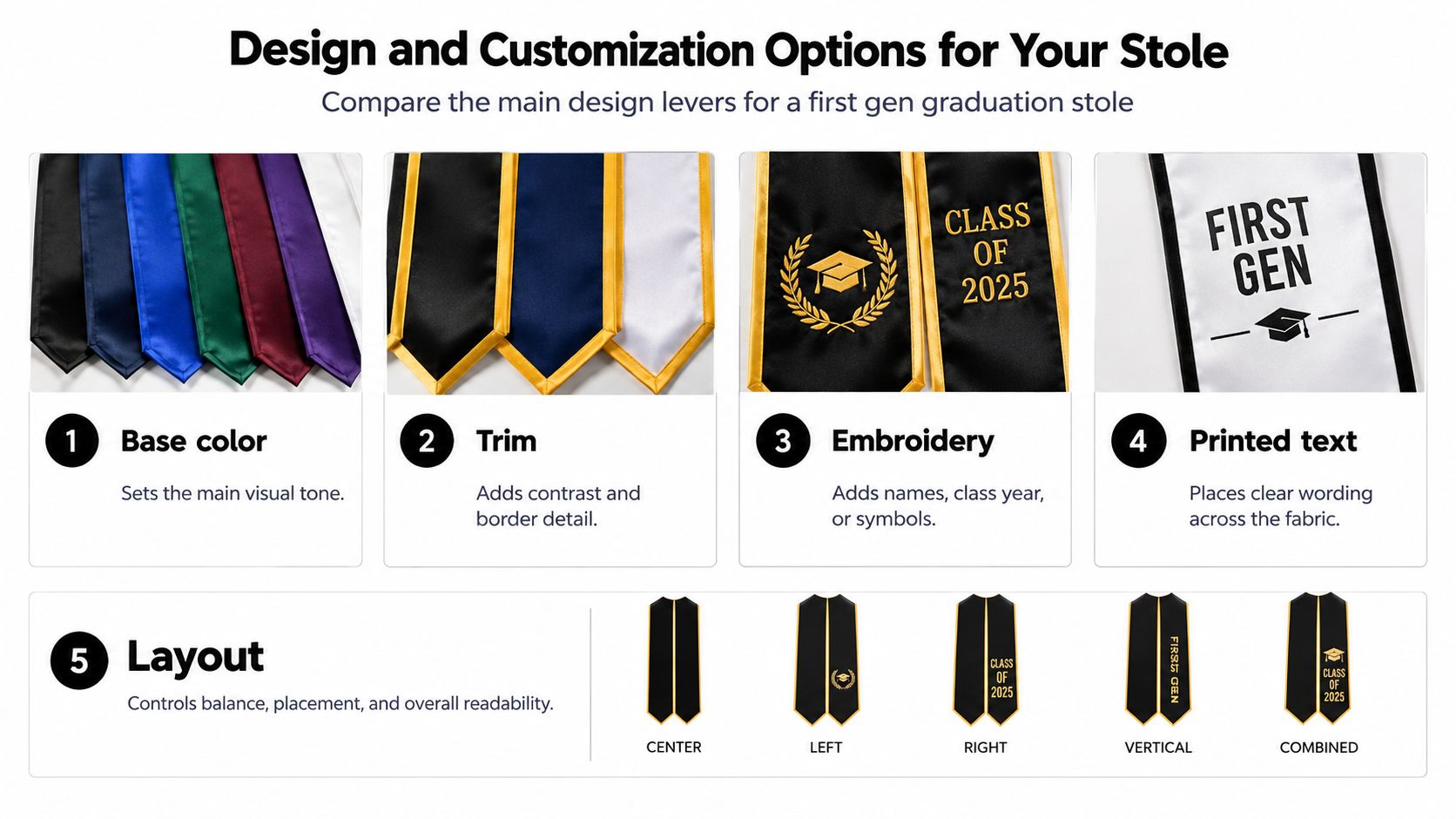
The visual below separates the main decisions so you can review them individually.
Compare the design before choosing the finish
A particular stole color doesn't carry a universal first-generation meaning. Choose from the colors your school permits, then evaluate how clearly the lettering contrasts with the fabric.
| Design choice | What to review | Practical decision |
|---|---|---|
| Embroidery | Letter size, stitched detail, and placement | Request a proof that shows the wording clearly |
| Printed text or artwork | Contrast, image clarity, and layout | Check whether the approved art remains readable |
| Single-color design | Separation between text and background | Keep the central message easy to identify |
| Multicolor design | Competing colors and visual emphasis | Make sure decorative details don't obscure the wording |
| Trim | Border width and relationship to the text | Leave enough space around important lettering |
For example, a family name can be meaningful, but it shouldn't compete with the first-generation designation if that's the stole's main purpose. An institutional emblem also needs permission where campus rules require it.
Review the layout as it will be worn
Keep essential text away from the shoulder fold, where fabric bends can hide letters. If you repeat information on both front panels, keep its placement symmetrical.
Our personalized graduation stole guide can help you organize wording and visual details before committing to a design. Review the proof against your actual gown color rather than judging the sash in isolation.
- Check the focal point: Identify the message someone should notice first.
- Check spacing: Leave room around names, symbols, and lettering.
- Check permissions: Confirm approval before adding institutional marks or honors.
- Check the complete outfit: Account for any approved hood, medal, or graduation honor cords.
A restrained design can still feel personal. You don't have to fit your entire college story onto the fabric for the stole to become a meaningful keepsake.
How to Order Your First Gen Stole
Check campus availability before purchasing. Your first-generation office, TRIO program, student affairs team, or commencement coordinator may already manage distribution.
The University of Texas at Austin provides eligible graduates with a free first-gen stole, limited to one per graduate on a first-come, first-served basis, according to its First-Generation Graduation program. That's a concrete reason not to assume buying a custom sash is the necessary first step.
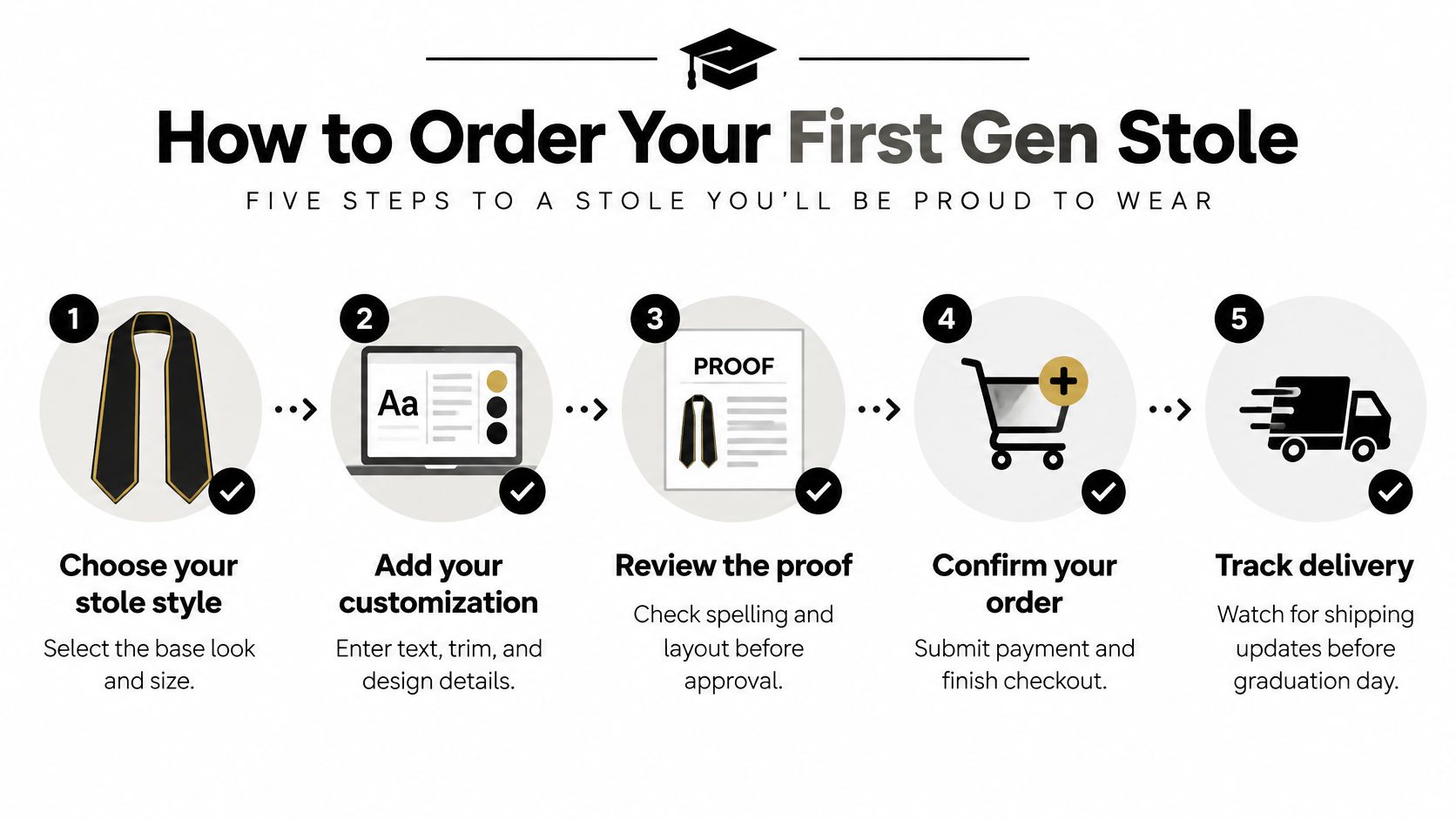
Use this ordering overview after checking your campus's requirements.
Complete the approval and ordering checklist
- Confirm permission: Ask whether the ceremony allows a campus-issued stole, an outside purchase, or a custom design. Florida International University's graduation gear guidance prohibits non-approved adornments.
- Record deadlines: Separate the campus approval deadline from the ordering, pickup, and ceremony dates. Don't assume a purchase receipt counts as approval.
- Choose the appropriate size: Our education-level sizing guidance uses 25-inch stoles for preschool and kindergarten, 31- or 33-inch stoles for elementary and high school, and 33- or 36-inch stoles for college and university graduations.
- Confirm quantity and delivery: Check distribution limits, pickup arrangements, and whether shipping is available before making plans.
- Review the complete cost: If you're purchasing, confirm the final amount and any applicable customization or delivery charges before payment.
- Approve the details: Check spelling, class year, artwork, colors, and panel placement against the approved design.
Leave room for review
Don't work backward from an assumed production schedule. Confirm the timing attached to your actual order, including proof approval and delivery, and leave room to resolve mistakes.
Before paying: Save the campus approval, the final design proof, and your collection or delivery details together.
For an additional visual reference while considering your graduation sash, watch the video below.
For a group order, the coordinator should settle eligibility and approval before collecting individual design requests. A consistent, approved approach is more useful than an assortment of purchases that graduates may not be allowed to wear.
Wearing Etiquette and Care for Graduation Day
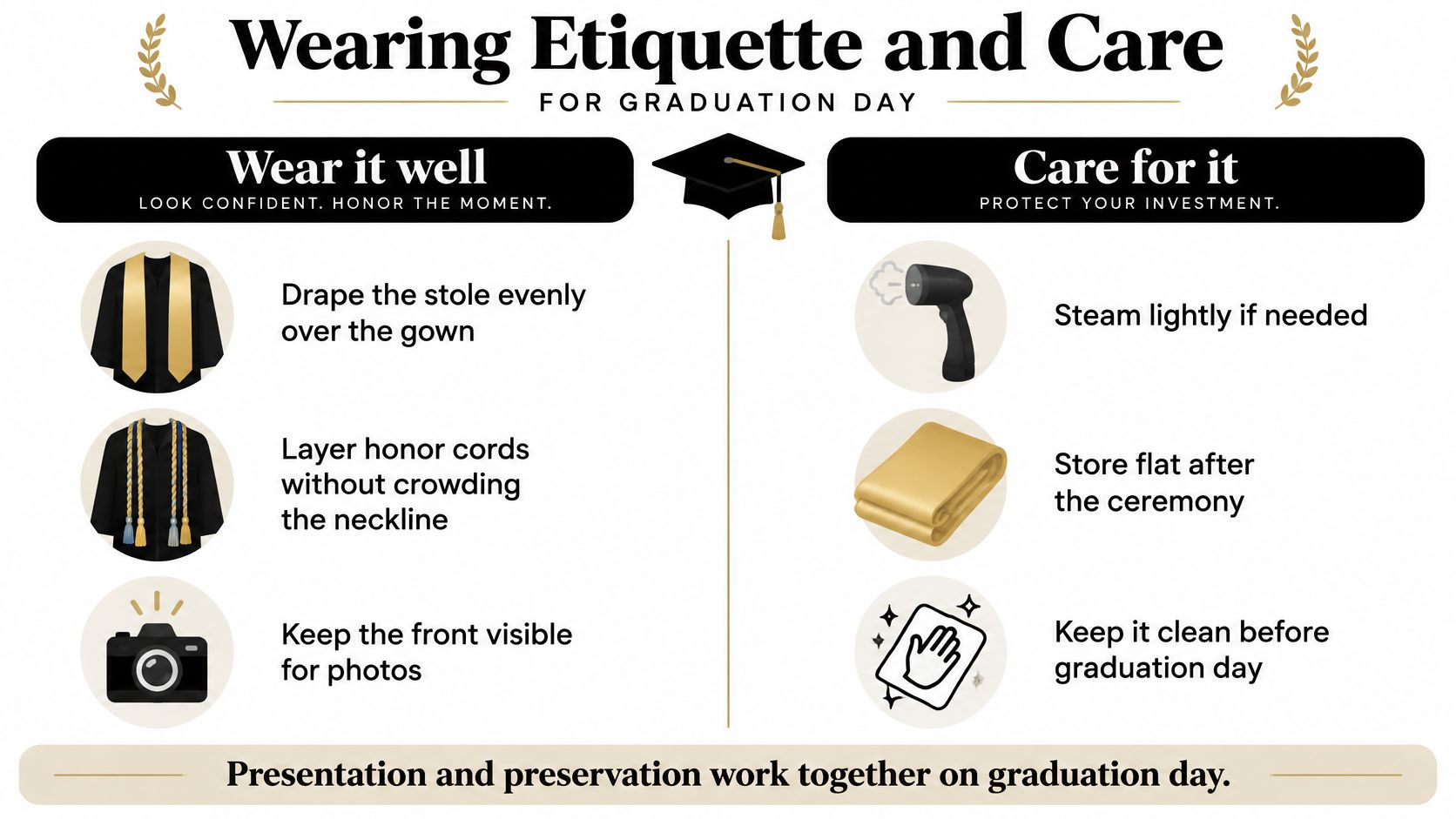
Put on your gown before arranging the stole. Drape it evenly around the back of your neck, smooth it over your shoulders, and check that the front panels hang evenly.
If your school permits graduation honor cords alongside the sash, arrange them without bunching the neckline or covering essential text. Our guide to wearing your graduation stole and sash provides additional presentation guidance.
These reminders bring wearing and preservation together.
Campus rules take priority over styling advice
The University of Southern Indiana permits only one approved student-selected stole or cord in addition to university-provided items. It prohibits personally designed or altered stoles, requires approval for new organization regalia at least 60 days before commencement, and reserves solid gold, red, and blue stoles for commencement honors, as explained in its approved commencement stoles and cords policy.
Those restrictions are institution-specific, not universal. They show why advice to “wear all your achievements” can lead a graduate astray.
Wearing multiple sashes can also obscure their wording and crowd the gown. If you must choose among first-generation, cultural, military, Greek, or academic recognition, ask which combinations the ceremony permits before deciding.
Preserve the stole without risking the decoration
Follow the care instructions supplied with the garment. Satin-like fabric, embroidery, and printed artwork shouldn't automatically receive the same treatment.
- Do inspect early: Unpack the stole before graduation day so you have time to address creases or visible problems.
- Do follow care directions: Confirm whether steaming, pressing, or cleaning is permitted for that fabric and decoration.
- Don't apply heat blindly: Avoid treating embroidered or printed areas without appropriate instructions.
- Do store it clean and dry: After the ceremony, lay it flat where practical or fold it gently without sharply creasing decorated sections.
- Don't make unapproved alterations: Check before adding pins, patches, or other attachments.
Presentation can include family participation, too. At the University of Washington Tacoma's first-generation celebration, a family member, mentor, or friend traditionally places the stole on the graduate, and graduates may wear it at commencement. That kind of presentation offers a concrete way to acknowledge the people who helped make the day possible.
Choosing the Right Stole and Taking the Next Step
Choose the option you can wear confidently, not the most elaborate design. A campus-issued graduation sash may be the right fit when it meets your needs and comes with institutional approval.
If outside purchases are permitted, compare construction, fabric, wording, and fit. Ask whether the stole is fully lined, whether the material suits your preferred appearance, and whether your personalization remains legible when worn.
Match the purchase to the occasion
At Stoles.com®, we offer first-generation stoles acknowledging being the first in the family to graduate, along with custom graduation stoles and sashes made from heavyweight bridal satin or a matte finish. Every stole is fully lined, whether in stock or custom ordered, and customization choices include colors, trims, length, cut, and your own imprinted artwork. Custom Graduation Stoles are listed at $29.00 and available as low as $23.20; our Gold Graduation Honor Cord for college and high school graduation lists at $5.95, with an as-low-as price of $4.76.
Decision check: Choose the approved option that fits your ceremony, your budget, and the message you want to share.
Before committing, make sure you can answer these questions:
- Eligibility: Has the responsible campus office confirmed your status?
- Permission: Is the exact stole or design allowed?
- Fit: Have you selected the appropriate length?
- Timing: Can you complete approval and receive it before your deadline?
Your stole doesn't have to explain everything about your journey. It needs to represent this milestone clearly and belong comfortably within your graduation-day plans.
Stoles.com® offers first-generation graduation stoles, customizable graduation sashes, and honor cords to help recognize your achievement. Confirm your campus's regalia policy, then visit Stoles.com® to compare first-generation and custom stole options and place your order before your ceremony deadline.