

The night before commencement usually starts with a pile of fabric on a bed, a wrinkled gown, a cap that won't sit flat, and one question that keeps coming back, which piece says cum laude. If you're ironing at the last minute and trying to figure out whether you need a stole, a cord, or both, you're already doing the right thing by checking before ceremony day.
Academic regalia works like a visual language. The gown shows the degree level, the hood signals the field, cords often mark official honors, and stoles can show institutional recognition, membership, or personal identity. A cum laude stole belongs in that system, but it isn't a universal object with one fixed meaning. It has to match the school's own commencement rules, and that's what makes it worth understanding before you order or wear one.
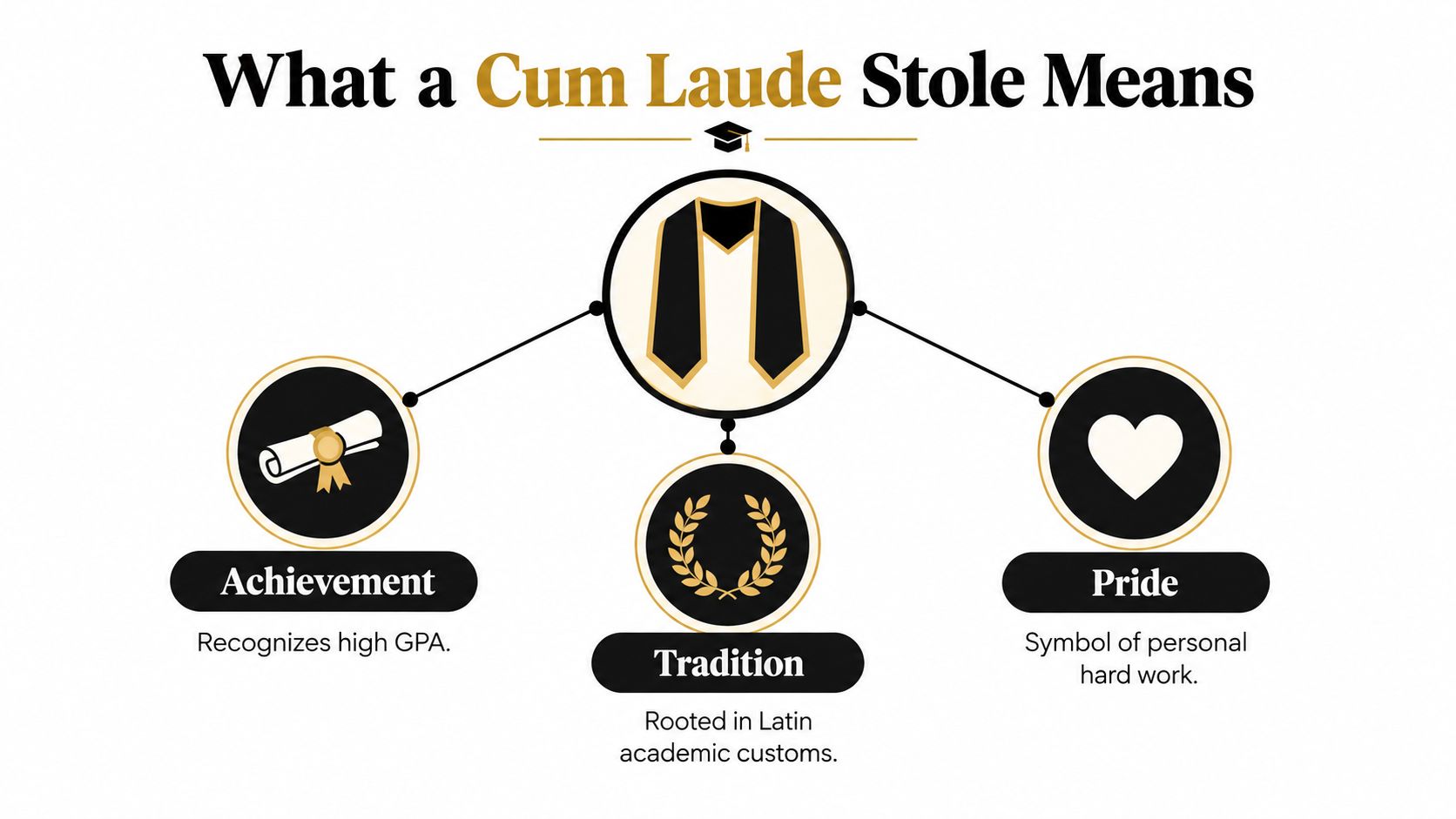
What a Cum Laude Stole Actually Means
A cum laude stole is best understood as visible punctuation on years of coursework. It sits on top of the gown and adds a clear, ceremony-day signal that the graduate has earned an honor the institution recognizes. The modern meaning of that accessory comes from a long academic tradition, not from fashion alone. Academic dress traces to 12th-century European universities, and shared U.S. standards were later formalized in 1895 through an intercollegiate code for academic dress, which is why regalia still carries so much structure today. USCA's regalia history explains that continuity well.
Where the stole fits in the regalia system
Think of commencement dress as layers with different jobs. The gown carries the academic level. The hood identifies the field. Cords usually communicate honors or affiliations. The stole, by contrast, often communicates a specific recognition, a cultural identity, or an organization's approved design.
That matters because a cum laude stole is not just decoration. It works as a public marker that connects the graduate's achievement to the institution's traditions. For some readers, that visual meaning is easier to understand after seeing how it appears alongside other garments, and a practical overview like Jimmy Clemmons Photographer architectural education can help with that visual planning.
Why the wording matters
When a school uses Latin honors, the phrase cum laude points to academic distinction, not to one universal color or one universal pattern. The accessory only carries the right meaning when it matches the university's approved regalia rules. In plain terms, the stole is the symbol, but the registrar decides whether that symbol belongs in the ceremony.
Practical rule: if the school doesn't approve the garment, the stole's message is incomplete no matter how polished it looks.
That's why the safest starting point is simple, check the school's commencement page before you buy anything. A stole can be personal, but it still has to live inside an official academic system.
The Three Tiers of Latin Honors Explained
A student can walk across the stage with a cum laude stole in one university and earn the same Latin honor without any stole at another. That is why the three tiers matter: the title, the threshold, and the regalia rule are often set separately by each school.

What each honor usually signals
Cum laude is the first tier of Latin honors and usually marks solid academic distinction. Magna cum laude sits above it, and summa cum laude sits at the top. The names describe level, not a universal color, garment, or GPA rule.
Some schools translate those tiers into cords or stoles, while others do not. FIU is one example of a university that makes the color assignment clear, with white cords for cum laude, silver for magna cum laude, and gold for summa cum laude. FIU's graduation gear page shows how one registrar ties honor wording to ceremony gear.
Why color alone can mislead
A color cue helps only when it matches the school's own policy. A gold cord can mean one honor at one campus and a different adornment, or no approved adornment at all, somewhere else. Students often see the visual first and assume the meaning is universal, but the registrar's page is the final authority.
| Institution | Cum Laude | Magna Cum Laude | Summa Cum Laude |
|---|---|---|---|
| UCLA | Next roughly 10% of the class | Next 5% | Top 5% |
| Jefferson University | 3.50 to 3.64 | 3.65 to 3.79 | 3.80 or higher |
| Johnson & Wales University | 3.50 to 3.69 | 3.70 to 3.89 | 3.90 to 4.00 |
| UC San Diego | Recent cutoff has ranged from 3.876 to 3.945 | Published on the university's honors policy page | Published on the university's honors policy page |
Thresholds as published by each registrar; see the linked university pages in the following section.
The table makes one point plain. Latin honors are not a single national code, and the same title can carry different academic cutoffs from school to school. A student who wants to wear the right stole should verify the policy first, then match the garment to that policy. For a plain-language refresher on honor wording, how to graduate with honors is a useful companion piece.
How Universities Actually Set Their GPA Thresholds
The biggest mistake students make is assuming cum laude means the same GPA everywhere. It doesn't. Some schools set fixed GPA bands, while others rank students against classmates and recalculate the cutoff as the class changes.
Four different policy models
UCLA uses a class-rank model. Under that system, the top 5% receive summa cum laude, the next 5% receive magna cum laude, and the next roughly 10% receive cum laude. UC San Diego publishes a moving cutoff, and its cum laude threshold has ranged from 3.876 in 2023–24 to a projected 3.888 to 3.958 for 2026–27. UC San Diego's Latin honors page shows why one school can treat honors as a distribution rather than a fixed GPA.
Jefferson University takes a fixed-band approach, with cum laude at 3.50 to 3.64, magna cum laude at 3.65 to 3.79, and summa cum laude at 3.80 or higher. Johnson & Wales uses a slightly different set of bands, with cum laude at 3.50 to 3.69, magna cum laude at 3.70 to 3.89, and summa cum laude at 3.90 to 4.00.
How to read a registrar page without getting lost
Start with the honors section, then look for three details, the GPA rule, the residency or credit rule, and whether the school uses final grades or a preliminary calculation. If the page mentions class rank, don't try to convert it into a universal GPA. If it mentions residence, outside credits may not count the way you expect.
A 3.5 can be generous at one campus and highly selective at another. The number means nothing until you put it beside the registrar's policy.
What this means for shoppers
A cum laude stole should be treated as a school-specific symbol, not as proof of one global standard. If your institution uses a rank model, the stole still needs to match the school's approved presentation. If your school uses fixed bands, the cutoff can still differ from the neighboring university down the road.
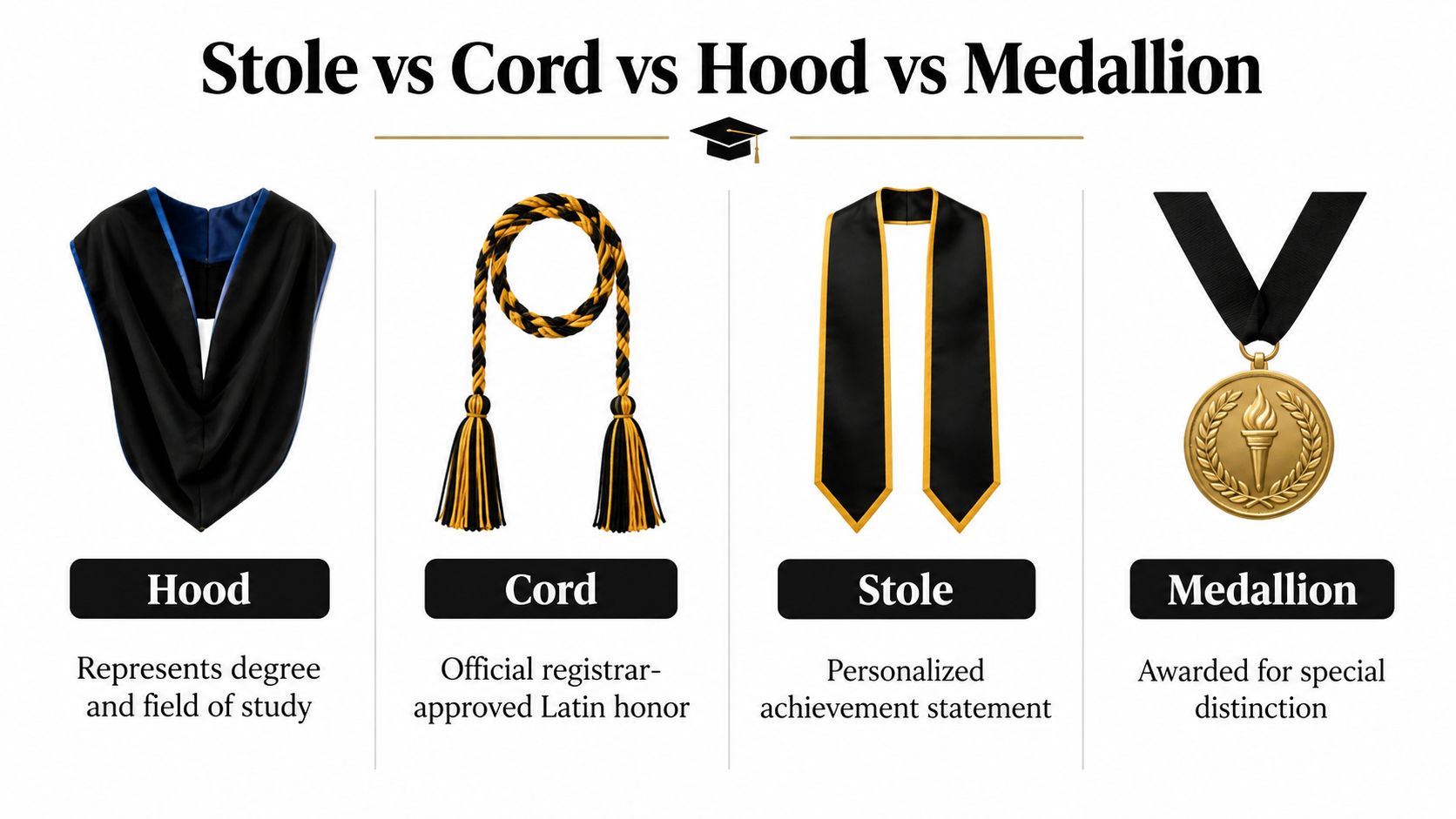
Stole vs Cord vs Hood vs Medallion
A student can wear several pieces of graduation regalia at once, but each one signals something different. Commencement offices separate them for a reason, and mixing the roles can lead to the wrong item being worn for the wrong purpose.
What each piece actually does
The hood identifies the degree and field of study. The cord is often the official honor marker when a school assigns Latin honors through approved colors. The medallion usually signals a society, institution, or special distinction. The stole is the most flexible piece, since schools may use it for affiliation, culture, service, or an academic message.
Florida International University shows how specific cord rules can be. Its grad gear page ties white cords to cum laude graduates with GPAs from 3.5 to 3.699, silver cords to magna cum laude graduates with GPAs from 3.7 to 3.899, and gold cords to summa cum laude graduates with GPAs from 3.9 to 4.0. A policy like that makes the cord a school-assigned signal, not a decoration chosen at random.
Why a stole can't just replace a cord
Some schools reserve cords for official honors and stoles for approved organizations or institutional use. Kansas State's regalia guidelines treat honor cords as the formal marker of university-defined academic achievement and separate that rule from other regalia choices. Kansas State's regalia guidelines also show why approved stoles need their own policy review instead of being assumed to mean the same thing everywhere.
A cum laude stole should be checked against the registrar's rules before graduation day. If the school already assigns cords for honors, the stole may need to stay decorative or personalized rather than carrying the official honor on its own. That keeps the meaning clear at check-in and avoids a last-minute correction when staff review the regalia.
How to Wear a Cum Laude Stole on Graduation Day
Start with the gown, because everything else has to sit on top of it cleanly. Once the gown is on, drape the hood from the shoulders if your school uses one, then add the official honor cords, and place the stole last so it shows clearly across the front. That order keeps the layers visible and helps the photo look intentional instead of crowded.
A simple wearing sequence
- Put on the gown first. Make sure the front panels hang straight and the zipper or buttons are closed properly.
- Set the hood, if required. It should rest from the shoulders and lie flat.
- Add the official cord. Keep it centered so the colors don't bunch near the neck.
- Place the stole last. Let it fall evenly on both sides, with the front edges aligned.
A clean drape matters because the stole sits in the most visible part of the outfit. If the fabric twists, the lettering can disappear in photos. If the stole is pinned too tightly, it can crease the embroidery.
The details students usually miss
Avoid clips that pierce embroidered names or honor text. If you're wearing more than one stole, order them from longest to shortest so each layer stays visible. If the stole has metallic thread, try to coordinate it with the existing cord color rather than fighting it.
Visual check: the stole should lie flat, the cords should center neatly, and nothing should hide the honor text or insignia.
For a practical look at how graduates arrange these pieces, the guide at how to wear your graduation stole and sash is useful before the ceremony rush.
Before you leave for commencement, do one final mirror check. The cap should sit level, the tassel should hang correctly, the gown should close cleanly, and the stole should read clearly from a few feet away. That five-second scan can save you from redoing everything in the parking lot.
Ordering and Customizing Your Stole With Confidence
Order the stole only after you have confirmed the school's policy. The registrar or commencement office can tell you whether the color is approved, whether the wording is allowed, and whether the order has to be submitted by a specific deadline. Some schools are strict about adornments, while others allow more flexibility for personalized pieces.

What to customize
Start with the details the school is most likely to review first, such as a name, program, graduation year, or honor wording. Some graduates also add Greek letters, society insignia, or a school-specific color palette that complements the gown without copying the official honor cord. If you want to see how personalization options work in practice, the guide to a personalized graduation stole walks through text, color, and insignia choices.
Material matters too. Satin gives a more reflective finish, while matte polyester reads a little quieter in photos. A standard 72-inch length usually gives enough drape for most adults, and a weighted hem can help the stole hang straighter on a windy stage.
What to ask before you click buy
- Is the color approved? Verify that the shade will not conflict with the school's own honor system.
- Is the wording allowed? Some campuses limit the use of official honor language.
- What is the deadline? Production time matters more than many shoppers realize.
- What should the stole match? Some schools want a coordinated look, while others only care that it is not an imitation of an official cord.
Families ordering a keepsake alongside the ceremony stole can browse Ecuadane's university gift guide for complementary graduation gifts.
Stoles.com® offers customizable stoles, including honor stoles and personalized graduation stoles, so students and coordinators can compare text, colors, and insignia options in one place. The useful part is not the product alone. It is the ability to match the design to the school's actual rule set.
Common Myths Students Believe About Honor Regalia
The first myth is that one color means the same thing everywhere. It doesn't. Auburn uses a different honors model than many other schools, with cum laude at 3.40, magna cum laude at 3.60, and summa cum laude at 3.80, plus a requirement of at least 60 hours in residence using Auburn coursework. Auburn's commencement regalia page shows how specific one policy can be.
The second myth is that one GPA defines cum laude. Rice shows why that assumption breaks down, because its honors thresholds vary by academic school and can range from 3.7160 to 3.9401 for cum laude in the 2025–26 cycle. A student looking at the number alone could easily miss the school's actual rule set. That's why a registrar page beats a rumor every time.
The third myth is that a stole automatically replaces a cord. It doesn't. Some universities use cords as the official honor marker, while others require approval for stoles or reserve them for organizational use. If the school already assigns cords for Latin honors, a personalized stole has to avoid duplicating that role unless the campus says otherwise.
Check the registrar first, then choose the garment. If the school's policy and the product description disagree, the school wins.
A good fallback position is simple, confirm the honor level, confirm the approved accessory, and confirm the deadline before you order anything. If something still looks off, ask the commencement office to verify whether the item belongs on stage at all.
Choosing Your Stole and Wearing It Well
A good cum laude stole does three things at once, it reflects the honor, respects the school's rules, and looks clean on graduation day. Loma Linda University shows why timing matters too, because students can become eligible for honor cords at a 3.5 GPA at the start of the spring quarter before commencement, while the final cum laude designation stays pending until all final grades are tabulated. Loma Linda University's commencement regalia page makes that sequence clear.
That's why the safest choice is always the same. Check the registrar, verify whether the honor is final or provisional, and make sure the stole doesn't duplicate the school's official cord system. If you're a transfer student or your grades changed late in the term, that confirmation step matters even more.
A few final questions come up every season. Can you wear the receiving school's stole? Only if that school allows it. Does provisional honor status automatically qualify you for a custom stole? Not necessarily, because the ceremony rule and the diploma rule can differ. What if final grades move you up to a higher level? Ask the registrar whether they use a replacement process or a final correction.
The right stole should feel personal without overriding the institution's own honor system. When the design, wording, and approval all line up, the result looks intentional and respectful, which is exactly what graduation day calls for.
Stoles.com® offers customizable graduation stoles, honor stoles, and related regalia that can be matched to school-specific commencement needs, including personalized text, colors, and honor themes. If you're comparing options for a cum laude stole, visit Stoles.com® to review designs that fit graduation-day use and support a polished, policy-aware order.