

If two graduates from different universities cross the same stage in gold cords, did they earn the same honor?
Usually not. One may have finished with summa cum laude, another may have completed an honors program, and a third may be wearing the color of a society that has nothing to do with grades. The color matches. The achievement doesn't.
That gap is where most graduation-season confusion starts. Families search for a chart of honor cord colors for graduation, find one, and treat it as a national standard. No such standard exists. What exists is a written policy at each school or organization, and the color is the visible part of that approval. Once you learn to read the policy instead of the color, the whole system becomes easy.
Common Honor Cord Colors and What They Usually Mean
Start with the default meanings, because they're the ones you'll see most often. Gold usually signals the highest academic honor, blue usually signals magna cum laude, silver or white usually signals cum laude, and red or crimson usually signals a high distinction level. Those are defaults, and a default is only useful until a specific school publishes something different.
Color combinations are how many universities separate Latin honors, honor societies, and special achievement programs, and Henderson State University's academic regalia page shows how far the detail runs. There is no single worldwide meaning for honor cord colors, so the same shade can shift rank a few hundred miles away.
| Color | Common meaning | Example institution |
|---|---|---|
| Gold | Highest honor (summa cum laude or highest distinction) | University of New England; University of Memphis |
| Blue | Magna cum laude | University of New England; Penn State Harrisburg |
| Silver | Cum laude | University of New England |
| White | Cum laude or distinction | Penn State Harrisburg; University of Memphis |
| Red or crimson | High distinction | University of Memphis |
| Purple and gold | Summa cum laude | Louisiana State University |
| Red, white, and blue | Military affiliation | University of St. Augustine |
Practical rule: treat any published color chart as a set of leads, not a set of answers. A lead tells you what to ask the registrar. An answer comes from the policy page.
The University of New England's 2026 commencement program lays out a clean three-level scheme: gold for summa cum laude, blue for magna cum laude, and silver for cum laude. Penn State Harrisburg splits the same hierarchy differently, listing a blue-and-white cord for summa cum laude, a blue cord for magna cum laude, and a white cord for cum laude. Read those lists side by side and the trap appears. At one school blue is the middle honor. At the other, blue is part of the top honor and also the middle one on its own.
Some institutions signal status with a pair of colors rather than a single shade, which is why purple and gold appears as one specification for summa cum laude at Louisiana State University. Others reserve a whole trio for something outside academics entirely. The University of St. Augustine assigns red, white, and blue to military affiliation, putting a service recognition in the same visual family as an honor one.
So how should you use the table? Read each row as a clue about what a color can mean, then check the issuing school's own list for what it does mean at that ceremony. If the school publishes a single combined page, read it in full. If it doesn't, ask the registrar or commencement office for the cord list in writing before anyone orders anything.
GPA Thresholds Behind Honor Cord Colors
A 3.75 GPA can qualify for different honors at different schools. GPA thresholds are institutional rules: the honor name alone does not establish which cord a graduate is approved to wear.
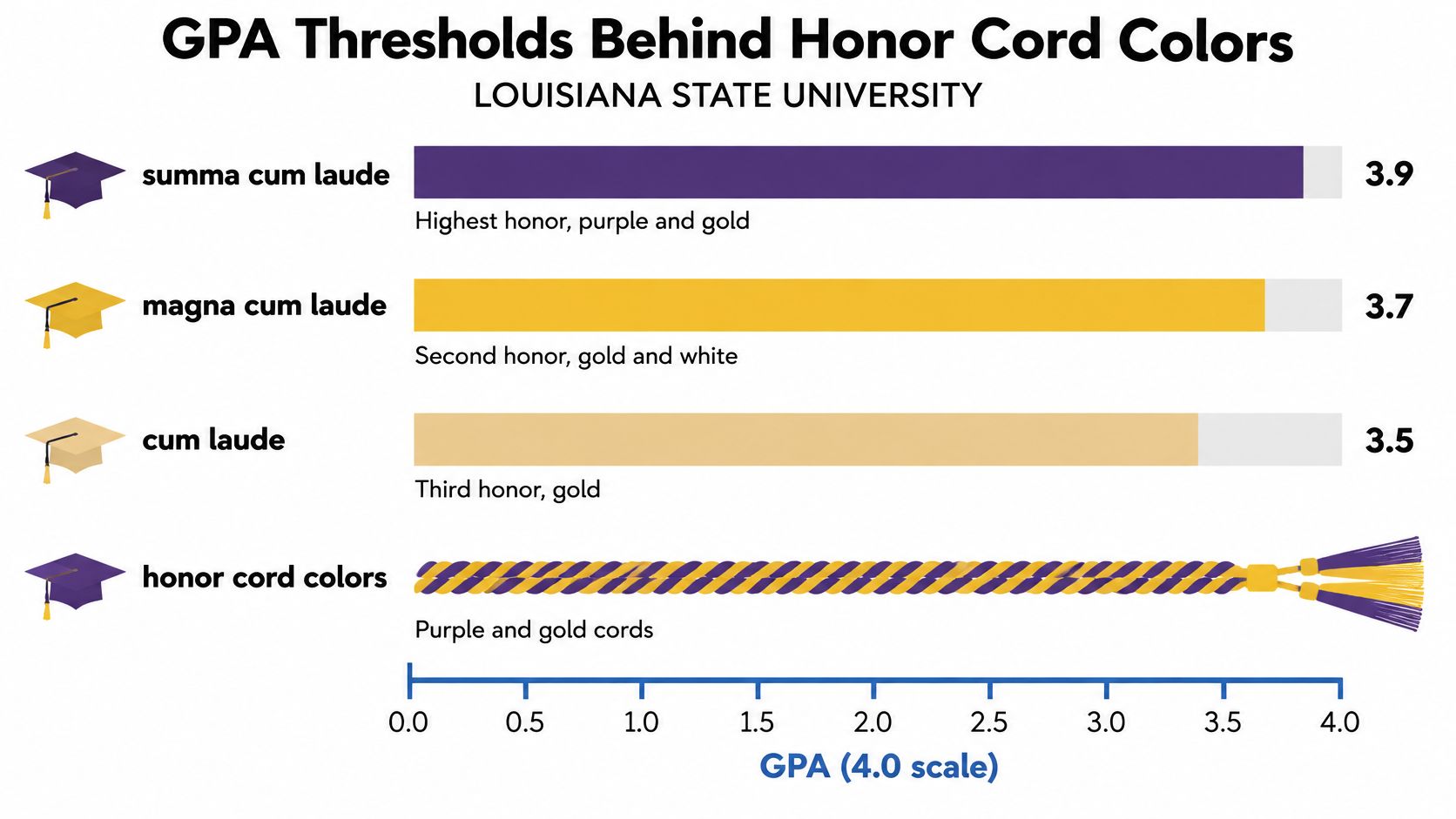
Louisiana State University's academic regalia page connects each Latin honor to both a GPA threshold and a cord specification. Its published requirements are 3.90 or higher for summa cum laude, 3.80 or higher for magna cum laude, and 3.70 or higher for cum laude. Upper Division Honors has a separate status-based requirement and a white cord.
| Institution | Honor level | GPA requirement | Cord specification |
|---|---|---|---|
| Louisiana State University | Summa cum laude | 3.90 or higher | Purple and gold cord |
| Louisiana State University | Magna cum laude | 3.80 or higher | Two gold cords |
| Louisiana State University | Cum laude | 3.70 or higher | Two purple cords |
| Louisiana State University | Upper Division Honors | Set by honors-program status, not a GPA cutoff | White cord |
The LSU thresholds show how the rule works: eligibility determines the honor, and the institution's regalia policy identifies the approved cord. Cord count matters too. LSU specifies two gold cords for magna cum laude and two purple cords for cum laude, not a single cord in either color.
Same honor name, different cutoff
Consider a student with a 3.75 GPA. Under LSU's published thresholds, that GPA reaches the cum laude level. The result follows the school's rules, just as a key opens only the lock it was made for. To understand the meanings of the three Latin honor levels, see this explanation of what cum laude means.
Three fields to check separately
Before choosing a cord, confirm the honor level, the eligibility rule, and the cord specification. These are related, but they answer different questions: what recognition is awarded, who qualifies, and what the graduate is authorized to wear.
Eligibility rules may use institutional GPA rather than an overall GPA that includes transfer credits. Degree type or honors-program participation may also affect the applicable rule. Check the current commencement or academic-regalia policy for the graduate's program before ordering.
Society Cords That Mark Membership, Not Grades
A society cord identifies a graduate's membership in an organization. For example, North Dakota State University reported that Beta Gamma Sigma members wear blue-and-gold cords and may qualify through class standing: the top 10% of a bachelor's class or the top 20% of an MBA class, according to its 2024 explanation of academic regalia.
| Organization | Cord colors | What the cord recognizes |
|---|---|---|
| Beta Gamma Sigma | Blue and gold | Business honor society membership; eligibility includes the top 10% of a bachelor's class or the top 20% of an MBA class |
| Sigma Tau Delta | Red and black | English honor society membership, as listed by Henderson State University |
| Thomas Edison State University adult-student and professional honors | Set by the university for each category it lists | Adult-student honors, business, nursing, education, military service, and charitable giving |
The table shows why a cord's color needs context. Henderson State University lists red-and-black cords for Sigma Tau Delta membership without attaching a GPA band to that entry. Read the recognition named by the school, rather than assuming a cord signals academic rank.
Two approvals matter. A society may set its color standard, while the campus determines which cords students may wear at commencement. Confirm both before ordering.
Check the society and the campus
Colors travel across campuses, but permission to wear one stays with the issuing body. A society's color guidance does not automatically mean a campus allows that cord at its ceremony. Some schools limit cords to recognized societies or other approved groups.
Confirm that the society recognizes the student as a member and that the campus permits the cord at commencement. If you are unsure whether a society provides cords, this guide to whether the National Honor Society provides a cord explains what may vary by chapter.
Choose cords that correspond to a named recognition and an approving organization. A color without that connection may not meet the ceremony's rules.
Reading Several Cords Without Confusing Honors
Three cords can represent three different approvals, not three levels of academic standing. Each one may come from a different authority, so identify who issued it and what recognition it represents before deciding whether the cords can be worn together.
Sort each cord into one of five categories:
- Academic rank: Latin honors such as cum laude, magna cum laude, and summa cum laude, set by the registrar.
- Honor-society membership: recognition granted by an organization, often with a national color standard.
- Military service: a service affiliation, which may be represented by a red, white, and blue combination.
- Program or cohort recognition: study abroad, adult-student honors, or a nontraditional-student designation.
- Service and philanthropy: recognition tied to charitable giving, volunteer hours, or campus leadership.
A color's meaning depends on the institution's approval. At the University of St. Augustine, white identifies Honors Program membership, rather than a cum laude distinction. Thomas Edison State University lists separate combinations for adult-student honors, business, nursing, education, military service, and charitable giving in its commencement honor cord reference. The same color can therefore represent different categories at different schools.
Three questions for the commencement office
Before ordering several cords, ask:
- May graduates wear more than one cord? Is there a limit?
- If two cords conflict, which organization's rule applies at the ceremony?
- Does a stole count as a separate recognition, or does it replace a cord?
For placement, follow this guide to how to wear graduation honor cords, so each cord remains visible.
Keep a record of each cord's issuing body, category, and approval date. Order only the cords the school or society permits for commencement.
Why Colors Differ and the Errors to Avoid
Academic regalia has a long history. Gowns helped identify members of early European universities, as the University of South Carolina at Aiken's regalia history explains. Later academic-costume standards addressed gowns, hood trim, and discipline colors, but they did not establish one national color chart for honor cords.
That distinction explains why the same color can mean different things at different schools. A cord color is an approval granted by an institution or society, not a universal symbol. The University of South Carolina at Aiken, for example, identifies a gold braided cord with an honor-graduate designation. Another school may use gold for a different honor level or organization. The color is like a word whose meaning depends on the institution's rules.
Six errors and the fix for each
- Trusting a universal chart. A general guide may label gold as the highest honor everywhere. Check the issuing institution's policy before relying on that meaning.
- Assuming gold means summa cum laude. At the University of South Carolina at Aiken, gold identifies an honor-graduate designation. Confirm the named honor level rather than inferring it from the color.
- Ordering before reading the commencement policy. Requirements may depend on the school's GPA rules or how it handles transfer history. Check the current policy before choosing a cord.
- Ignoring braid and strand details. Kansas State University distinguishes its three honor levels with purple-and-white cords in different styles and sizes. Match the full description, not just the color.
- Treating a society cord as a grade cord. A society may use a cord to recognize membership rather than academic rank. Check what the organization's cord represents.
- Assuming a stole and a cord mean the same thing. They are different regalia items and may be governed by separate rules. Confirm which items are allowed at the ceremony.

Some graduates have more than one approved recognition to display. Stoles.com offers Double Graduation Honor Cords as a custom option. A combination cord does not, by itself, show what either color represents; that meaning comes from the school or society that approved it.
The question to ask: What recognition does this item represent, and which institution or society approved it? A color alone cannot answer either question.
Confirm the Approved Cord Colors Before You Order
Which cord color has your school approved for your recognition? Treat the answer as an institutional decision, not a universal code. A color chart can offer a starting point, but only the school or society's policy can confirm what a cord represents at your ceremony.
The six-step check below helps you confirm the details before ordering.

- Find the regalia page for your institution and degree level. A general university page may not cover rules for a particular college or program.
- Check the honor level and GPA rule, including how the policy handles institutional GPA and transfer credits.
- Confirm the approved color, braid pattern, and strand count. Some schools distinguish honors by cord style or size as well as shade.
- Review the eligibility rule for any society cord. Membership recognition may follow a different policy from academic honors.
- Ask whether multiple cords are permitted and whether your ceremony restricts stoles or other adornments.
- Get the approved description in writing from the commencement office or society before ordering.
Pay close attention to the current GPA rule and the policy on wearing multiple cords. A cutoff may change, and a cord that does not meet ceremony rules may need to be removed at check-in.
A campus-specific guide, such as this explanation of ASU honors cords, illustrates how one institution can specify its own cord colors and requirements.
Once you have written approval, match the order to that description. Stoles.com offers honor cords, including a Gold Graduation Honor Cord for college and high school graduation at a list price of $5.95, with an as-low-as price of $4.76.
Use the written policy to confirm eligibility, then shop by the approved color and details. A product listing describes what is available; the institution's rules determine what you may wear.