

Your gown is ordered, your family wants photos, and you're deciding whether to add a white stole for graduation. Then a classmate says white means honors, someone else says humanities, and your school's regalia page seems to describe something different. Before you buy anything, separate what the color suggests from what your university authorizes you to wear.
Why the White Stole Trips Up So Many Graduates
You're comparing graduation outfits with a classmate who already has a white stole. They're wearing it for an organization, but another friend insists white belongs only to honors graduates. You open the registrar's website and find rules about approved adornments rather than a simple color chart.
That's a plausible graduation-day dilemma, not evidence that you've missed an obvious tradition. A white graduation stole isn't a credential you can identify reliably by color alone.

Start with the garment, not the assumption
A graduation stole is the scarf-like textile that rests over the shoulders and hangs down the front of the gown. A graduation sash may be the shopping term you encounter for a similar garment, while graduation honor cords are a separate adornment. Cornell's explanation of academic dress and commencement colors describes how regalia can communicate fields of study, honors, and cultural affiliations.
The distinction matters when you're checking eligibility. Permission to wear a white cord doesn't automatically authorize a white stole, and a classmate's organization-issued sash doesn't establish your own eligibility.
Practical rule: Identify who issued the stole and what designation it represents before deciding what its color means.
Read the complete design rather than just the background fabric. Trim, lettering, insignia, and the issuing organization may tell you more than white alone.
- Check the context. Is the item distributed by your university, an academic program, or a student organization?
- Read the wording. An organization name communicates something different from an academic-honors designation.
- Separate ceremony and portraits. Ask whether a personal design is permitted during commencement, rather than assuming permission for photographs also covers the ceremony.
You don't need to memorize every academic color. You need to identify the garment, understand its intended message, and confirm that your ceremony permits it. White's academic history explains why people attach meaning to it, but history alone won't settle your purchasing decision.
The Academic-Regalia Roots of the Color White
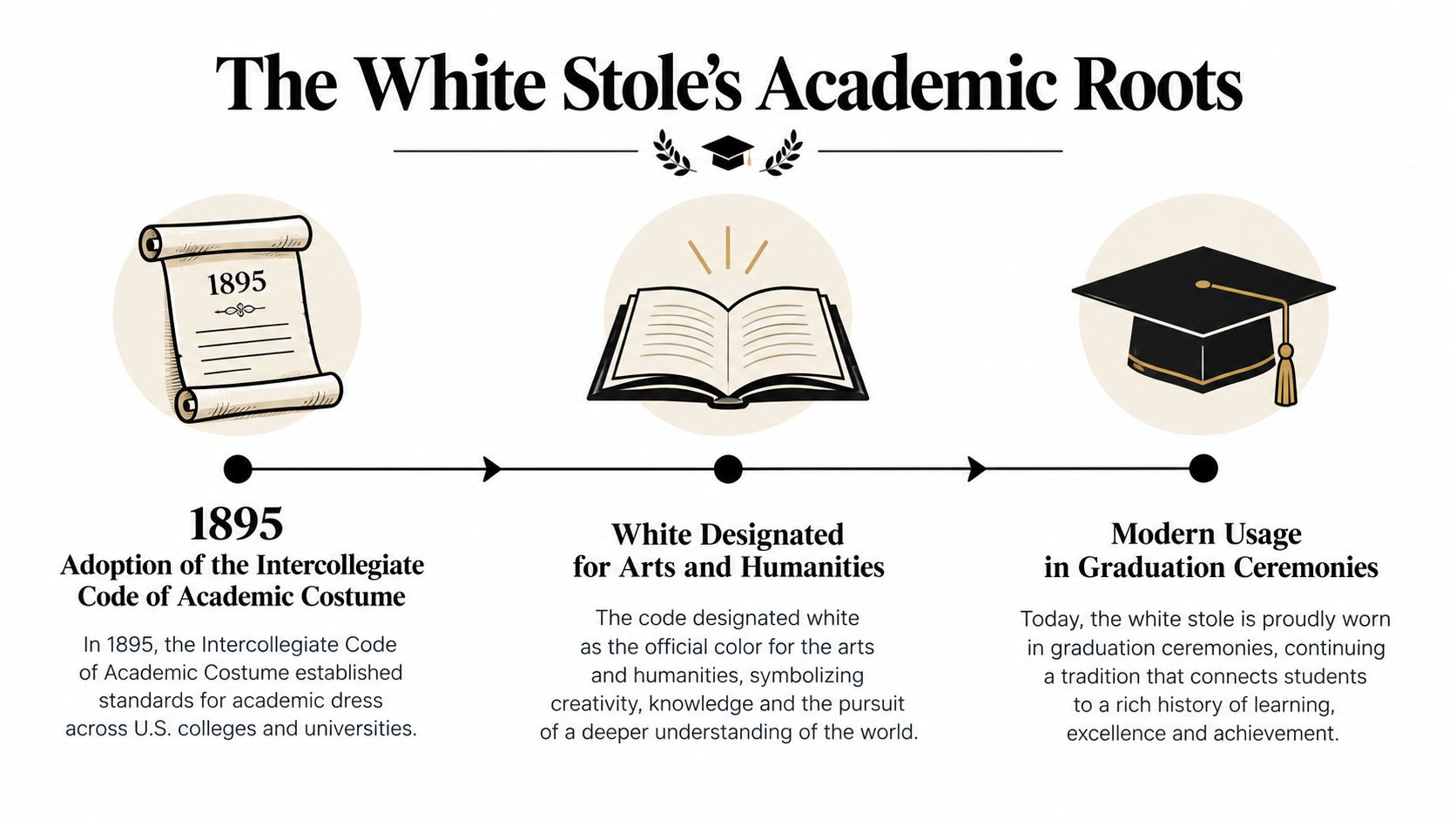
White's association with academic achievement has a specific historical foundation. The Intercollegiate Code of Academic Costume, adopted in the United States in 1895, designates white for arts, letters, and humanities; hood velvet identifies the discipline, while hood lining identifies the institution, according to the University of South Carolina Aiken's history of academic regalia.
That arrangement explains why white may bring English, history, literature, or other humanities-related study to mind. It doesn't establish a universal rule for every white graduation sash.
Hood velvet and hood lining do different jobs
Think of academic dress as several separate labels worn together. Each component has its own purpose, so the same color can require a different interpretation depending on where it appears.
| Component | What to examine | What it can communicate |
|---|---|---|
| Hood velvet | The trim around the hood | Academic discipline under the code |
| Hood lining | The fabric inside the hood | Institutional identity under the code |
| Graduation stole | The shoulder-draped garment and its decoration | A designation established by its issuer |
Princeton's hooding program likewise lists white for arts and letters, alongside blue for philosophy, peacock blue for public affairs, orange or yellow for engineering, brown for architecture, and light brown for finance. The University of South Carolina also identifies white with Arts, Letters, and Humanities while describing the honor stole separately.
Those examples illustrate an important distinction: a discipline-color listing isn't automatically a stole-eligibility policy. A student can encounter a historically accurate color chart and still reach the wrong conclusion about which accessory to purchase.
Use history as context
The history of academic regalia can help you understand why commencement clothing has distinct components. When you examine your own outfit, ask whether a rule concerns a hood, tassel, stole, or cord before applying it.
For example, don't choose a humanities-colored stole solely because your degree falls within that field. First establish whether your institution uses stoles to identify disciplines.
White has a documented place in academic dress. Your university's rules determine whether that historical meaning applies to the particular garment you'll wear.
What a White Stole Actually Signals at Different Schools
Compare university policies and the ambiguity becomes easier to understand. Schools don't choose different descriptions for the same honor. They may assign white to entirely different kinds of recognition.
At the University of Arkansas, the undergraduate hierarchy uses a cardinal stole for honors, a white stole for high honors, and a white stole with a cardinal-and-white cord for highest honors, according to its commencement regalia policy. There, the complete combination matters.
Compare the whole designation
The University of Colorado Boulder's academic-dress listing includes a plain white stole for American Society of Civil Engineers members and a white stole with gold trim for first-generation graduates. It also identifies white combinations associated with sports, leadership, wellness, and engineering-related groups.
| Example | What the white garment communicates |
|---|---|
| Arkansas white stole | High honors |
| Arkansas white stole with cardinal-and-white cord | Highest honors |
| Colorado Boulder plain white stole for ASCE | Organizational membership |
| Colorado Boulder white stole with gold trim | First-generation graduate recognition |
A comparison based only on the base color would miss those differences. Removing trim from a custom design, substituting a cord, or copying another student's stole could change the intended message.
Other institutional examples reinforce the point. Caltech associates a white stole with Avery House, whose residential color is white, while Southern Indiana assigns white cords to a named honors program rather than treating white as an unrestricted decoration.
A white stole can recognize belonging just as readily as academic standing.
Personal meaning and official permission are separate
A graduate may want a white stole to express cultural identity, religious affiliation, or a personal milestone. That intention is meaningful, but it isn't evidence that the school has approved the design for commencement.
Don't assume white signifies nursing, education, purity, or a particular Latin honor by itself. If someone describes one of those meanings, ask whether they're explaining local policy, an organization's tradition, or personal symbolism.
Use a simple verification habit before wearing an unfamiliar stole:
- Check the registrar. Find the eligibility rules for academic distinctions.
- Check the commencement policy. Look for garment restrictions, reserved colors, and permitted combinations.
- Check the issuing organization. Confirm the exact fabric color, trim, wording, and insignia.
If those answers conflict, send the commencement office a photograph or design proof. A question about an actual garment is easier to resolve than a general question about what white means.
Choosing Materials, Embroidery, and Customization
Once you know your approved designation, choose a design that communicates it clearly. A plain white stole may suit an institution-issued outfit, while an organization stole may need lettering or an emblem to distinguish its purpose.
Kansas State University describes stoles as organization-colored or insignia-bearing adornments and requires institutional approval for recognized groups wearing them at commencement in its regalia guidelines. Treat approval as a design requirement, not a final administrative detail.

Compare fabric descriptions carefully
Satin and polyester aren't mutually exclusive choices. Satin describes a fabric construction, while polyester describes a fiber, so ask the seller for the complete material description. If a listing uses terms such as bridal satin or shimmer satin, request a close-up photograph or sample rather than assuming how it will feel.
For a white graduation stole, compare these practical features:
- Surface appearance. Decide whether you prefer a restrained finish or a more reflective look.
- Drape and lining. Ask how the garment hangs and whether its construction suits your planned embroidery.
- Comfort. Check the feel of seams, backing, and decorated areas that may touch your neck or clothing.
- Color matching. Review the white fabric and trim together before approving a cohort order.
White against a black gown creates a strong visual contrast. My recommendation is to keep lettering equally easy to distinguish, especially if recognizing the organization in photographs matters to you.
Make the wording do the explaining
Choose an organization name, approved achievement, or meaningful emblem before adding decorative details. Names, graduation years, Greek letters, national flags, and religious symbols should have deliberate placements rather than compete for the same space.
If you're unfamiliar with stitched decoration, Merchandise's explanation of what is embroidery is a useful starting point for discussing the technique with a supplier. Ask to see the actual thread colors on white fabric, particularly when considering metallic thread or subtle tonal stitching.
Custom graduation stoles, international flag stoles, fraternity stoles, sorority stoles, and honor stoles provide different routes for expressing achievement or affiliation. Choose the appropriate category, then verify the exact options available rather than assuming every symbol, fabric, or production method is offered.
A restrained design with accurate wording is preferable to a crowded stole whose intended meaning is unclear.
How to Wear a White Stole with Cap, Gown, and Cords
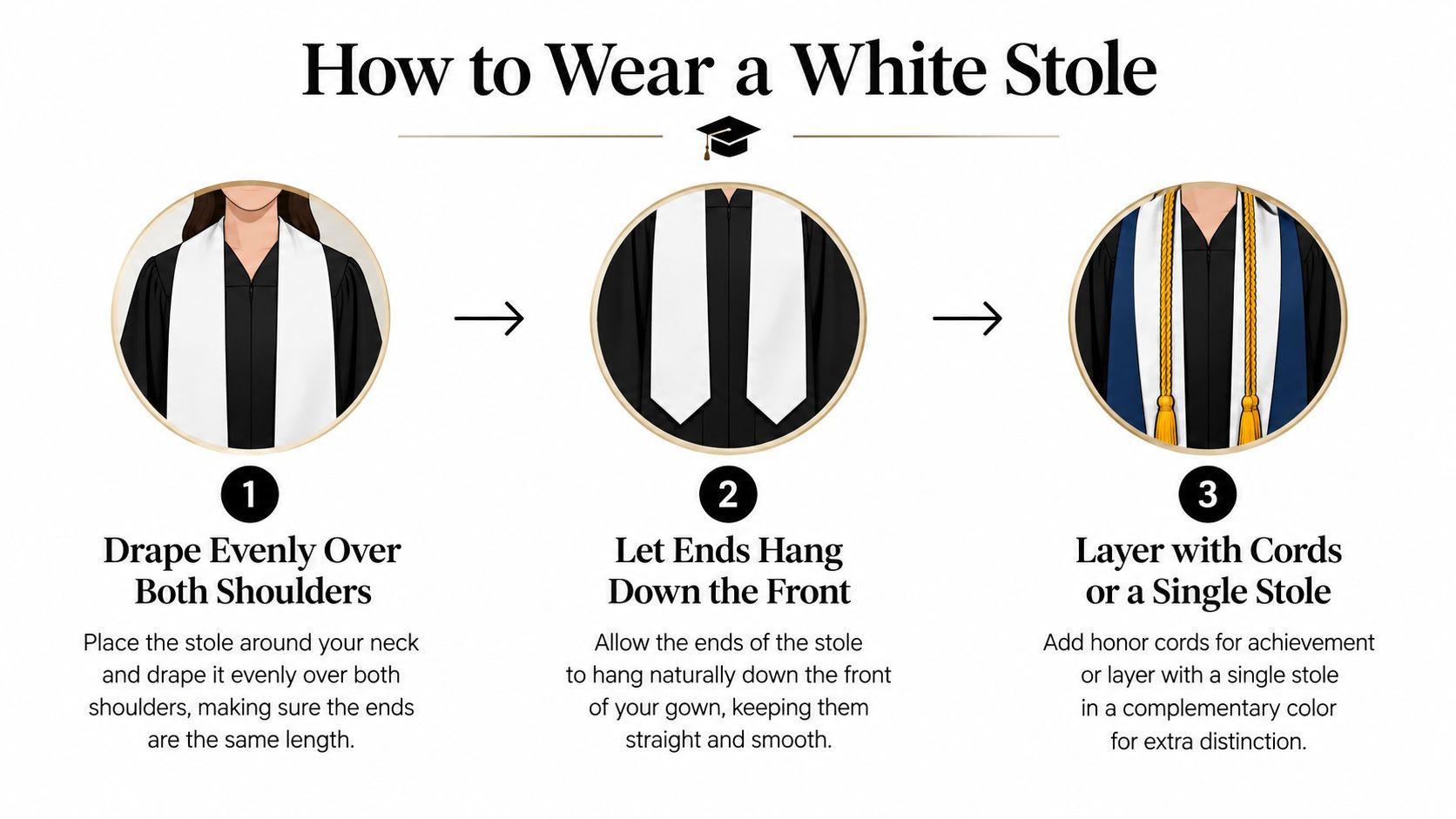
Put on your gown before arranging accessories. Drape the stole over both shoulders, let the ends hang down the front, and adjust the center until the garment rests comfortably around your neck.
Check the front in a mirror without pulling either end downward. Your goal is an even drape with visible lettering, not a perfectly rigid arrangement that becomes uncomfortable when you sit.
Layer according to your authorized combination
When cords and a stole are both permitted, arrange them so the cord doesn't twist the stole or hide its insignia. Follow any school-specific placement instructions, then rehearse sitting, standing, and walking.
Georgia Tech illustrates why accessories need separate eligibility checks: its thresholds are 3.15 GPA for white honors cords, 3.35 for gold high-honors cords, and 3.55 for white-and-gold braided highest-honors cords. It also requires 60 Georgia Tech credit hours and uses the final GPA from the term immediately preceding the final term, as explained in its honor-cord requirements.
- A single stole. Keep the approved wording unobstructed and check that the ends don't catch on the gown.
- A stole and honor cords. Separate the hanging pieces before taking photographs or joining the procession.
- An honor cord and cultural stole. Verify permission for the combination rather than assuming separate approvals cover both together.
My styling recommendation is to favor a single stole with an approved cord over overlapping stoles when you have a choice. It gives the lettering less competition, but it's a photographic preference, not a universal commencement rule.
Fit the outfit to your body
Use the guide to wearing a graduation stole and sash as a fitting reference, then adapt placement to your own needs. Don't allow hanging fabric to interfere with wheelchair wheels, walking aids, hearing equipment, or other assistive technology.
Test the stole while seated if that's how you'll spend much of the ceremony. If seams feel scratchy, the neckline creates pressure, or the garment conflicts with cultural clothing, contact the ceremony team before making permanent alterations.
A comfortable setup should let you focus on crossing the stage, not repeatedly readjusting your outfit.
Ordering, Approvals, and Customization Workflow
Start with the approval deadline, not the delivery estimate. A stole that arrives before commencement may still be unusable if the organization or design hasn't received the required authorization.
Utah State University prohibits organizations, colleges, and departments from using solid gold, silver, or navy cords, reserving them for summa cum laude, magna cum laude, and cum laude distinctions in its adornment guidelines. That's a warning against ordering accessories that resemble protected honors, even when the resemblance is unintentional.

Move from authorization to production
Confirm the message. Write down the proposed organization name, achievement wording, colors, and symbols. Ask the school to review the actual combination.
Keep written approval. Save the response with your order records, especially when purchasing for a chapter or cohort. LSU's requirement for organization-issued adornments to receive Academic Affairs approval at least 30 days before commencement illustrates why authorization must precede production.
Review a full-size proof. Check spelling, Greek letters, flags, emblem orientation, and placement on both hanging panels. The personalized graduation stole guide can help you prepare customization decisions before contacting a supplier.
Before paying: Confirm whether the proof represents the actual embroidery placement and whether changes remain possible after approval.
Choose among custom, Greek-letter, flag, and honor-stole designs according to the approved purpose. Don't replace an unavailable authorized design with a similar-looking one without checking first.
Coordinate the complete order
Ask separately about production time, dispatch, delivery, and what happens if an item arrives with an error. If you're also selecting a cap, consult Dirt Cheap Headwear's 2026 graduation hat buyer's guide alongside your school's cap specifications, not instead of them.
For bulk orders, keep a shared approval record and confirm:
- Minimum quantities. Ask whether they apply to the entire order or each design variation.
- Matching trim. Approve a consistent fabric-and-thread combination across the group.
- Embroidery details. Check every personalized name and preserve shared insignia placement.
- Distribution plans. Decide who receives, inspects, and hands out the finished garments.
Assign someone to approve the final proof. A clear decision-maker helps prevent conflicting edits after production has been authorized.
Care, Storage, and Making the Stole Last
Read the care instructions before trying to remove packaging wrinkles. Don't assume the fabric, embroidery, lining, and applied insignia can tolerate the same treatment.
If pressing is permitted, follow the specified temperature, use a protective cloth, and avoid direct heat on decoration. Don't improvise with steam or a hot iron when the supplier hasn't confirmed that the material can tolerate it.
Prepare gently and store without pressure
- Before commencement. Unpack the stole early enough to inspect it and ask the supplier about any creases or marks.
- For small stains. Follow the cleaning directions, test any permitted treatment discreetly, and avoid vigorous rubbing around thread or insignia.
- After the ceremony. Let the garment dry completely before storing it flat or gently rolled in a clean, dry space.
- For decorated areas. Avoid tight folds through raised embroidery or attached emblems.
Keep the issuing information with the stole. The University of Southern Indiana, for example, reserves white cords for undergraduates who completed its University Honors Program and prohibits other groups from selecting white under its stoles and cords policy. A saved explanation preserves meaning that color alone can't convey.
Preserve comfort alongside appearance
Universities may offer individualized arrangements rather than expect every graduate to manage identical clothing and movement. Sussex's accommodations include alternative gowning, quiet spaces, venue run-throughs, aisle seating, step-free stage access, and support for traditional or cultural attire; ask your own institution what's available.
The University of Salford's graduation accessibility guidance is another reminder to raise access needs before ceremony day. Your white stole should fit your approved, comfortable setup, not force you into an unsuitable one.
With its designation verified and its fabric cared for, the stole can become a keepsake with a story you can explain.
Stoles.com® offers customizable graduation stoles, international flag stoles, Greek-letter stoles, honor stoles, and honor cords for celebrating achievement and identity. Visit Stoles.com® with your school's approved colors, wording, and insignia ready, and explore a white stole design that represents your graduation accurately.