

The familiar advice that gold means academic excellence, red means leadership, and white means service is too simple to guide a graduation purchase. There's no universal honor cord color code. A color chart can help you recognize possibilities, but it can't tell you what you're authorized to wear at your college.
The safest approach is to identify the achievement first, confirm your school's approved color and format, and then arrange the cord. That order helps you avoid buying an attractive accessory that doesn't match your award or your ceremony's rules.
Honor Cord Colors and What They Signal
A college honor cord is a pair of twisted ropes draped around the neck, knotted at the back, with the ends hanging over the front of the gown. Academic dress provides the ceremonial foundation, but institutions decide which achievements their accessories represent, as described in Charleston Southern University's graduation guidance.
Think of the gown as the ceremony uniform and the cord as a label. You can see the label's color, but you need the school's rulebook to interpret it.
Honor cord colors and their meaning at named schools
The institutional examples below illustrate why you shouldn't translate a cord's meaning from one campus to another. Gettysburg College's regalia guide, for example, identifies gold with summa cum laude and silver with magna cum laude.
| Color | Meaning at the named school | School |
|---|---|---|
| Gold | Summa cum laude at Gettysburg; cum laude, magna cum laude and summa cum laude at Oakland | Gettysburg College; Oakland University |
| Silver | Magna cum laude | Gettysburg College; St. Cloud State |
| Red | Departmental or conciliar honors at Oakland; cum laude at St. Cloud State; a 4.0 GPA with at least 45 semester hours at UMBC | Oakland University; St. Cloud State; UMBC |
| Blue | Magna cum laude at Hampton; Meyerhoff Scholars at UMBC | Hampton University; UMBC |
| White | Cum laude at Hampton; upper-division honors at LSU | Hampton University; LSU |
| Green | General honors | Hampton University |
| Purple and gold | Latin honors | LSU |
These aren't interchangeable designations. A red cord could distinguish academic performance, a departmental award, or another institutionally defined achievement. A blue cord might indicate a Latin honor at one college and participation in a particular scholars program at another.
Nor should you assume that every cord recognizes GPA. Colleges may recognize honor-society membership, service, leadership, military service, or departmental accomplishments through approved accessories.
Why a graduate might wear several cords
Latin honors, departmental honors, and honor-society membership are separate categories. A student can qualify for more than one without receiving the same award twice. Millersville University, for example, distinguishes its Latin honors, University Honors College, and Departmental Honors cords and permits multiple cords for multiple qualifying distinctions.
That doesn't mean adding more cords automatically communicates a higher academic rank. Each approved item should correspond to an actual recognition.
Practical rule: Read a cord as an institution-issued designation, not as a nationally standardized color symbol.
For families, the most useful question is not what a color means alone. Ask what award the graduate received and which office issued it. Before choosing college honor cords, find the school's written list and match the category, color, and approved format.
How Schools Decide Who Earns a Cord
A GPA cutoff works like a snapshot. The school chooses which grades go into the calculation and the date it takes the picture. Those two choices can decide whether a student crosses the line.
What a published GPA threshold looks like
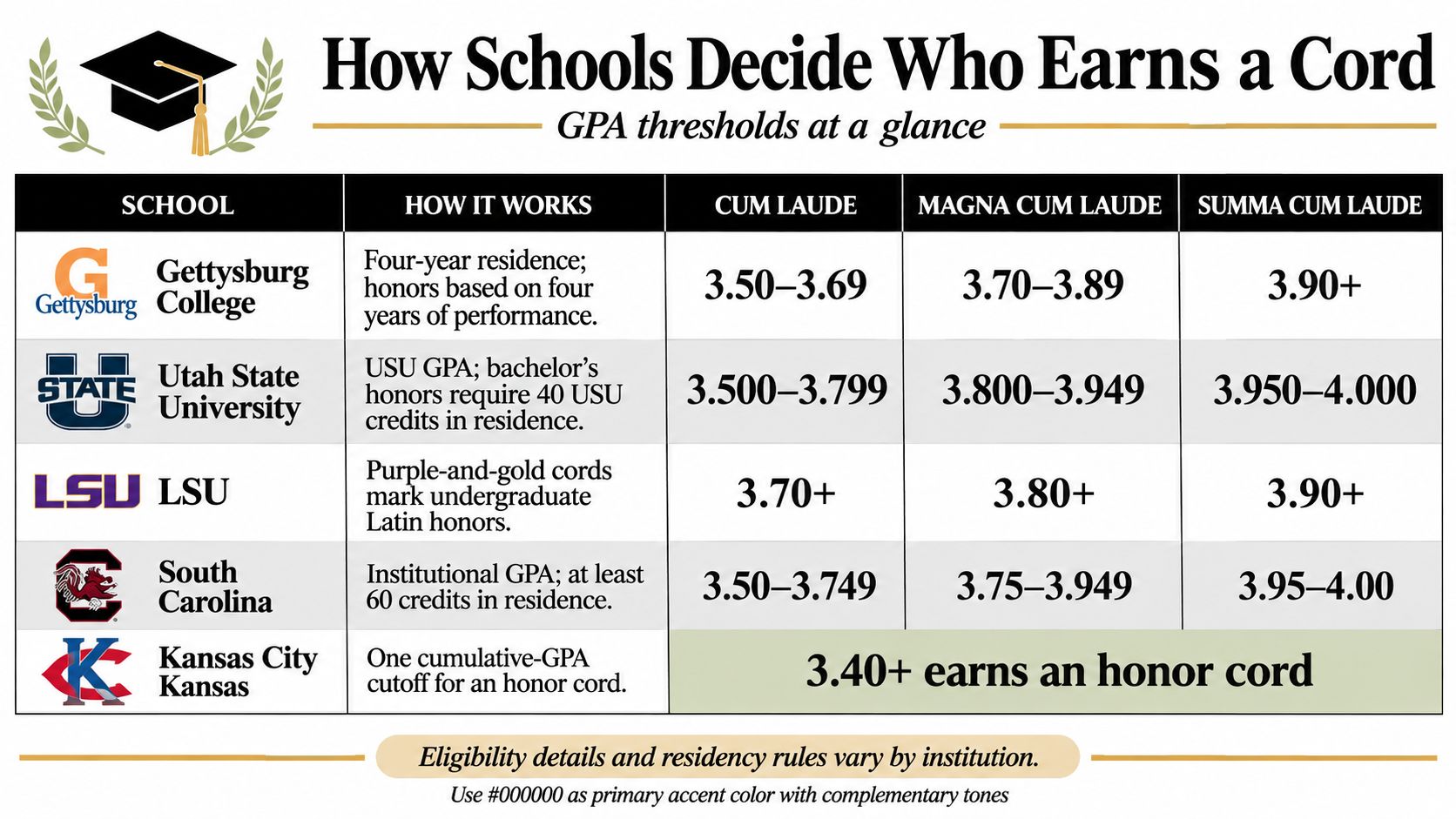
Published rules show how much the details vary. Kansas City Kansas Community College's graduation-cord requirements set a cumulative GPA threshold of 3.40 or higher in 2025 for general honor-cord eligibility. That single figure still leaves two questions: which courses count, and when the registrar freezes the number. A hundredth of a point can separate a cord from no cord, so treat the cutoff as an administrative line, not a judgment about effort.
| Institution | What the published rule states | GPA basis |
|---|---|---|
| Kansas City Kansas Community College, 2025 | Cumulative GPA of 3.40 or higher for general honor-cord eligibility; the rule does not create separate cum laude levels | Cumulative GPA |
| Four-year colleges and universities | Honors levels, cord eligibility, and timing are set by each institution; use the current commencement or registrar page | Cumulative GPA, sometimes with a residence or timing rule |
Use the visual guide to separate an eligibility threshold from the timing of the decision.
Why the measuring date matters
Oakland University's academic-policy guidance describes determinations as preliminary and based on cumulative GPA at the start of the graduating semester. Other campuses use a prior semester and may correct upward when final grades arrive. If your final semester raises your GPA above an honors boundary, you may qualify for an updated academic record without having received the corresponding ceremony cord at the original distribution.
Ask three separate questions: Will the ceremony recognize the award? Will final honors appear on the transcript? Can you obtain a replacement accessory if the answer changes?
Early distribution gives staff time to prepare awards and organize pickup, but it can mean provisional decisions. Waiting for final grades produces a more complete calculation while leaving less time to distribute cords. The trade-off is administrative, not a sign that one campus values honors less than another.
For academic planning, the guide to how to graduate with honors can help you distinguish longer-term preparation from commencement arrangements. Society membership has its own eligibility rules, so confirm them separately.
If you're reviewing graduation preparations with family, this video can accompany that conversation.
Confirm Your School's Rules Before You Order
Treat approval as an administrative task, not a shopping preference. Kansas State University's regalia guidelines define an honor cord through university-established academic achievement and distinguish honors through approved styles and colors.
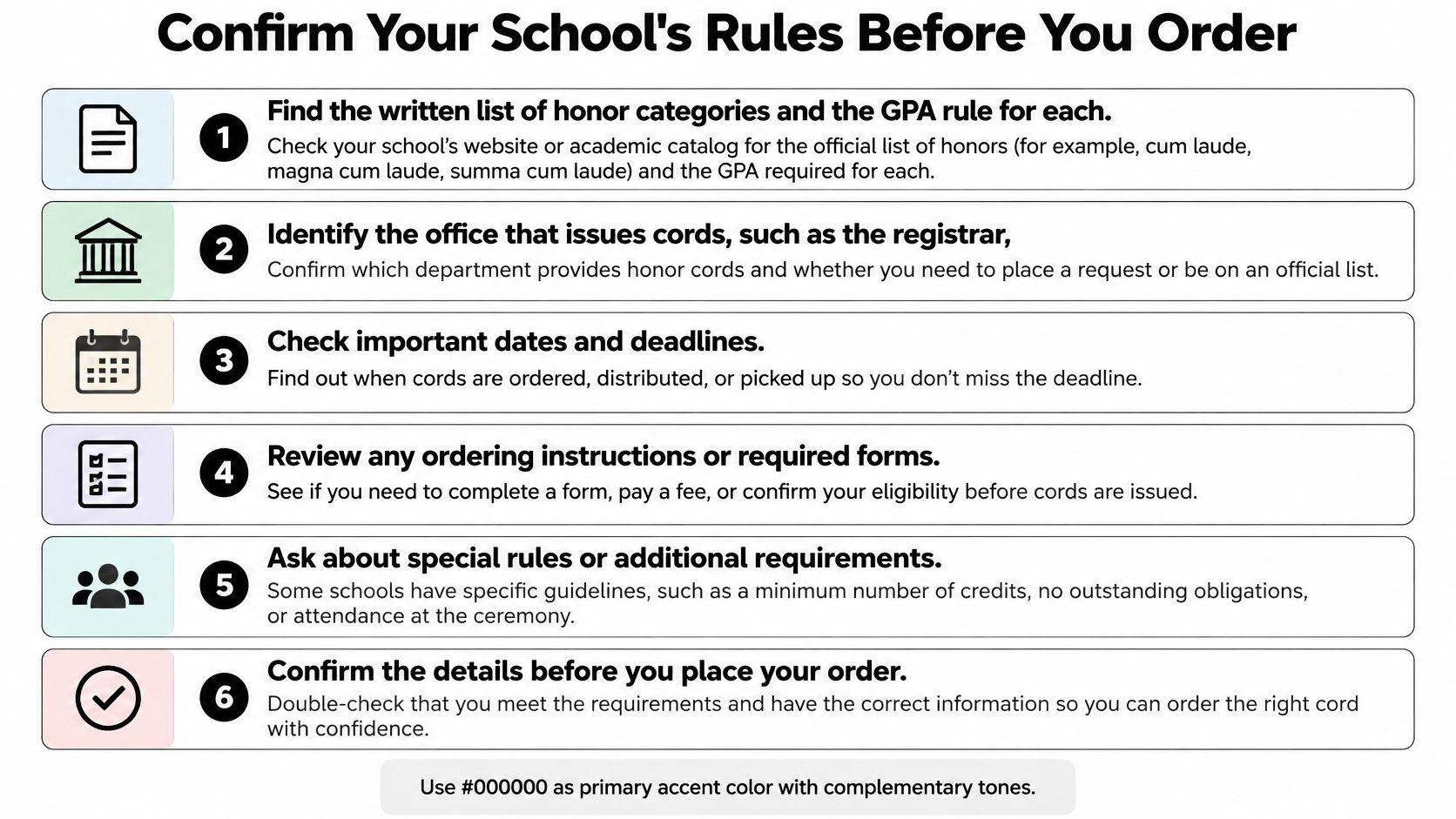
A practical verification checklist
- Find the written categories. Open the current commencement or registrar page and locate the honor designation you expect to receive. Save the wording rather than relying on a general graduation announcement.
- Identify the issuing office. Determine whether the registrar, academic department, honors program, or society handles your award. Send eligibility questions to that office.
- Confirm how you obtain it. Ask whether the cord is supplied, purchased, or ordered through an approved channel. Eligibility alone doesn't confirm that an item will arrive automatically.
- Check accessory combinations. Ask about outside organizations and limits on cords, stoles, and other recognition items. Don't interpret permission for a cord as permission for every accessory.
- Establish your award status. Request confirmation of the GPA calculation date and whether the decision is provisional. Ask what happens if your category changes.
- Get fulfillment details in writing. Record the ordering deadline, pickup location, delivery arrangements, and contact for missed pickup. Remote learners should ask specifically about receiving items before traveling.
- Read the ceremony restrictions. Confirm the approved appearance and any inspection or lineup requirements before making alterations.
Keep this checklist with your commencement emails.
Keep one complete approval record
St. Mary's University's cord and sash policy recognizes several categories, including academic honor societies, university honors, and study-abroad participation. That breadth makes the precise category important, especially when different programs issue different accessories.
If you're considering a custom graduation stole, submit the design for approval separately from your cord question. A personalized design isn't automatically authorized because its colors match.
Keep a simple record containing award category, approved item, issuing office, deadline, and written confirmation. For group orders, use that same record to label each item before distribution.
Choosing Single, Double and Multi-Color Cords
The same cord shade can mean different things on different campuses. Choose the approved construction first, then match the color.
Cord format works like punctuation. A comma and a semicolon take up similar space on the page, but they change how the sentence reads. A single-color cord, doubled cord, and intertwined multi-color cord can look similar in a small product photograph, yet each sends a different signal to a reader who knows the school's code.
A single-color design offers a straightforward way to display an approved category. A doubled arrangement changes the construction, while an intertwined design combines colors within the cord itself. No format establishes an award by itself.
Cord formats and what to confirm before ordering
| Format | Typical use | Confirm before ordering |
|---|---|---|
| Single-color cord | One honor category or school color | The color matches the written category |
| Two-strand cord in one color | An institution-approved doubled arrangement or second distinction | Doubling is permitted and which category it signals |
| Multi-color cord, with colors twisted together | A school color paired with white or another color | The issuing office recognizes the pairing |
| Custom-personalized cord | A nonstandard design or wording | The school accepts that nonstandard item for the ceremony |
Ask for a photograph showing the whole item, including the midpoint and tassels. A close-up of the braid may not reveal whether you're ordering intertwined colors or separate cords joined together.
This product photograph shows the construction details to inspect.
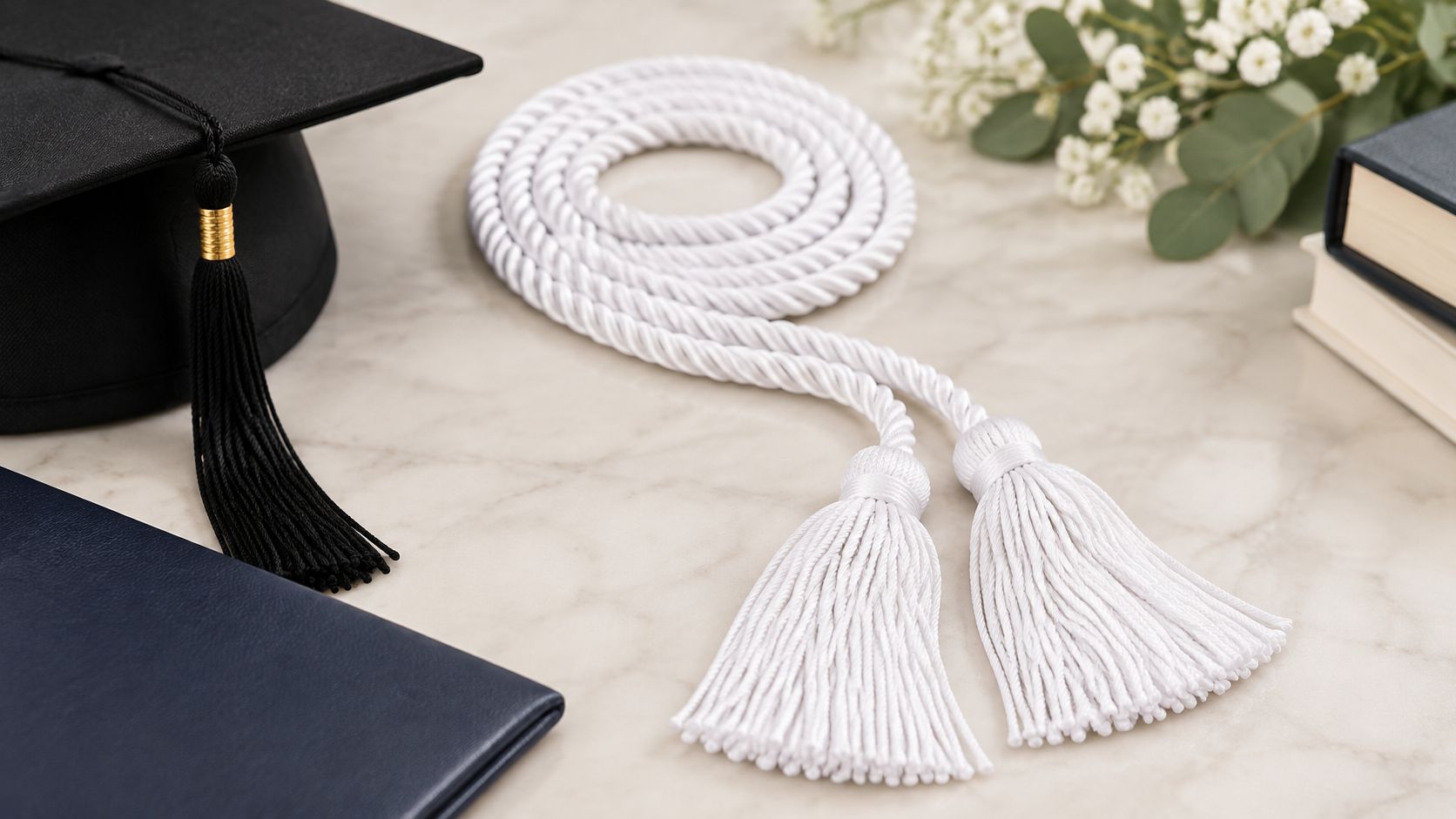
The White Graduation Honor Cord - College & High School Graduation Cords is a single-color option from Stoles.com. Use its product page and the photograph above to compare the midpoint, tassel ends, and overall construction before you order. White belongs on your order only when the issuing institution's written designation names white.
Match shade names and actual construction
Don't substitute a nearby shade because it looks similar on a screen. If the approved list names antique gold, navy, or a particular green, preserve that wording in your order request. Ask the issuing office to resolve any mismatch between its terminology and the available item.
A coordinated look and an authorized award are separate questions.
Keep operational accessories separate from graduate recognition. For coordinators arranging staff identification, The Print Warehouse lanyard range from The Print Warehouse Ltd. covers event lanyards. Approved academic cords remain a separate purchase and approval question.
Before committing to a group order, request a proof or sample where available and check the ceremony date against the proposed fulfillment arrangements. Leave room for corrections to shade, construction, or recipient assignments. Avoid promising students replacements until you have confirmed the actual process.
How to Wear Honor Cords and Stoles Correctly
Arrange your cords while wearing the gown, not over everyday clothing. The gown's neckline and shoulder shape affect where the ropes rest, and a rehearsal gives you time to notice crossed strands or uneven tassels.
Use a mirror and ask someone to check the back. You should be able to turn your head, sit, stand, and walk without repeatedly adjusting the cord.
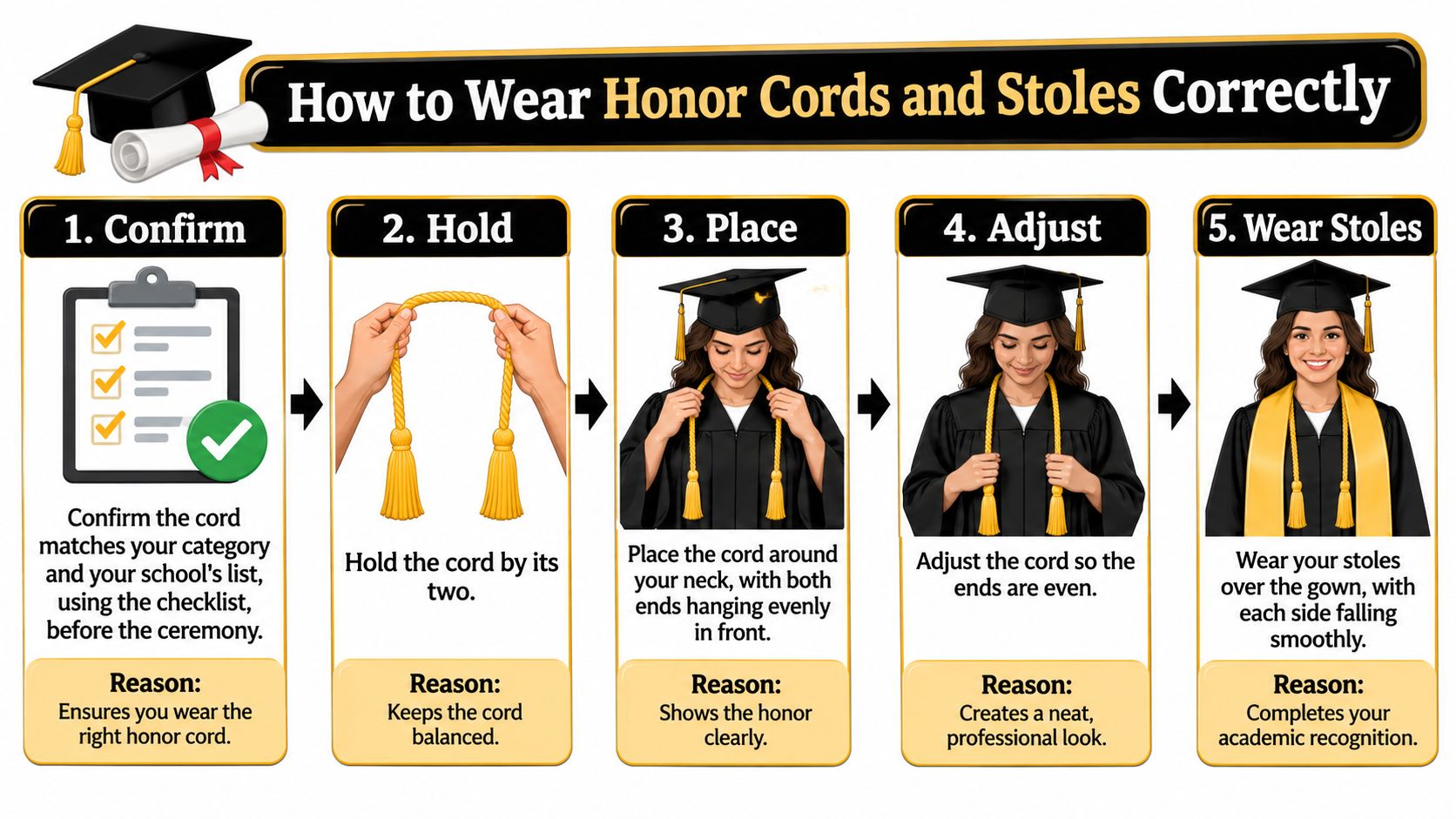
Put each item on deliberately
- Confirm the award before dressing. Match the item in your hand to your approval email and recipient information. This prevents a borrowed cord or a group-order mix-up from becoming a ceremony problem.
- Locate the midpoint or joined section. Hold the ropes so the tassels hang freely, then gently separate any twisted strands. Don't pull on the tassel fringe to untangle them.
- Drape the cord around your neck. For a joined or knotted arrangement, center that section behind your neck. Let the cord rest on the gown rather than tucking it inside the collar.
- Balance the front ends. Set the ropes on your shoulders and adjust until the tassels hang evenly. Smooth the arrangement without tightening it against your throat.
- Add only permitted stoles or sashes. Follow the ceremony's instructions for combinations and layering. If you're uncertain about the accessory names, the explanation of graduation sashes and stoles can help you describe the item accurately when asking staff.
- Finish with a movement check. Walk a short distance, sit down, and stand again. Remove unapproved pins or additions, and make sure nothing catches on your gown closure or other regalia.
Use the visual guide when practicing the arrangement.
Keep cords tidy without damaging them
Before commencement, store cords flat or loosely coiled in a clean, dry place. Keep them away from direct heat, and avoid crushing the tassels beneath shoes, books, or other packed items.
If cleaning is needed, follow the material label. For material that permits spot cleaning, test an inconspicuous area first, use a lightly damp cloth, and let the cord air dry completely before storage.
Don't iron the tassel bulbs or apply high heat to an unidentified material. Gently straighten the fringe with your fingers rather than trying to press it into shape.
Ceremony etiquette: Wear the distinction you earned, and let staff resolve any uncertainty before the procession begins.
Save your confirmation email on your phone, preferably with an offline copy. If a ceremony officer questions an item, show the written approval calmly and follow the officer's directions. The goal is an accurate, comfortable arrangement that stays in place while you celebrate.
Honor Cord Questions Students Ask
Can I wear a cord from an outside organization?
An outside organization's recognition doesn't automatically authorize its cord at your university's ceremony. Send the commencement office the organization's name, award description, and a photograph, then ask whether approval applies to the main ceremony, a departmental event, or both.
What if my GPA changes after cords are handed out?
Ask the issuing office whether it can revise your ceremony designation, exchange the cord, or update only your final academic record. Include your student identification details and the relevant grade change, but don't buy a different cord until the office confirms your status.
What happens if I wear the wrong cord?
Mississippi University for Women's commencement rules permit only regalia, cords, and stoles issued or approved by designated university offices and state that noncompliance can result in removal from the procession. If you discover a mismatch, contact staff before lineup rather than assuming nobody will notice.
Can I buy a cord if my school doesn't provide one?
Possibly, but obtain purchase authorization and the exact specification first. Ask whether the college requires a particular source, whether pickup-day purchases are available, and what to do if the approved item doesn't arrive.
What if I want a keepsake that isn't approved for commencement?
Separate ceremony attire from personal celebration: an item can be meaningful without being worn in the procession. For a friend's celebration, gift ideas from Custom Mark offer another starting point without assigning an academic distinction the recipient hasn't received.
Do cords replace any part of the required outfit?
Don't treat an honor cord as a replacement for required regalia. Review the school's outfit instructions alongside this explanation of what academic regalia is, then confirm any questions about gowns, hoods, tassels, or accessories with the commencement office.
This week, request written confirmation of your category, cord color, approved format, and deadline. Once you have that response, arrange the matching item and save the message with your ceremony instructions.
Stoles.com® offers honor cords and customizable graduation stoles for celebrating academic achievement and identity. Once your school confirms what you may wear, visit Stoles.com® to choose an option that matches your approved ceremony attire.