

You've picked the flag, you've pictured the photos, and commencement is close enough that the gown order is already in. Then someone asks the question that stops the whole plan. Does your school allow a custom flag stole at the main ceremony, and does it need approval before you pay for it?
That's the right place to start. Size, artwork, and trim matter, but they come after permission. A graduate who documents the design, checks orientation against an official reference, and orders early gives family, chapter members, and marshals no reason to argue on the day. A graduate who orders first may end up hiding a meaningful stole under a gown or leaving it in a bag.
Settle the Size and Width Before You Design
Start with the size most graduates know. A 31 inch by 5 inch stole is the standard catalog size, and the Green Choir Stole uses those same dimensions, with each side 31 inches long and 5 inches wide, arrow pointed edges, premium green bridal satin, and full lining. It's a useful baseline because the panels show a flag clearly without overwhelming an average gown.
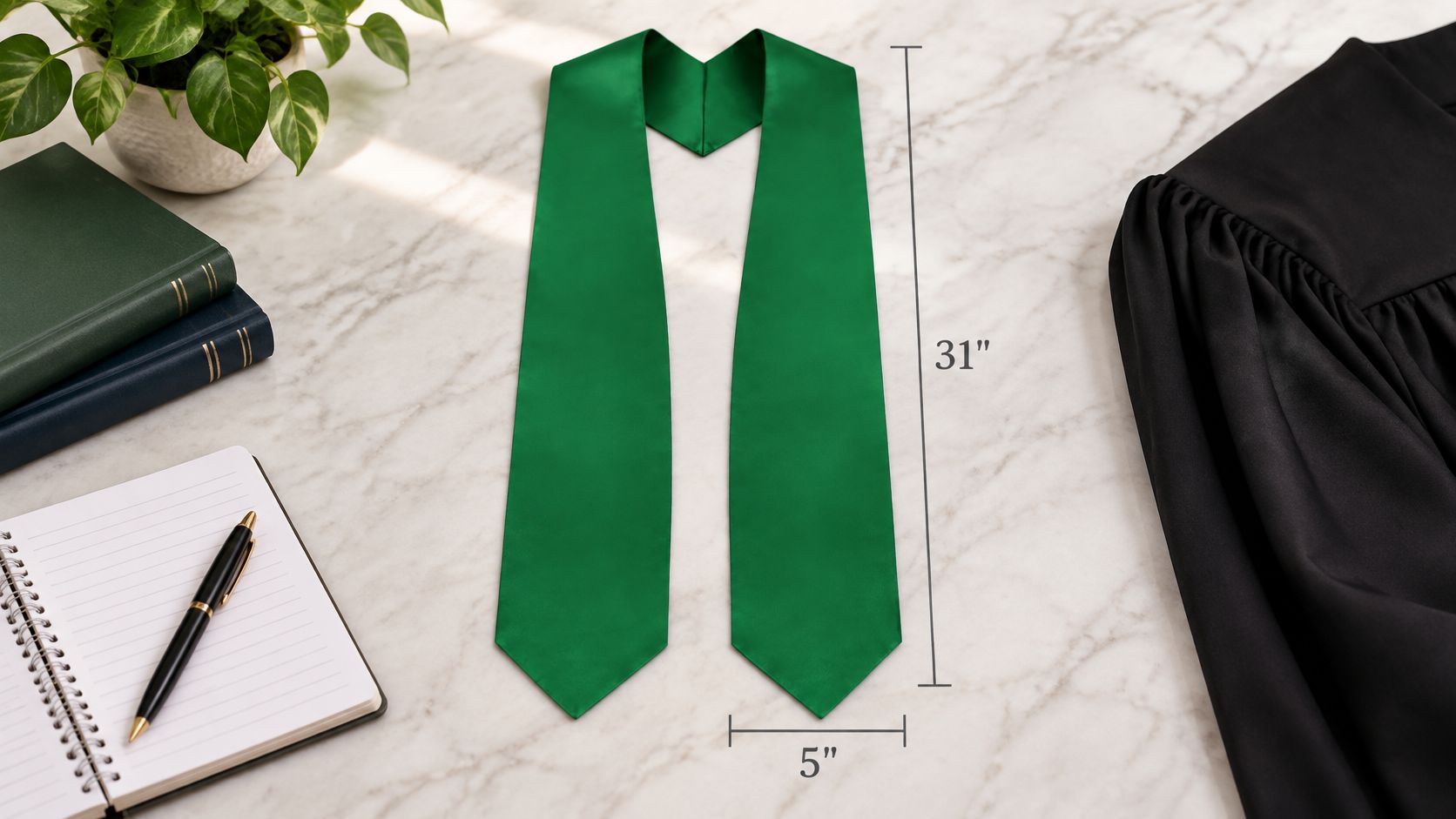
Length changes where the ends land. A shorter stole stops higher on the body and sits more neatly when you're seated in a tight row. A longer stole reaches closer to the gown hem and looks more proportional on a tall graduate, but the ends can bunch in your lap or catch when you stand.
Width changes two different things. It controls how much flag a parent can read at chest height from several rows back, and it controls bulk under a hood or a thick robe. Don't judge width on a hanger. Stoles sit over the shoulders, so both front panels need to lie flat against the gown, not curl at the edges.
| Length | Width | Typical fit |
|---|---|---|
| 31 inches | 3.2 inches | Petite build or narrow gown, lowest bulk |
| 31 inches | 4.5 inches | Average height with a standard gown |
| 31 inches | 5 inches | Standard catalog size, balanced flag visibility |
| 33 inches | 3.2 inches | Average height, slim profile under a hood |
| 33 inches | 4.5 inches | Average to tall build, most common middle choice |
| 33 inches | 5 inches | Average build wanting a bold flag panel |
| 36 inches | 3.2 inches | Tall graduate, slim look with longer ends |
| 36 inches | 4.5 inches | Tall graduate or heavy robe, balanced width |
| 36 inches | 5 inches | Tall graduate wanting maximum flag visibility |
How to Choose Without Guessing
Measure the graduate's height and shoulder width, then check the gown maker's sizing notes before you commit. I'd put a tall graduate or someone in a heavy doctoral style gown at 36 inches. A petite graduate, or a school using narrow gowns in a crowded procession, usually looks cleaner at 31 inches and 3.2 inches.
Chapters should pick one length and one width for everyone unless body sizes vary enough to justify an exception. Mixed lengths look like a mistake in group photos. If you're starting from plain stock before decoration, review the options for blank graduation stoles with the same measurements in hand.
Practical rule: Write the length and width on the design sheet before you start any artwork.
Artwork sized for a 5 inch panel won't crop the same way on a 3.2 inch panel. Lock the canvas first, then draw on it.
Campus Rules and Approval Before You Order
Most buyers assume that if a stole is tasteful and personal, the school will allow it. That's the assumption that creates ceremony day problems, because permission differs by campus and marshals can enforce rules at the door.
| School | What is allowed | Approval or limit |
|---|---|---|
| La Salle | Decorated stoles permitted | Political references and content inconsistent with institutional values are prohibited |
| University of Oklahoma | Additional regalia for identity or affiliation welcomed | Students are directed to outside organizations for coordination |
| SUNY Oneonta | Stoles showing official, department, national-organization or identity recognition | Otherwise formal regalia is required |
| Kansas State University | Organizational stoles, cords and medallions | Approval form due October 1 for fall or March 1 for spring; generally one adornment type per organization |
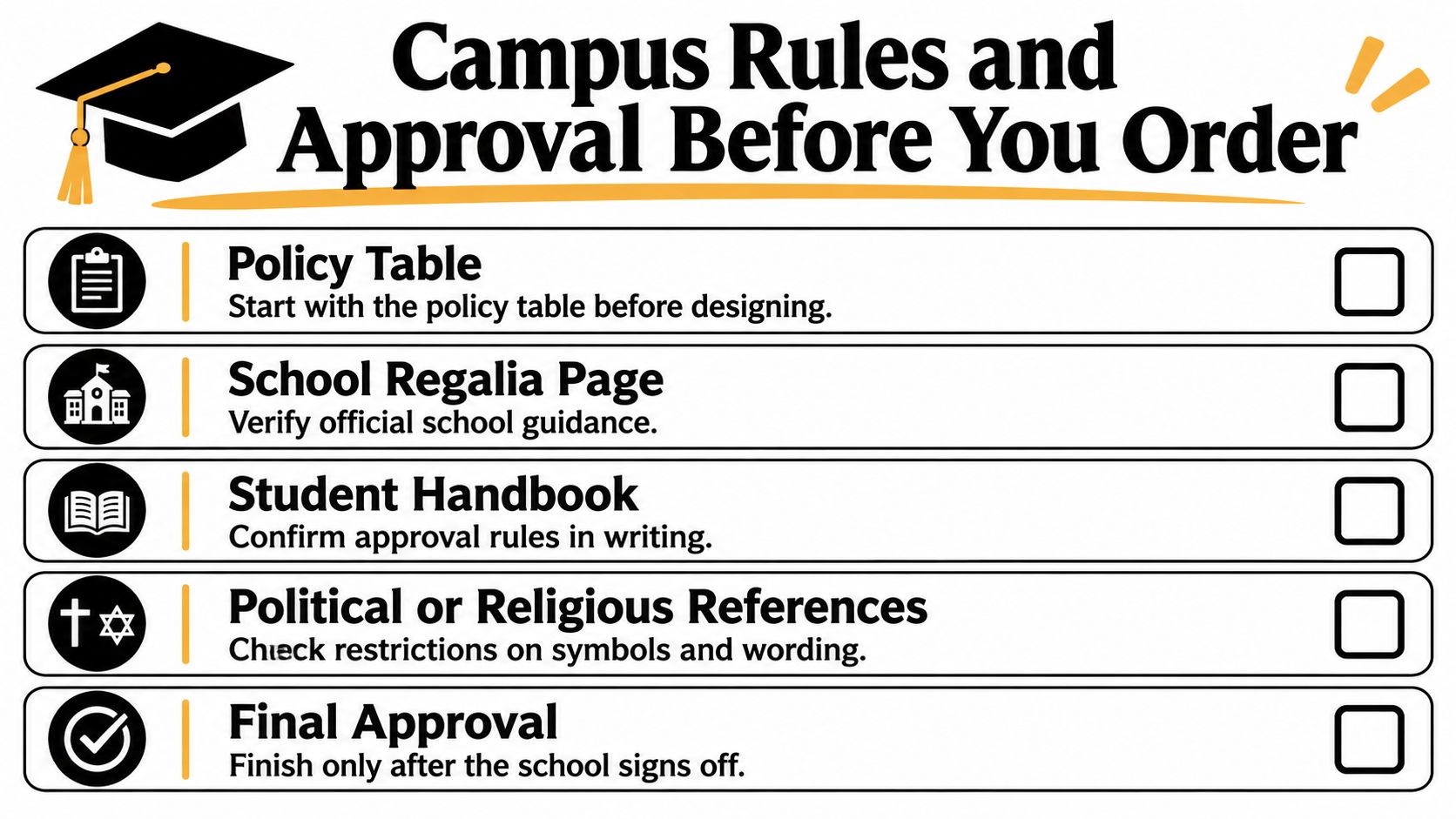
The La Salle academic regalia guidance shows why wording matters. La Salle permits decorated stoles but prohibits political references and other content it considers inconsistent with institutional values. Another campus may welcome identity regalia, while still requiring formal dress underneath or sending students to an outside organization for coordination.
What to Check in the Regalia Page and Handbook
Look for three specific limits before you finish the design.
- Political or religious references: Check whether flags, slogans, seals, or faith symbols need review or are barred outright.
- Layering rules: Confirm whether a flag stole can sit with an academic hood, honor cords, medals, or a second stole.
- Accessory limits: Ask how many adornments one graduate can wear, because a limit can force a choice between a stole and a cord.
Kansas State gives a clear picture of a formal process. Recognized organizations submit an Academic Regalia Adornment Approval Form due October 1 for fall commencement and March 1 for spring commencement, and an organization generally gets one adornment type, such as one stole, cord, or medallion. K-State treats an academic honor cord as a marker of a specific achievement set by the university, so don't assume you can add a flag stole on top of it without asking.
Younger students face the same issue in simpler form. If you're ordering for secondary school, compare your plan with high school graduation stole requirements and then confirm the local rule anyway, because a district page overrides general guidance.
Document the Design Before Production
Send the coordinator a one page design sheet. Include the flag image, every word you plan to add, the size, the colors, and whether you're using embroidery, screen printing, or a transfer. Ask for the reply in writing and keep it with your order confirmation.
If the rules are unclear, email the registrar or commencement office directly. Don't ask a classmate and don't rely on photos from last year, because staff and policies change.
We're a third-party vendor and we don't keep information about any specific school's regalia requirements on file. You must obtain your school's rules before ordering. That's not paperwork for its own sake. Without approval, more customization can mean more risk, and a graduate may be told to remove or conceal the stole minutes before the procession.
How to Design a Custom Flag Stole Step by Step
Work in this order and you'll avoid the expensive mistakes. Each step locks a decision the next step depends on.
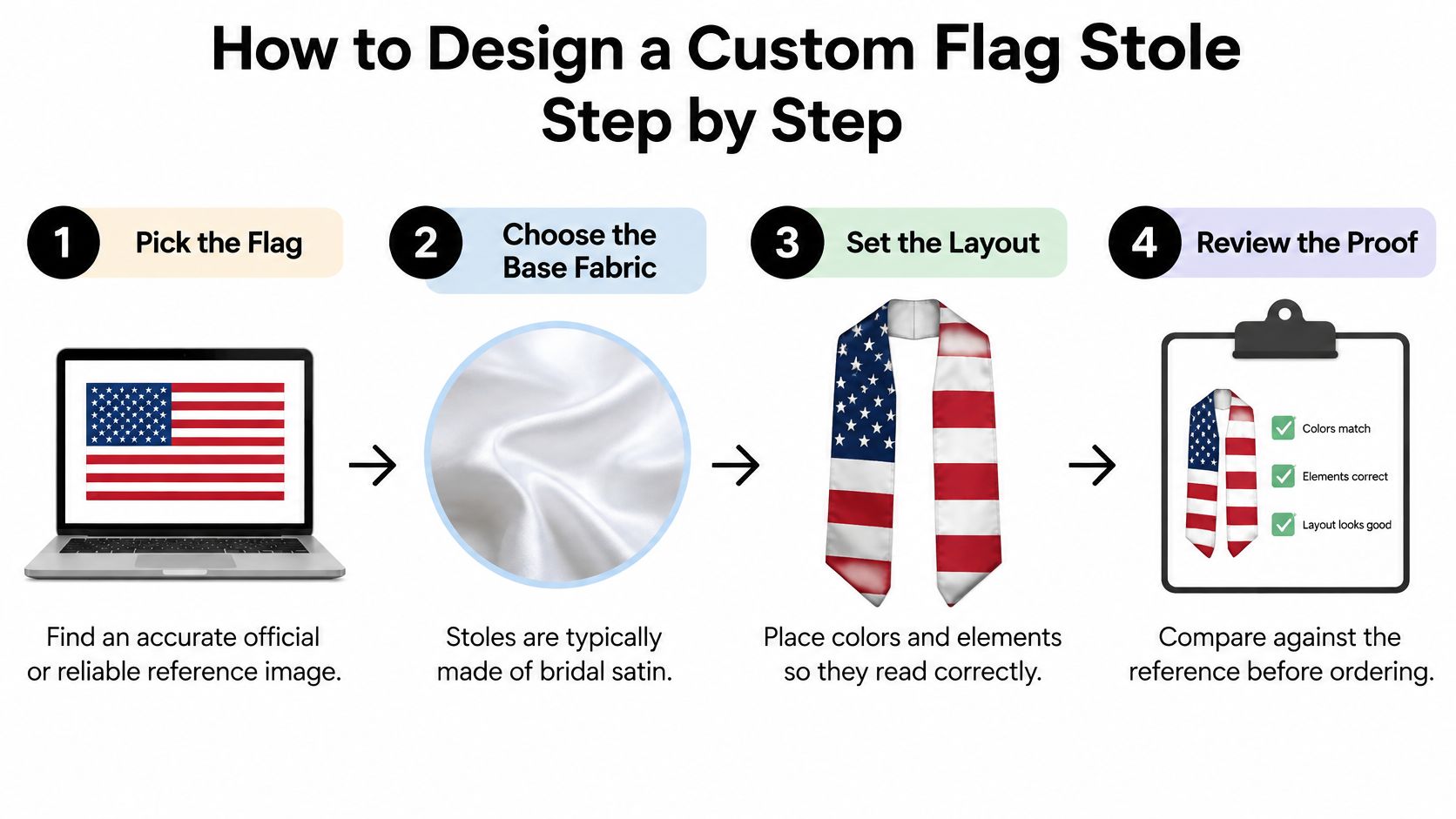
Steps 1 to 4
- Pick the flag from an accurate reference. Use an official or reliable source so stripe order, emblem position, and proportions are right. The common mistake is copying a low quality image from a search result and discovering the colors are off only after printing.
- Choose the base fabric. Stoles are typically bridal satin with arrow pointed edges and full lining, which gives a smooth surface for color and enough body to hang flat. Browse the full stole range before choosing, so your fabric and trim match real catalog options instead of a color you invented on screen.
- Choose trim that supports the flag. Options include Antique Gold, Black, Brown, Emerald Green, Gold, Green, Hunter Green, Light Blue, Maroon, Navy Blue, Orange, Pink, Purple, Red, Royal Blue, Silver, and White. Pick a trim that frames the flag rather than fighting its strongest color. If you're sewing or evaluating an edge finish, trim application tips from Display Guru are useful for understanding why a clean stitched border looks sharper than a glued one.
- Build the layout in the custom stole generator. You can create and share designs, use exclusive art and fonts, and upload your own artwork and photos. We also allow you to upload your own art to be imprinted, so use the highest quality file you have, not a screenshot.
Steps 5 to 8
- Match the decoration method to the artwork. We provide custom embroidery, screen printing, and custom transfers on stoles and sashes. Embroidery suits names, short text, and simple emblems because the thread gives texture and holds up well. Printing or a transfer handles full color flags, small details, and gradients better, and it won't pucker satin the way dense stitching can.
- Add personalization sparingly. A name, graduation year, school, or one emblem is enough. Keep text to a few short lines in a size that reads from a distance. A full sentence across a narrow panel turns into decoration nobody can read, and it steals space from the flag.
- Request a mockup with complete details. Send quantity, needed by date, stole color, trim color, embroidery or print choice, length, width, and any images or logos in one message. Incomplete requests create a second round of questions and eat the time you need for revisions.
- Check the proof like an examiner. Compare color order, orientation, spelling, punctuation, and the placement of every emblem against your reference and design sheet. The most common slip is a low resolution image that blurs flag edges. Zoom in on the proof. If an edge looks soft on screen, it won't sharpen in production.
Don't approve a proof on your phone while distracted. Open it at full size, read every word out loud, and have a second person check names and dates.
Flag Colors and Orientation That Read Correctly
A flag stole may pass a visual check and still conflict with campus rules. Confirm approval requirements first, then record the flag reference and any approved design limits so the artwork has a clear standard to follow.
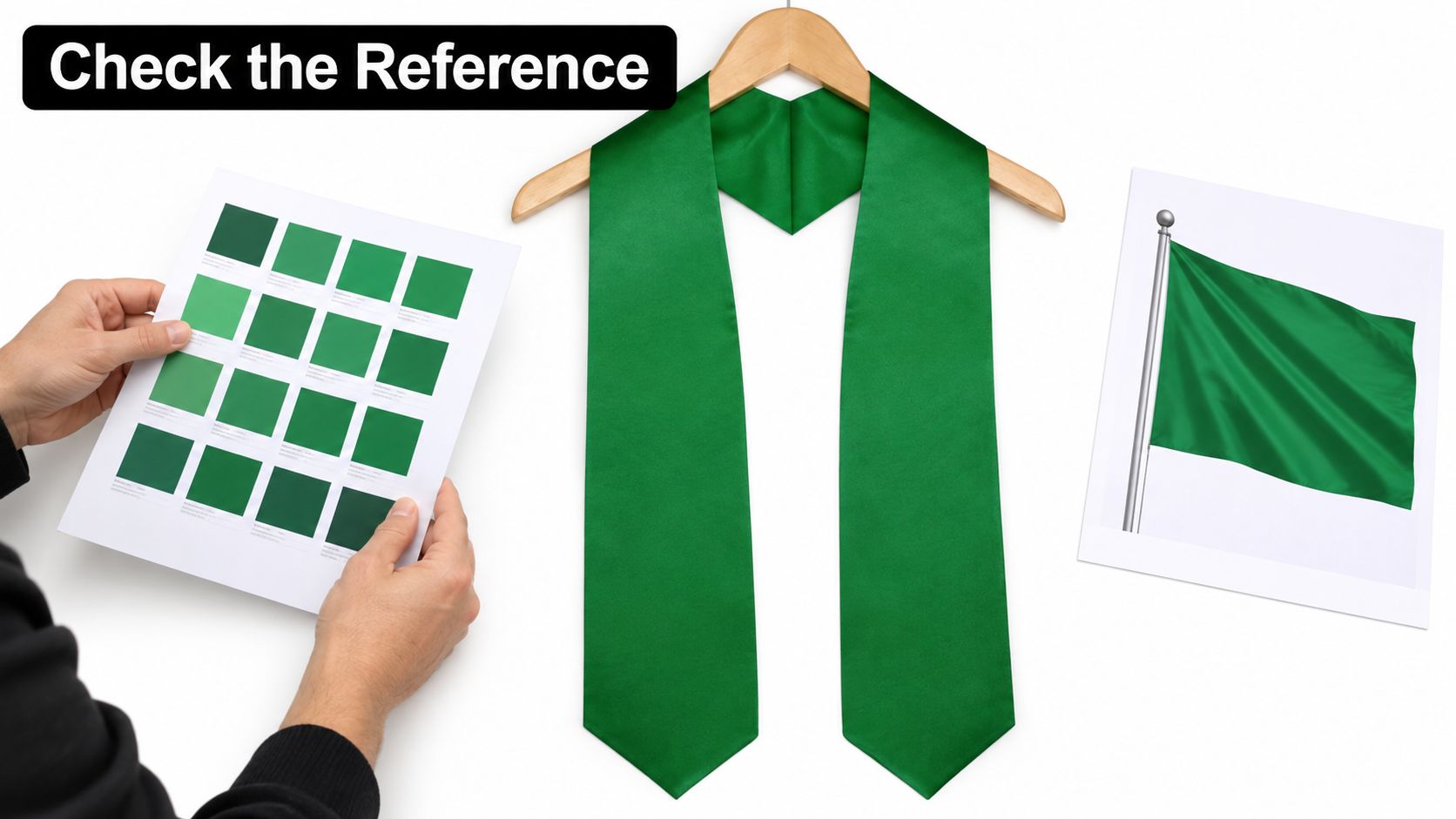
Use an official flag reference to identify the correct arrangement. For example, Mexico's flag has vertical green, white, and red bands, with green at the hoist; Nigeria's has vertical green, white, and green bands; and the Philippines' has blue above red, with a white triangle at the hoist.
For a U.S. flag design, keep the blue union in the upper hoist corner. Use the 4 U.S.C. § 6 display rules as a reminder that a faithful layout matters, not as a clothing rule. The statute describes customary display of the U.S. flag on buildings and stationary outdoor flagstaffs from sunrise to sunset, with 24-hour display permitted when properly illuminated.
Keep the flag's proportions and major features recognizable on the stole. Trim can echo a national color when it helps the design read clearly, but extra symbols can create approval problems. Get permission before adding government seals, military insignia, university marks, or other protected emblems.
Timelines, Pricing and Group Orders for Chapters
A chapter can have an approved design and still miss its ceremony date if proofing starts too late. Work backward from the event: allow time for campus approval, a final design, proof review, production, and shipping. Keep room in the schedule for corrections, especially if names or colors change.
Campus approval can take weeks, and a requested change may affect both the design and the order. Settle the approval process before paying for rush production. Stoles.com has provided stoles and sashes with custom embroidery, screen printing, and custom transfers for over 8 years. For price context, its U.S. Air Force stole lists at $29.95, is on sale for $24.95, and has prices as low as $19.96.
What Drives the Price
Request a quote for each design variant and the full order quantity. Stoles.com offers embroidery, screen printing, and custom transfers on stoles and sashes. Compare the decoration method and the amount of individual artwork or text each version requires. Trim color is another design choice, with options including gold, navy blue, red, black, and white.
For a 20-person chapter ordering the same flag design with individual names, the shared artwork can use one approved master proof, while each name needs its own spelling and placement check. A second version for an officer title requires a separate proof approval. Track those versions as distinct designs so the chapter does not approve the base stole and overlook a changed title or name.
If cost is a concern, review these ways to order cheap custom graduation stoles and decide which personalization details matter most. Keep the flag artwork accurate; simplify individual text before compromising the design that gives the stole its meaning.
Run the Group Order Through One Coordinator
Appoint one coordinator to maintain the master design and collect each member's details. Give a named chapter approver responsibility for the base design, and assign the relevant officer or wearer to approve each personalized variant. Record approvals by name and date.
For a mockup, use the details listed in step 7 of the design process. For group orders, the coordinator should identify every variant and gather approval for each before production. The mockup request process also lets customers submit images or logos for the design.
Confirm the payment method and delivery address before production begins. Sending the full order to one coordinator can simplify checking and distribution, though members in different cities may receive their stoles later. Keep enough time to report an incorrect name or other order issue before the ceremony.
Wearing, Caring for and Reusing Your Flag Stole
Keep your stole in its poly bag inside an easy-to-reach tote until you have checked in. If the venue requires graduates to pass security without regalia, you can put it on afterward.

Drape the stole over your shoulders, smooth the front panels, and check that both ends hang evenly. Follow the layering order your school approved. If you are wearing an honor cord, arrange it over or under the stole according to that guidance, then sit and stand once to check that they do not twist together. See our guide to how to wear your graduation stole and sash for placement details.
Ask your school early about accessibility arrangements if you need an accessible route, adjusted seating, or help with regalia. A narrow 3.2-inch panel may catch less on armrests or mobility-device straps than a wider panel. Check the fit while seated, too.
The same attention to fit and dress rules applies at formal events. A MUN conference dress code offers a useful comparison for checking clothing requirements before arrival.
This short video shows the wearing sequence before you leave home.
Care and the Reuse Decision
Satin can be damaged by heat and rough handling. Spot-clean with cool water and mild soap, then dry the stole flat. Store it flat in its poly bag away from direct sunlight, and do not iron directly over printed or embroidered areas.
Decide whether the stole is personal or intended for reuse before choosing its design. A plain flag stole without a name or year is easier to pass to a younger sibling, donate, or wear again at an affinity ceremony. Keep a named or photo-personalized stole if the details are part of its meaning to you; those additions make it less suitable for another graduate.
Lafayette College's commencement planning describes a hand-me-down regalia program using a pay-what-you-can model. Its listed cost was $79.99, and supplies were limited.
Start Your Stole Order This Week
Email the registrar this week with a design sheet showing the flag, its orientation, colors, and any added text or symbols. Ask whether the design needs approval and when the form is due. A clear record of the decision helps prevent last-minute changes.
Once you know what the campus allows, use the custom stole generator to build the design from the steps above. Check the proof against the design sheet, especially flag direction and spelling. Custom stoles are non-refundable, so correct errors before ordering.
Stoles.com has provided stoles and sashes with custom embroidery, screen printing, and custom transfers for over 8 years. Keep the design sheet with the proof and order details. If a chapter member places the order, this gives the group a shared reference for reviewing the finished design.
Order your approved custom flag stole, country flag sash, honor stole, or personalized graduation stole with the size, trim, and artwork you've documented, and we'll turn the checked proof into a finished stole for commencement. Visit Stoles.com® to build your design, request your mockup, and place the order while you still have time for revisions.