

You've found the perfect cord colors online, your cart's ready, and commencement is close enough that there's no room for a redo. That's exactly when most custom graduation cords go wrong. A color chart says one thing, your school requires another, and a cord you paid to personalize can't be worn on stage. Approval comes first, design comes second. Get the issuing body, the exact colors, and the deadline in writing, then build your spec sheet around those facts.
Confirm the Rules Before You Design
Who decides what a cord color means at your ceremony? Not a color chart, and not a vendor. The issuing body at your institution decides, and meanings are assigned locally. That single point prevents most wasted orders.
The Thomas Edison State University honor cords guidance shows how local these systems are, because TESU uses different combinations for specific honor societies, military service, awards, and donor recognition, while Kansas State defines its own purple-and-white cord system for GPA-based honors. The same color can therefore signal different achievements at different schools, or no approved achievement at all.
Who Decides What a Cord Color Means
Different issuers control different decisions. Ask the right one for the right document.
| Issuer | What it controls | What to request |
|---|---|---|
| Commencement office | Recognized honors and approved colors | Written approved color list |
| Honor society or Greek chapter | Society colors and eligibility | Official chapter color standard |
| Military or veteran program | Service recognition cords | Program authorization letter |
| Award or donor program | Named award recognition | Award confirmation from the program |
| Cultural or religious group | Heritage or faith-based identity | Group approval of the design |
A commencement office can tell you what's allowed on stage, but it can't confirm your society eligibility. A chapter can confirm its colors, but it can't override a campus limit on how many cords you may wear. If you're reviewing honor society cords for a chapter order, treat that as product research, not permission.
Run the Verification Sequence
Do these five checks in order, before you choose thread shades or pay for a proof.
- Confirm the issuing body. Name the office, society, program, or group that owns the designation you're claiming.
- Get the approved color list in writing. Ask for exact color names and combinations, not a verbal okay.
- Check how many cords a graduate may wear. A school may allow one cord, a tied double cord, or several separate cords.
- Ask for the approval deadline for custom designs. Your proof may need review well before you place the order.
- Confirm whether a custom cord can be worn alongside a stole or sash. Some ceremonies limit total adornments, even when each item is approved on its own.
An internet color chart is not proof of eligibility.
Customization raises misrepresentation risk because anyone can order any color. That's the trade-off. A vendor will make what you specify, so the burden of proof sits with you and your issuer. If ceremony staff question a cord at check-in, a screenshot of a chart won't help you. A letter or email from the registrar, commencement office, or issuing organization will.
I would not design anything until that approval is saved. Keep the message with your order records, use its exact color names on your spec sheet, and bring a copy on ceremony day. That document turns a nice-looking cord into a defensible one.
How to Pick Colors and What They Signal
A gold cord at one school can mean cum laude. At a school across town, the same shade might mark an honor society, a departmental prize, or nothing official at all. Color codes are local, so design work starts with your issuer's approved list, not a color wheel. The image below shows the range you will be choosing from once that list narrows it.

The University of South Carolina Aiken history of regalia describes the gold braided cord as an indicator of an honor graduate, and gold cords are also commonly tied to cum laude, magna cum laude, and summa cum laude. Those terms mean with distinction, with great distinction, and with highest distinction. A single shade covering three possible tiers is exactly why your school's definitions decide what a gold cord claims at your ceremony.
Cords do their job in a large, formal room by making an academic record visible at a distance. The audience reads that record correctly only when everyone at your ceremony shares the same code. I would treat the approved list as the design brief and the color chart as raw material.
Map Each Designation to an Approved Color
Work outward from your qualifications, not inward from a favorite color.
- List every designation you hold. Include Latin honors, society membership, service recognition, leadership roles, and named awards.
- Map each one to the approved list. Write the designation next to its approved color or combination.
- Choose solid or two-color construction. A solid cord suits one clear designation. A two-color cord suits a society with two official colors or an approved pairing.
- Check the full outfit. Hold the colors against your gown, hood if you wear one, and stole so nothing clashes or gets lost in photos.
- Confirm society colors exactly. If a society is involved, match its official standard rather than a close substitute.
If you're checking how combinations are commonly read, a guide to graduation honor cords color meaning can help you form sharper questions for your issuer. That issuer's list is still the final word.
The short video below is useful for seeing how cord colors read at ceremony distance before you commit to a pairing.
Say you hold a society award and a cum laude designation. Order two cords only if your institution allows both to be worn together. If it allows only one on stage, choose the designation your issuer prioritizes and keep the other for photos or a separate celebration if that's permitted.
A two-color product such as the Red and Antique Gold Intertwined Graduation Honor Cord - College & High School Honor Cords gives you a concrete example of intertwined construction. Before ordering, compare the listing's stated specs, including length and tassel size, against your spec sheet. Use listings like that to confirm construction, not to infer meaning.
Avoid novelty or variegated colors that have no official meaning at your ceremony. Staff may read an unfamiliar combination as an unapproved honor, even if you meant it as decoration. Once you've chosen, write the exact color name on your spec sheet, such as antique gold rather than gold, so the vendor isn't guessing and your documentation matches what arrives.
Cord Types, Materials and Specs at a Glance
Lock the base cord before you personalize anything. Length, tassel count, and construction determine how the cord sits, how it photographs, and whether two approved designations can be shown cleanly. Put those specs next to the approval itself: the same style can carry different meanings from one institution to another, so the order is only as strong as the document that says who approved it and for what designation.
| Cord type | Length to lock | Tassels to lock | Typical use |
|---|---|---|---|
| Single custom cord | Finished length end to end, confirmed in writing | Count, size, and attachment method | One honor, society, or club designation |
| Double (tied) honor cord | Per-cord length and finished tied length, confirmed in writing | Total across both cords, bulb size, and knot placement | Two designations approved to be worn together |
| Greek cord (two cords tied) | Per-cord length and finished length after the center knot, confirmed in writing | Total count and whether tassels match each strand | Sorority or fraternity colors approved for ceremony wear |
| Variegated cord | Finished length and color repeat, confirmed in writing | Count, size, and whether each tassel matches the strands | Mixed colors only when the issuer accepts the combination |
The photo below shows a tied double construction, which helps you judge bulk at the neck and how four tassels fall at the front.

Check the Length Math Before You Compare Listings
Listings do not always quote the same measurement. One vendor may give each cord before tying, another may give the finished piece after the knot, and a third may describe the drop from the shoulder. Ask for all three in writing: untied cord length, finished length once tied, and expected drop over the gown you will wear.
The Double Graduation Honor Cords - Custom Honor Cords page is a useful reference for a tied two-cord construction. Treat it as a style reference, then have the vendor confirm the measurements for your order, your colorway, and your knot position before production.
Do a gown check at home. Drape a flexible tape around the back of your neck over the gown, let both ends fall down your chest, and mark where the tassels land. If they hit a stole emblem, a zipper, a hood edge, or your hands when you hold a diploma cover, note that on the spec sheet before ordering.
Diameter, Fiber and Color Count
Cord diameter changes visibility more than buyers expect. A slimmer cord can disappear against a dark gown or under a hood, while a double set adds bulk because you are wearing two cords at once. Ask where the knot will sit, since it rests at the back of the neck and can shift under a collar or hood.
Most vendors describe the base as sturdy twisted cord, but fiber content is not something to assume. Ask for it in writing. Fiber affects sheen, how the twist holds, how tassels respond to heat, and whether the cord can be cleaned or recycled later. If a vendor cannot state the fiber, record that gap on the spec sheet rather than treating it as a minor detail.
Color count is both a design and an approval decision. Solid, two-color, and three-color versions give you different ways to represent a designation, and each added color can change the proof you need to review. If you are comparing base constructions, a breakdown of types of graduation cords can help you name the style correctly when you request a quote.
Start a one-page spec sheet now. Record the approving office, the approved meaning, cord type, finished length, untied length if quoted, expected drop, diameter, tassel size and count, knot position, fiber content, and exact color names. You will add personalization and quantity to that same sheet instead of rebuilding the order from memory.
How to Personalize and Lock Your Design
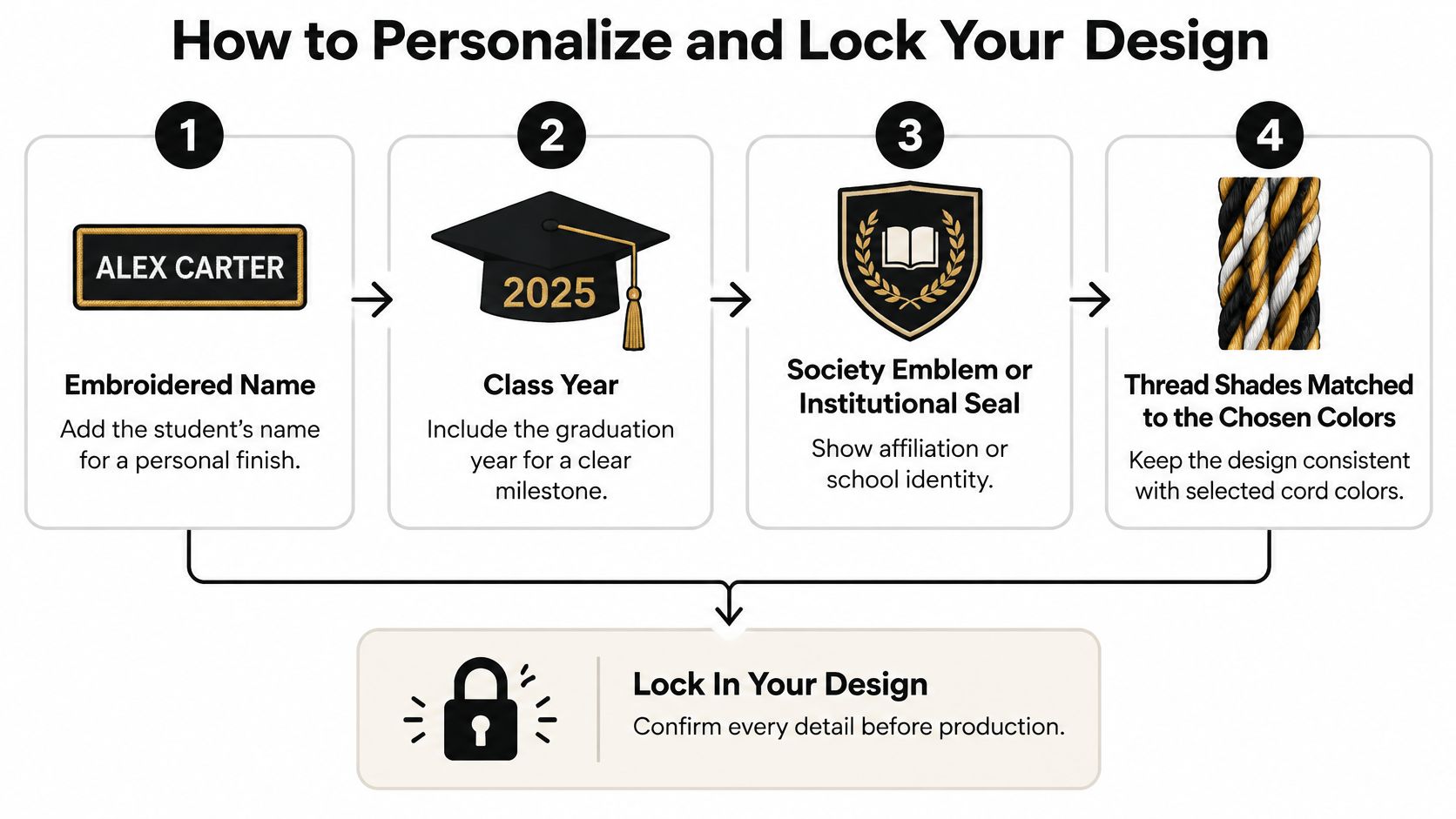
Personalization should clarify the designation, not compete with it. Common options include an embroidered name, class year, society emblem or institutional seal, thread shades matched to your chosen colors, tassel color changes, and small charms or pins. Each addition needs a reason, a placement, and, in some cases, separate approval.
The visual guide below summarizes the main personalization choices and the final confirmation step.
Charms deserve extra caution. They add weight at one point on a narrow cord, can swing in photos, and may catch on a stole or gown zipper. A school that approves your cord colors may still object to extra decoration, so list every charm or pin in your approval request rather than adding it after sign-off.
If your design involves lettering on an accompanying stole or sash, it helps to think through choosing embroidery or print for workwear, because the same trade-off applies here. Embroidery gives raised, durable lettering for names and years, while print handles finer detail but reads flatter and depends more on accurate color previews.
Lock the Design in Seven Steps
- Choose the base cord type. Use your spec sheet to select single, double tied, Greek, or variegated construction. The usual slip is personalizing first, then discovering the base cord can't carry two designations the way you expected.
- Confirm the colors. Copy the exact approved color names onto the order. Don't shorten antique gold to gold or navy to blue, because those shortcuts create mismatches.
- Decide embroidery text and font. Keep it to name and year where possible, and spell every name exactly as it should appear. Misspellings are the most common preventable error, especially in chapter orders copied from a spreadsheet.
- Select tassel style and any charm. Record tassel size, tassel color, charm type, and attachment point. Extra weight on one side can pull the cord unevenly, so balanced placement matters.
- Request a physical sample or digital proof. A physical sample shows twist, sheen, and tassel bulk. A digital proof is faster, but thread shades often look different on screen than they do on the finished cord.
- Check the proof against your school approval. Compare colors, emblems, text, and total adornment count with the written rules you saved. Don't approve a proof that adds an element your issuer never saw.
- Sign off a complete spec sheet. It should list length, diameter, tassel size, thread shades, personalization text, and quantity. Your signature should mean production can start without another design decision.
Proof rule: If a detail isn't on the signed spec sheet, don't assume it's in the order.
Watch your proof deadline as closely as your ceremony date. Approving late compresses production and shipping, and it leaves no time to correct a spelling or shade error. If a proof looks wrong, mark the exact change in writing and request a revised proof rather than describing the fix in a call.
When the finished cord arrives, check it against the signed sheet immediately. The twist should be even, the knot should be secure, both sides should hang evenly, tassels should match in size and color, and any name or year should be spelled correctly. Try it on with your gown and stole, then take one front photo at arm's length. That's the fastest way to spot uneven drop, clashing shades, or a charm that pulls the cord off center.
Pricing, Minimums and Production Timeline
A price is only as stable as the approval behind it. Until your issuer signs off on colors, emblems, and eligibility, every quote is provisional, because one required change can alter construction and unit cost. Get the written approval first, then price the documented design rather than a rough idea of it.
Published catalog prices still work as anchors before personalization enters the calculation. On Stoles.com, three cord options cover most starting budgets:
Stoles.com Honor Cord Prices
| Cord | List price | As low as |
|---|---|---|
| Gold Graduation Honor Cord (college and high school) | $5.95 | $4.76 |
| Double Graduation Honor Cords (custom option) | $8.95 | $7.16 |
| Military Graduation Honor Cord (red, white, and blue) | $12.95 | $6.36 (sale price $7.95) |
Those are base figures. Don't budget from the base price alone. A second or third color changes construction. Embroidered names turn identical units into individual units that must be checked one by one. A physical sample adds a step before production. Each change is reasonable on its own, but together they move both cost and schedule.
Before you request a number, list every cost driver your design carries:
- Base cord. Single or double construction, and how many colors are twisted in.
- Extra thread colors. Each added shade changes construction.
- Personalization. Names, years, or embroidery on individual units.
- Proof or sample charges. Digital proofs are faster; physical samples show twist and tassel bulk.
- Shipping. Carrier, speed, and whether the order goes to one address or many. Stoles.com ships all graduation stoles by UPS, USPS, or DHL.
Ask for an itemized quote that separates the base cord, extra colors, personalization, proof or sample charges, and shipping. If a quote gives you only one bundled number, you can't tell which feature is driving the cost or what to remove if the total is too high.
Minimums and Shared Orders
Every vendor sets its own minimum quantity, and custom work doesn't always follow the same rules as stock cords. Ask two direct questions before you finalize a design. What's the minimum for this exact construction, and do you accept small custom runs?
If your quantity falls short, consider a shared chapter or department order. A society, Greek chapter, or academic department can combine eligible graduates under one approved design, which makes production more practical and keeps colors consistent. The trade-off is coordination. One person must own the roster, spelling list, payment collection, and final proof approval, or the shared order creates more errors than it solves.
Don't pad an order with ineligible names to reach a minimum. That undermines the approval you worked to get and puts the whole group design at risk. If the eligible group is too small, simplify the design or choose a base cord that can be produced in a smaller run.
Back Up From the Ceremony Date
The sequence drives the schedule more than any single promised duration. Attach a target date to each step, not just the last one.
- Approval of the design. Your issuer confirms colors, emblems, and eligibility in writing.
- Proof sign-off. You approve the sample or digital proof against the spec sheet.
- Production. The vendor makes the full run only after sign-off.
- Shipping. The finished order travels to one delivery address or to individual buyers.
- Delivery check. You count units, check spelling and colors, and try cords on with regalia.
Write your ceremony date at the top of your spec sheet, then work backward to the last date you can approve a proof and still leave time for production, shipping, and corrections. That backward date is your real deadline. The order date matters less than the proof date, because production can't begin responsibly without it.
Changes after sign-off and late rush requests are the usual reasons custom cords arrive late. A name change sounds small, but it can restart the proof and separate one unit from the rest of the run. I would freeze names, colors, and quantity at sign-off unless an issuer withdraws approval or you find an error that would make the cord unwearable.
Caring for Cords and Choosing Lower-Waste Options
A sharp crease in the twist is hard to reverse, so cord care starts with storage. Keep cords flat or loosely rolled, away from heat and direct sun, which fade shades unevenly and make tassels brittle. Don't press tassels flat under books, and don't iron them. If tassels arrive compressed from packaging, hang the cord so the tassels fall freely and let gravity reopen them.
Handle a cord by its length rather than yanking the tassels, and keep it separate from pins or charms that can snag the twist. A short guide on how to wear graduation honor cords doubles as a care check, because correct placement reduces pulling at the neck knot and keeps tassels from dragging across zippers or rough stole edges.
Think Past the One-Day Ceremony
Graduation attire is often worn once, so the lowest-waste choice depends on what happens after the ceremony. Cal Poly notes that graduation attire is typically used only once, and its graduation gown reuse program collects donated regalia to divert it from landfill. That model translates directly to cords.
A chapter can keep a shared inventory for graduating members, collect cords after the ceremony, inspect them, and issue them again. A school donation or reuse program can do the same at larger scale. Personalized names make sharing harder, which is one reason I favor society colors and year-neutral designs for group cords. Documentation matters here too: a cord built on an approved, standing color meaning can be reissued with confidence, while a cord designed around one person's name or a one-off emblem cannot.
Small textile accessories raise the same reuse question elsewhere. Families pass down items such as children's tartan headbands and bows when the design isn't tied to one child or one event, and an unnamed cord works the same way for the next graduate.
Ask Three Buyer Questions
- Can the cord be shared? Removable charms and year-neutral colors support reuse, while embroidered names usually don't.
- How is a mixed-fiber cord recycled? Ask whether the vendor or school accepts take-back items, because mixed fibers are harder to process through ordinary textile recycling.
- What evidence supports the recycled-content claim? Request the fiber content and the basis for any recycled claim in writing, not just a label.
Durability, local production, take-back programs, and reuse potential also define a lower-waste cord. A bespoke cord for a one-day ceremony is easiest to justify when it's documented, well made, and planned for reuse, donation, or long-term keeping rather than disposal. Keep the signed spec sheet with the cord itself. The next chapter officer can then confirm what the colors meant and whether the design still carries approval, instead of guessing.
Confirm the Order Before You Pay
Payment is a gate, not a formality. The earlier steps in this guide should already be done; this last pass confirms nothing slipped between approval and checkout. Any gap is a reason to pause.
The Final Pass
- Approval. The written answer from your issuing body is saved, and its exact color names match your order.
- Specs. The signed spec sheet matches the proof you approved.
- Quantity. Your total meets the vendor's minimum, and every roster spelling is final.
- Timing. Delivery lands before the ceremony, with room to count units and correct an error.
Do not pay to solve an unanswered approval question. An unapproved cord stays unapproved no matter how fast you pay.
Price needs one final look at checkout because vendor prices can change. For context when you compare a tied double option, Stoles.com offers Double Graduation Honor Cords as a custom option at a list price of $8.95, with an as-low-as price of $7.16, and Stoles.com offers honor cords more broadly. Confirm the current price and the full itemized total before you submit payment, including personalization and shipping.
Keep the approval email and the signed spec sheet where you can reach them on ceremony day. The same cord color can stand for different achievements at different institutions, so if a marshal asks what your custom graduation cords represent, the issuer's words and the exact design record are your answer. That documentation is what makes a custom design defensible.
Ready to order with your approval and spec sheet in hand? Browse honor cords and customizable graduation pieces at Stoles.com®, choose the base construction and colors your issuer approved, and confirm the current price at checkout before you commit.