

The most popular advice about honor society cords is also the easiest to misuse: find a color chart, match the cord, and read off the graduate's achievement. A color chart isn't an eligibility policy. Before interpreting or ordering a cord, you need to know who awards it, what it recognizes, and whether the graduate's school permits it at commencement.
That distinction matters whether you're a senior choosing regalia, a parent preparing an announcement, or an adviser ordering for a chapter. Start with authorization, then choose the cord and the wording that accurately represent the achievement.
What Honor Society Cords Are and Where They Come From
An honor society cord is a long, twisted rope with tassels at each end, worn with graduation regalia to represent recognized society membership or an academic honor. It works like a label sewn onto a garment: anyone can see that a distinction is present, but the label alone does not reveal who granted it or what the graduate had to do to earn it. That context comes from the issuer, not the cord itself.
From practical clothing to academic recognition
According to the University of South Carolina Aiken's history of academic regalia, academic dress originated in European universities during the 12th and 13th centuries, while American standardization included a color and design system in 1893 and a broader code in 1895. Gowns, hoods, and caps originally served practical purposes, including warmth, before becoming formal markers of scholarly status.
Honor cords developed as an additional layer of recognition. Rather than identifying an academic discipline, they could distinguish achievement, honors-program participation, or another institutionally recognized accomplishment.
The issuer supplies the meaning
A gold braided cord commonly identifies an honor graduate, but it isn't a universal credential. Institutions can distinguish university honors, departmental honors, and honors-college recognition through their own combinations. Two graduates can wear nearly identical cords that certify entirely different accomplishments, because each issuing organization attaches its own standard to the color it awards.
Practical rule: Read a cord as a visible translation of an issuing organization's standard, not as a self-explanatory award.
So the useful question isn't merely what color a graduate wears. It's what that school or society authorized the color to represent.
Honor Cord Colors and What Each One Signals
A cord's color has no fixed meaning until its issuing school or society assigns one. The same shade can represent Latin honors at one institution and membership in a society at another. Check the issuer's policy before interpreting a cord or choosing one.
The examples below show how local assignments differ. Use them to frame questions, not as a universal guide to eligibility.
Common honor cord colors and what they usually signal
Henderson State University's academic-regalia guidance documents color combinations for societies. Texas A&M University–Corpus Christi's honors guidance and cord assignments lists silver for summa cum laude at 3.9 CGPA or above, blue for magna cum laude at 3.7–3.899, and green for cum laude at 3.5–3.699.
| Color or combination | Typical meaning | Example from a school or society |
|---|---|---|
| Gold | Top honors or honor-graduate recognition | Millersville University, summa cum laude; University of Memphis, highest distinction |
| Silver | Summa cum laude at one school; magna cum laude at another | Texas A&M University–Corpus Christi, summa; Millersville University, magna |
| Blue | Magna cum laude under the institution's CGPA rules | Texas A&M University–Corpus Christi |
| Green | Cum laude under the institution's CGPA rules | Texas A&M University–Corpus Christi |
| White | Cum laude or distinction under local policy | Millersville University, cum laude; University of Memphis, distinction |
| Red or crimson | High distinction or departmental honors | University of Memphis, high distinction; Millersville University, departmental honors |
| Purple | University Honors College recognition | Millersville University |
| Red and black | Recognized society membership | Sigma Tau Delta at Henderson State University |
| Red and blue | Recognized society membership | Phi Alpha Theta at Henderson State University |
The University of Memphis cord-and-stole policy assigns white to distinction, red or crimson to high distinction, and gold to highest distinction. These examples show why shade alone cannot confirm an honors tier: white and silver each carry different meanings across institutions.
Separate the color from the claim
Latin honors, honors-program recognition, and society membership are distinct categories. A school may use a solid color for academic rank and a paired combination for society membership; that combination does not necessarily rank members against other graduates.
A chart that labels blue as science or purple as humanities does not establish commencement eligibility unless it identifies the issuer and its rules. Use this guide to honor cord color meanings to compare possible interpretations, then confirm the color and its approved meaning with the school or society before ordering.
Honor Cords Versus Graduation Stoles
A cord is a twisted rope with tassels that marks an academic honor or society membership. A stole is a broad sash that can carry a school's, program's, organization's, or graduate's identity. Both signal recognition, so shape alone does not settle meaning.
A graduate reaches the lineup station holding both pieces: a stole issued by the school and a cord authorized by her honor society. Two accessories, two issuers, two separate approvals. Her checklist runs in a fixed order: confirm the stole, confirm the cord, then confirm that the school allows the pairing.
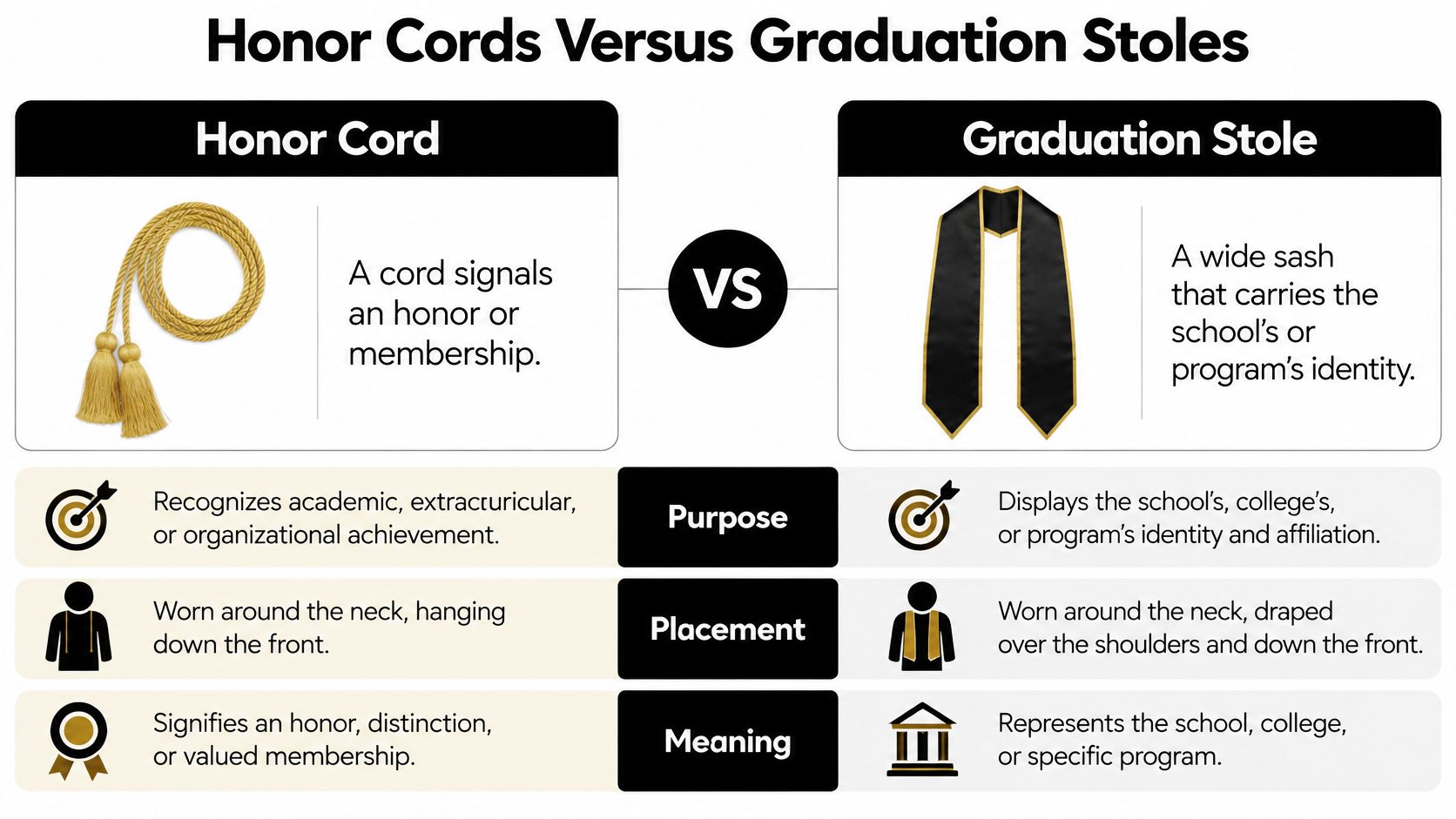
Honor cords compared with graduation stoles
| Feature | Honor cord | Graduation stole |
|---|---|---|
| Construction | Twisted cord with tassels | Broad sash, often satin-like or polyester |
| Width | Narrow rope with a pronounced twist | Broad band subject to any school-set width limit |
| What it signals | Academic honor or society membership | School, program, identity, organization, or honor |
| How it is worn | Centered behind the neck, with ends hanging down the front | Draped around the neck and over both shoulders |
| Who approves it | School, with society authorization where applicable | School or approved organization |
| Can it be combined | May accompany an approved stole when policy permits | May accompany approved cords; an additional stole needs authorization |
Choose the approved combination
A graduate whose school has approved both a stole and an honor cord wears the two together. That approval covers exactly that pairing. Adding a second organization's stole requires its own authorization, even when the graduate already belongs to that organization.
For arrangement guidance, consult how to wear a graduation stole and sash. Put the broad accessory in place before arranging the narrower cords, unless the school gives a different sequence.
Use these situation-based decisions:
- No stole issued: Wear the authorized cord with the gown. You don't need to add a sash merely to complete the appearance.
- Cord and school stole approved: Wear them together, checking that the stole lies flat and the cord ends remain visible.
- Program-specific stole designated: Use the school's assigned version rather than substituting a personally selected design.
- Additional organization stole requested: Obtain permission before adding it or replacing another item.
Count each accessory and each pairing as its own line on the approval checklist. The ceremony's complete regalia instructions, including any restrictions on organization items, give the final answer.
How to Confirm Eligibility and Choose the Right Cord
The first question is may this graduate wear this cord? Membership, academic eligibility, institutional recognition, and permission to wear an accessory can involve separate decisions.
A society adviser can confirm membership, while the registrar or commencement office can explain ceremony eligibility. Don't assume an invitation to join a society settles both questions.
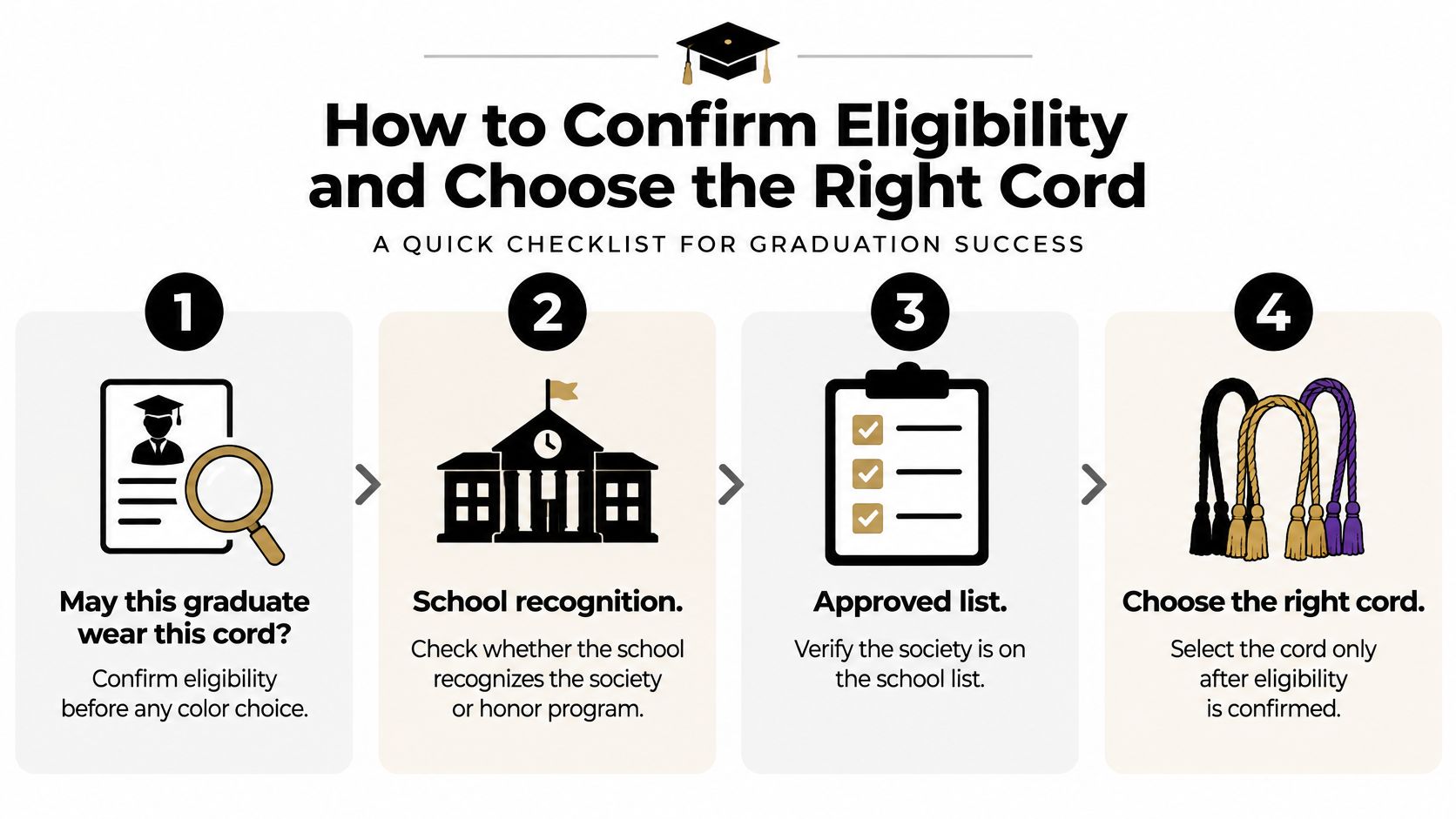
Verify the requirements in order
- Check school recognition. Find the society or honor program on the approved list. If it's absent, ask whether a sponsor must request authorization.
- Identify the GPA calculation. Ask whether eligibility uses cumulative GPA, major GPA, or a specified completed term. Georgia Tech's honor-cord guidance requires at least 60 credits earned in residence and uses the GPA from the term immediately preceding the final term. Students still building toward a cutoff can use effective study strategies for college students while the term is underway.
- Resolve transfer-credit questions. Ask whether transferred coursework affects the GPA calculation, residence requirement, or other eligibility conditions. Those are different questions.
- Confirm distribution. Determine whether the school, department, or society provides the cord and whether graduates must collect it or order it themselves.
- Check documentation requirements. Ask whether written approval and commencement-program recognition are necessary.
- Match the specification. Confirm the shade, color combination, and whether the approved item is a single cord, paired cords, or an intertwined design.
If you're asking specifically about chapter distribution, the explanation of whether National Honor Society provides a cord can help you frame the request. Your chapter still needs to confirm its own arrangements.
Turn approval into an order specification
Keep the written answer with the order record. Record the recognition category, exact colors, approved configuration, and person responsible for distribution.
Then compare products against that description, not against a graduation photograph. We offer honor cords at Stoles.com®, but a product's availability doesn't establish a student's right to wear it.
Before paying: Ask the registrar or society adviser to resolve any uncertainty about eligibility or the approved design.
Also record whether the cord recognizes GPA-based honors or society membership. That detail belongs in your announcement wording, not just your purchase notes. If the school cannot confirm permission, pause the purchase rather than treating the ceremony as the place to find out.
Ordering Timeline and Approval Deadlines
The ordering timeline works like a two-key lock. The school turns the first key by approving the cord, and only then does the vendor's production and shipping time matter.
Work backward from commencement using your own school's calendar. Each school and society sets its own approval windows, just as it sets its own cord colors, so treat the examples below as illustrations of how such rules look in practice rather than a schedule every graduate should adopt.
Cord ordering timeline from eligibility to ceremony day
The University of Southern Indiana's regalia policy requires approval for new cords or stoles at least 60 days before commencement, permits one approved additional organization stole or cord beyond university-issued items, and prohibits stoles wider than 5 inches. At institutions that route requests through a sponsor, a faculty or staff member may need to file the submission well ahead of the ceremony so approved adornments can be listed in the commencement program.
| Timing | Task | Why it matters |
|---|---|---|
| Early in the academic year | Confirm eligibility with the registrar and society adviser | Academic qualification and society status determine whether a cord can be authorized |
| School-set sponsor deadline | Submit the color-and-meaning specification through the required sponsor | The reviewing office needs an identifiable recognition category and design |
| Advance-approval cutoff (60 days before commencement at Southern Indiana) | Complete approval for a new cord or stole | Purchasing doesn't substitute for authorization |
| Sponsor-routed submission | Where the school requires one, the faculty or staff sponsor files the request | Approved adornments must appear in the commencement program |
| After approval is confirmed | Order and confirm dimensions and attachments | Allows production, inspection, and correction |
| Ceremony day | Wear the approved configuration | Keeps the graduate within the school's adornment rules |
Keep approval and fulfillment separate
For a chapter order, assign one person to maintain the approved specification and another to check the recipient list. The same person may hold both roles, but each task needs a named owner. The written approval already kept with your order record doubles as the inspection checklist when the shipment arrives.
If a color or attachment changes during ordering, send the revised description back to the approving office instead of assuming the substitution is equivalent. A shade that looks close in a product photo can sit outside the approved specification.
When considering custom honor cords, settle the recognition category before selecting decorative details. An appealing pairing cannot justify using an organization's insignia or reserved university colors.
After delivery, inspect the cords against the approval record. Look for incorrect combinations, loose tassels, or mismatched configurations while there is still time to resolve the problem before the ceremony.
Build the calendar around the school's decision first, then allow time for production, delivery, inspection, and a fitting.
How to Wear, Customize and Care for Your Cords
Begin with the gown on and fastened. A cord normally rests behind the neck with its ends down the front, not precariously over a single shoulder.
Don't force a new knot into a finished cord because you have more than one. Some double cords arrive joined; others require an approved connection method. Check the construction before pulling on the strands.

Arrange the cords without straining the tassels
- Lay the cords side by side. Match the tassel ends and identify the midpoint of each cord.
- Check how the double cord connects. If it's already joined, leave that connection intact. If joining is required, use the supplied method rather than tightening the decorative twist by force.
- Check the balance. Hold the midpoint gently and confirm that the tassels hang evenly. Adjust the strands, not the tassels themselves.
- Position the midpoint behind your neck. Let the cords pass over both shoulders, with the ends visible down the front of the gown.
- Smooth the arrangement. Separate crossed strands and check that the cords aren't trapped beneath the stole or pulling it out of position.
- Test before the procession. Sit, stand, and walk briefly. Have someone check the back, then adjust anything that shifts or catches.
A mirror helps with the front, but another person can spot a trapped midpoint or folded stole more easily. Avoid adding visible fasteners unless the school permits them, and don't puncture borrowed regalia without permission.
Specify customization before production
- Color and configuration: Write down whether the design uses separate solid-color strands or colors twisted together. A photograph alone may not communicate that distinction.
- Length and tassels: Specify the approved dimensions and tassel style when arranging a group order. Consistency helps prevent accidental substitutions.
- Names and years: Add personalization only where the institution allows it. Permission for a standard cord doesn't automatically include permission for attached ornaments.
- Society identity: Obtain authorization before reproducing letters, emblems, or other organization identifiers.
Protect the cord after graduation
- Store without tension: Lay cords flat or roll them loosely in a clean box. Don't hang them by their tassels.
- Clean cautiously: Check any care instructions first. For suitable materials, test cool water and mild soap on an inconspicuous area before gently spot cleaning.
- Dry naturally: Blot excess moisture and air dry flat. Avoid direct heat, which can damage synthetic fibers or attached details.
- Handle the ends gently: Lift cords by the rope rather than the tassels. Pulling at tassel knots can loosen the attachment or encourage fraying.
Keep the issuing society's note or award information with the stored cord. Years later, that record will explain the recognition more reliably than its color.
Ceremony Etiquette and Accurate Wording
A cord is a public claim, so describe the claim accurately. Careful wording protects the graduate's credibility without diminishing the achievement. Each school and society sets its own categories, so the award notice is the source of truth for any announcement.
The Northeastern State University commencement guidelines distinguish cords representing specific academic achievement from those representing membership in a recognized academic honor group. They also separate registrar-approved GPA cords from other academic cords that a society may distribute.
Describe the recognition awarded
An announcement works like a citation: it should name the issuer and the designation exactly as they appear on the award notice.
- Society membership: Describe the graduate as a member of the named society when membership is confirmed.
- Society recognition: Use recognized by the named society when that accurately describes the award.
- Latin honors: Use magna cum laude graduate only when the institution has awarded that designation.
- Pending results: Don't announce an anticipated final distinction as already confirmed; registrar review can still change it.
For example, membership in the National Honor Society and graduating magna cum laude aren't interchangeable descriptions. Neither phrase should be substituted for the other to make an announcement sound more impressive.
Don't turn accessories into a ranking system
A photograph showing several cords cannot reliably establish GPA, class standing, or academic superiority. The cords may represent separate accomplishments rather than progressively higher academic tiers.
On ceremony day, leave out items the school hasn't authorized, including organization pins or stoles where those are prohibited. Buying an accessory or receiving it from an outside organization doesn't override commencement rules.
Before posting an announcement, match its wording to the award notice or membership confirmation. If the issuer or recognition category is unclear, ask the commencement office or society adviser rather than interpreting the photograph.
Then test the draft against the record. A family might write, “Jordan graduated with top honors, among the best in the class.” If the notice records magna cum laude and society membership, the accurate version reads, “Jordan graduated magna cum laude as a member of the campus honor society.” That sentence will still be correct when someone reads the program years later.
Frequently Asked Questions About Honor Society Cords
Whom should I ask first, my society chapter or my school?
Treat these as two separate questions that need two separate answers. Your chapter adviser can confirm the official cord colors, who distributes the cord, and whether purchasing one is the graduate's responsibility. Your commencement office answers a different question: whether that specific cord may be worn at the ceremony. A chapter can confirm a cord's design and still leave you without permission to wear it, so collect both answers before you act.
What should an approval request include?
Give the commencement office enough detail to answer in a single reply. A complete message names the society, describes the cord's color and style, states who supplies it, and asks directly whether it is approved for the ceremony, for example: "I am a member of [society name], and our chapter wears a [color] cord supplied by [the chapter / the graduate]. May I wear it at commencement?" Attach the society's written description or a photo when you have one, and save the reply for your records.
What does the National Honor Society cord look like?
Your own chapter's current specification is the only description worth relying on, because cord colors and distribution practices are set locally. Royal blue and gold appears in many online descriptions of NHS regalia, yet an online description never counts as authorization for your campus. Get the specification from your chapter adviser in writing, then confirm it with the school before you order or wear anything.
What if the cord that arrives doesn't match the approved description?
Compare it against the written specification you confirmed, not against how other cords look. Shades of gold or blue vary between suppliers, and a cord that drifts from the approved colors can read as a different recognition entirely. Contact the chapter or supplier about an exchange before the ceremony, and use your saved written description to support the request.
Do international or online students follow the same rules?
Confirm with the school that issues the cord, since country and program systems differ. Applicants weighing an overseas path can pair that check with pre-med guidance for international applicants.
Stoles.com® offers honor cords and graduation stoles for recognizing academic achievement and society membership. Once your school confirms your eligibility and approved colors, compare the options at Stoles.com® against that written specification before preparing your commencement regalia.