

You're looking at a cart full of gold cords two weeks before commencement, your graduate says the GPA qualifies for honors, and you're not sure if that gold means the right honor, or if the school will even let a purchased cord on stage. That's the normal place to start. Custom honor cords aren't hard to buy. They're hard to buy correctly, because the color, braid, and right to wear one all come from one school's policy, not from a national chart.
What Custom Honor Cords Add to the Gown
A graduate walks in wearing the same black gown as everyone in the row. From a distance, nothing sets that gown apart until two colored ropes fall down the front, catching light every time the graduate moves. Families in the stands notice those ropes first, often before they can read a name in the program.
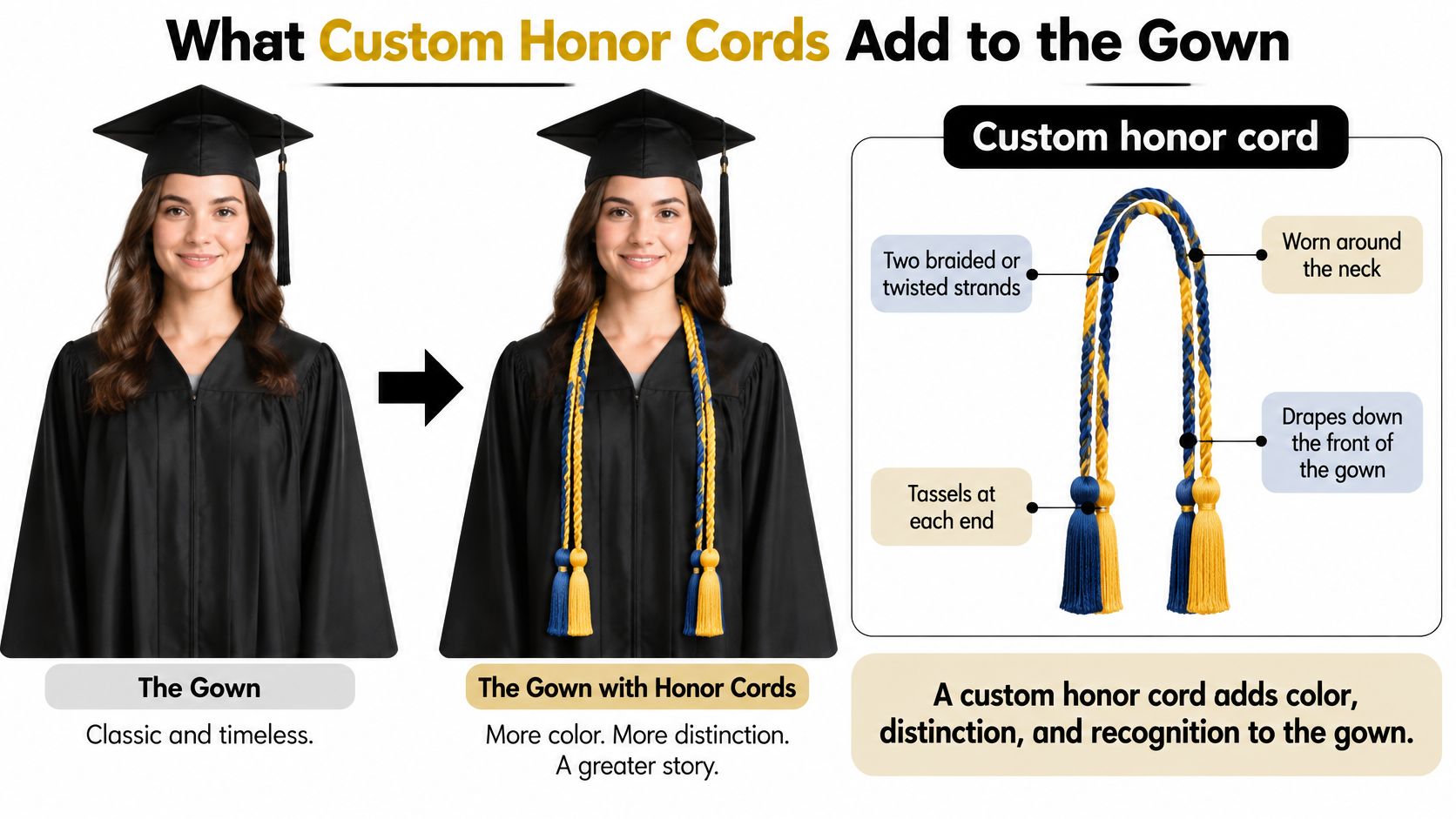
A custom honor cord is generally made from two braided or twisted strands with tassels at the ends, worn around the neck so the cords hang down the front of the gown, as the University of South Carolina Aiken history of regalia describes. The center knot sits at the nape. The two ends rest over the shoulders and finish at the front, where the tassels show.
An Addition, Not a Replacement
The cord adds a distinction. It doesn't replace the diploma, the hood, or the colors that mark a degree. A school can use it to show something those pieces don't show on their own, such as a Latin honor, departmental honors, an honors college, leadership, service, or membership in a recognized honor society.
That extra signal has a long history. American academic dress became more standardized after the United States adopted the Intercollegiate Code of Academic Costume in 1895, building on medieval European university traditions whose robes had remained relatively stable since the sixteenth century. Later guidance treated the 1895 code as a framework schools could adapt, not as a complete set of rigid rules.
Think of the cord like a jersey number. The garment looks familiar everywhere, but the roster that explains what it means belongs to one team.
That's why gold often marks an honor graduate on one campus and only the highest Latin honor on another. The form stays recognizable. The meaning stays local.
So custom doesn't mean free-form. It means you've matched three things the school controls: an approved color, an approved braid or construction, and an eligibility rule your graduate meets. Get those three right and the cord reads clearly from the stands. Guess at them and you've bought a well-made rope that may say the wrong thing.
Honor Cord Colors Schools Assign
No single color means the same honor everywhere, so start with comparison. A family that shops by color alone often orders the wrong cord.
Sample honor cord colors and thresholds by school
| School or system | Honor level | Cord colors | Threshold or rule |
|---|---|---|---|
| Documented five-level system | Cum laude | White | With distinction, school sets the GPA |
| Documented five-level system | Magna cum laude | Silver | With great distinction |
| Documented five-level system | Summa cum laude | Gold | With highest distinction |
| Documented five-level system | University Honors College | Purple | Program recognition, separate from Latin honors |
| Documented five-level system | Departmental honors | Red | Major level honor |
| Regional campus example | Highest Latin level | Blue and white set | Undergraduate honor level, per campus policy |
| Regional campus example | Middle Latin level | Blue set | Undergraduate honor level, per campus policy |
| Regional campus example | Entry Latin level | White set | Undergraduate honor level, per campus policy |
| University of Memphis | Summa cum laude | Gold | GPA 3.80 to 4.00 |
| University of Memphis | Magna cum laude | Crimson | GPA 3.50 to 3.79 |
| University of Memphis | Cum laude | White | GPA 3.25 to 3.49 |
| Tech institute example | Highest honors | White and gold braid | Higher campus minimum |
| Tech institute example | High honors | Gold | Middle campus minimum |
| Tech institute example | Honors | White | Entry campus minimum |
The Three Latin Levels, in Order
The Latin phrases name three ordered levels. Cum laude means "with distinction," magna cum laude means "with great distinction," and summa cum laude means "with highest distinction," a sequence laid out in Millersville University's guide to academic symbolism. Schools then assign their own colors to that shared ladder.
One documented system uses white, silver, and gold for the three Latin levels, then adds purple for University Honors College recognition and red for Departmental Honors. Another campus route uses school colors for undergraduates, with a two color set for the top level, a single dark color for the middle level, and white for the entry level. The shared Latin ladder stays steady across campuses while each color code stays local.
Why GPA Bands Make the Color Local
GPA thresholds split campuses further. The University of Memphis commencement application page maps gold to summa cum laude at 3.80 to 4.00, crimson to magna cum laude at 3.50 to 3.79, and white to cum laude at 3.25 to 3.49. Other institutes set their own cutoffs on a different scale, with a white and gold braid for the top tier, gold for the middle tier, and white for the entry tier.
Read those rows side by side. Gold can mark the top honor in one system and the middle honor in another, while the same GPA can qualify on one campus and miss the cutoff on another. Color alone cannot tell you which honor you are looking at.
Cords also reach beyond grades. Some schools award them for service and leadership, while still limiting approved wear at commencement to academic achievements and recognized campus honor societies. For background on common associations, our guide to honor cord color meanings explains how these traditions vary, but background is not permission. Match a row only after your registrar or honors office names the color, braid, and eligibility rule for your graduate.
Twisted Braided and Single Cord Styles
A family comparing cord photos on a kitchen table sees three builds that all read as "honor." The double cord looks fullest, the braid looks neatest, and the single strand looks cleanest. The school's approval list is the only thing that decides which build can be worn for a given award. Custom in this setting starts with the school's approved color, braid, and eligibility, so begin with the registrar's list, then choose the build.
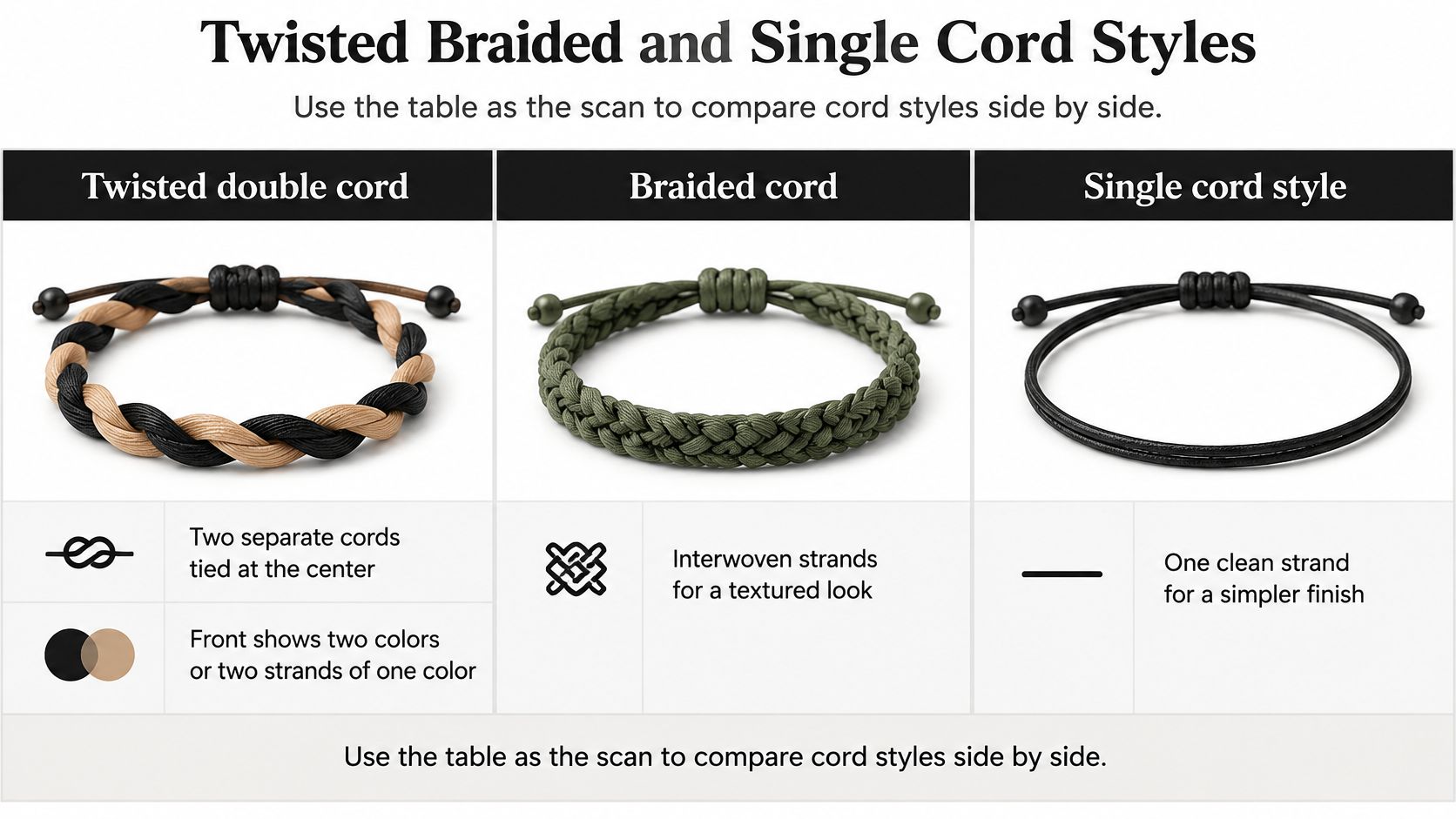
Honor cord constructions compared
| Construction | What it is | Typical use | Check before ordering |
|---|---|---|---|
| Twisted double cord | Two strands joined at a center knot, with tassels at the strand ends | Two colors for one honor or two honors worn together | The center knot shortens the finished hang, so confirm the measured length |
| Two-color braid | Two colors twisted into one rope | A combined honor the school lists as one braid | Hard to reuse for a different honor |
| Three-color braid | Three colors in one rope | An approved tri-color set, such as a military cord | Confirm the school allows that exact combination |
| Single cord | One strand with tassels at both ends | A reserved solid color | Can read as an extra cap tassel when it hangs loosely |
| Variegated cord | Shifting shades of related colors | Only if policy allows a non-solid cord | Can look unofficial next to a reserved solid |
What Each Build Does on the Gown
A twisted double cord is two separate cords tied at the center. The front shows two colors, or two strands of one color, with tassels at the ends. Stoles.com lists Double Graduation Honor Cords - Custom Honor Cords as a custom option at $8.95, with prices as low as $7.16, and that product is one example of the double-cord build. A double cord reads as a fuller front than a single strand. Fullness is a visual effect, not proof of eligibility.
A two-color braid twists both colors into one rope. A braid works like a single printed ticket: one design carries one meaning. Some campuses use that single rope to mark a combined honor, and it reads as one award rather than two. Once the colors are braided together, you cannot easily split that cord for a different honor next year.
A three-color braid carries a tri-color meaning, such as a red, white, and blue military cord. Order it only when that exact combination appears on an approved list. A single cord, one strand with tassels at both ends, suits a policy that reserves one solid color, but when it hangs loosely it can read as an extra cap tassel. Variegated cords shift through related shades. They can look unofficial beside a flat solid color that a school has reserved, so check the list first.
Material Affects Reuse
Fabric choice affects reuse. A soft cord with a high sheen can crush or fade after a season in storage. A firmer cord holds its twist and color better, which matters when a department plans to collect and reuse a shared set. Ask which material the cord uses before you build a reusable inventory around it.
If you want more detail on how these builds differ across ceremonies, our overview of the different types of graduation cords explains the common categories. Before you order, write the approved combination on the order form: color, braid, and the honor it marks.
Length Tassels and Embroidery Specs
A registrar opens a custom cord order and finds three blank boxes: finished hang, tassel size, and lettering. Leave them blank, and the vendor fills them in from a sample photo taken on someone else's gown.
Custom honor cords are not a free-form design project. The school or society approves the color, the braid, and who may wear it. Your order form translates that approval into measurable specs.
| Spec | What to write on the order | What it controls |
|---|---|---|
| Diameter | The thickness of the approved cord, measured on a sample | How round and substantial the rope looks beside a stole |
| Strand length before the knot | The cut length the maker should start with | How much cord is available for the center tie |
| Finished hang after the knot | Shoulder to tassel end on a sample gown | Where the tassels land on the wearer |
| Tassel count and size | Number per end and length of each tassel | The silhouette at the front of the gown |
| Color count and sequence | Solid, two-color, or three-color, and which color leads | The honor the cord documents and how it reads from the audience |
| Lettering | None on the cord; names and logos go on a stole | Whether the piece can carry embroidery at all |
Reading the Length Correctly
Length causes more remakes than any other field. A strand measured flat on a table is not the same as a cord hanging on a graduate. The center knot eats some of the raw length, and the height of the wearer changes where the tassels sit.
Use the finished hang, meaning shoulder to tassel end on a sample gown, as the number you approve. That works like hemming trousers: the length on the bolt is not the finished break over the shoe. If the graduate is much taller or shorter than the sample wearer, write the finished hang you want and ask the maker to confirm it in writing before production.
Greek Sets and the Same Form
Greek sets follow the same ordering logic. A chapter may approve a two-color or three-color braid, but the finished hang still comes from the same shoulder-to-tassel measurement. The color count changes the look, not the geometry.
Put the color sequence on the order. “Blue and gold” does not say whether blue or gold leads the braid, and the chapter's approval usually does.
Where Names and Logos Belong
Embroidery is the one spec that does not belong on a cord. A twisted rope has no flat face to hold stitches, and stitching into it breaks the twist. Treat the cord as color and construction. Put names, graduation years, and logos on a stole or sash.
A group that wants both should pair them: the stole carries identity, the cord carries the honor. At check-in, staff can read the stole and glance at the cord without asking the graduate to explain either piece.
Practical rule: If it needs letters, it needs a flat surface.
Before you pay, put five lines on the order: diameter, finished hang, tassel count and size, color count, and color sequence. Add the school or chapter approval reference if the form has a field for it. Those lines prevent most remake arguments because both you and the maker are describing the same finished object, not the same product photo.
How to Order Cords a Ceremony Will Allow
Before you open a cart, treat the cord like a permission slip. A purchased cord counts only when the awarding office and the ceremony policy both allow that exact build. Cord colors are a campus rule, much like a parking permit. The campus sets the color, braid, and eligibility, so the order form should match the policy rather than a generic idea of an honor cord. The gap between those approvals shows up at check-in, when a staff member asks your graduate to remove a cord that looked right online.
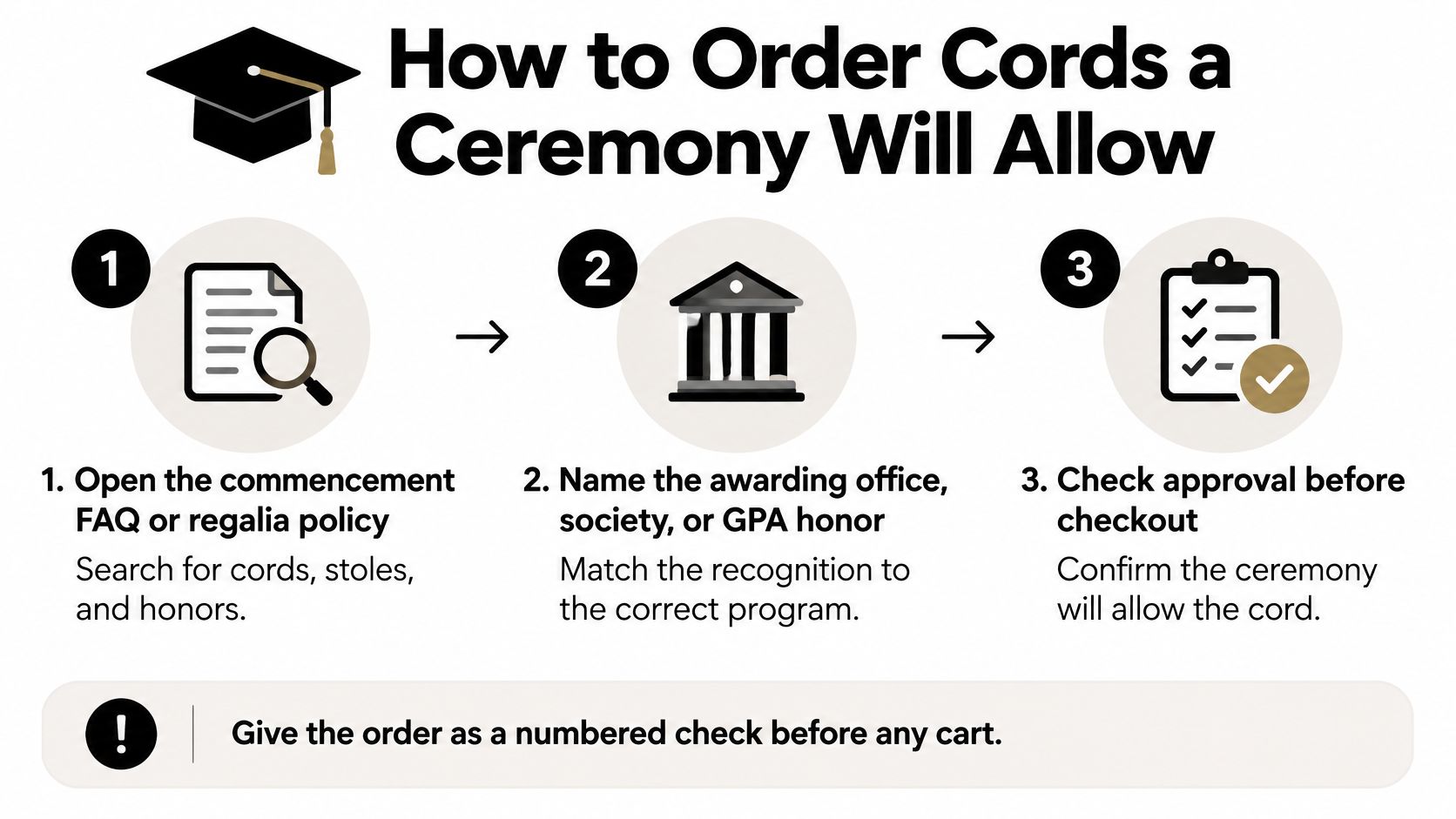
- Open the commencement FAQ or regalia policy. Search the page for cords, stoles, and honors, and read what the school permits on stage.
- Name the awarding office, society, or GPA honor. Write down who grants the recognition, because eligibility comes from that office, not from your order.
- Record the permitted build. Note the color, single versus double, any braid, and whether graduate students qualify at all.
- Count what's allowed together. Note how many cords a graduate may wear and whether a stole or medal may be worn with them.
- Put the specification on the order. List the institution, honor category, color, and braid so a look-alike cord isn't produced by mistake.
- Use one approver for group orders. A school or chapter should order through one approver and a purchase order rather than many separate student carts.
- Order when honors are posted. Give any custom color or braid the most lead time, and don't leave a special order until ceremony week.
Policies Really Do Conflict
Some commencement policies prohibit added stoles, jewelry, or badges outright. SUNY Oneonta's commencement information for students permits approved honor cords, stoles, and medals for university, departmental, or national-organization recognition. Other policies allow cords only for honors and categories the school names.
That middle ground is where families get caught. A cord can be visually appropriate, well made, and still be disallowed at your graduate's ceremony. High school buyers face the same issue at a smaller scale, and a summary of high school graduation stole requirements shows how approval rules work before college. Ask which office owns the answer, whether that is the registrar, the dean of students, or the honors college, and keep the approval email with the order.
Timing Without a Promised Date
Don't assume a production window. Ask the vendor for its production and delivery window in writing, then count back from two dates, the day honors are posted and the commencement date itself. Allow extra time for a custom braid or a school-approved color check. Start earlier for a shared department set because it needs one approver and a purchase order moving through an office. For a group order, put the approver's name and the purchase order number on the specification sheet so the vendor and the school are working from the same document.
Once the ceremony is settled, families often plan the gathering next. It takes only a few minutes to find a graduation celebration venue that fits your group size before the weekend fills up. Handle the venue after the regalia. The cord rule stays simple: custom means personalized inside the institution's rules.
Cords Students and Societies Wear
Scan a commencement row and you will usually spot three kinds of cord wearers. Each cord answers a different question, and each one has to fit the school's approval list.

Honor society members wear reserved color pairs tied to their organization. The pair identifies the society, not a GPA band, so a student earns it through membership rather than through the registrar's honors list. The exact colors come from the organization and the campus approval list, not from a national cord chart.
Greek chapter members wear two cords tied as one set in chapter colors. The set shows affiliation, and many chapters attach it to a scholarship standard they set themselves. A military graduate may wear a red, white, and blue cord beside a branch stole when the school allows both pieces together.
A single-color cord works the same way at smaller scale. A Pink Graduation Honor Cord - College & High School Graduation Cords, for example, is a twisted cord. Pink carries that meaning only where an organization has assigned it.
Why Reserved Colors Stay Reserved
A reserved color stays legible to the audience and faculty marshals only while it remains tied to one defined group. LSU authorizes purple-and-gold cords for Latin Honors and white cords for Upper Division Honors, and the university restricts those combinations from other graduates, as LSU's academic regalia page sets out.
Another campus may reserve white for its University Honors Program and use separate solid-color stole and tassel systems for cum laude, magna cum laude, and summa cum laude. The principle is the same: a cord is a label, and a label loses meaning when the same colors appear on graduates outside the group.
Pairing Cords With Stoles
One cord set plus one stole is the usual stage look. A flag stole, kente stole, first-generation stole, nursing stole, or student-athlete stole can sit under the cord without crowding it. Add a second stole and the pieces start covering each other, and both honors get harder to read.
To wear a double cord, pull the two strands until the knot is centered and sits at the nape, then let the cords fall over the shoulders and down the front of the gown. Check it in a mirror before you leave, because an off-center knot makes one side hang longer than the other in every photo.
A cord works like a one-line caption under a graduate's name: it should tell the audience which honor, society, or program the wearer represents. If you can't answer that in a short phrase for a cord in your cart, you're probably buying decoration, and regalia policies are written to keep decoration off the stage.
Compare Cord Prices and Care Before Ordering
A family finds a three-color cord on sale and almost checks out, then notices the school's honor list names a single gold cord. Cost follows construction: more strands and more colors take more material and time, so the lowest tag on the page may not be the cord your campus will let through the door. The table below gives current Stoles.com examples so you can compare like with like.
Sample Stoles.com honor cord prices
| Cord | Construction | List price | Lowest listed price |
|---|---|---|---|
| Gold graduation honor cord | Single | $5.95 | $4.76 |
| Custom double graduation honor cord | Double | $8.95 | $7.16 |
| Red, white, and blue military honor cord | Three-color | $12.95 (on sale for $7.95) | $6.36 |
A custom cord is still a school item. The color, braid, and who may wear it come from the campus policy, not from a design menu. Before you pay, match the order to the school's line: one approved color, two strands, or a three-color military combination. Check who issues the cord, the student or the honor society, and whether the package arrives before the ceremony. For stoles, the same rule applies: the approved list comes before the sale tag, as these notes on affordable custom graduation stoles show.
Care is light. Hang the cord so the twist relaxes, spot-clean rayon rather than machine-washing it, and store it untangled. Polyester holds twist and color better if the set will be reused.
A department that wants cords to outlast one ceremony can buy a shared set, lend it to qualified graduates, and collect it after the stage walk. The University of Tennessee's 2025 sustainability initiative offered free graduation regalia through a campus Free Store and linked sustainability participation to earning a green cord and medallion. That model keeps a durable cord in circulation and lets the honor, not the student's budget, decide who wears it.
Questions Students Parents and Schools Ask
The week before commencement, the questions arrive in bunches: whether a cord is allowed, whether a stole can join it, who pays, and whether the cord can be worn again. Most answers sit in the same two places, the commencement FAQ and the regalia policy.
Can I wear a custom cord my school didn't approve?
No. Eligibility is set by the institution, and the approved list is usually the controlling document. Search the policy for "honor cord," "recognition cord," or "academic cord," because the same item can appear under more than one label. A cord that matches the gown color can still be turned away at the door if it is not on that list.
Is a stole allowed with a cord?
Check whether your policy treats stoles and cords as one category or two. A campus that permits cords may still limit stoles to approved organizations, so read the category lines rather than copying a photo from another graduation. If the policy is silent, ask the registrar's office to confirm in writing.
Do graduate students qualify?
Only if the policy says so. Look for language that separates undergraduate honors from graduate honors. Some schools issue cords to undergraduates and use medallions or hoods for graduate recognition, so degree level alone does not settle it.
Who should pay?
A student can buy a personal cord. A department or honor society can also fund a shared set so cost does not block a qualified student from being recognized. Ask the advisor which path applies before the order is placed, and have the funding decision match the eligibility list.
Can cords be reused?
Yes, when the school runs a reuse program or an honor society keeps a shared set. Ask where cords are collected after the ceremony and whether there is a return deadline.
What should families handle outside the regalia order?
The ceremony is one part of graduation week. A simple planning walkthrough can help you plan a stress-free family celebration while the graduate keeps the regalia questions with the school.
Once your school has named the approved color and construction, we can supply the single, double, and three-color custom honor cords to match it, along with the stole that carries any names or emblems the cord can't hold. Bring your institution, honor category, color, and braid details with you and visit Stoles.com® to build the set your ceremony will allow.