

You've got the cap and gown sorted, family photos are planned, and now you're scrolling through Filipino graduation stole designs late at night. One shows the Philippine flag in bright blue, red, white and yellow. Another uses a woven border and a family name. Both feel right, but you're not sure which one your school will let you wear across the stage.
That's the right question to ask first. A Filipino graduation stole can carry ancestry, family support and years of hard work in a single garment, but ceremony rules decide what reaches the procession. Start with school approval, then choose meaning, size and fabric inside what your ceremony allows.
Filipino Graduation Stole Types at a Glance
Most Filipino graduation stoles fall into five types, and each one sends a different signal to the audience and to your school. The table below sorts them so you can match a type to both your story and your campus rules. Read the right-hand column first, because approval decides which types are available to you.
| Stole type | What it signals | Check before ordering |
|---|---|---|
| Philippine flag stole | National pride and ancestry | Request the school's written policy on national-flag stoles |
| Filipino cultural-design stole | Heritage shown through motifs and textiles | Confirm cultural designs are allowed at your ceremony |
| Custom heritage stole | Heritage combined with a name, year or milestone | Check width, text and design rules |
| Organization or Greek stole | Club, chapter or honor society membership | Confirm the organization is listed as allowed for graduates |
| Homemade or personalized design | Personal meaning and family story | Get written approval before ordering materials |
Reading the Table Like a Buyer
A flag design is the clearest public statement, which is why schools most often route this type through an approval process. A cultural-design stole communicates heritage through pattern and textile rather than nationality alone, so it can suit graduates whose connection is regional or familial. A custom heritage stole adds a name, year or milestone, which means text, spelling and placement all need checking before production.
Organization and Greek stoles work differently because they claim membership. Your school may only recognize listed clubs, chapters or honor societies, so confirm your group appears on that list. A homemade design carries the most personal meaning, but it also carries the highest risk of removal if no one approved it in advance.
Pick the type that matches your campus approval first, then narrow it by personal meaning.
We offer flag graduation stoles and sashes, which gives you a starting point if a flag design is what your school permits. Whatever type you choose, write down the category, ask your commencement office whether it is allowed, and keep that answer with your order details.
What the Colors, Flags and Motifs Mean
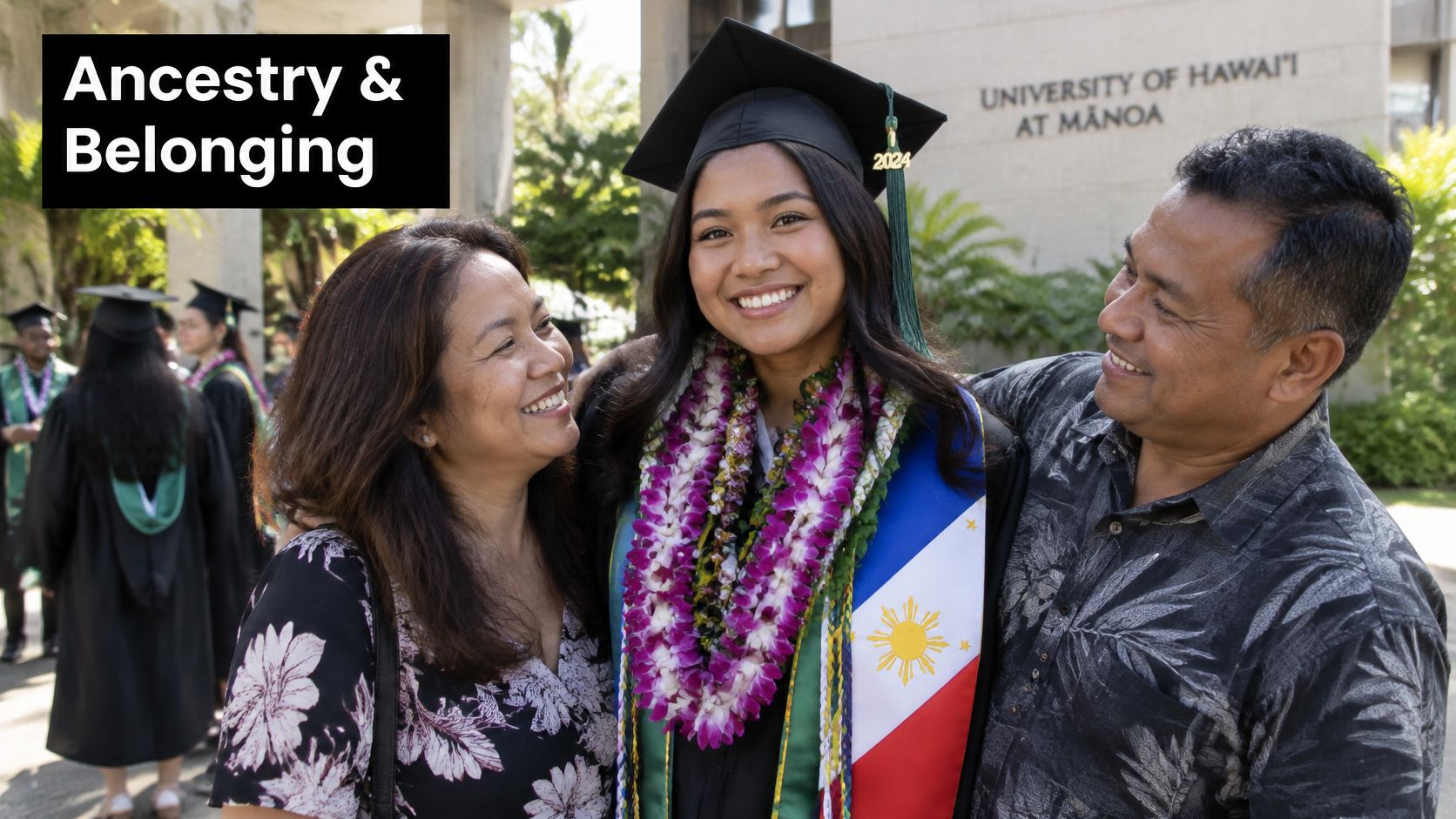
A Filipino graduation stole names who the graduate carries across the stage: parents who immigrated, a home province, a student organization, a country. It is a visible statement of ancestry and cultural belonging at the moment a degree becomes public.
FilGrad at the University of Hawaiʻi at Mānoa shows how literal that statement can be. Civil Beat's account of the ceremony reports that it began in 2017, when Filipino graduate students worked with the Tinalak Filipino Education Advisory Council, and that participants wear a stole modeled after the Philippine flag with their cap and gown. By 2024 the tradition had run for at least seven years, and graduates could also wear the stole at the formal commencement the following day.
What Each Symbol Is Saying
A stole communicates at two distances, like a poster on a wall. Flag colors read across an arena, while a motif or woven texture rewards the closer look of family photographs.
| Symbol or textile | What it conveys | Where it appears |
|---|---|---|
| Philippine flag blue, red, white and yellow | National identity and ancestry | Flag stoles and national-pride designs |
| Sampaguita | The Philippine national flower | Floral borders and embroidered patterns |
| Ukkil motif | An angular geometric pattern used in Philippine-inspired academic dress | University and heritage stole designs |
| Triangles and chevrons | Repeating lines that echo woven cloth | Woven or embroidered borders |
| Piña and hablon weaving | Regional textile crafts, with piña made from pineapple leaf fibers | Premium woven keepsake stoles |
No single motif carries one official definition, so treat ukkil, triangles and chevrons as visual references rather than coded messages. If a relative asks what your stole "means," the honest answer is the story you chose it for.
If you're comparing flag-based layouts, our guide to graduation flag stoles and how national designs are structured shows how color blocks sit over a gown. The sampaguita suits graduates who want a Filipino reference that reads as floral rather than political. Geometric work stays legible even when a stole folds slightly at the shoulder, which is why ukkil-style and chevron patterns appear so often in borders.
Piña earns a separate note because it is woven from pineapple leaf fibers. That origin explains why a piña-inspired finish reads as a keepsake rather than a printed souvenir, even when the finished stole uses a modern base fabric for durability.
Read a motif by asking whether it matches the meaning you want to express. Keep official university symbols separate from personal heritage designs, so your Filipino graduation stole doesn't look like official regalia you weren't issued. If a pattern resembles a specific university's academic dress, treat it as reserved regalia unless your school confirms it is permitted.
Customizing Your Stole Beyond the Flag
A Filipino stole doesn't have to reproduce the flag from end to end. A flag states a country of origin, and a graduate shaped by a specific province, a mixed-heritage family or a second-generation story may want the sash to say more than that.
You can build the design in layers. Start with one clear foundation, then add only what strengthens that story. Run each layer past your school's regalia rules as you plan it, because approval decides which of these choices reach the ceremony.
- Country layer: Use the Philippine flag or its colors when national origin is the main message.
- Heritage layer: Use a sampaguita border, geometric motif or textile-inspired panel when culture, region or family tradition matters more than nationality.
- Milestone layer: Add a graduation year, family name or first-generation status when the degree marks a personal or family first.
- Community layer: Add a student organization or chapter reference when a campus community supported your degree.
Two graduates can start from the same list and finish with very different stoles. One combines a sampaguita border with a name on one side and the graduating year on the other, so the floral work carries heritage while the text stays balanced and readable. Another pairs a piña-inspired woven panel with a small first-generation mark, keeping the design formal enough for a conservative ceremony. Notice that each stole still has one dominant idea. Layering works like seasoning in cooking: a few elements that support one flavor, rather than every ingredient in the kitchen.
That distinction between nationality and heritage appears in campus practice too. The Drury University commencement regalia guidance lists heritage stoles such as Kente and Serape alongside home-country stoles, showing that cultural regalia can communicate identity beyond nationality. Some schools also recognize dedicated first-generation stoles, so confirm whether that category needs separate approval before you count on it.
Our overview of personalized graduation stole design choices can help you judge text placement and balance. In practical terms, you can customize a stole by choosing different colors, trims, length, and cut, and have your own art imprinted on the sash. Custom stoles are made from heavyweight bridal satin or a matte finish, and every stole is fully lined whether ordered in stock or custom, so the base fabric carries embroidery and print cleanly rather than puckering under it.
For a sense of what an unadorned base looks like, the Brown Elementary & Middle School Graduation Stole is a plain, in-stock sash listed at $7.49, the kind of simple foundation that makes clear how cut and width shape the canvas before any artwork goes on.
Keep customization inside clear limits. Avoid political statements, profanity, decorations that could be read as disruptive, and anything that imitates official university regalia. Before you order, ask three questions: What story does this stole tell, who is it for, and does your school allow each element on it?
School Rules and Etiquette Questions
A Filipino graduation stole works like a concert ticket: the design can be meaningful, but the gate still decides whether you can bring it inside. First-time buyers often pick the flag, colors and wording first, then learn that the ceremony office has a separate approval step.
Start with the policy, not the product. The University of Southern Indiana approved stoles and cords policy permits approved international stoles representing a student's country, limits students to one personally chosen stole or cord, and requires approval for new designs at least 60 days before commencement. Another campus may use a different category list, a different deadline, or a different definition of what counts as an extra adornment, so a friend's approval is not portable.
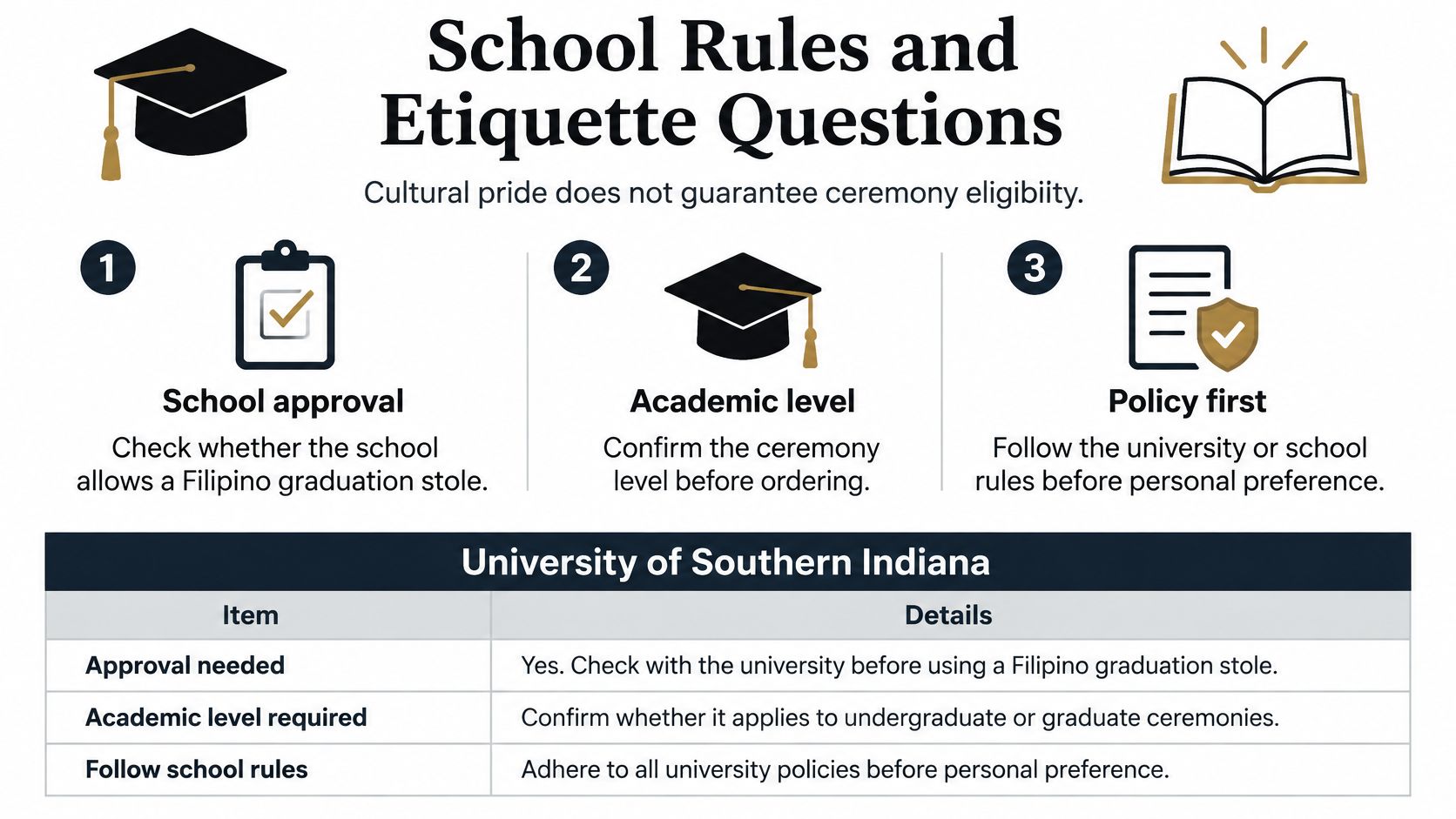
| Rule pattern | What is permitted | What to confirm |
|---|---|---|
| Linked policy: University of Southern Indiana | Approved international stoles representing the student's country | One personal stole or cord only; new designs need approval 60 days before commencement |
| Flag-only approval pattern | A national or flag design may need approval before it is worn | Ask whether unapproved cultural or organizational regalia can be removed at lineup |
| Level-based pattern | Undergraduate and graduate candidates may follow different rules | Ask whether graduate candidates have tighter limits on extra adornments |
| Inclusive-design pattern | Cultural designs may be reviewed for tone as well as category | Ask what standard the school applies to respectful imagery and wording |
Can I Wear a Stole With an Honor Cord
Often you can wear one stole plus a cord, but do not treat that as automatic. Under a one-item limit, your Filipino graduation stole and your honor cord could be counted as competing choices, even though one marks heritage and the other marks academic recognition. Ask whether the cap applies only to personally chosen items or to every piece beyond the required gown.
If both are allowed, put the stole on first so it lies flat, then drape the cord over it. Check our guidance on high school graduation stole requirements and layering rules if you're graduating below university level, because schools at that level often use a single approved list.
Is It Respectful If I Am Not Filipino
A stole tied to your personal story, family or community is generally well received. That could include a Filipino parent, spouse, adoptive family, or a heritage you'll share with your children, as long as you can explain the connection without overstating it.
Copying official regalia is different. Don't reproduce a university's official garment, seal or academic costume as if it were a generic cultural design. If you're unsure about a motif, ask a knowledgeable family member or Filipino cultural organization before you commit it to embroidery.
Is a Stole Required
Read the handbook language closely. Some ceremonies prescribe a specific stole for one academic level and a hood for another, while others treat heritage stoles as an added layer over required regalia. The same word, "stole," can mean a required marker of level in one handbook and a permitted expression of identity in another.
Checker rule: If the handbook calls a stole prescribed, buy exactly that item. If it calls a stole permitted, get your design approved.
Can I Add a Message
Keep messages short and factual. A name, year, degree or heritage marker is easier for a school to approve and easier to read in photographs. Political statements, profanity and decorations meant to draw attention are commonly restricted, and they can turn a simple approval into a refusal.
Get five answers in writing from your own school: the approval process, the deadline, any width and length limits, the number of stoles or cords allowed, and whether graduate regalia differs from undergraduate regalia. Once those answers are clear, design choices become much easier: every color, flag, motif and line of text either fits the rule or goes back for revision.
How to Buy the Right Size and Fabric
Measure first, then choose fabric and artwork. A beautiful design still looks wrong if it hangs unevenly, crowds a hood, or exceeds a width limit your school wrote into its rules.
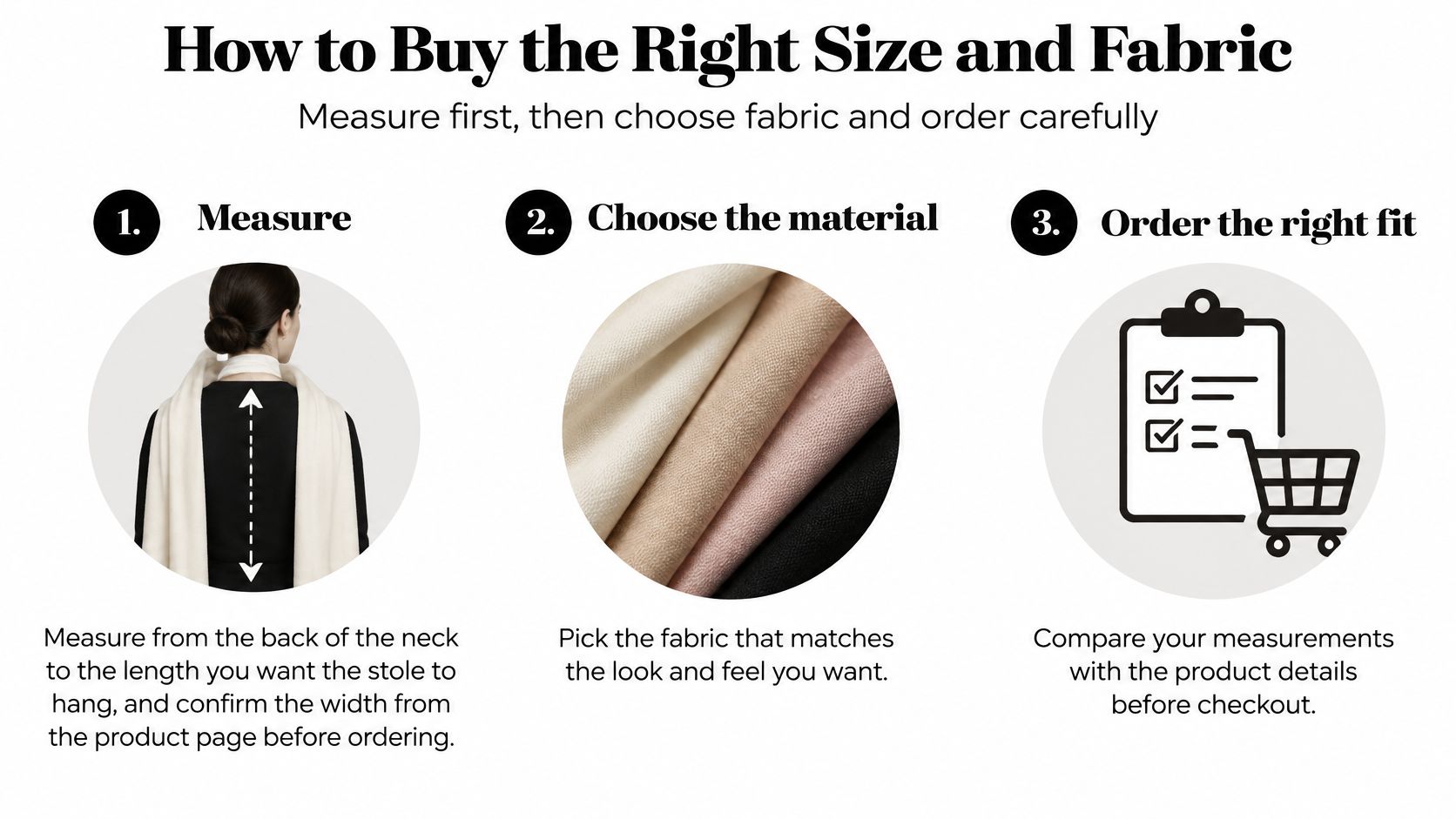
- Measure from the back of the neck. Run a soft tape from the nape, over one shoulder, down to where you want the stole to end on your gown. Confirm whether the product page lists length per side or end to end, and check the stated width before you compare designs.
- Choose the base fabric for the order size. A durable polyester or rayon base suits large club or class orders because it holds color and shape consistently. A woven or piña-inspired finish suits a single keepsake, where texture matters more than matching dozens of identical pieces.
- Pick a reversible, balanced layout. Use symmetrical front artwork and balanced embroidery weight on both sides. That keeps the stole legible if your ceremony includes a shoulder change and stops one side pulling longer than the other.
- Confirm colors and trims against the approved list. Hold your chosen colors against the gown in daylight, not only on a screen. Our notes on graduation robe length and gown proportions can help you judge how far a stole should fall over your specific gown length.
- Check the lining. A fully lined stole holds its shape, hides the back of embroidery, and looks finished when it turns slightly during the procession. We make custom graduation stoles and sashes from heavyweight bridal satin or matte finish, with every stole fully lined whether it's in stock or custom ordered.
- Order by your school's deadline. Build in time for proof approval on custom text and artwork, especially names with accents or special characters. A proof you rush is where spelling errors survive.
Before you buy, confirm the approved width and length limits from your school's written rules, then match them to the product page.
A finished stole should show even edges, a straight drape, and artwork that reads clearly on both sides without twisting. If one side curls or the embroidery puckers, the problem won't improve under stage lighting.
How to Wear It Through the Ceremony
Shoulder placement can signal status in Filipino ceremonies, not just style. That surprises graduates who assume a stole is just draped and forgotten until photos.
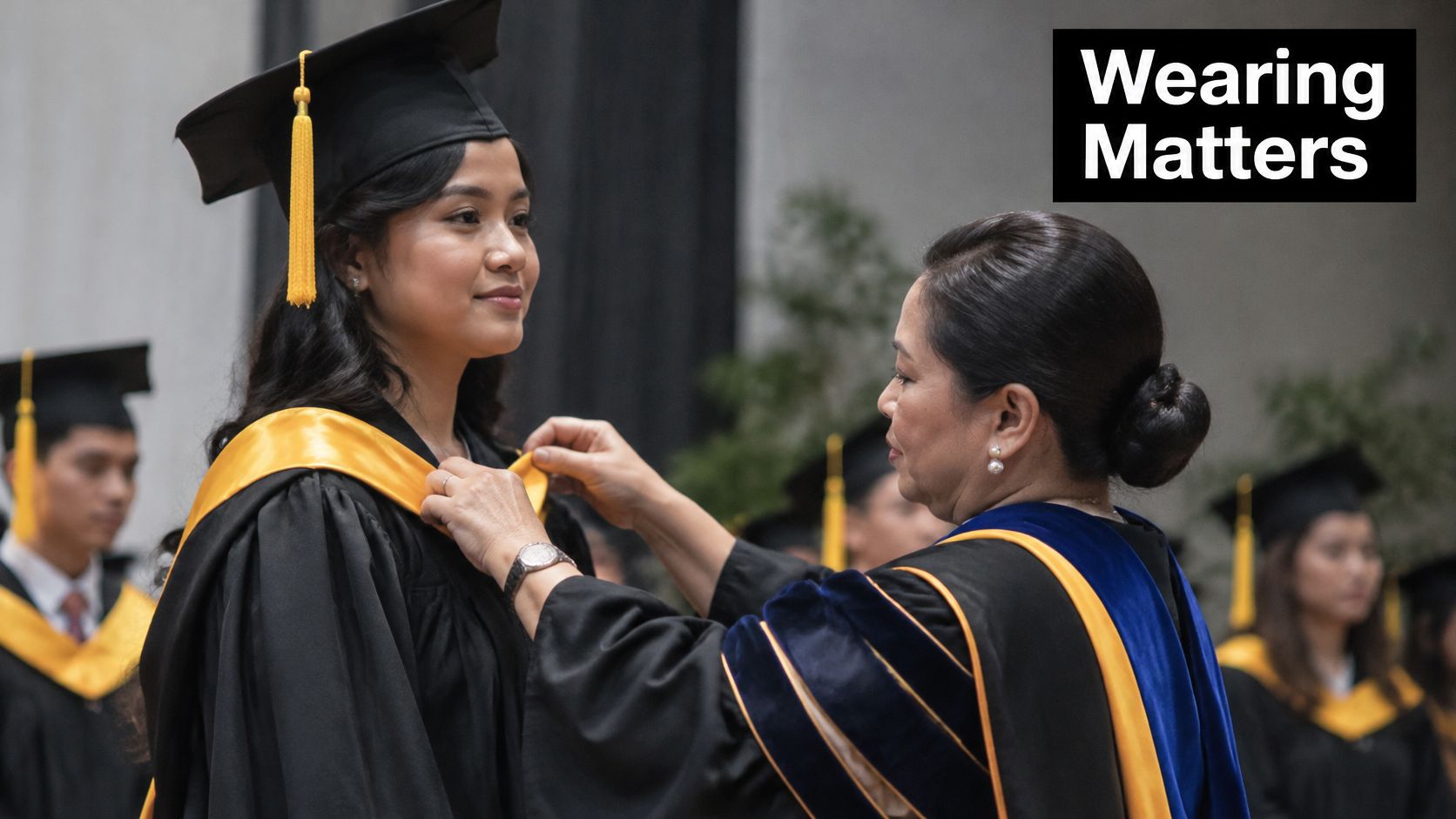
University of the Philippines guidance makes the sequence clear. According to the University of the Philippines Visayas academic costume guidance, the sablay begins over the graduate's right shoulder and is transferred to the left shoulder after degree conferment, making the move a visual status change. That same guidance supports choosing a stable, reversible drape, with balanced embroidery so the design stays legible on either side.
| Ceremony moment | Shoulder placement | What to do |
|---|---|---|
| Before degree conferral | Right shoulder | Follow the school's rule and confirm the drape before the procession |
| After degree conferral | Left shoulder | Move the stole across once conferral is announced |
| Throughout the ceremony | Secured on both shoulders where the school requires it | Pin it firmly and keep the artwork facing forward |
This placement sequence follows the sablay example, so don't apply it automatically to every ceremony. Other schools may want a centered drape pinned at both shoulders, or they may place a heritage stole under a graduate hood. Confirm your own school's rule before the procession, then try the full outfit at home while standing, sitting and walking.
Caring for the Stole Afterward
Care depends on construction, because embroidered, printed and handwoven elements respond differently to abrasion, moisture and heat.
- Embroidered areas: Spot clean gently rather than soaking, so threads don't loosen or bleed into the base fabric.
- Printed panels: Keep them away from direct heat and excess moisture, which can fade color blocks.
- Handwoven or piña-inspired pieces: Use low heat only if pressing is needed, and test an edge first.
- Storage: Store the stole flat or loosely folded, away from pins and cords that could snag or crush embroidery.
A five-minute trial with your gown settles pin points and drape before you're in a crowded line. That's the difference between adjusting your Filipino graduation stole once at home and tugging at it on stage.
Order Your Stole Before Your School Deadline
Work backward from your ceremony date, not forward from today. Approval, proofing, production and delivery each need room, and the school's deadline is the one date you cannot negotiate.
1. Build the timeline. Put your ceremony date and the school's approval deadline on a calendar, ask the seller for production and delivery times in writing, then count back. Don't assume a fixed turnaround, because a custom design needs proofing time that an in-stock sash does not.
2. Settle type, customization, size and fabric together. Choose the design type that fits the approval, add only the personal layers your school permits, then lock the measurements and material. Changing width or artwork after approval can mean asking again.
3. Keep everything on file. Store the school's approval reply alongside your design details, measurements and proof. When the package arrives, check the received stole against those notes piece by piece, so what you wear matches what was approved.
We offer flag graduation stoles and sashes, cultural and ethnic stoles, and custom graduation stoles, alongside categories such as International Stoles, First Generation Stoles, Greek Stoles and Honor Cords. That range lets you compare an in-stock flag design with a customized heritage version before you commit.
Stoles.com® offers flag, cultural, custom and first-generation graduation stoles and sashes, so you can choose a Filipino graduation stole design that matches both your heritage story and your school's approval. Compare in-stock options with custom colors, trims and artwork, then order with your written approval and measurements in hand. Visit Stoles.com® to find the stole you'll be ready to wear on graduation day.