

The popular advice that gold means highest honors and every other graduation color has a fixed meaning is too simple to trust. Honor stole colors are local recognition codes, not a universal ranking system. Before you buy a stole or interpret someone else's, you need to know who authorized it, what item the policy describes, and which recognition it represents.
A color chart can help you ask better questions, but it can't establish your eligibility. The reliable question is not just what a color means. It's what that color means at your school, for your recognition, at your ceremony.
Honor Stole Colors and What They Signal at Named Schools
Gold can signal top honors, red or crimson a higher distinction, silver an intermediate honors level, white distinction, and navy blue cum laude. Those are useful starting associations, not meanings you can transfer between schools. Purple and other colors can also identify a society or an academic discipline rather than an honors tier.
The lookup below preserves an important distinction: some institutions award cords, while others use stoles. A cord is a narrow, rope-like accessory, while a stole is a broader sash draped around the neck and shoulders. Don't substitute one for the other just because the color matches.
Honor and society color codes at named schools
Kansas State's purple-and-white system uses three styles and sizes for its academic-honor levels under its GPA policy, as described in its regalia guidelines.
| School or organization | Recognition | Color or colors | Stated basis |
|---|---|---|---|
| Utah State University | Cum laude | Navy blue cord | GPA 3.50 to 3.79 |
| Utah State University | Magna cum laude | Silver cord | GPA 3.80 to 3.94 |
| Utah State University | Summa cum laude | Gold cord | GPA 3.95 to 4.00 |
| University of Memphis | Distinction | White cord | Commencement cord policy |
| University of Memphis | High distinction | Red or crimson cord | Commencement cord policy |
| University of Memphis | Highest distinction | Gold cord | Commencement cord policy |
| University of Southern Indiana | Summa cum laude | Solid gold stole | Institutional policy |
| University of Southern Indiana | Magna cum laude | Solid red stole | Institutional policy |
| University of Southern Indiana | Cum laude | Solid blue stole | Institutional policy |
| Kansas State University | Summa, magna and cum laude | Purple-and-white cords in three styles and sizes | GPA policy |
| Thomas Edison State University | Alpha Sigma Lambda | Burgundy and gold | Society affiliation |
| Thomas Edison State University | Delta Mu Delta | Purple and gold | Society affiliation |
| Thomas Edison State University | Sigma Theta Tau International | Purple and white | Society affiliation |
Read each row as a complete instruction: issuing school, recognition, accessory, and basis. Reading only the color column removes the information that makes the color meaningful.
For example, a silver cord in an honors system isn't interchangeable with a silver stole chosen for a student organization. Likewise, a purple-and-gold society item doesn't tell you the wearer's Latin-honors level. It identifies an affiliation unless the institution explicitly assigns it another meaning.
What the differences tell you
The schools use different methods to make recognition visible. One separates honors through color, another through the style of a shared color combination, and another distinguishes society membership through paired colors. These are administrative choices, not competing versions of a worldwide code.
That matters when a family member orders a graduation gift. A product labeled honor stole may be suitable in appearance but still be the wrong accessory for the graduate's ceremony. Confirm the award before choosing the item.
Reading rule: Interpret the whole policy entry, not the fabric color alone.
If your school isn't listed, use the table as a question template rather than a substitute policy. Ask for the recognition name, authorized accessory, approved color combination, and eligibility rule. For society regalia, also ask whether membership authorizes that item at commencement.
Why Stole Colors Vary and Common Misconceptions
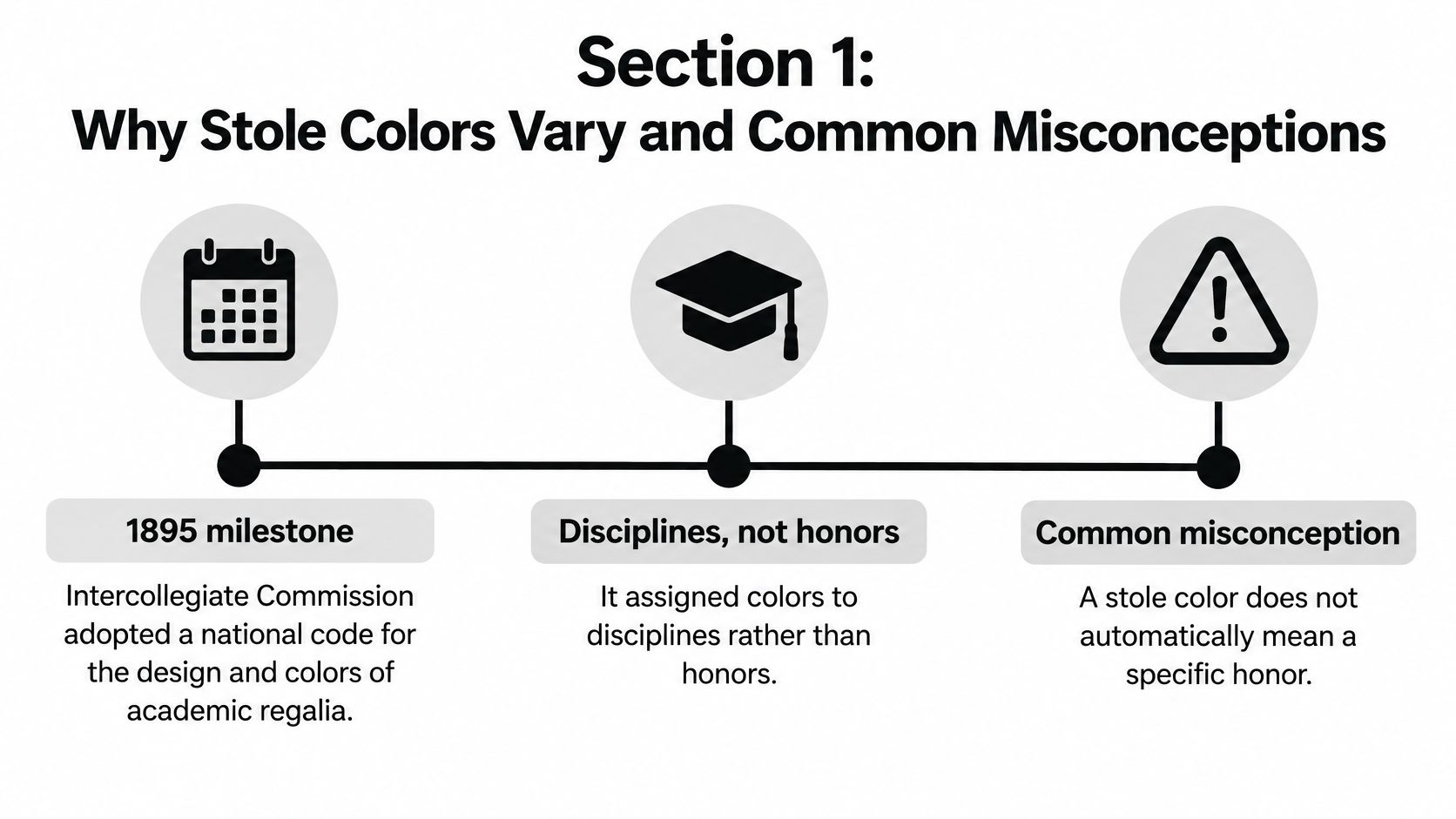
The assumption that gold always means highest honors confuses disciplinary color traditions with local recognition policies. The modern American system was formalized in 1895, when the Intercollegiate Commission adopted a national code for academic regalia, according to the University of South Carolina Aiken's history of regalia. That scheme assigned colors to eight faculties, rather than making every colored accessory a universal honors badge.
The faculty associations were arts and letters with white, theology with scarlet, law with purple, philosophy with dark blue, science with golden yellow, fine arts with brown, music with pink, and medicine with green. The same history traces the broader tradition to European universities of the twelfth and thirteenth centuries and explains that the palette later expanded to additional fields.
A shared alphabet with local spelling
Think of academic color traditions as a shared alphabet with local spelling. Schools recognize familiar colors, but each institution determines how particular accessories communicate recognition at its ceremony. A golden-yellow element associated with science therefore doesn't establish that its wearer earned the highest academic honors.
Local restrictions make that distinction enforceable. The University of Southern Indiana's regalia policy reserves solid gold, red, and blue stoles for summa cum laude, magna cum laude, and cum laude, respectively, and states that no other group may use its white cord.
Common misconceptions about honor stole colors
| Misconception | What is actually true | What to do |
|---|---|---|
| Gold always means the highest honors | Gold means top honors at some schools and a discipline or society at others | Check the school's published color list |
| A society color overrides the school color | Society colors apply at commencement where the school authorizes them | Ask whether the society item is permitted |
| Any stole can be ordered in any color | Schools can reserve colors and accessory types; Utah State restricts solid gold, silver, and navy cords for organizations, colleges, and departments | Check reserved colors before ordering |
| A color on a bulk-ordered stole proves the honor | Appearance doesn't establish eligibility or authorization | Request a specification naming the school, program, recognition, and approval source |
Another source of confusion is assuming that all meaningful regalia indicates academic rank. Identity, affiliation, and achievement are different categories. A guide to cultural graduation stoles can help you distinguish personal heritage from an institutionally awarded distinction.
You don't need to memorize every tradition to avoid these mistakes. Ask the commencement office what the proposed accessory represents and whether your group may wear it. That answer is more useful than a generic explanation of what a color supposedly symbolizes.
Combining Honor Cords, Society and Cultural Stoles
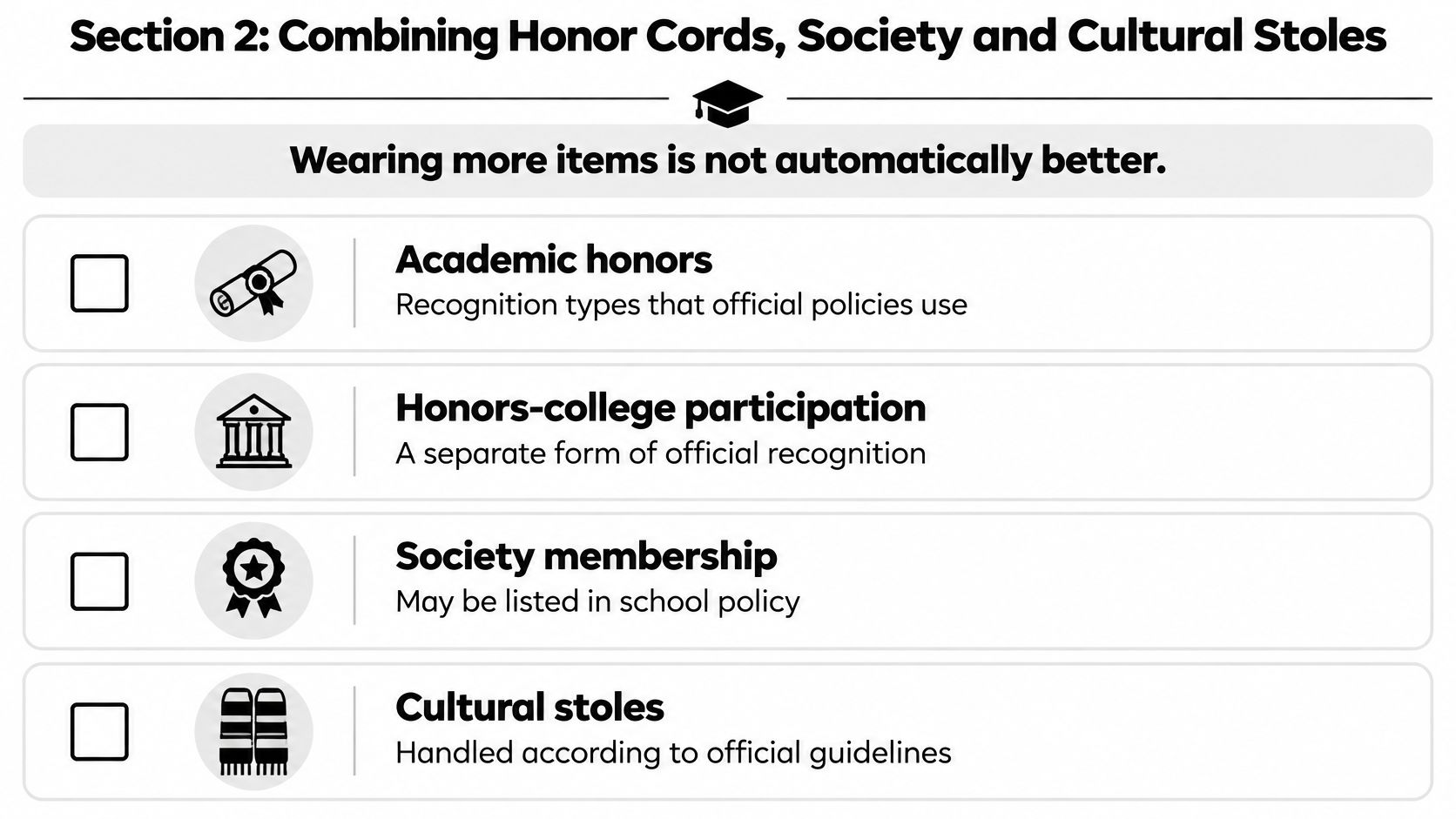
Wearing more items is not automatically better. Your goal is to represent your achievements and identity accurately, while following the ceremony's requirements and wearing an arrangement you can manage comfortably.
Official recognition can include academic honors, honors-college participation, first-generation status, military service, leadership, research, community engagement, and student organizations. For example, UTSA's commencement regalia guidance describes stoles as indicators of achievements such as Honors College or first-generation status. Those categories shouldn't be mistaken for interchangeable academic rankings.
Set priorities before layering
Use this order as a planning framework, not as a universal dress rule:
- Academic recognition first. Identify the regalia officially awarded for your achievement and preserve its visibility.
- Approved organizational items next. Consider society, department, or student-organization accessories after confirming permission. The guide to honor society regalia can help you identify the questions to bring to your chapter and school.
- Personal or cultural expression alongside those requirements. Choose how you'd like to represent your heritage or experience, subject to the ceremony's rules.
This order doesn't rank the personal importance of your accomplishments. It helps you separate institution-issued recognition from accessories you choose yourself.
A cultural or flag stole can communicate identity without claiming an academic distinction. Similarly, personal or religious symbolism shouldn't be confused with a university's award system. Readers interested in the religious meaning of intertwined cords can explore the threefold cord's biblical origin through HolyJot, while keeping that interpretation separate from commencement eligibility.
Test the complete outfit
Put on your gown and the proposed accessories together. Take a front-facing photograph, then sit, stand, and walk in the combination. Check whether a stole hides a society emblem, whether cords shift under the neckline, and whether any piece catches on clothing or mobility equipment.
Consider warmth and weight, too. An arrangement that looks balanced on a hanger may feel distracting during a ceremony.
Before settling on the combination, complete this check:
- Item limit confirmed. Ask how many accessories the ceremony permits.
- Each item authorized. Don't treat approval of a society as automatic approval of every design.
- Photograph checked. Make sure the recognitions you want visible aren't covered.
- Combined wear permitted. Ask specifically whether your cord and stole may be worn together.
Ordering Stoles for Groups and Bulk Orders
A group should check reserved colors before ordering anything. A unified design can still be inappropriate if it resembles an award reserved for another recognition or uses an accessory the ceremony doesn't permit.
Start with the group's status. Confirm whether approval applies to the organization itself, its proposed regalia, or both. A recognized student organization shouldn't assume that recognition gives it unrestricted control over commencement clothing.
Build an approval-ready specification
Give the school a concrete proposal rather than asking whether a group stole is generally acceptable. The production specification should record:
- School. Name the institution and the ceremony concerned.
- Program. Identify the department, society, or student organization.
- Recognition level. State the achievement or affiliation the item represents.
- Color. Use the approved name for the main fabric and any secondary elements.
- Trim. Describe the border separately from the body.
- Authorization source. Identify the policy or written approval supporting the design.
These fields help prevent a group accessory from implying an academic honor its members haven't received. They also give the purchaser, approving office, and production team the same reference.
Approval should attach to a specific design, not merely to the idea of a group stole.
Keep purchasing and eligibility separate
Assign someone to maintain the approved artwork and someone to check the recipient list. A correct design doesn't establish that every person on an ordering spreadsheet qualifies for the recognition printed on it. Keep any individual honors wording separate from general membership wording.
For example, a society might approve a common membership design while only certain members qualify for an additional academic distinction. Don't add that distinction to the whole group's artwork for visual consistency.
Once the school approves the specification, use the wholesale and custom quote request to communicate the approved requirements. Keep the approval with the order records, and compare the final proposed design against it before authorizing production.
At Stoles.com®, we don't color match orders placed through another company. If your group is coordinating with existing regalia from elsewhere, don't assume identical color names guarantee an identical appearance. Resolve the school's expectations before purchase, and don't place the bulk order until written approval is in hand.
When No Published Policy Exists
An unsuccessful website search doesn't establish that a school has no rules. The relevant guidance may be available directly from the registrar, commencement office, academic department, or organization adviser. Your next step is a focused request, not a guess based on another school's ceremony.
Send the request to the registrar or commencement office first. Include your graduating year, degree program, exact recognition, and the accessory you're considering. Attach the proposed design if it includes wording, symbols, or contrasting trim.
Ask questions that produce a usable answer
A clear message can follow this wording without treating it as a quotation from a policy:
I'm graduating in [year] from [program] and have been awarded [recognition]. Please confirm the authorized accessory and color for this recognition, whether the color is reserved, and whether I may wear it with my proposed society or cultural regalia.
Then ask for any missing details:
- Accessory type. Is the authorized item a cord, stole, tassel, or sash?
- Color restriction. Is that color limited to a particular award or group?
- Society permission. Is the organization's proposed item authorized for this commencement?
- Written confirmation. Can the office provide the applicable policy or approve the attached design by email?
Be precise about the accessory. A reply approving a cord doesn't necessarily approve a stole in the same color. Likewise, approval for a department celebration may not answer what's permitted at the main commencement ceremony.
Handle silence without inventing permission
If the office doesn't reply, follow up through its published contact method and ask which office owns the decision. Keep the message focused on the unresolved point rather than resending a broad request for every graduation rule.
Don't interpret a supplier's color menu, an older graduate's photograph, or another institution's catalog as authorization. Those materials may help you describe a design, but they don't confirm your school's requirements.
You can organize design ideas using a custom graduation stole guide, but keep the proposed design separate from confirmed permission. Mark unresolved elements as pending in your own records, rather than approving them for production.
If neither a published policy nor a written reply identifies your color and recognition, the meaning remains unconfirmed. Don't wear or order an item that claims that honor until the responsible office resolves the question.
Verify Your Color and Order It Correctly
Treat the final check as a comparison between your award, the school's instructions, and the proposed item. Each should describe the same recognition. A mismatch in accessory type, wording, color, or eligibility is a reason to pause the order.
The University of Memphis cord and stole policy illustrates why that comparison matters: it assigns white cords to distinction, red or crimson to high distinction, and gold to highest distinction, while separately permitting stoles for registered student organizations, recognized honor societies, and other university programs. Its cord permissions also address university-recognized honor societies and military service.
Complete the verification before purchase
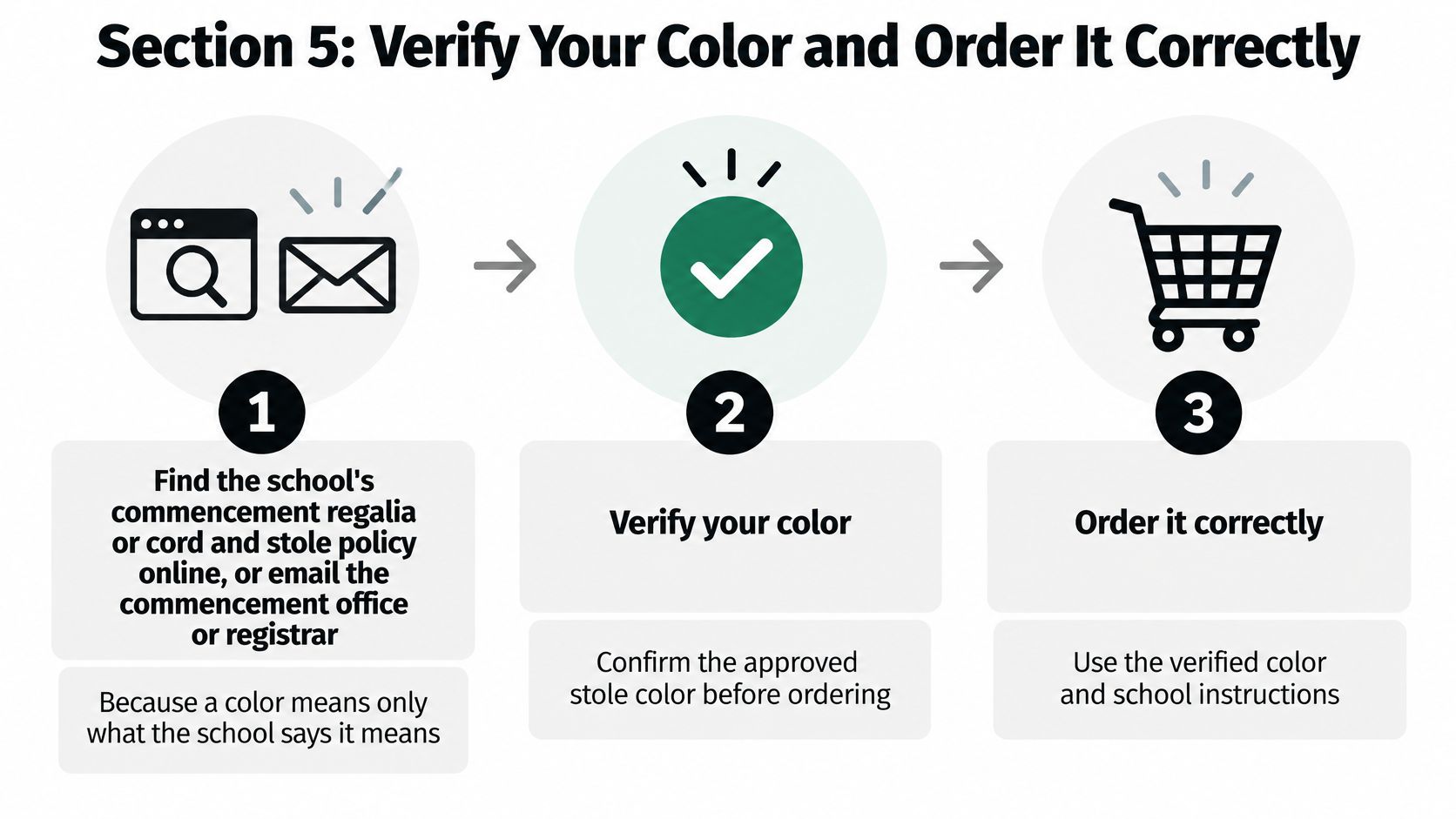
- Find the controlling instructions. Locate the commencement regalia or cord-and-stole policy for your ceremony. Check that you're reading the institution's own guidance, not a general graduation-shopping page. If the instructions don't cover your situation, obtain a written decision from the responsible office.
- Identify the authorized item. Compare the policy's terminology with the item you intend to order. Pay attention to whether the document specifies a cord, stole, tassel, or sash. If the school and supplier use different names, describe the shape and how it's worn so there's no ambiguity.
- Match the recognition and eligibility rule. Confirm the exact honor awarded to you and any applicable GPA requirement. Don't select an item based only on a GPA you calculated yourself. Ask which official recognition the school has approved for commencement if your status is unclear.
- Check reserved elements. Review restrictions on the main color, combinations, and accessory type. Don't assume that adding trim makes an otherwise restricted design acceptable. Submit the complete proposed appearance if the rule is ambiguous.
- Resolve society authorization. Ask whether your chapter's item is permitted at this ceremony. A society's own color convention doesn't automatically replace the institution's requirements. Keep the school's answer with the chapter's design instructions.
- Secure approval for customization. Include artwork, wording, trim, length, and cut in the proposal where relevant. If you change a meaningful element after approval, return the revised version to the approving office rather than assuming the original decision still applies.
- Place the order from the approved specification. Record the school, program, recognition level, color, trim, and authorization source together. Compare the proposed production details with that record before giving final approval.
Translate approval into the actual design
At Stoles.com®, we offer honor stoles, honor cords, and custom stoles. Customers can choose colors, trims, length, and cut, and have their own artwork imprinted on the sash. Available trim colors include Antique Gold, Gold, Silver, Navy Blue, Purple, Red, and White, among other options, but availability doesn't establish a color's academic meaning.
Keep your approved specification beside you while selecting those details. Check the body color separately from the trim, and make sure printed wording names only the recognition you're entitled to represent. If an approved design changes during ordering, resolve the discrepancy before production.
Final test: if the published policy doesn't name your color and recognition, and you have no written approval resolving the gap, the meaning isn't confirmed.
Stoles.com® offers honor cords, honor stoles, and customizable graduation stoles to represent approved achievements and personal identity. Once your school confirms the correct accessory and color, visit Stoles.com® with your approved specification to choose the details that accurately represent your graduation.