

A brighter stole or a personalized name does not, on its own, make the cloth more meaningful. Provenance and an honest label shape what it can say; the written rules for the ceremony determine whether it may be worn.
School handouts may offer a color chart, assigning meanings such as royalty to gold, growth to green, and passion to red. Treat those as interpretations, not a universal code. Start by asking where the cloth comes from and what the ceremony allows.
What a Kente Graduation Stole Means on Graduation Day
Picture a parent in a gym the night before commencement, holding two narrow sashes. One is bright geometry. The other is school colors with a class year at the tip. Both will look sharp in photos. Only one may be the kente graduation stole this family means to buy.
A kente graduation stole is a narrow ceremonial sash worn around the neck and over the gown. It borrows the visual language of Ghanaian kente to mark heritage and the finish of a program. That is the definition worth repeating at the kitchen table.
Shoppers usually blur three layers. Keep them separate.
- The cloth: The tradition is associated with Asante and Ewe communities in Ghana and Togo. Historically it signaled royalty, special occasions, and rank. It was not everyday dress.
- The U.S. ceremony: On American campuses the sash became a public sign of Black educational achievement, especially at historically Black colleges and universities and at multicultural celebrations.
- This graduate: The purchase may name Ghanaian family lineage, a broader African diasporic connection, or a seat in a school-sponsored kente celebration.
Think of the pattern the way you think of a proverb printed on a diploma cover. The pattern speaks an older language. Commencement adds a sentence about completion. The stole does not replace the diploma, and the diploma does not translate the cloth.
The limits are plain. It is not an honor cord. It does not certify a GPA. It is not Adinkra cloth, a different Ghanaian textile tied to different occasions.
Practical rule: Name the layer first. Choose the color second.
Lineage, diasporic connection, and a school celebration are three different sentences. If you cannot say which one you are buying, you are not ready to pick a palette. Families sorting portraits, guest lists, and which events the sash will attend can explore prom and graduation highlights while they make that call.
Color and Pattern Meanings That Are Not a Fixed Code
A color chart can help you start a conversation, but it cannot translate every kente cloth. The meanings below are common readings, not a universal code accepted by every maker or community.
| Color or motif | Often cited meaning | Safer way to explain it |
|---|---|---|
| Gold or yellow | Status, wealth, royalty | A frequent reading, not a universal code |
| Green | Growth, harvest, renewal | Harvest and healing both appear; ask the maker |
| Red | Life force, passion, or sacrifice | Context decides; do not lock it to one emotion |
| Blue | Peace, harmony, love | Peace is common in school guides; confirm the cloth |
| Black | Maturity and ancestral connection | Ancestral meaning is both textile and diaspora usage |
| White | Purity and festive occasions | Festive use is not the same as mourning cloth |
| Ashanti Stool | Leadership and legitimate authority | Name it as a leadership symbol when it is actually woven |
| Sankofa | Returning to one's roots | Identify it precisely and do not treat Adinkra as kente |
Patterns can carry more than a color gloss
A woven pattern may refer to a proverb, a named symbol, or a particular design tradition. The Ashanti Stool, for example, is described as a leadership symbol when that motif is present. That is different from assigning a meaning to a color alone.
Sankofa is commonly represented as a bird turning back and associated with returning to one's roots. It belongs to Adinkra symbolism, which is distinct from kente weaving. The traditions may appear together on a sash, but one should not be mistaken for the other.
Campus ceremonies may also use stole colors as part of their own regalia customs. Those conventions are separate from the meanings attached to Ghanaian patterns. For a broader look at how schools discuss sash colors, see this guide to graduation stole color meanings.
Kente stoles at U.S. commencements can express Black identity, African connection, and resistance. To explain a particular stole accurately, ask:
- Origin: Is it Ghanaian kente, a kente-inspired print, or a diaspora adaptation?
- Pattern: Does the maker provide a pattern name or explanation?
- Maker: Who made or designed it?
- Story: What does the graduate want to say about wearing it?
A clear answer might be: “This is the pattern our family chose, and I'm wearing it to mark my graduation.” It connects the design to the wearer without claiming that every color or motif has one fixed meaning.
How Kente Traveled from Royal Cloth to Commencement
The sash on a gown is a late, narrow use of a much older cloth. The multicolored, proverb-based kente traditions associated with Akan and Ewe communities in Ghana and Togo developed roughly 400 years ago, although some researchers trace related textile production in the region as far back as 1000 BCE, as the African American Intellectual History Society account of kente in the Black diaspora lays out.
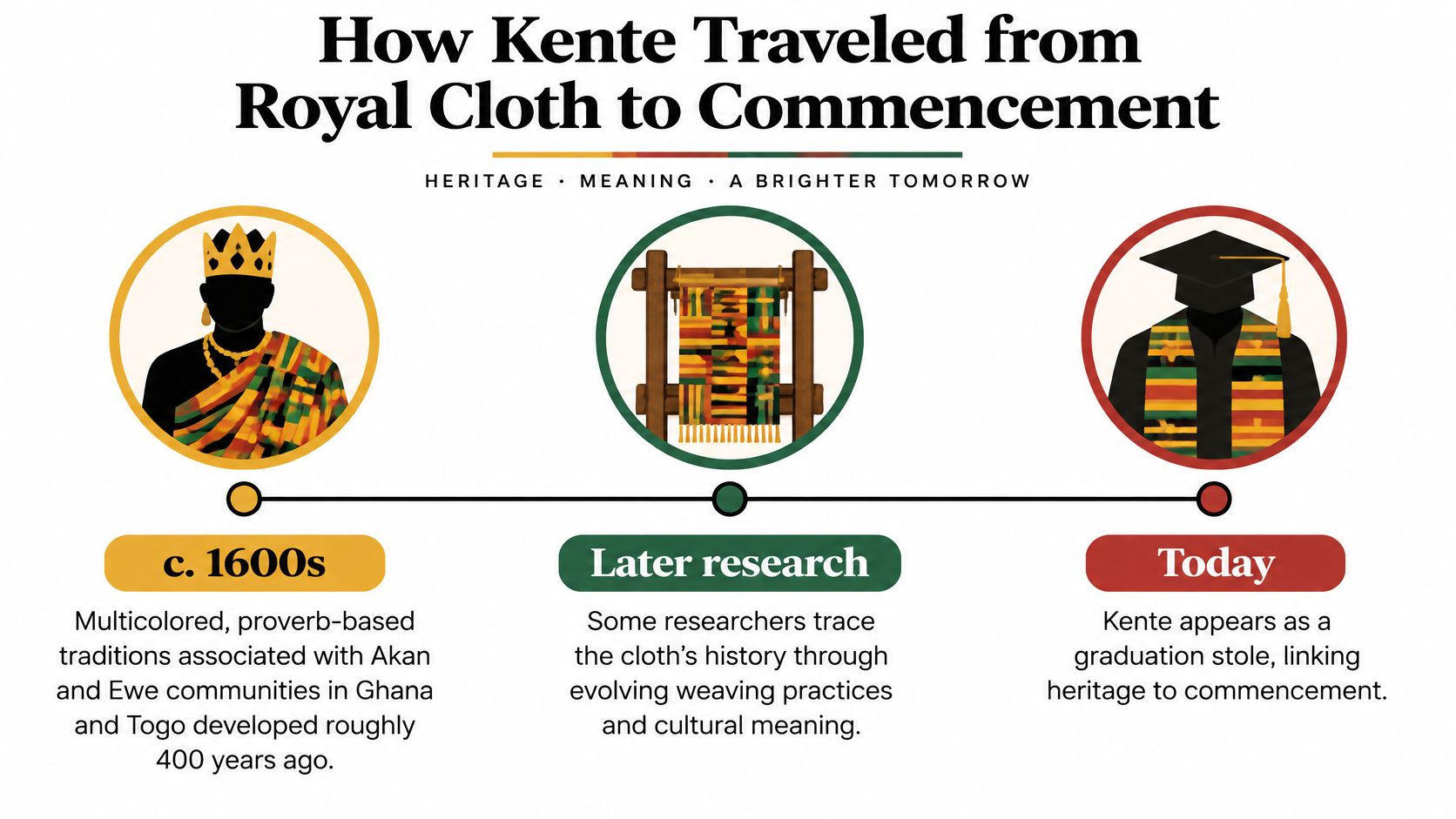
For generations the cloth was largely restricted to Ashanti royalty. It represented status, authority, and social position, and it was worn for special occasions rather than as daily dress. Public meaning widened after Ghanaian independence and during the African American cultural and Civil Rights movements.
The 1958 meeting and the campus stole
A major international milestone came in 1958, when Ghanaian leader Kwame Nkrumah wore kente during a meeting with U.S. President Dwight Eisenhower at the White House. That appearance tied the textile to African sovereignty, dignity, and diasporic pride. In the United States, kente then became increasingly visible at historically Black colleges and universities and in Black student celebrations.
The adaptation is physical as well as symbolic. A full cloth built from long narrow strips becomes a narrow ceremonial sash. Colors and patterns still evoke Ghanaian tradition. Placement over the gown marks a finished degree and continuity with earlier generations of Black scholars.
That is why the stole can be both cultural cloth and academic regalia. It is not a substitute for the hood, the tassel, or the diploma, and it is not a costume laid on top of an otherwise empty outfit. If you want the wider map of gowns, hoods, and sashes, the history of academic regalia keeps the ceremony's own dress code in view while you learn the cloth's.
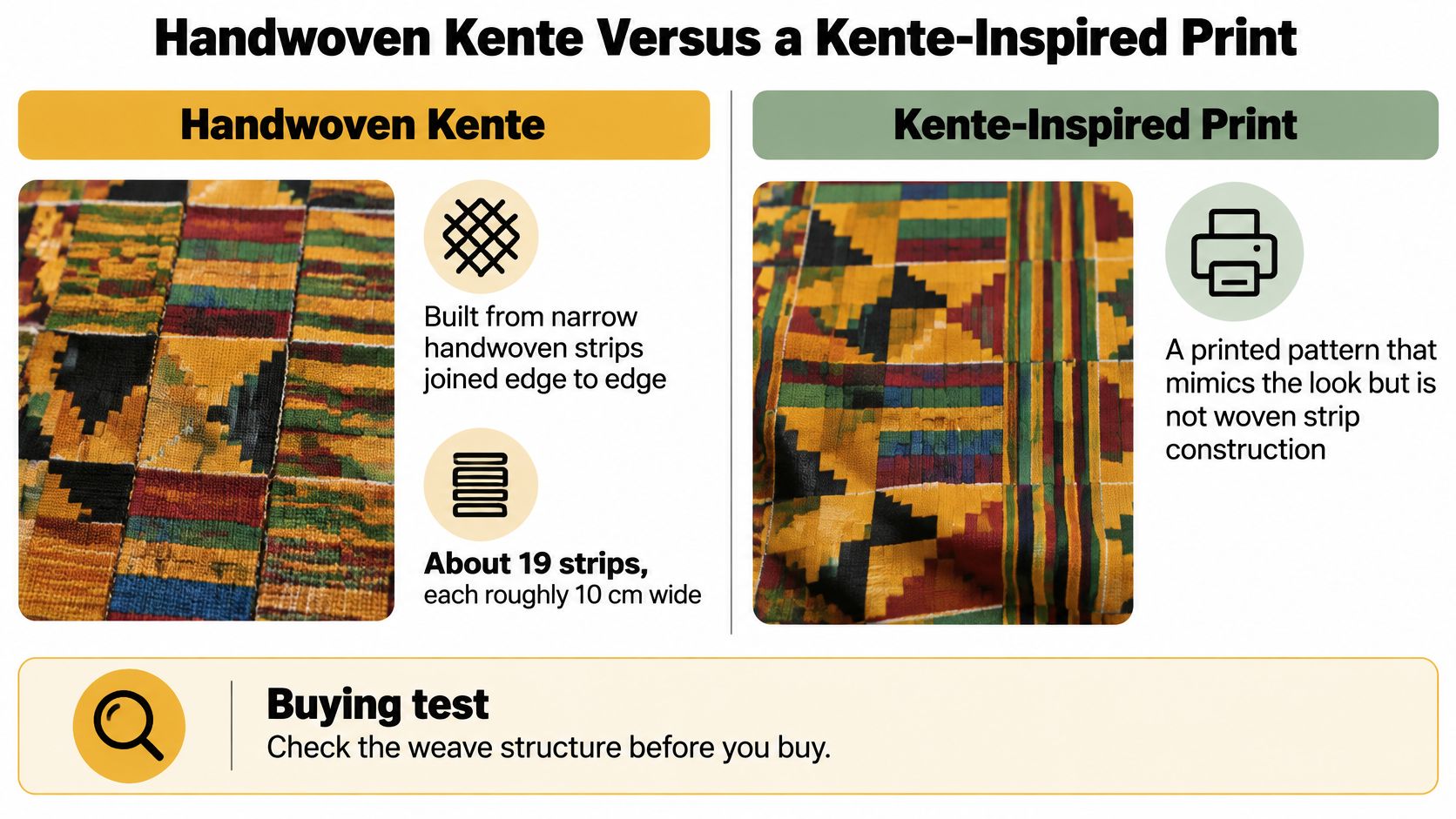
Handwoven Kente Versus a Kente-Inspired Print
A bright pattern can look meaningful without being handwoven. To tell the difference, check how the cloth is made and how the seller describes it.
The strip-weave test
Kente cloth is made from narrow handwoven strips joined edge to edge. A textile in the Victoria and Albert Museum collection has about 19 strips, each roughly 10 cm wide and 280 cm long. Traditional production uses a small double-heddle loom, where warp stripes and weft-float structures form the block-like motifs.
A graduation stole is much narrower than a full cloth, but its construction still matters. On a woven piece, look for joined strips and motifs formed by the weave. Seams, lining, or embroidery may interrupt the pattern, so inspect how they meet the cloth.
Fiber and design can also help describe what you are seeing. Asante kente is historically associated with geometric designs and silk. Ewe examples more often combine cotton and silk, and may include figures, letters, or people. These are distinctions between traditions, not a single rule for every kente textile.
| Check | Handwoven kente component | Kente-inspired print |
|---|---|---|
| Construction | Narrow strips joined edge to edge | Continuous satin or polyester with printed geometry |
| Scale clue | Full cloth can use narrow strips around 10 cm wide and 280 cm long | Pattern scaled to a narrow sash panel |
| Fiber | Asante work historically tied to silk; Ewe work often mixes cotton and silk | Commonly polyester or bridal satin |
| Motifs | Weft-float blocks; Ewe pieces may add figures, letters, or people | Repeating geometric print |
| Customization | Embroidery may cover or interrupt the woven pattern | Name, year, or trim can be added at an end or border |
| Honest label | Handwoven, with fiber and pattern identified | Called kente-inspired or kente-pattern |
What an inspired satin sash is for
A satin or polyester sash with a kente-like geometric print is an adaptation, not handwoven kente. Calling it “kente-inspired” or “kente-pattern” makes that distinction clear. The pattern itself is only part of the story: its material and construction tell you what the stole can accurately claim.
Stoles.com offers a Brown Elementary & Middle School Graduation Stole, listed at $7.49. A satin school stole and a handwoven kente component serve different purposes, so describe each according to its construction.
A short look at how a sash sits on a gown can help you judge its drape.
How to Clear the Rules and Wear the Stole
A meaningful stole can still be the wrong choice for a ceremony if it does not meet the school's rules. Check the published length and regalia requirements before ordering.
| School level | Typical stole length | Action |
|---|---|---|
| Preschool and kindergarten | 25 inches | Verify against campus specifications |
| Elementary and high school | 31 or 33 inches | Verify against campus specifications |
| College and university | 33 or 36 inches | Follow the published campus specifications |
These lengths are general guidance. The campus requirements take precedence.
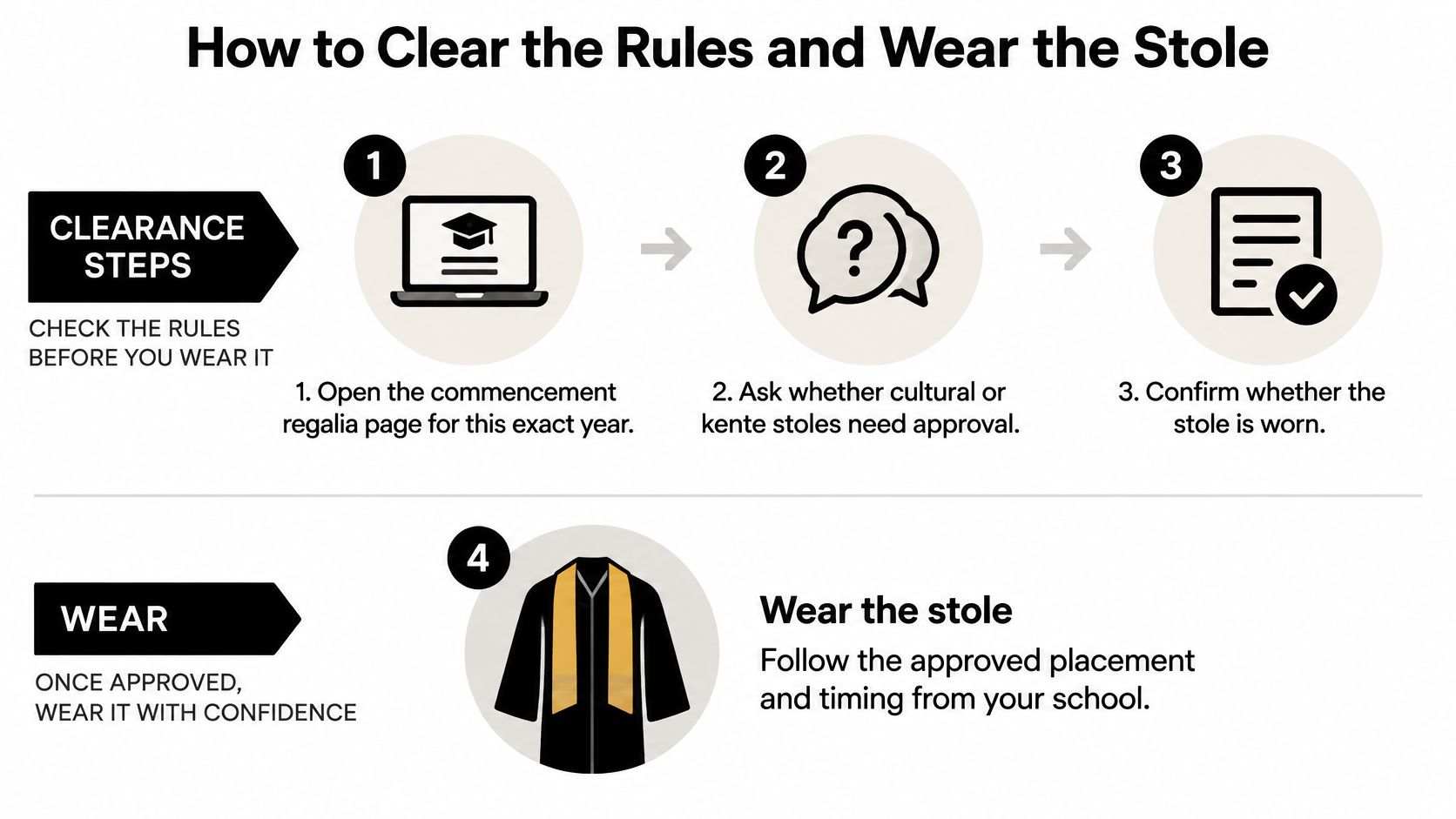
Clearance, in order
- Check the current commencement page. Use the page for your ceremony year, since requirements can change.
- Ask whether approval is required. Confirm whether a cultural stole needs advance permission, a student-group sponsor, or no additional step.
- Confirm how it sits with your hood. Ask whether the stole goes over or under the academic hood, especially if you will wear a master's or doctoral hood.
- Check length and width. Compare the school's specifications with the typical ranges above. If the page does not give dimensions, ask the commencement office before ordering.
- Ask about additional regalia. Find out whether honor cords or another stole may be worn alongside it.
- Clarify which event permits it. A kente celebration may have separate requirements from the main commencement procession.
Policies vary by institution and event. The University of North Carolina at Charlotte's commencement regalia decoration policy bars political, offensive, obstructive, or distracting decorations and says noncompliant stoles may need to be removed. Check your own school's written rules rather than assuming another campus's policy applies.
How it should hang
Place the center of the stole at the back of your neck. Let both panels fall evenly over your chest, with the ends above the gown hem. Keep approved cords beside the design so they do not cover it, and avoid pins or slogans that could conflict with ceremony rules.
A university-sponsored presentation and the main commencement procession are different settings. In a presentation, a program may include the act of draping the stole. For the procession, follow the ceremony's regalia requirements and use this guide to wearing a graduation stole and sash to check how it should sit.
Etiquette Stories and How to Care for the Cloth
A respectful explanation can be brief. If someone asks about your stole, say how it relates to you and what you are marking at graduation. For example: “My family is Ghanaian, and this marks finishing my degree,” or “This was presented at our Black student celebration, and I'm wearing it to honor that community.”
A school presentation and the main commencement procession are different settings. At a presentation, the stole may be part of a cultural program. At commencement, it joins the graduate's standard regalia, so follow the ceremony's written rules and wear it in a way that keeps its design visible.

Celebration, procession, and a one-sentence reply
Let the cloth's history guide your explanation. A stole chosen only for its bright appearance can say less than one whose connection the wearer can describe. Avoid joke slogans or symbols you cannot explain, and do not treat the cloth as a costume.
Keep the stole in good condition after the ceremony. Spot-clean satin, avoid running a hot iron over printed geometry, and keep embroidery dry. Hang it or roll it for storage rather than folding sharply through the center motif. A lined stole can keep its shape for family photos or another ceremony.
Buyer Questions Before You Place the Order
Personalization works best when it supports the meaning of the stole rather than covering its design. Decide what should appear on the sash, then check whether the ceremony permits it.
Name or class year. If you want to add a name or year, ask how much clear space the design leaves. Keep lettering away from the main motif so the pattern remains visible in photos and from the audience.
Custom work. Stoles.com® offers kente cloth stoles that symbolize African history and pride. Its custom stoles can be personalized with your own art, with options for colors, trims, length, and cut. See the guide to customizing a kente stole before choosing where lettering or artwork should go.
Approval and fit. Check the current commencement rules for approval, length, and how the stole may be worn with other regalia. A product photo cannot confirm what your school permits.
If the design and the ceremony rules are settled, you are ready to order. If the intended message is still unclear, wait until you can describe it plainly. A kente graduation stole can honor heritage and mark an academic milestone when its design is represented accurately and the ceremony allows it.
Stoles.com® offers kente cloth stoles and custom graduation sashes. Visit Stoles.com® to view the kente and custom options for your ceremony.