

The popular advice that a red graduation stole automatically means honors, leadership, or a particular major is too simple. A red sash can mark an earned distinction, but it can also identify a school, a residential house, a community, or someone a graduate wants to thank. Before buying one, check who assigns the color, which garment carries it, and what purpose it serves.
What a Red Graduation Stole Usually Means
A red graduation stole has no single meaning. The school or organization that issues or approves it decides what it signals. Institutional identity is a useful starting point, because wearing a school's color isn't necessarily the same as receiving an academic award.
Academic dress does have established conventions. MIT's history of academic regalia explains that American educators formed the Intercollegiate Bureau of Academic Costume in 1894 to bring consistency to academic dress. That history doesn't make every red sash interchangeable with every other red item.
What red typically signals by context
| Context | What Red Typically Signals | Confirm With |
|---|---|---|
| Institutional identity | The school's designated or official color | Commencement office regalia policy |
| Academic honors | Scholastic distinction, only where the school defines red as an honor color | Honors section of the commencement policy or GPA threshold |
| Theology and ministry | Scarlet tradition linked to theology and the Church | Department or faith organization guidance |
| Residential house | House color, such as Fleming House at Caltech | Residential life or house office |
| Gratitude | Thanks to supporters, often a stole given away after commencement | Ceremony rules on personal adornments |
| Heritage, country or community | Cultural, national or community pride | Official approval rules for adornments |
The theological association has a specific historical basis. Whittier College's commencement traditions guide identifies red as the traditional color of the Church and scarlet as indicating theology. That convention shouldn't be stretched into a claim that every graduate wearing red studied ministry.
Treat the table as a starting map, not a verdict. The Confirm With column tells you where to settle the question for your ceremony. Match the proposed meaning to written rules before assuming your stole represents an honor, affiliation, or degree.
How to Confirm the Right Red for Your Ceremony
Check the color before choosing the stole. A campus bookstore photograph, a friend's graduation outfit, or a familiar school color can suggest what to investigate, but none replaces instructions for your ceremony.

Check the policy and your eligibility
- Find the commencement regalia policy on the school website. Search for regalia, academic dress, honors, and approved adornments. Check that the page applies to your degree level and ceremony rather than relying on an archived photograph.
- Identify the category assigned to red. Look for institutional color, residential affiliation, organization membership, or academic recognition. Don't substitute a general description of school spirit for a specific rule about what graduates may wear.
- Ask whether your stole is official, recognized, or personal. An official item supplied with your gown may have a different status from a sash purchased independently. If the policy discusses recognized organizations but says nothing about personal designs, ask for clarification rather than treating silence as permission.
- Verify eligibility for any honor wording. If red identifies academic distinction, confirm the applicable GPA requirement and how the school determines commencement honors. A retailer's description doesn't establish that you've received an award.
Resolve the details before paying
- Check combinations and appearance requirements. Ask whether you may wear the stole with an honor cord, academic hood, or another sash, and whether a particular red shade is required. Don't assume approval for an item also approves every combination or custom alteration.
- Save the policy line or written reply. Keep it with your order confirmation and design proof so you can resolve questions during gown collection or ceremony check-in. A screenshot should show enough context to identify the school and the applicable rule.
Practical rule: A confirmed answer names the garment, its meaning, your eligibility, and whether you're allowed to wear it.
If no written policy is available, email the commencement office. Ask which garment and color you'll receive, what it signifies, and whether an independently purchased red stole is permitted.
A useful request is specific: you're graduating from a named program, you want to wear a red sash for a stated purpose, and you need approval before ordering. Save the reply rather than relying on a classmate's arrangement or an informal conversation.
How Schools Assign Red Differently
The same shade of red can be an award at one school and a keepsake at another. The University of Southern Indiana uses solid red stoles for commencement honors such as Magna Cum Laude. The University of Nebraska–Lincoln gives undergraduates a red stole of gratitude they can separate and present to someone who supported them. Color works like a jersey: it means little until you know which team issued it.
Schools establish meaning through eligibility rules, garment types, seals, and recognized affiliations. UTSA's commencement traditions guidance describes stoles as colored sashes representing university activities, a useful reminder that these garments are not restricted to academic rank.
How named schools use red
| Institution | How Red Is Used | What to Verify |
|---|---|---|
| University of Southern Indiana | Solid red stole for honors such as Magna Cum Laude; confirm the qualifying GPA with the school | Commencement honors rules and GPA threshold |
| Caltech | Red stole or tassel for Fleming House (the residential-affiliation example noted above) | House affiliation with residential life |
| Stanford | Whether the red belongs to the doctoral gown or sleeve lining rather than a separate stole | Doctoral regalia guide for the degree field |
| SMU | Red silk stole embroidered with the university seal | Academic ceremonies office guidance |
| Millersville University | Red cords, not necessarily stoles, for Departmental Honors | Commencement office policy |
| University of Nebraska–Lincoln | Separable red stole of gratitude for undergraduates | Undergraduate regalia instructions and gratitude-stole rules |
| Liberty University | Whether a red stole bearing the university seal is issued as official regalia | Official commencement regalia page |
Read the garment and the qualifying rule together
Each mechanism raises a different kind of question. An honors threshold gives you an eligibility question to resolve with the school. A house color gives you an affiliation question. A seal signals an institutional connection, but on its own it establishes nothing about class rank.
The doctoral-gown row shows why photographs can mislead. A red robe is not evidence that a red stole carries the same meaning, and a sleeve lining is a different component from a sash. When a school's only visible red sits inside the gown itself, there may be no stole policy to interpret at all.
For a high school ceremony, consult your own school's instructions rather than importing a university's practice. A guide to high school graduation stole requirements can help you organize questions about approved awards, organizations, and personal additions.
Interpretation check: Ask what the school is recognizing, not merely what color you can see.
When an entry gives no eligibility rule, ask the responsible office rather than filling the gap with an assumed GPA or a leadership claim. Color alone cannot establish a student's rank or degree.
Stoles, Cords and Hood Linings
A red item in your graduation package might not be a stole at all. Identify its physical form before searching for its meaning, because schools can assign different purposes to garments of the same color.
SMU's guide to academic symbols and traditions describes its red silk stole with the university seal. Other institutional examples distinguish red honors cords from stoles, and red-and-black hood linings from separate recognition items.
Identify what you've received
- Stole: A broad sash draped around the neck and over the gown, with ends hanging down the front.
- Cord: A narrow, braided strand worn around the shoulders. Receiving one doesn't mean you're also entitled to a matching stole.
- Hood lining: The colored interior of an academic hood, rather than a separate sash.
- Robe or sleeve lining: Color incorporated into the gown itself, which must be interpreted using that gown's instructions.
The distinction matters at institutions such as the University of Louisville, where red-and-black hood linings for advanced degrees are separate from stoles or cords used for honors and organizations. Don't transfer the meaning of a hood's colors to another accessory.
Say the honors office gives you a red cord and your family buys you a red stole. Ask whether the stole is permitted in addition to the cord, and explain its intended purpose. Matching colors don't make the items interchangeable or automatically authorize wearing them together.
A comparison of graduation honor cords and stoles can help you describe the item accurately when contacting the commencement office. If a sash is intended only as a gift presented after the ceremony, treat that separately from permission to wear it during commencement.
Stoles That Express Identity and Gratitude

A red stole can mark something other than academic rank. Carnegie Mellon's explanation of commencement regalia describes stoles as representing athletics or country of origin, so the same color can carry a meaning the school's honors system never assigned.
That flexibility matters in both directions. International and study-abroad graduates may wear a country stole to signal heritage, while a graduate might present a gratitude stole to a parent, mentor, or supporter after commencement, making the recipient part of what the garment means.
Separate recognition from expression
- Official recognition: The institution or an approved organization grants an award, membership, or status that the stole identifies.
- Personal expression: The graduate chooses a symbol for heritage, faith, community, family, or gratitude, subject to the ceremony's dress rules.
A first-generation graduate who wants red to honor the family's home culture faces two practical questions: does the design say what she intends, and does the ceremony permit it? Red has no built-in answer for either one. Describing the design plainly when requesting approval gives the commencement office what it needs to decide.
If she also qualifies for an organization stole, she should ask whether both may be worn rather than assuming individually meaningful items can always be layered.
Personal significance doesn't automatically confer official recognition, and official approval doesn't erase personal meaning.
Some institutions require adornments to be officially recognized, so a heartfelt design may still need permission. Browsing cultural graduation stoles can help you identify the symbols you want to discuss with your school.
For multicultural and international graduates, local interpretation matters. Explain what your red stole represents in your own context without describing it as an academic honor unless the institution has awarded that recognition.
Specifying a Custom Red Stole Before You Order
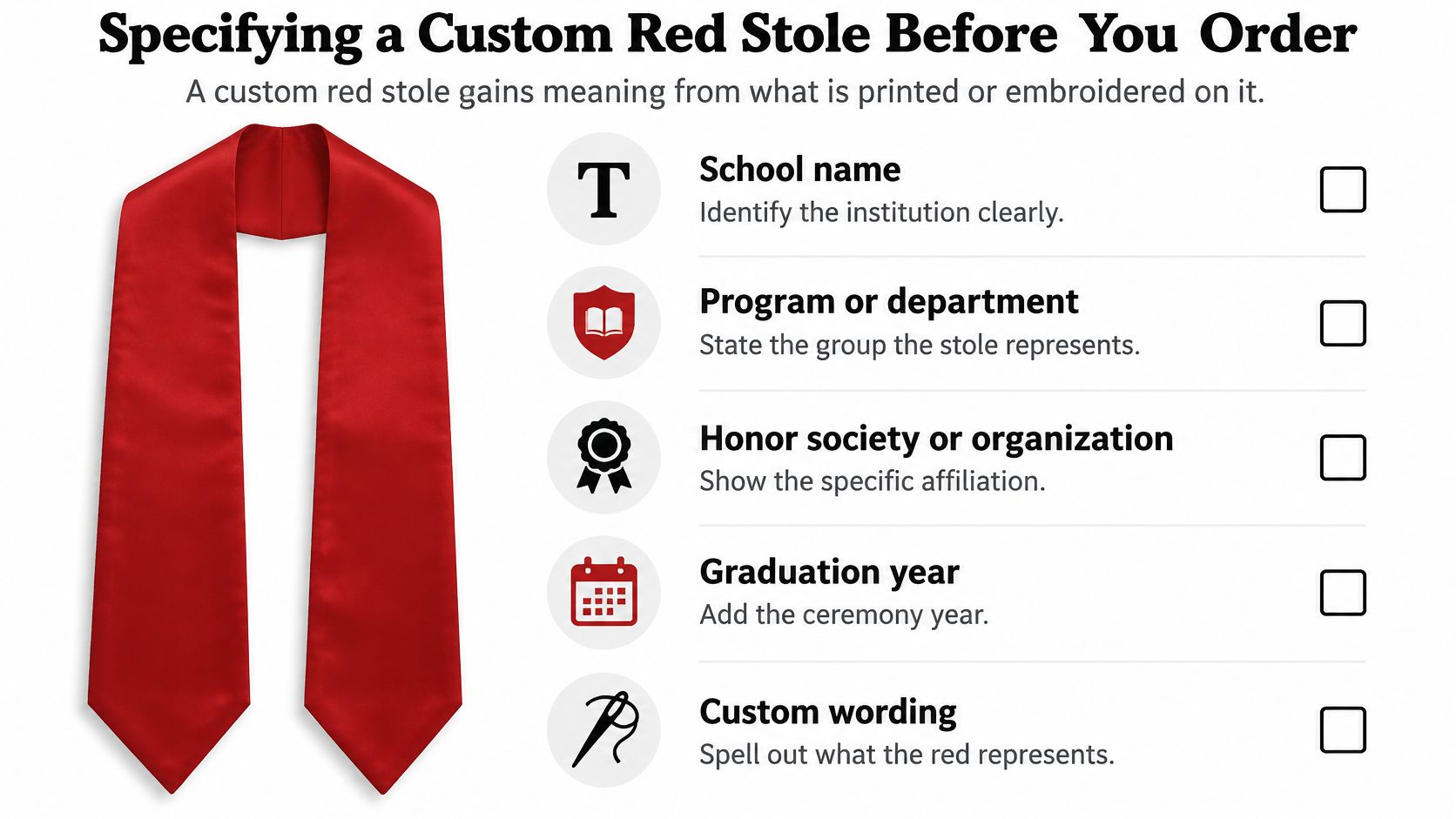
The design stage is where a red stole stops being a color and starts being a statement. Each element you add tells the audience which of red's possible meanings you intend: a school seal claims institutional origin, an organization name claims membership, and a country flag claims a national connection.
Choose identifiers your ceremony actually recognizes. If your school approved red for a specific society or department, the stole should name that group directly rather than hint at it through color alone.
Make the wording accurate
- School seal or approved emblem: Confirm authorization before reproducing it.
- Honor designation: Use the exact award you've earned, not a broader or more prestigious label.
- Organization or department name: State the affiliation clearly and check its approved wording.
- Country flag or community symbol: Choose imagery that represents your intended identity.
- Graduation year: Check the ceremony year and proof carefully before production.
An unmarked red sash leaves more room for misunderstanding, particularly where the school reserves red for a specific distinction. Lettering can clarify the purpose, but it cannot override restrictions on the underlying garment.
Approve the design before production
Read the proof against your school's regalia instructions and any written permission you obtained for a seal or emblem. Check spelling, placement, and the exact award wording, since a misplaced line or abbreviated title can change what the finished stole appears to claim. Ask for a revised proof whenever anything differs from what was approved, and review the correction rather than assuming it was made.
For a custom graduation stole, we offer choices of colors, trims, length, and cut, with your own art imprinted on the sash. Finalize those specifications only after you know which design your ceremony permits, because trim, length, and imprinted artwork all shape how the finished stole reads on graduation day.
You can also buy a Red Graduation Stole from Clerkmans. Before ordering, confirm that the color and design meet your ceremony's regalia rules.
Stoles.com® offers graduation stoles, flag stoles, honor stoles, and customizable sashes for academic and personal expression. Once your school has confirmed what red means for your ceremony, visit Stoles.com® to choose a stole or develop a design that accurately represents your approved honor, affiliation, or story.