

You're packing for commencement, and you've saved two photos: a saffron-white-green sash and a plain colored shoulder cloth worn at an Indian university. Both appear under the name Indian graduation stole, but they aren't interchangeable. Before you order, work out whether you need a garment that represents Indian heritage or one your university assigns to your degree.
What an Indian Graduation Stole Signals
Indian graduation stole types and what the colors signal
| Stole type | What it signals | Colors | Best fit |
|---|---|---|---|
| India flag stole | National identity | Saffron, white, and green | Diaspora or overseas commencement |
| Undergraduate angavastra | First degree stage | Yellow | Delhi University-style convocation |
| Postgraduate angavastra | Higher degree stage | Turquoise | Delhi University-style convocation |
| Doctoral angavastra | Research degree | Red | Delhi University-style convocation |
Start with the flag stole. Its purpose is to make a connection to India visible during a graduation ceremony abroad or within a diaspora community. The tricolor represents national identity, not the qualification the student has earned.
A graduate wearing an India flag stole could be completing school, an undergraduate program, or advanced study. The sash alone doesn't tell the audience which. Think of it as an answer to which heritage am I representing?, rather than which degree am I receiving?
Read academic colors as local instructions
The remaining rows describe a different garment and purpose. An angavastra is a stole-like shoulder cloth that can form part of a university's prescribed convocation dress. When the university assigns its colors, students should treat them as uniform instructions, not personal styling choices.
At Delhi University's 99th convocation on February 25, 2023, officials replaced conventional black robes with angavastras and assigned yellow to undergraduate students, turquoise to postgraduate students, and red to PhD scholars, according to ThePrint's report on the ceremony. The same report records a designated stall selling the stoles for ₹710 each, with hundreds of graduating students participating in traditional Indian attire.
Read those academic rows in order. Yellow marked the undergraduate stage in that university's system. Turquoise distinguished postgraduate students, while red identified doctoral scholars.
That doesn't establish a national rule for every Indian institution. A university can assign another color to a program, faculty, or ceremonial role. A family buying an angavastra as a gift should therefore obtain the graduate's dress instructions before choosing a shade.
Practical rule: A flag stole expresses the wearer's national connection. An official angavastra uses the university's own visual language.
Why the shoulder cloth became academic dress
The modern institutional use of the angavastra has a cultural context. An IIIT Hyderabad account of ethnic convocation dress describes a 2009 government communication establishing a formal approach around handloom Indian clothing, including off-white or pale-cream kurta-pyjamas, dhotis, sarees, and salwar kameez, with an angavastra as the shoulder garment.
That approach made Indian clothing part of the ceremony itself, rather than something concealed beneath imported academic robes. It also gave institutions room to preserve academic identification through color. The same account describes green for engineering graduates at some institutions, associated with fertility and the spread of knowledge, and mustard for faculty, associated with sophistication and respect.
These examples explain why a plain cloth can carry an official meaning. Without an emblem or a printed degree title, its color may still identify the wearer's place in the ceremony. Conversely, an elaborate heritage sash may have no official academic function at all.
The broader distinction between personal heritage and prescribed academic dress also helps when considering cultural graduation stoles. Don't assume that a meaningful cultural garment automatically replaces the university's required regalia.
An Indian graduation stole can identify an institution, a discipline, a degree category, or a cultural identity. Choose the row that matches the event you'll attend, then confirm that the institution recognizes that choice.
Getting the Stole Approved Before You Buy
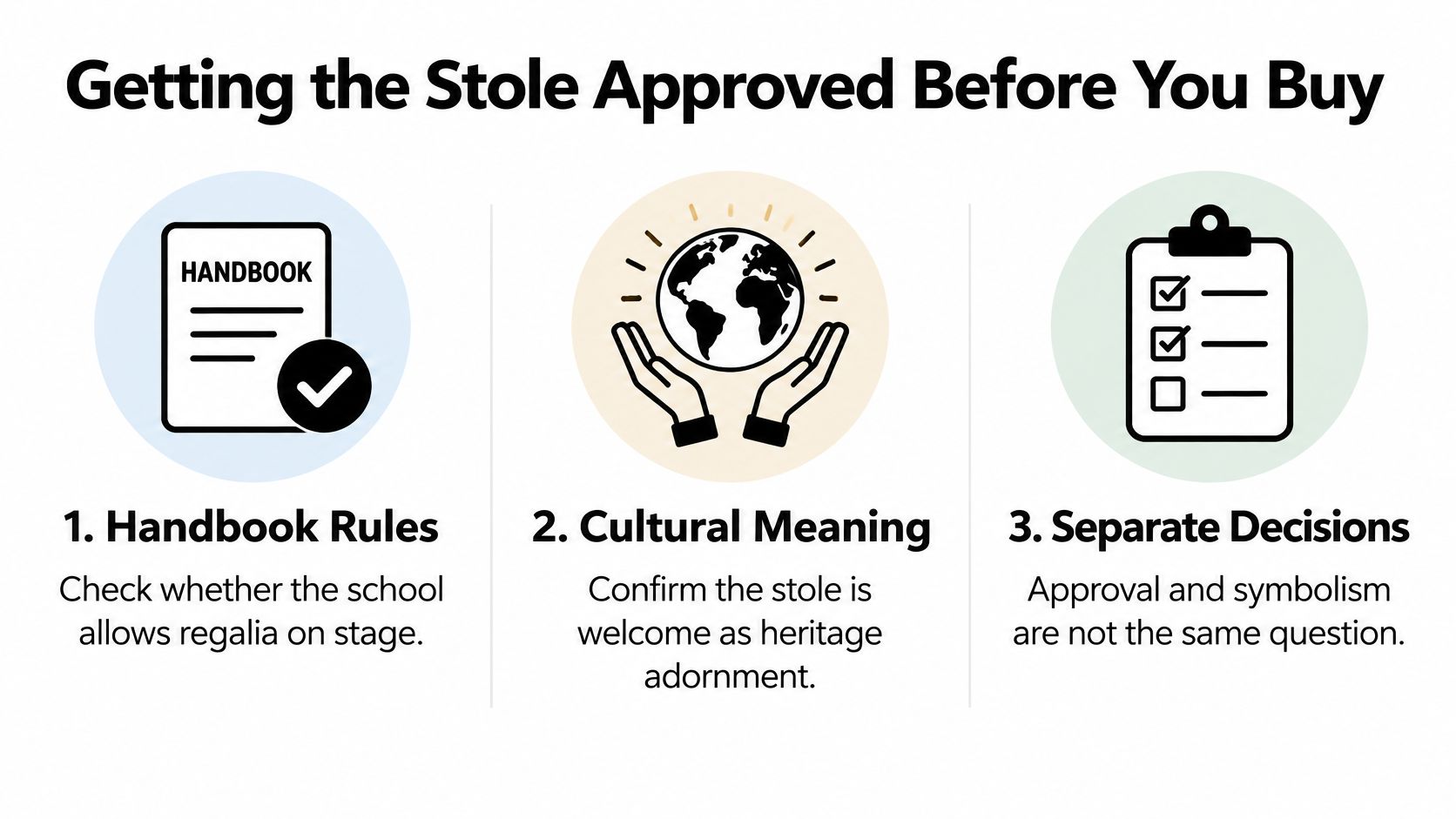
A commencement handbook may explain gown rental and footwear without saying anything about an Indian flag sash. Silence in that document is a reason to ask the office in writing, not a reason to assume the garment is allowed. Send the question before paying for a personalized piece that might be restricted during the procession or stage crossing.
Keep national or cultural stoles, tribal or Indigenous regalia, and religious attire separate in your question. Schools may have different policies for each category, and permission for one does not automatically extend to another. The same applies to the two garments that share this name. A flag sash worn over the gown and an angavastra-style drape treated as part of the degree dress can fall under different rules at the same school, so name exactly which one you plan to wear.
Complete the pre-order check
Use the school's current commencement instructions, not a photograph from a previous ceremony. North Dakota State University's student commencement guidance illustrates why students should check institutional requirements for cultural adornments and obtain any necessary permission.
- Find the governing document. Look for commencement dress, academic regalia, cultural adornments, and restrictions on personal accessories.
- Name the garment precisely. Explain whether it is an India flag stole, an angavastra-style drape, or a heritage sash with a particular motif.
- Confirm placement and dimensions. Ask whether it may sit over the gown, beneath the hood, or only beneath the gown.
- Describe flags and lettering. Include a picture or artwork proof so staff can assess the actual design.
- Save written approval. Keep the response with your ceremony information so you can produce it at check-in.
Settle those questions before developing a custom graduation stole. An approved plain sash does not guarantee that added wording, a flag, or a large emblem will also be accepted.
Separate visibility from permission
The University of Toronto's convocation guidance makes this distinction concrete: cultural stoles may be worn under the gown and hood, then displayed after the ceremony outside Convocation Hall, rather than added visibly to the approved academic regalia. A student can therefore receive permission to bring and wear a stole without receiving permission to display it on stage.
Legal protections have boundaries of their own. Washington law addresses items of cultural significance worn with or attached to graduation gowns, while earlier protections in some jurisdictions focused more narrowly on tribal regalia. A rule from another state does not settle what your institution will allow.
The office decides where the stole may sit. Only you decide what it means.
Send the coordinator a direct question: "I'd like to wear an Indian graduation stole representing my Indian heritage. May I wear this design visibly during the procession and stage crossing, and are there any placement or wording restrictions?" Attach the design and request a clear written answer before ordering.
Flag Bands or Cultural Motifs on the Sash
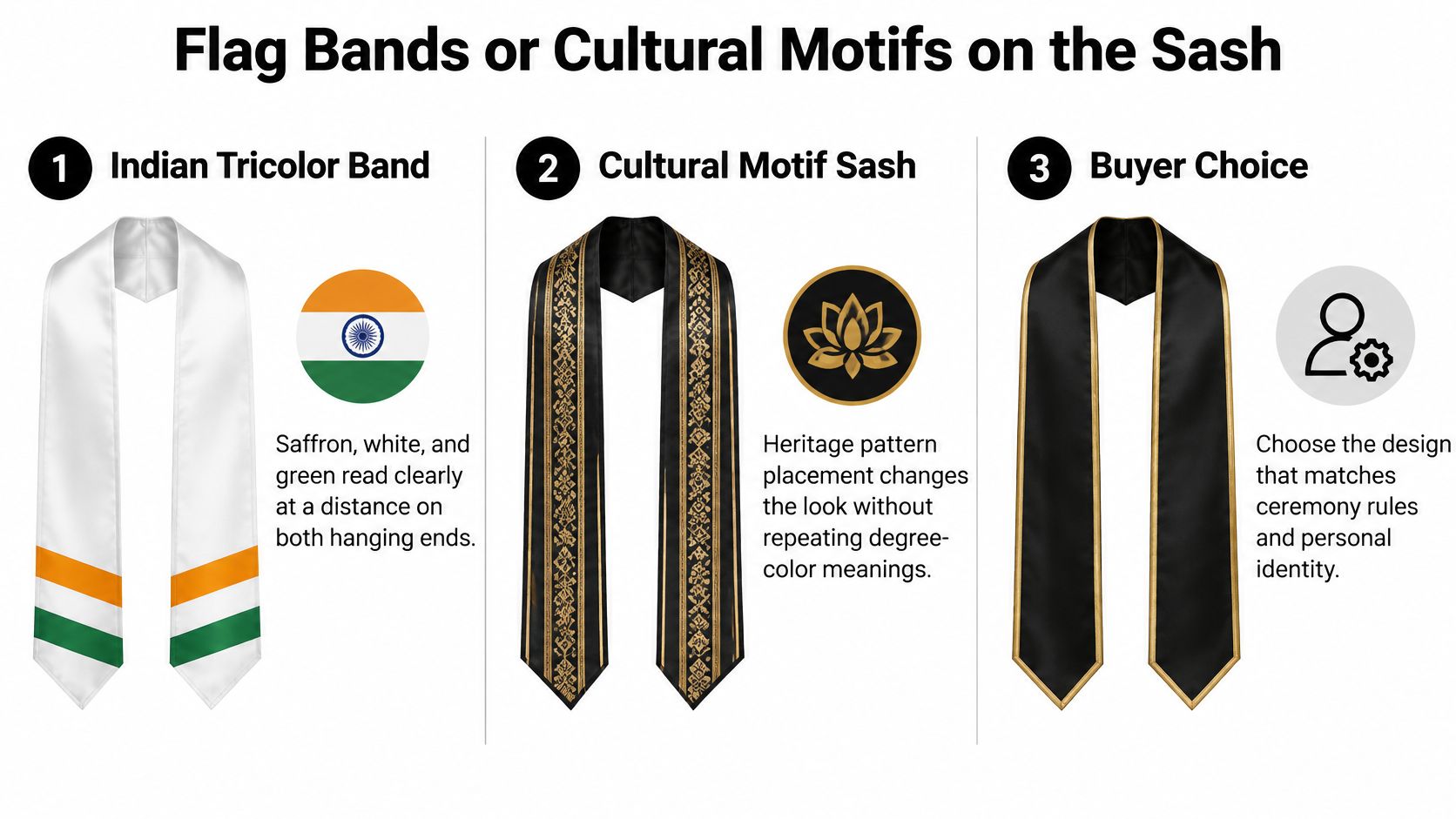
A buyer choosing an Indian graduation sash usually needs to distinguish among a flag design, a heritage pattern, and an institutional drape. These can share a similar outline while requiring different artwork and construction.
Flag stole versus cultural and institutional designs
| Design | Message | Construction | Check before ordering |
|---|---|---|---|
| India flag stole | Nationality at a glance | Saffron, white, and green bands on both ends | Whether the school allows a flag |
| Cultural motif stole | Heritage and craft | Woven or embroidered border, paisley, or temple motif | Motif scale and colorfast thread |
| Institutional angavastra | School and degree identity | Structured drape, colored edge, placed logo | Embroidery position and dye match |
For an India flag graduation stole, prioritize recognition. Saffron, white, and green should remain clear when the garment hangs over the shoulders, not just when it lies flat on a screen. Check the artwork on both hanging ends so the intended arrangement remains readable in a front-facing photograph.
A cultural motif stole gives more space to a particular textile reference. A paisley border, temple-inspired edge, or woven figure can express heritage without reproducing a flag. Choose a motif that has a meaningful connection to the wearer, rather than treating every Indian textile tradition as interchangeable.
Match the construction to the message
An institutional angavastra needs consistent placement more than decorative variety. The Indian Express explanation of convocation angavastras describes Banaras Hindu University's handspun-cotton uttariya edged in institutional colors, alongside Delhi University's adoption of the shoulder garment.
The practical distinction is useful. A lightweight shoulder drape can sit over a kurta, saree, or salwar kameez, while its border or panel identifies the institution. It doesn't need to behave like a full robe to perform an official ceremonial role.
Specify embroidery position, thread colors, and a repeatable dye standard before approving a group order. A description such as dark blue isn't enough to keep separate production batches visually consistent. Ask for a physical sample or a defined color reference, then approve the arrangement on the finished garment.
Inspect the design while it hangs
A flat artwork proof can hide problems that become obvious on the body. A border may disappear beneath a fold, or a logo may sit too high and become crowded by the neckline. Check sufficient width and length over the actual clothing students will wear.
- For flag designs, inspect the full hanging panels from a normal photograph distance.
- For motifs, check that the pattern remains recognizable after the cloth folds over the shoulder.
- For institutional artwork, confirm logo orientation, permissions, and matching placement across the batch.
Guidance on graduation flag stoles can help distinguish a country-focused design from other sash layouts. Keep the main message uncluttered rather than adding unrelated symbols to every available space.
Choose the flag when nationality is the point, motifs when craft and heritage are the point, and a controlled logo panel when the university needs matching garments. The best design is the one that communicates the intended message without competing with the required academic dress.
Fabric Weight Yarn and Edge Quality
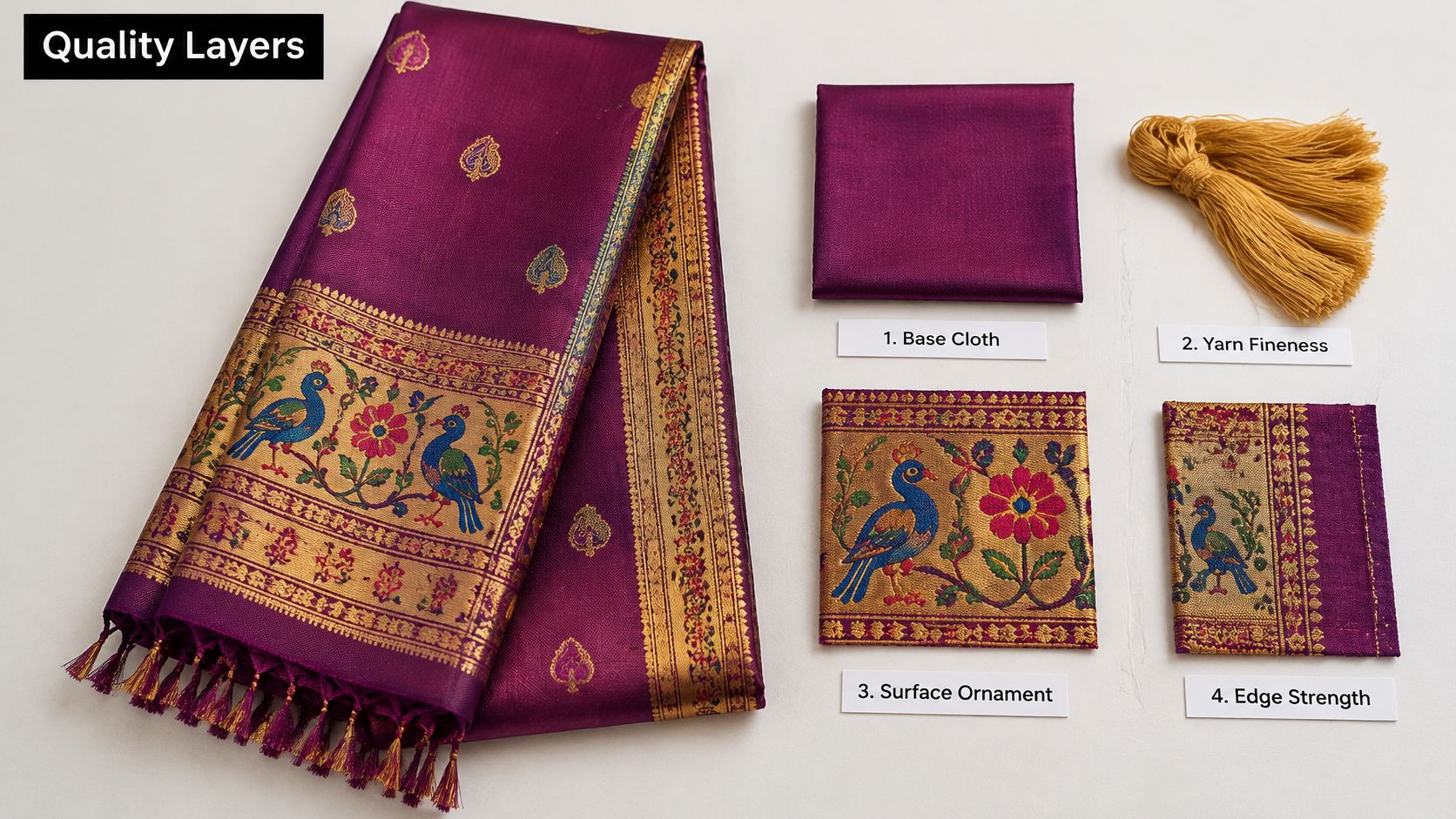
A glossy surface doesn't tell you whether an Indian graduation stole will hang evenly. Evaluate base cloth, yarn fineness, surface ornament, and edge strength separately. A heavy embroidered emblem can distort weak cloth, while a beautifully woven panel can still look unfinished if its cut edges are exposed.
Understand what the threads do
Paithani textile documentation offers a useful construction benchmark, not a specification that every stole must meet. The textile details associated with University World News' coverage of Indian convocation clothing describe silk yarn of approximately 20–22 denier in the warp and 30–32 denier in the weft, along with separate stages for sorting, reeling, spinning, dyeing, sizing, metallic-thread preparation, and design.
Denier describes yarn fineness, not finished fabric weight. The warp threads run along the cloth and help resist lengthwise tension. The weft crosses them, contributing to coverage, texture, and the way the cloth falls.
A plain-weave foundation with tapestry-style weft figuring and interlocking can build a motif into the fabric. That differs from placing a printed image on its surface. Neither technique should be judged by appearance alone, but a woven figure isn't a surface print that can crack.
Turn construction into an inspection
For a ceremonial stole, look for a stable woven base, finished or reinforced edges, and embroidery or woven motifs that won't transfer color onto the outfit beneath. Keep metallic accents controlled. Extra shine isn't useful if the added weight pulls a panel out of alignment.
If you're commissioning cloth rather than buying a finished garment, The Fabric Company's guide to calculate fabric yardage for garments is useful preparation. Account for the finished shape, lining, seam allowances, and pattern placement before purchasing material.
- Base cloth: Suspend the sample from its center and check whether both sides fall without twisting.
- Edges: Inspect the reverse for exposed cuts, puckering, or stitches that pull the border tight.
- Decoration: Look behind dense embroidery for distortion and ask how colorfastness is checked.
- Craft claims: Request fiber-origin and process notes when the garment is described as handloom or handspun.
Sample check: Rub a hidden area gently with a clean white cloth before letting the stole rest against pale formalwear.
Finish with a hand test. The drape should feel balanced, the lining or edge finish should conceal raw fabric, and the decoration shouldn't feel like a brittle coating on a slippery face. A convincing craft description needs both sound construction and traceable information.
How to Drape the Stole on Ceremony Day
Dress in the full outfit before adjusting the stole. A garment that sits neatly over a shirt can bunch over a gown collar or shift against a saree pallu. Use the institution's approved arrangement whenever it specifies placement.
Follow a centered dressing routine
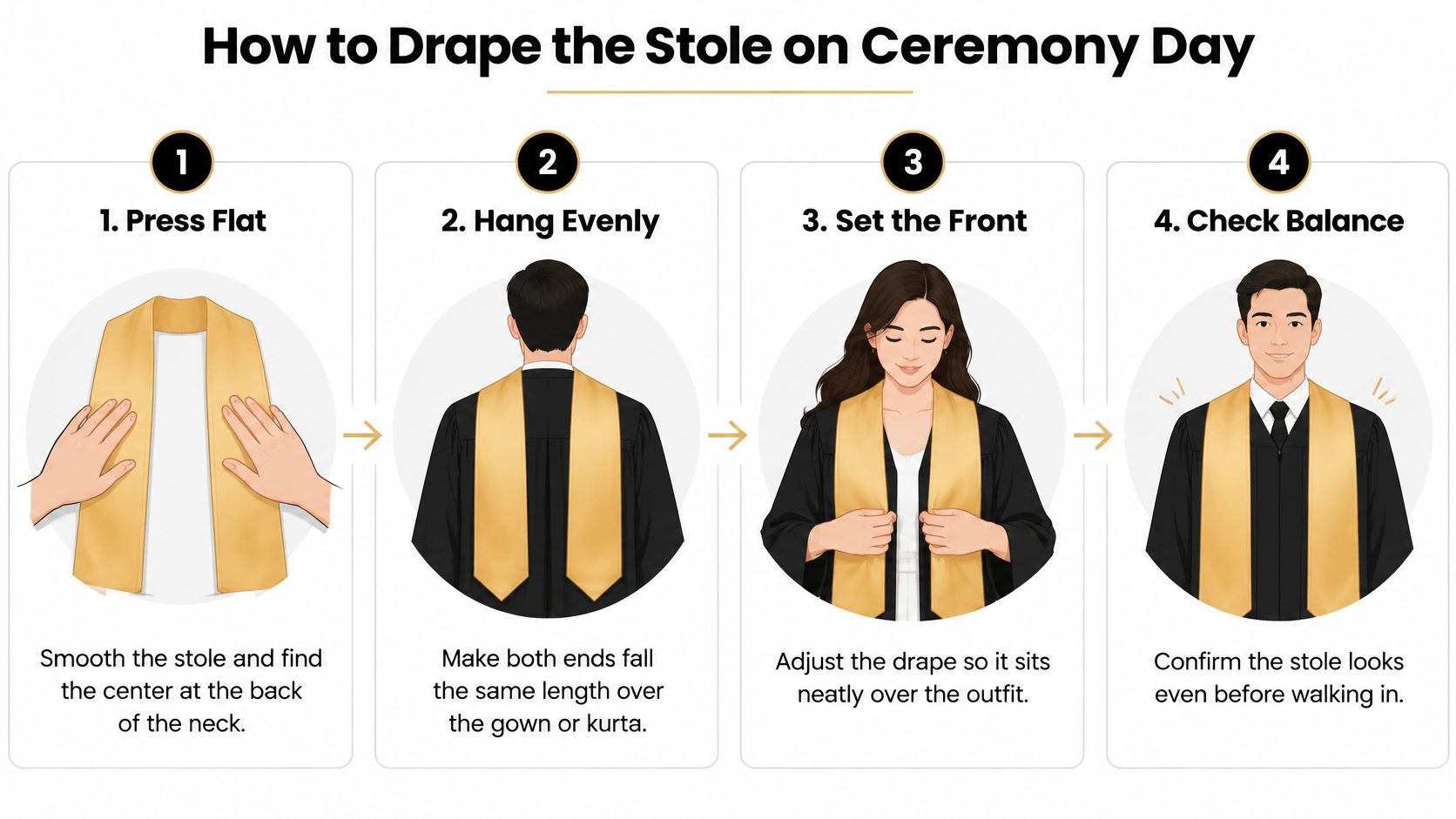
- Smooth the stole and locate its center. Press only with a method suitable for the fabric and decoration, using a protective cloth where appropriate. Position the center at the back of your neck so you aren't compensating for an uneven starting point later.
- Place the decorated face outward. Lay the stole over the approved outfit, whether that's a gown, kurta, saree, or salwar kameez. Check the neck area for a twist, since a reversed section can turn an entire front panel inward.
- Balance the hanging ends. Let them fall to approximately the same point on the front of your body, without crossing them. Smooth the shoulder sections so the panels remain open enough to read across the chest rather than collapsing into narrow folds.
- Give the academic hood its own space. If a hood is required, arrange it according to the university's instructions and keep its degree colors visible. Don't force the cultural stole over the hood merely to put every decoration on top.
- Keep additional accessories restrained. For a simple arrangement, add at most an approved honor cord and skip another personal stole unless the institution directs otherwise. Set the cord's back section neatly behind the neck and let its strands fall on the chest without tangling around the sash.
- Test movement before leaving. Sit, stand, and walk in the shoes you'll wear during the ceremony. Check that the stole doesn't snag on jewelry, slide off a shoulder, or hang where it could catch a heel or stage step.
- Reset the front for photographs. After the ceremony, straighten the flag bands, motifs, or lettering toward the camera. Ask a family member to check the reverse at the neck and confirm that neither end has slipped under the gown.
Use the mirror to catch small mistakes
Look at the whole outfit, not just the printed design. A backward stole may still show bright colors while hiding its intended front. Unequal ends can make a carefully made outfit look unbalanced.
The illustrated guidance on how to wear your graduation stole and sash can help with the basic shoulder arrangement. Check your side view as well, particularly where the stole meets a hood, collar, or layered neckline.
Leave enough visual space for each approved item to remain identifiable.
Finish with relaxed shoulders and your arms at your sides. If the stole only stays straight while you hold it, adjust the balance before taking photographs or joining the procession.
Confirm the Order and Care for the Stole
Place the order only after the design and ceremony placement are settled. Ordering a custom stole works like ordering a custom garment: once the fabric is cut and the artwork is printed, corrections cost time. For a group, collect an approved artwork file, a thread-color note, and a shared finished-size specification. Confirm spelling, logo permissions, and the delivery date in writing, leaving room for a corrected print instead of assuming a universal turnaround.
Choose the order format
Stoles.com offers flag graduation stoles and sashes for national representation, plus custom graduation stoles with choices of colors, trims, length, and cut, including your own imprinted artwork. A flag format suits the tricolor. A custom format fits a name, graduation year, border, or school mark that needs to be included.
Stole pricing and lead time
| Product | List price | Lowest price |
|---|---|---|
| Custom graduation stole | US$29.00 | From US$23.20 |
| University & College graduation stole | US$15.95 | From US$5.99 |
Request each product's production and delivery timing in writing before paying. These figures are in US dollars; the Indian university stall example used rupees, so they are not directly comparable price labels.
Check the intended age group too. The White Preschool & Kindergarten Imprinted Graduation Stole is a separate early-years garment with fully lined satin construction, sized for young children rather than made as an Indian heritage design.
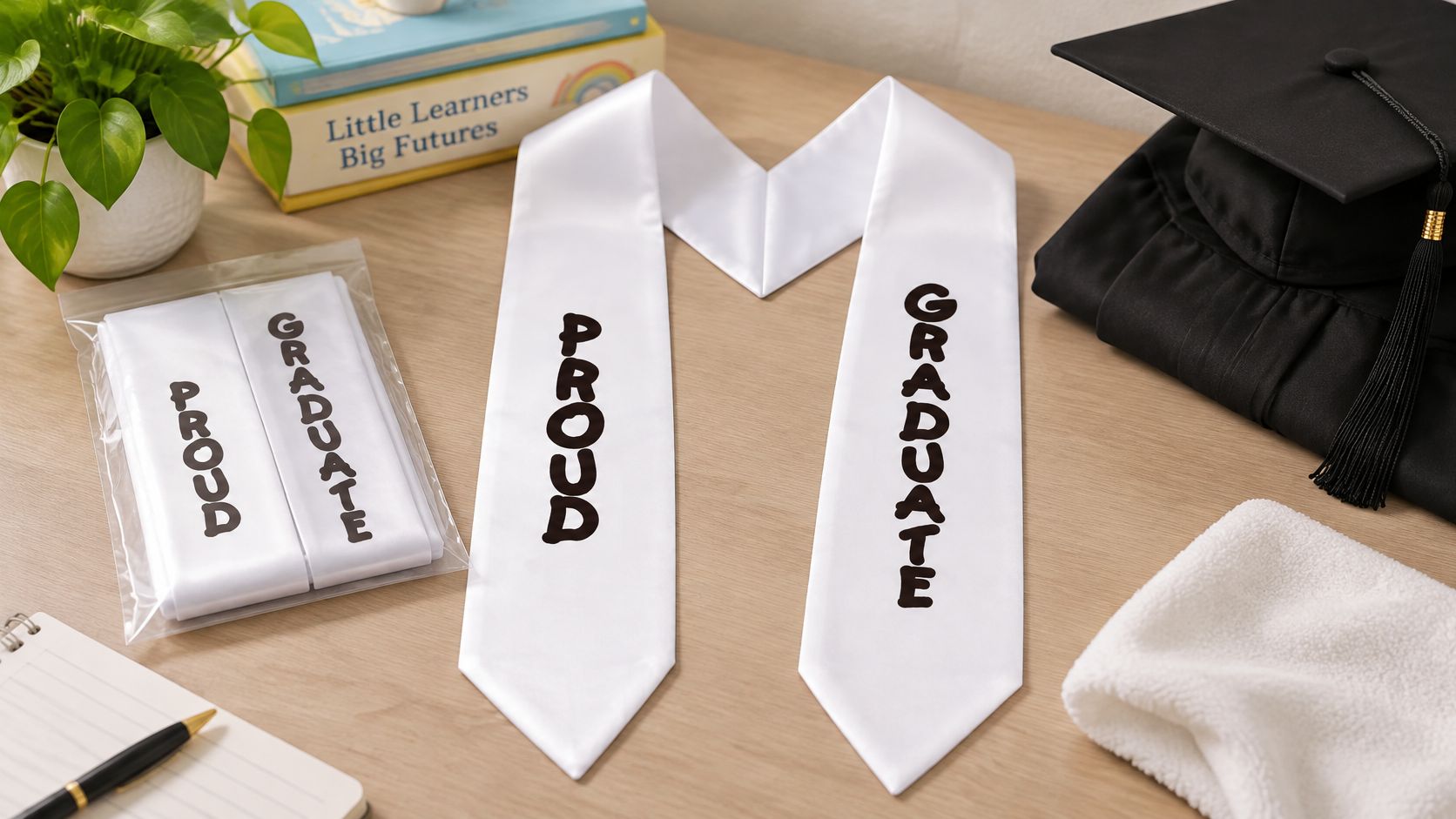
For school groups also planning informal farewell clothing, school leavers shirts from Zero Sports address a different purpose. Keep those artwork approvals separate from formal commencement regalia.
Preserve the finished garment
A stole spends far more hours in storage than it does on stage, so its condition years later depends on what happens in the first days after the ceremony.
- Air and inspect: Hang the stole after wearing it and check for marks before putting it away.
- Clean cautiously: Spot-clean only where the material permits, testing a hidden area first. Avoid a hot iron on metallic thread or printed flag artwork.
- Store dry: Lay it flat or roll it loosely in a breathable bag away from damp, with decorated surfaces protected from abrasive accessories.
Keep the approved design and care information with the garment. That makes it easier to preserve the colors for family photographs and to explain its meaning when it becomes a graduation keepsake, whether it crossed the stage as a tricolor flag sash or as part of degree-coded Indian dress.
Stoles.com® offers flag graduation stoles and customizable sashes for celebrating heritage alongside academic achievement. Visit Stoles.com® to choose an Indian graduation stole design that matches your identity and your school's written ceremony approval.